-
-
Thumbnail
-
screenshot
-
manual
Inspiration
On a manufacturing floor, the most expensive minutes are the ones right after a machine starts acting up. The operator who notices it usually isn't the person who can fix it — so they either flag down a maintenance tech who's already busy, or thumb through a binder while the line backs up. Two bad things happen under that time pressure: diagnosis drags out, and someone restarts a faulting machine or skips lockout/tagout to "just check something." Zapdos Labs frames the wedge perfectly — AI that reads the manual — and we wanted to take that all the way to the artifact a plant actually runs on: the work order. Not a chatbot that explains conveyors, but an agent that hands a technician a complete, safe, parts-checked, costed job ticket.
What it does
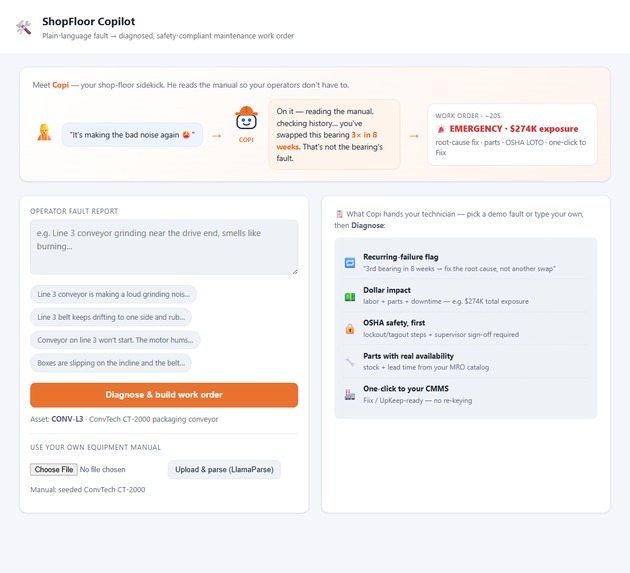
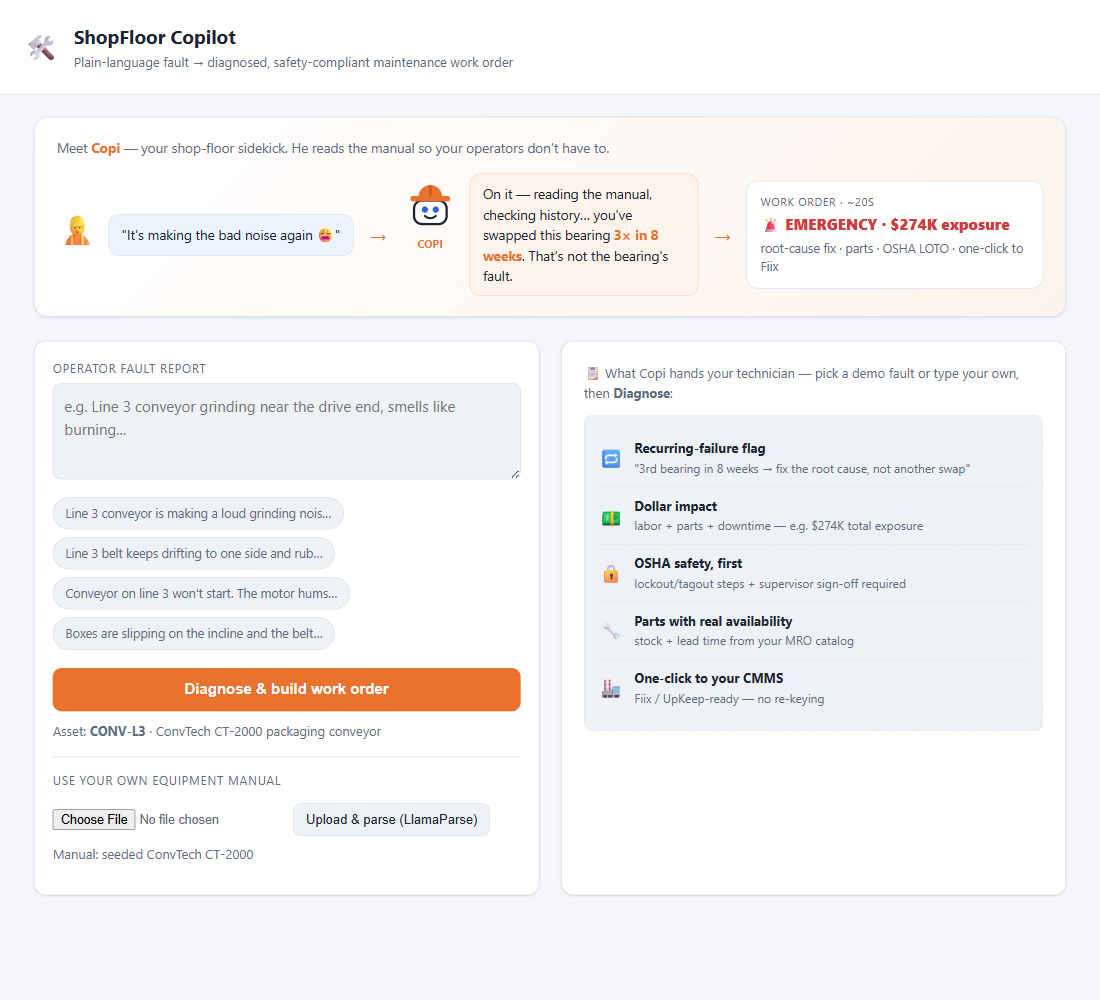
An operator describes the fault in plain language — "Line 3 conveyor grinding at the drive end, smells like burning." ShopFloor Copilot runs an agentic loop that:
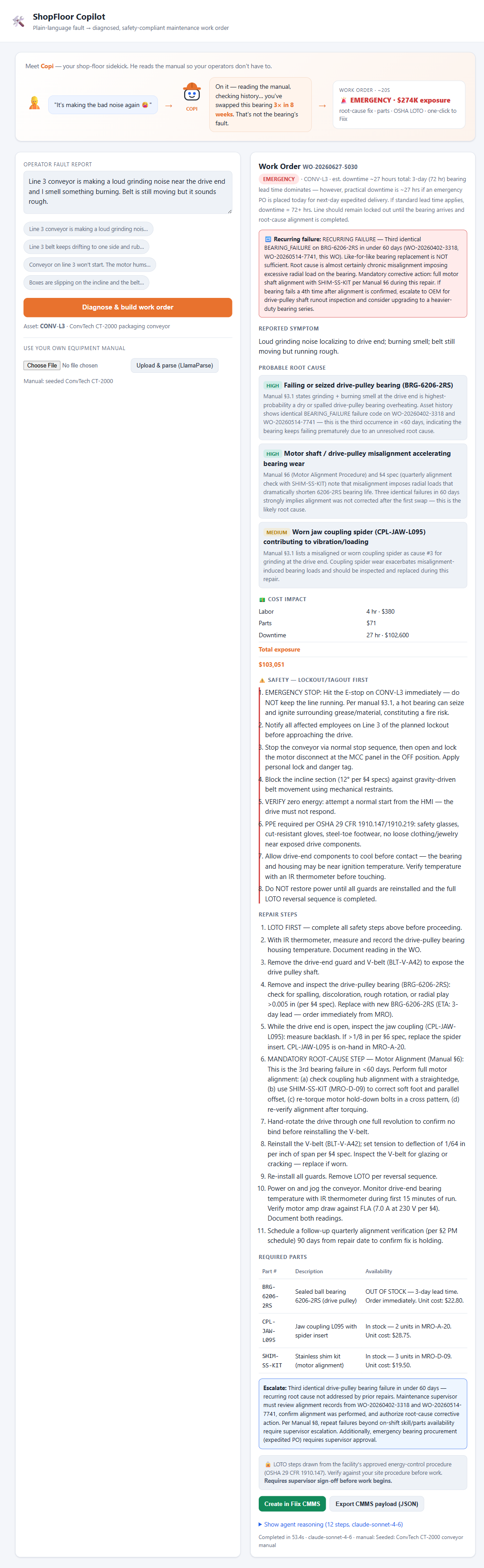
- Checks the asset's work-order history first — and flags recurring failures ("BEARING_FAILURE 3× in 8 weeks → this is a misalignment problem, not a bearing problem; fix the root cause, don't swap another bearing"). That's the thing a paper binder can't do.
- Reads the equipment manual to diagnose probable root causes, each tagged with a confidence level and the manual section that supports it.
- Confirms parts — real on-hand quantity and lead time for every part it recommends.
- Pulls the matching OSHA lockout/tagout procedure so the safety steps lead the job.
- Dollarizes the impact — labor + parts + downtime cost (often six figures, driven by the wait on an out-of-stock part) — which makes the business case to stock the part and fix the root cause.
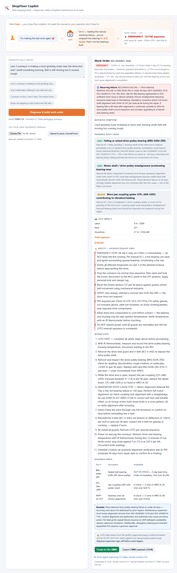
- Emits a structured work order + a CMMS-ready payload (Fiix/UpKeep field shape) — one click to export or "Create in Fiix," with supervisor sign-off required and the safety procedure sourced from the facility's approved energy-control procedure, not invented by the LLM.
And it works on your equipment: upload your own manual PDF and LlamaParse turns it into the agent's knowledge base — we demo it diagnosing a hydraulic press from an uploaded manual, not just the seeded conveyor. Every run exposes its reasoning trace, so a supervisor sees exactly which tools the agent called and why.
How we built it
A single FastAPI service serves both the JSON API and a vanilla-JS single-page UI — one process, one Railway deploy. The brain is an Anthropic Claude claude-sonnet-4-6 agentic tool-use loop. We give Claude the active equipment manual in a prompt-cached system block (reliable, exact retrieval without the fragility of a vector DB on a 24-hour clock) plus four tools: lookup_asset_history (recurring-failure detection), lookup_part (MRO catalog: stock, lead time, cost), get_safety_procedure (LOTO/PPE by hazard, modeled on OSHA 29 CFR 1910.147), and a strict create_work_order tool that guarantees the output validates against our Pydantic schema and renders directly. The loop is hard-bounded at 15 steps, every model call is wrapped in retry + exponential backoff, and the API key is read only from the environment. cmms.py maps the work order to a Fiix/UpKeep-shaped payload. For "works on your equipment," an upload endpoint sends the operator's PDF to LlamaParse (via httpx REST) and swaps it in as the active manual.
Challenges we ran into
Keeping the demo believable to an operations manager meant the diagnosis couldn't be generic. We authored a realistic conveyor manual whose troubleshooting tables map specific symptom patterns (grinding + burning smell → failing drive-pulley bearing; hum-then-trip → mechanical bind) to specific catalog parts, so the agent's reasoning is traceable rather than plausible-sounding. We forced a clean terminal state (always one complete work order) by forcing the create_work_order tool on the final step, and tuned the manual length to actually cross Claude's prompt-cache threshold so repeat runs stay fast and cheap.
Accomplishments that we're proud of
It's genuinely end-to-end and deployable: a real person at a line could use it Monday. Safety is first-class — LOTO steps always precede repair steps, are sourced from the approved procedure, and require supervisor sign-off. The output isn't prose; it's a structured work order a CMMS could ingest. The recurring-failure insight turns "replace the bearing" into "fix the alignment" — the kind of call that saves a plant real money. And it shows its work, which is what earns trust on a floor.
What we learned
For an industrial agent, the win condition isn't model cleverness — it's whether the output is safe, specific, and shaped like the artifact the floor already uses. Strict structured output plus a small set of well-described tools beat an open-ended chatbot on every judging criterion. Prompt-caching the manual was the right call over a vector store for a bounded, single-asset demo.
What's next
- Live CMMS write-back (we export the payload + mock "Create in Fiix" today): real OAuth into Fiix/UpKeep/Maximo and notify the on-call tech.
- Per-asset parts + history feeds wired to the customer's CMMS, so a manual upload also brings their real catalog and failure log.
- Floor-native input: voice (gloves/noise) and photo of the nameplate or the leak — a natural tie-in to Zapdos's factory-floor video AI.
- Bilingual EN/ES — a large share of the US maintenance workforce is Spanish-speaking; accept and answer in the operator's language.
- OT-network deployment: runs in the IT DMZ with a floor kiosk, plus an on-prem/edge model option for air-gapped plants (Purdue model / IEC 62443).
- Feedback loop + fleet view: technician confirms the actual fix to sharpen per-machine priors; cluster recurring faults to flag the machine that needs a PM, not another work order.
Built With
- anthropic
- claude
- css
- fastapi
- html
- javascript
- llama-cloud
- llamaparse
- osha
- pydantic
- python
- railway

Log in or sign up for Devpost to join the conversation.