ShopChain — AI-Powered Safe Deals with Solana Escrow
Inspiration
Buying expensive items from strangers online — bikes, laptops, cameras, tickets, sneakers — always feels risky.
You see a listing, you like the price, but something in your mind whispers:
“What if this is a scam?”
Most platforms still rely on trust, screenshots, and hope.
We wanted to replace trust with verifiable safety.
Our core idea was simple:
$$ Trust = Transparency+ Verification $$
If we could combine AI (to evaluate risk) and blockchain escrow (to protect the payment),
we could create a system where deals feel safe, predictable, and transparent — even between total strangers.
That is what inspired ShopChain.
What It Does
ShopChain makes online peer-to-peer buying safe, smart, and visual.
Listing Analysis
Paste any listing from Facebook Marketplace, eBay, Craigslist, Discord, WhatsApp — anything.
ShopChain uses an NLU model to extract:
- Item name
- Price
- Delivery terms
- Seller behavior
- Missing or suspicious details
It then generates a risk score and a short explanation.
Solana Escrow
If you decide to proceed, ShopChain creates a Solana escrow contract:
- Buyer funds the escrow vault
- Seller only gets paid after shipment
- If anything goes wrong, funds are refunded
Interactive Deal Card UI
Both buyer and seller get a beautiful animated Deal Card showing:
- Buyer side vs seller side
- A central lock that “closes” when funded
- Coins moving during escrow operations
- Real-time status: Funded → Shipped → Released
It feels like a real digital contract.
How We Built It
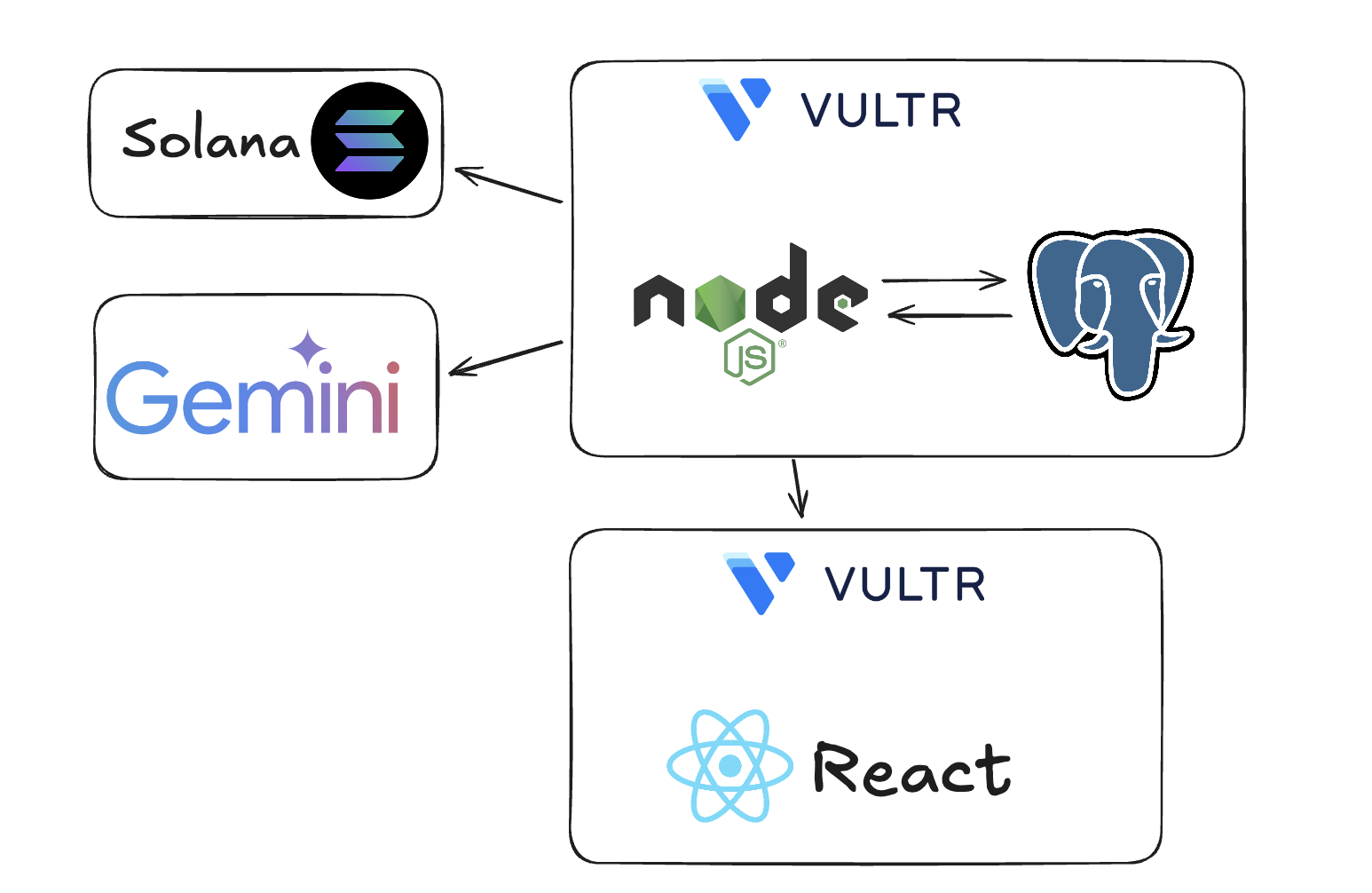
Blockchain — Solana Web3
- Escrow vault contract
- Buyer → Escrow → Seller flow
- Refund path
- Deployed on devnet for demo stability
Frontend — React + Solana Wallet Adapter
- Input for listing text/link
- Real-time risk display
- Dynamic risk bar
- Animated Deal Card
- Phantom wallet integration
Data collection, condensation, and Gemini AI interpretation
- Using URL given in input (as stated above), we parse data from the product site
- Using variety of data optimization methods we simplify/shorten data to most relevant information for AI
- AI makes determination on risk given the necessary data
Deployment
- Frontend on Vultr
- Backend and Hosting on Vultr
- PostgreSQL Database entirely on Vultr
- Solana programs on devnet
Challenges We Ran Into
1. Messy Listings
Listings vary wildly — emojis, slang, broken grammar.
We built preprocessing + heuristics to stabilize the NLU pipeline.
2. Solana Transaction Timing
Devnet confirmation delays caused UI desync.
We added fallback states like:
“Waiting for transaction settlement…”
3. Complex Animations
Synchronizing animations with real blockchain events required
a clean state machine for each escrow stage.
4. Time Pressure
Building AI + blockchain + UI in a hackathon forced us to prioritize aggressively.
Accomplishments We're Proud Of
- A working Solana escrow system
- A clean, helpful AI risk analyzer
- A fully animated Deal Card UI
- End-to-end flow: listing → analysis → escrow → release
- A project that feels like a real product, not just a prototype
What We Learned
We learned:
- How to build real trust infrastructure
- How to integrate LLMs for structured information extraction
- How escrow systems operate behind the scenes
- How to manage complex frontend state tied to blockchain events
- Why UX and trust-signals matter for financial tools
We also learned that a small insight can grow into
a powerful product with the right architecture.
What’s Next for ShopChain
Near Future
- Chrome extension: “Scan this listing”
- Fraud-detection ML trained on real scam datasets
- Shipment verification via QR scans + photo proof
- Stronger NFT proof system
Long-Term Vision
We aim to transform ShopChain into a full Safety-as-a-Service ecosystem, where marketplaces, apps, and communities can instantly plug into our escrow, verification, and fraud-analysis APIs. From small sellers to large platforms, anyone can add a single line of code to unlock trusted peer-to-peer commerce.

Log in or sign up for Devpost to join the conversation.