-
-
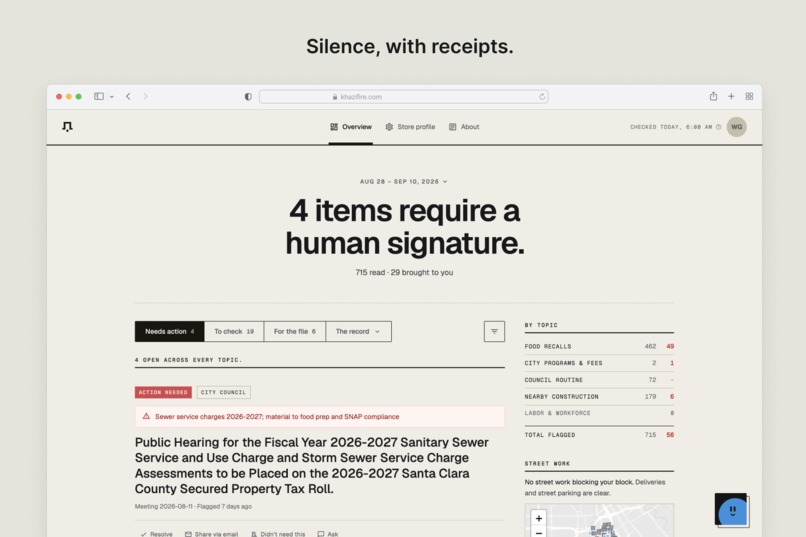
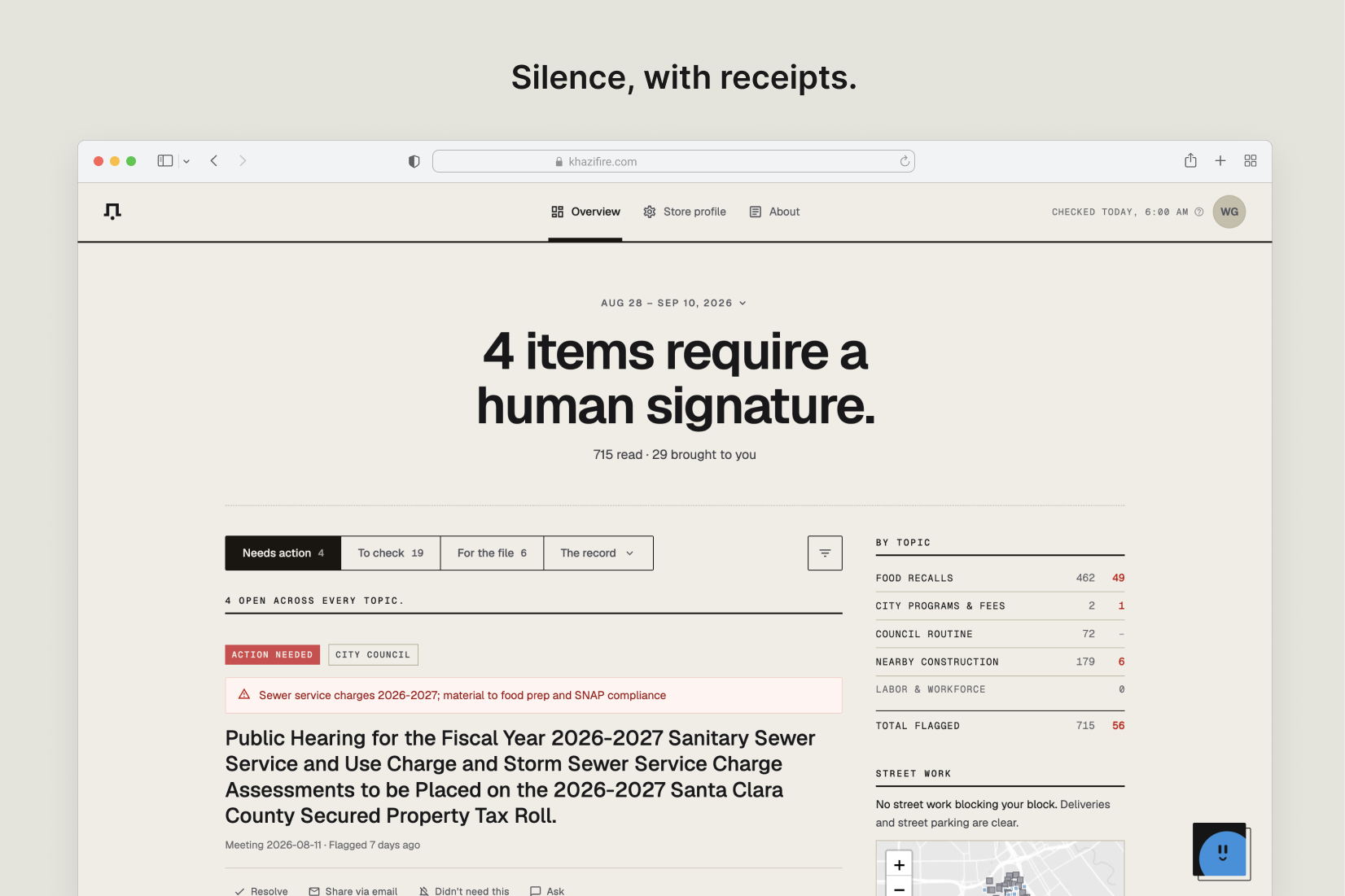
The morning brief: everything read, almost nothing surfaced. The headline only counts items that need a human decision.
-
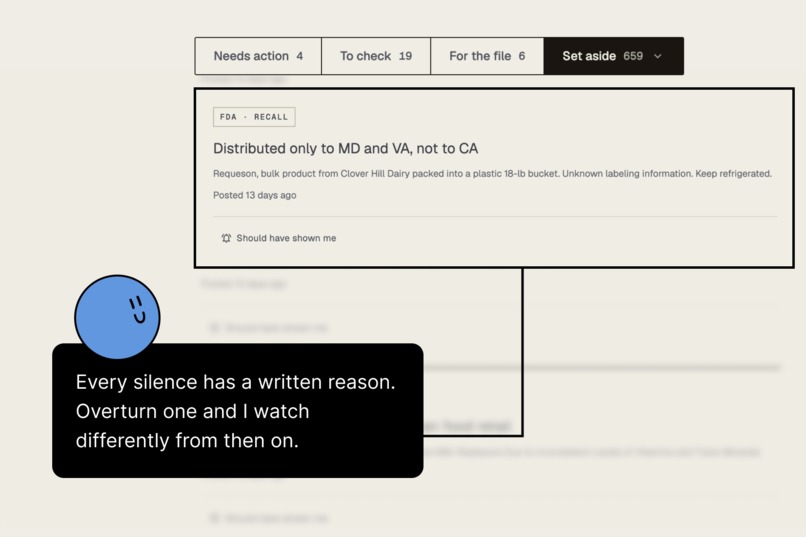
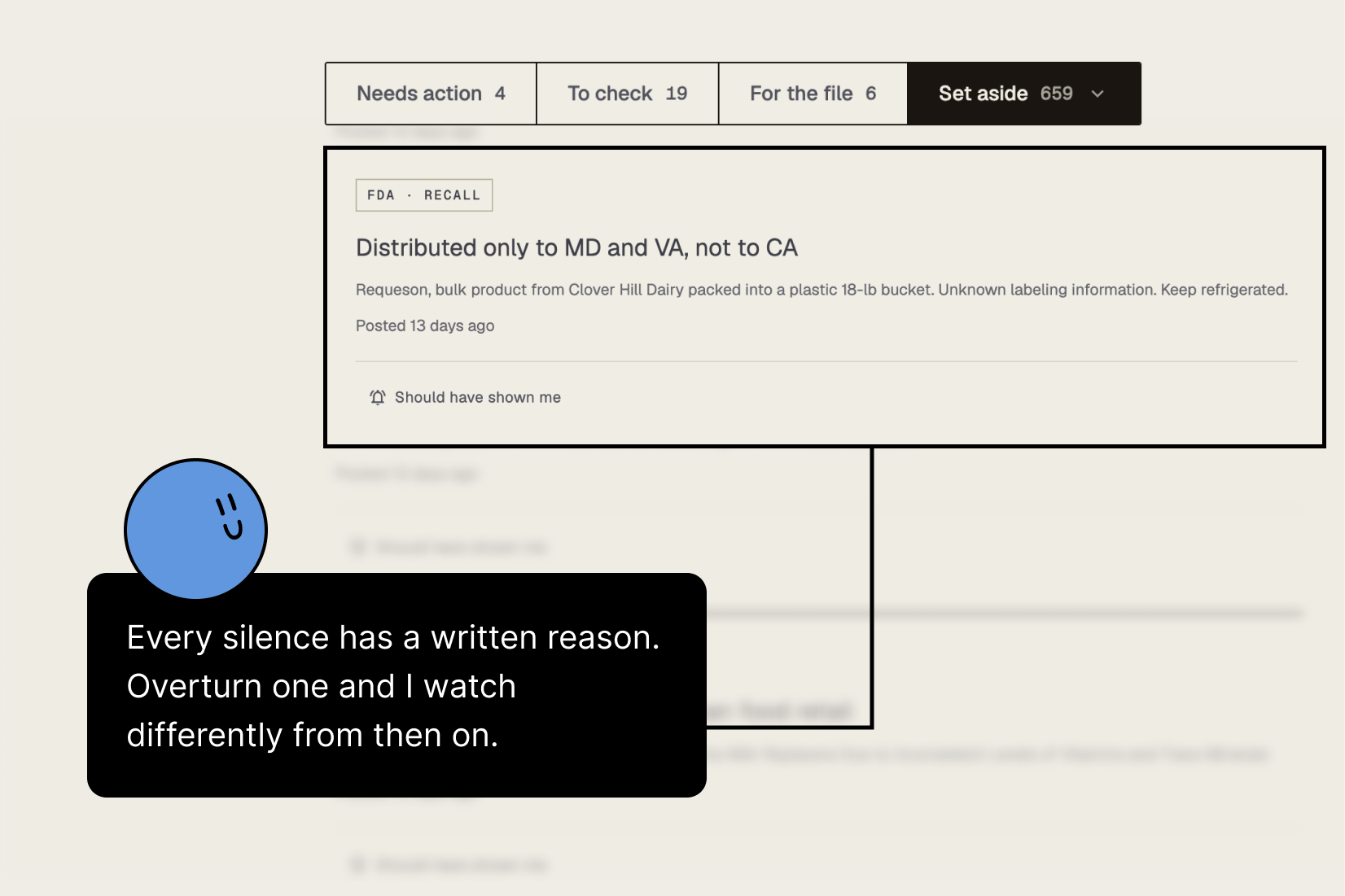
The rejection log: every filtered item keeps a one-sentence reason, and any overturn becomes context for future triage.
-
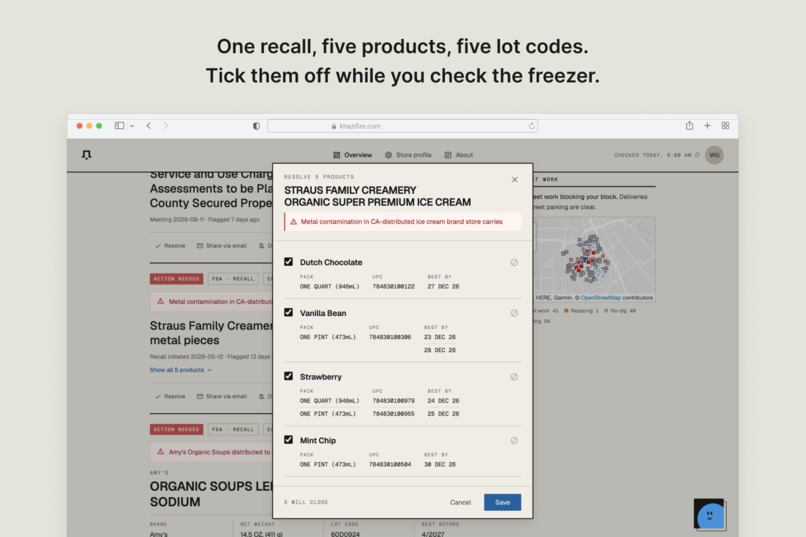
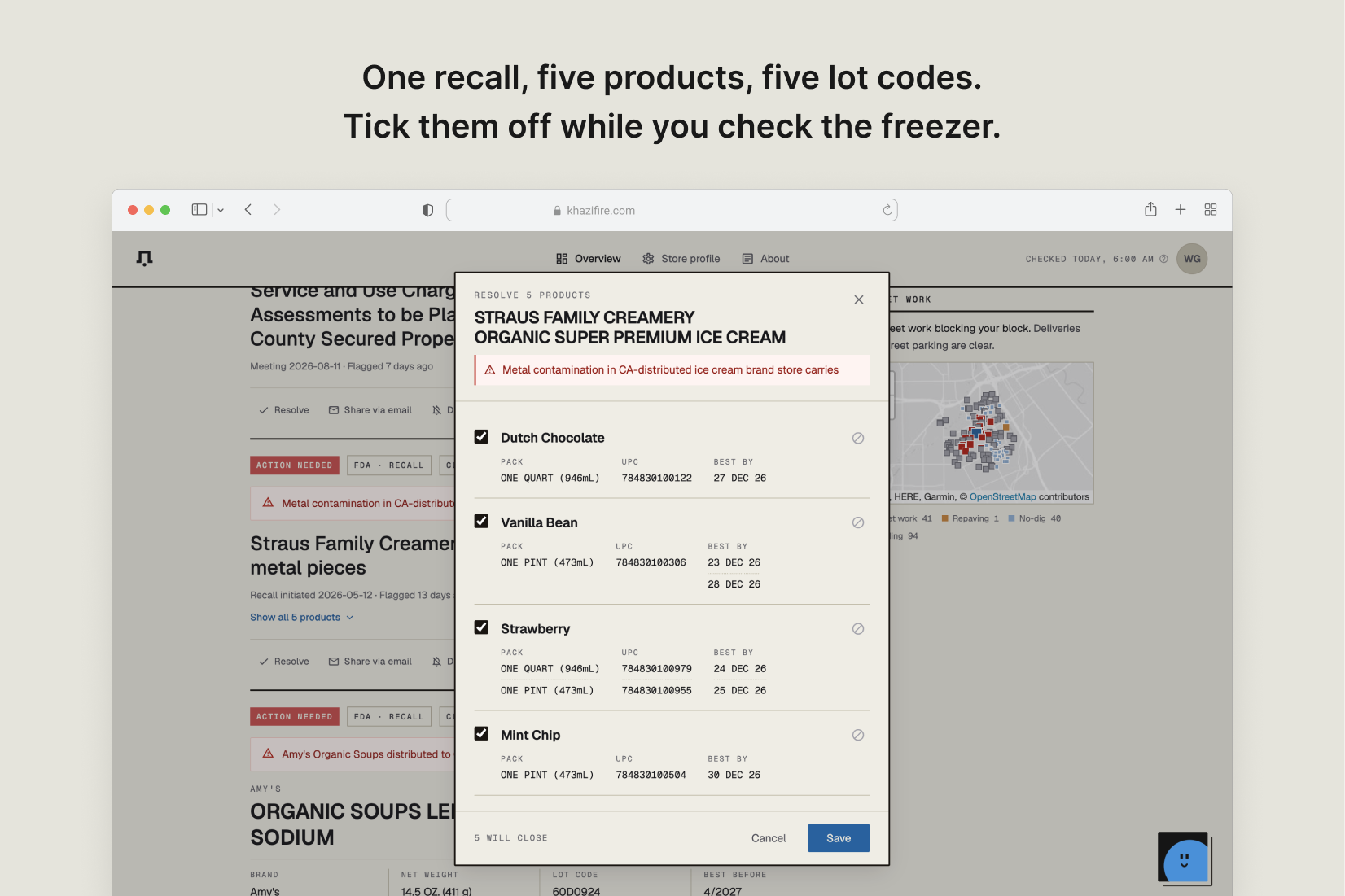
One grouped recall, every flavor, UPC, and best-by date. Resolving it product by product becomes part of the audit trail.
-
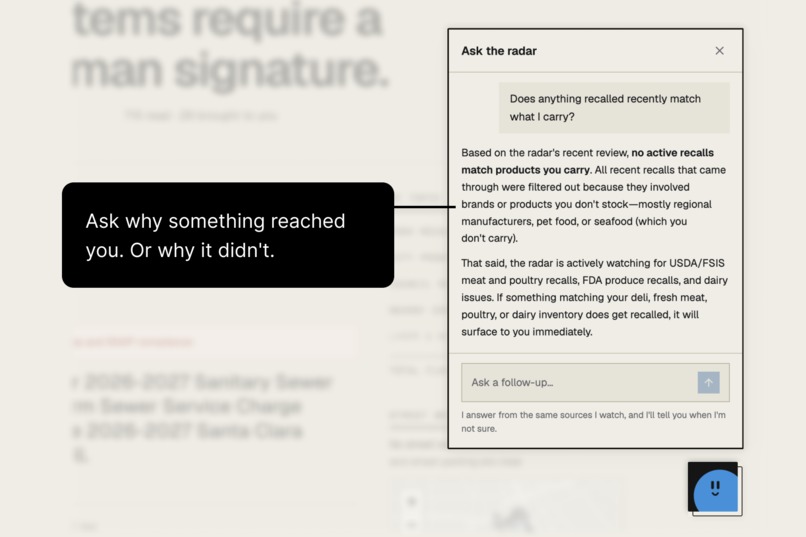
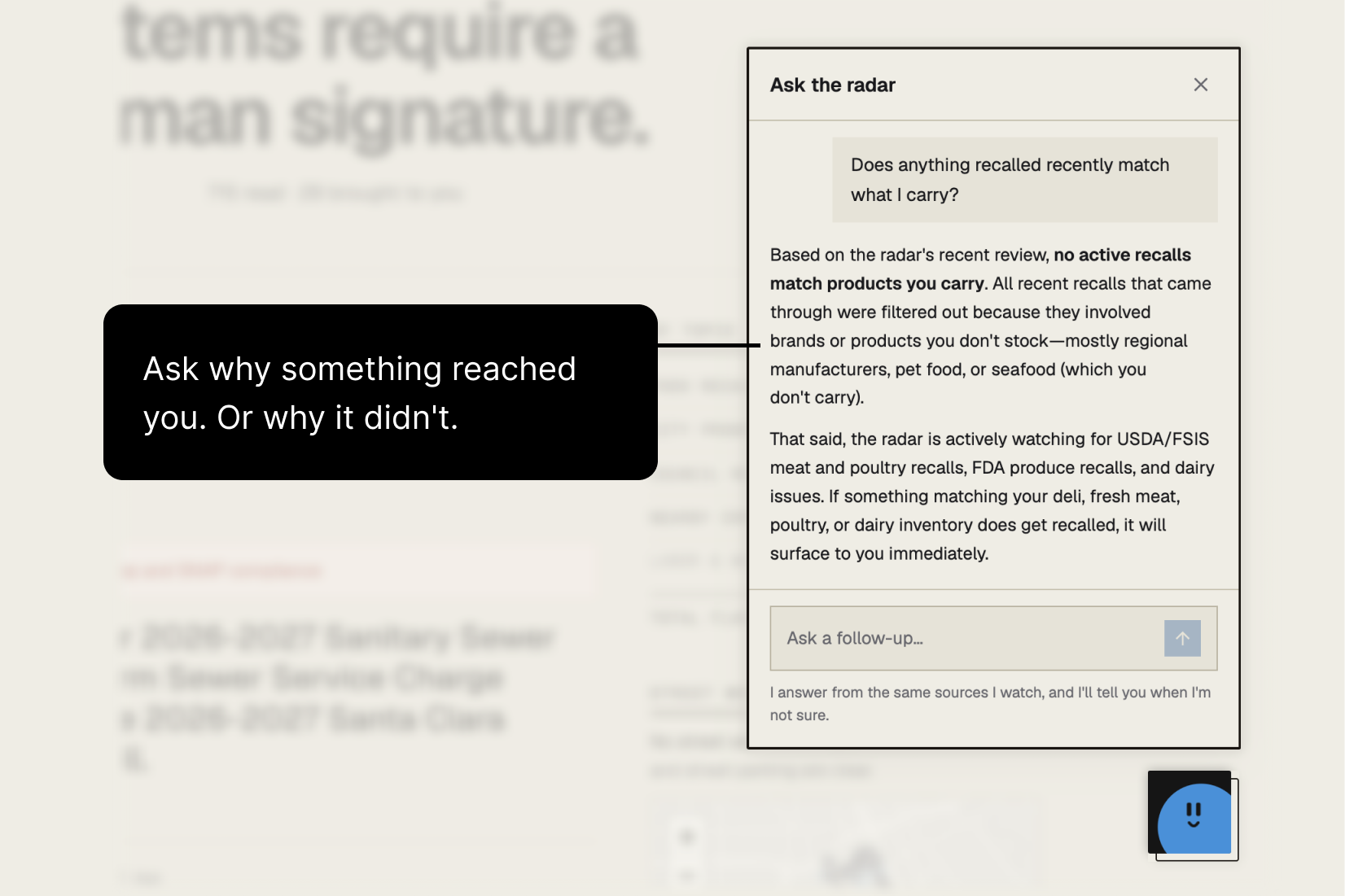
Ask the radar answers from the same database it triages, cites the store's own profile, and says so when it is not sure.
-
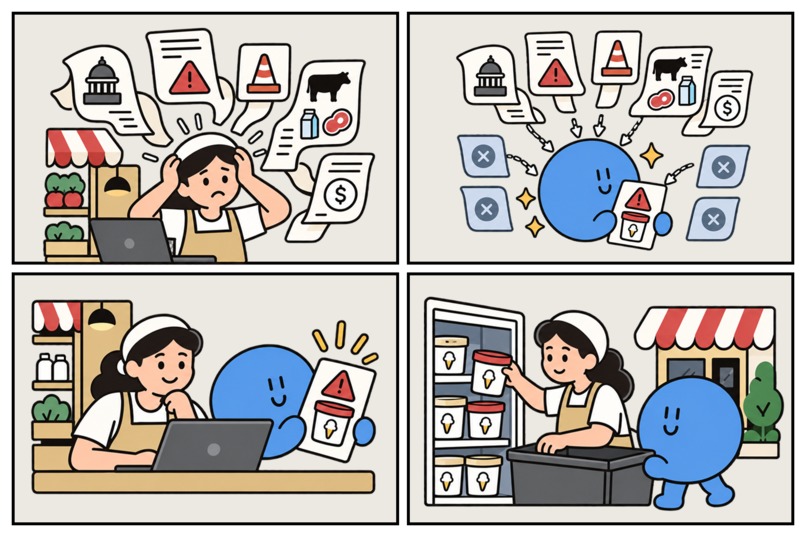
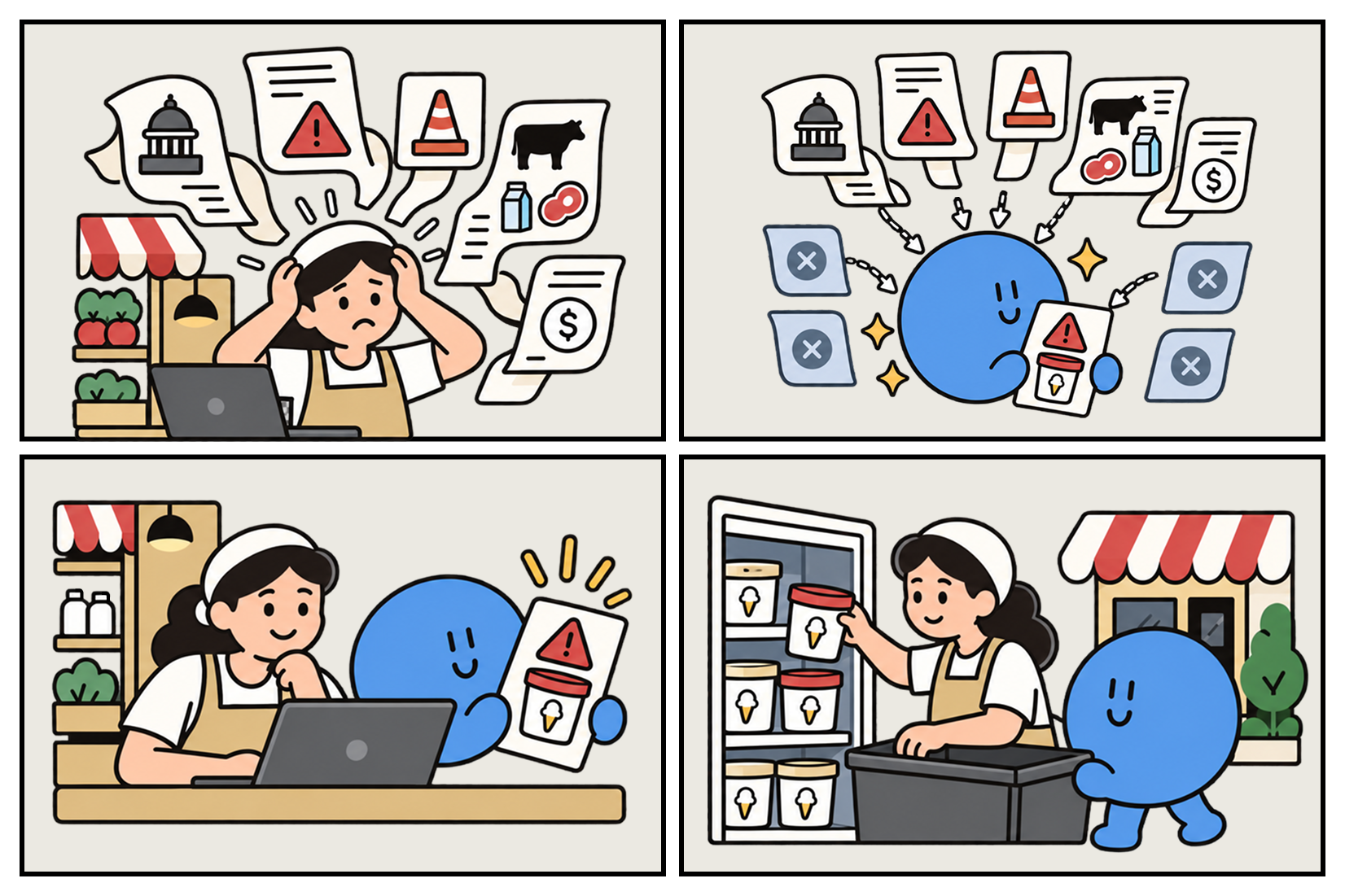
The loop in four panels: drowning in notices, filtering the noise, surfacing the one recall that matters, pulling the pints.
-
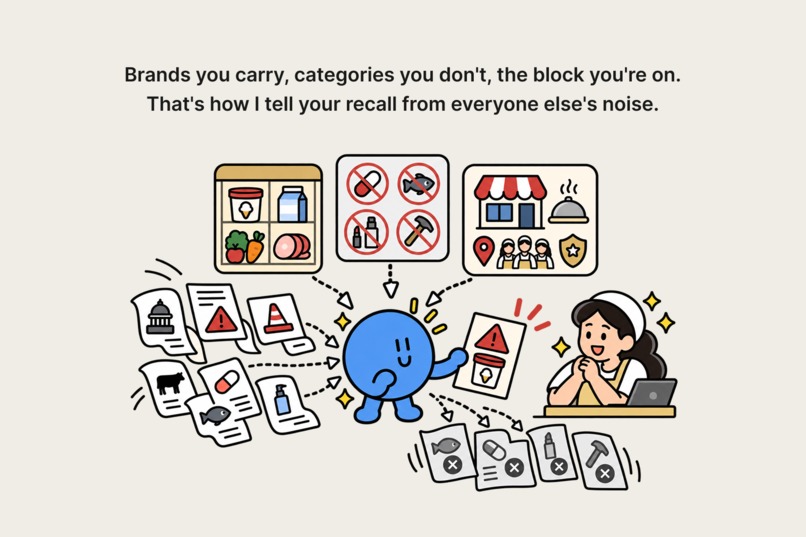
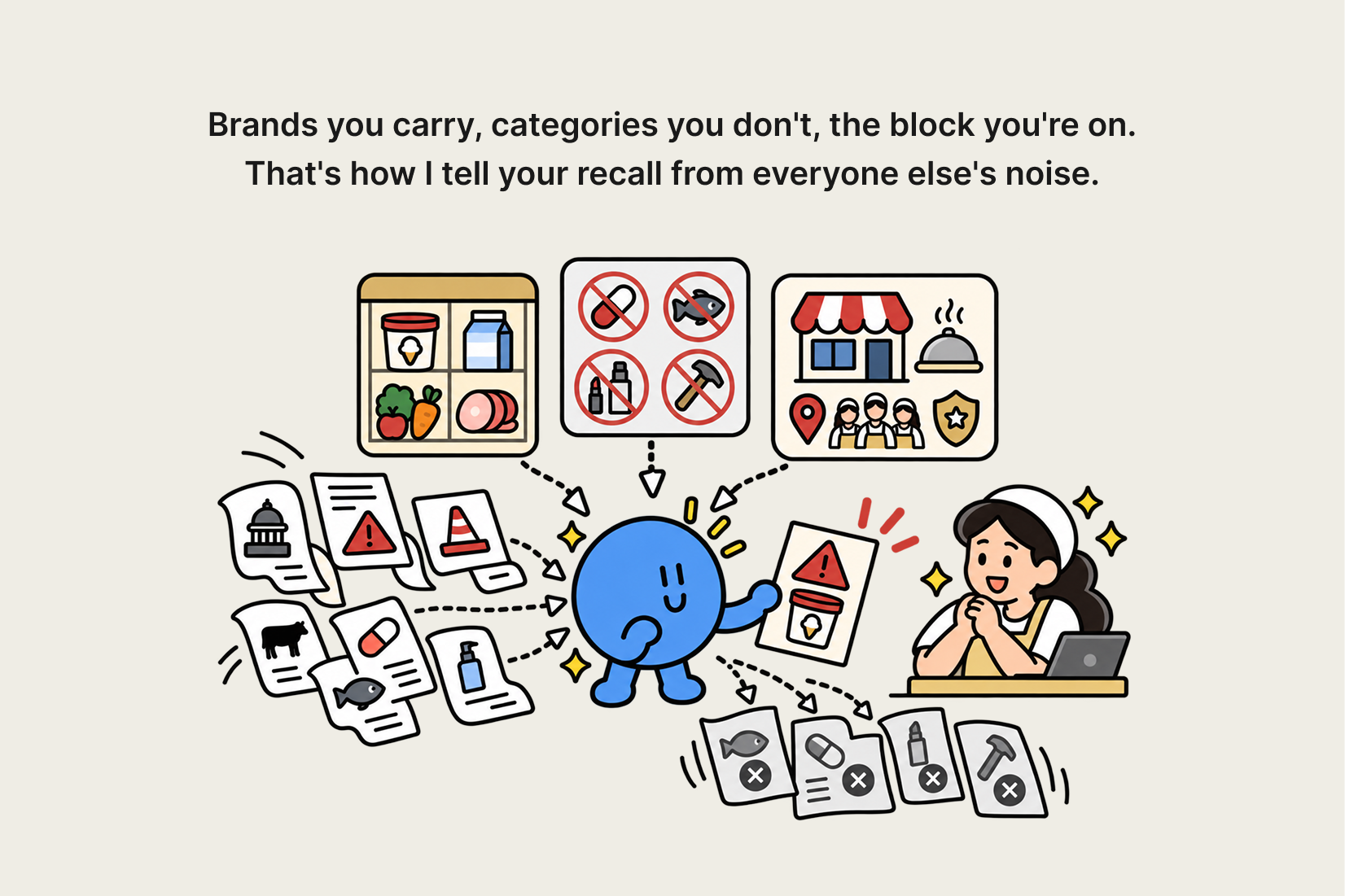
Triage is driven by the store profile: brands carried, categories skipped, and the exact block the store sits on.
Inspiration
Small business owners usually do not get blindsided by the regulations they already know about. They get blindsided by a consent-calendar line item, a recall notice that never reached them, or a fee that quietly appears on a property tax bill.
The owner of an 18-employee grocery store cannot realistically read the FDA enforcement feed, the USDA recall list, the dozens of council agenda items that come with every meeting, and every permit filed near the store. So most owners do not, and the anxiety of missing something never goes away.
I built the radar for one of the hardest cases first: an independent grocery store with a deli counter. Grocery stores operate under several overlapping regulators, which makes them a good test case for the problem.
What it does
Every morning, a Strands agent running on Amazon Bedrock AgentCore reads five real data sources: openFDA enforcement data, FDA recall press releases, USDA FSIS recall emails, San Jose city council agendas including the staff-report PDFs behind consent items, and street-work permits near the store.
The agent triages every item against a detailed profile of one specific store. The profile includes what the store carries down to the brand level, its street address, headcount, and licenses.
Silence is the product. It has read 761 real items so far and brought 30 of them to the owner. Four of those thirty asked for a decision today.
Its signature feature is the rejection log. The log shows every item the radar chose not to interrupt the owner about, along with a one-line reason such as "Sold exclusively at Albertsons," "Distributed only to OR and WA," or "City payroll classification, not private wage law."
The owner can overturn any rejection. That correction becomes retrieved context for future triage decisions.
A chat panel called "Ask the radar" lets the owner ask questions such as "Why did this reach me?" The agent answers by using tools over the same live database. Every surfaced item can also be turned into a plain-text brief that the owner can forward to an accountant or lawyer.
The system has already found several real issues in real data, and each one maps to money or liability the owner would otherwise absorb without warning:
It caught a Class II metal-contamination recall involving five Straus Family Creamery flavors that the store actually carries. This matters because the recalled pints could be sitting in the freezer case being sold right now: selling recalled product exposes a store to customer harm and real enforcement (California district attorneys settled a $1.6M case against a regional grocer over exactly this class of shelf-management failure), and nobody calls a small store to tell them. The radar named the exact flavors, UPCs, and best-by dates to pull.
It found a sewer-rate hearing placing about $209 million in sanitary sewer charges, and $33 million in storm sewer charges, on the county property tax roll. This matters because commercial sewer charges are rate-classed, and a store with a deli that prepares hot food falls into a higher-strength class: the outcome of that one hearing lands directly on the store's property tax bill as a line item most owners only discover after it is already final.
It found a one-year rescheduling of utility trenching on the store's own street, buried on page 2 of a staff report attached to a consent item titled "Rule 20A and Rule 20B (In-Lieu Fee) Underground Utility Program." For a store with a small lot and front-door deliveries, street trenching is a survival issue, and a keyword search would never have connected that title to this street.
Midway through the build, the radar caught a live recall expansion for Everything Sprouts' Robust Radish Mix and emailed the owner at 6 AM on a Sunday with nobody watching the system.
How I built it
The system runs one Strands agent with two modes on a single AgentCore Runtime.
In batch mode, EventBridge Scheduler triggers Lambda, which calls InvokeAgentRuntime and starts the daily triage loop. The system fetches each item, creates an embedding with Titan V2, retrieves similar past decisions through TiDB vector search, asks Claude Haiku 4.5 to make a decision, and writes the decision and reason back to the database.
In interactive mode, the web app calls the same runtime using AgentCore session IDs. A Strands agent uses five database tools for decision lookup, filtered logs, open items, resolution history, and semantic search. It answers the owner's questions while keeping memory bounded to the current session.
Council items use a two-stage triage process. The system first performs a low-cost title triage. If an item survives that step, the agent reads the staff-report PDF in detail and extracts important dates, supporting evidence, and the page number where that evidence appears.
TiDB Cloud Serverless stores the product state. It stores source documents, every triage decision and its reason, embeddings, the rejection log, resolutions, overturns, and the store profile that the UI edits live.
I deliberately did not use AgentCore Memory for this data. The rejection log and store profile are auditable product data. The UI needs to query them through SQL, the vector search needs to retrieve them, and the owner needs to be able to overturn individual decisions row by row. A database is the right place for that state. I use session-scoped agent state for conversational context instead.
The frontend runs on Next.js and Vercel. It reads TiDB through database views using the serverless HTTP driver. The application uses one least-privilege AWS key, and that key only has permission to invoke the runtime.
Challenges I ran into
Most of my hard problems were about running one agent in two very different modes, and about sources that lie in ways you only see if you check.
Reusing a stateful chat agent inside a batch loop cost me $30 and a day. The Strands agent kept its conversation history across items, so item 400 carried the prompts of the 399 before it and my token usage went up about 25 times. I now clear the agent state between items: batch triage wants amnesia, chat wants memory, and the same agent object cannot have both.
A quieter version of the same lesson nearly corrupted a day of data. The Lambda that calls InvokeAgentRuntime used boto3's defaults, and a daily run that took longer than the default 60-second read timeout was silently retried by the client. The retry re-ran the entire triage pass. Nothing errored; there were just two runs. I set the client to one attempt with a 900-second read timeout, matching the Lambda's own.
Interactive mode needed a different shape again. Ask has to remember the last few turns, so I keep a bounded window of 12 messages per AgentCore session in an LRU of 64 sessions. Follow-up questions work, and a long conversation cannot grow without limit. AgentCore's cold start is real: the first call after an idle period takes about ten seconds, so anything that looks like a demo gets a warm-up request first.
Council agendas forced a two-stage design. Reading every staff-report PDF would have been slow and expensive, and most agenda items are ceremonial. So stage one triages titles only and returns REJECT or INVESTIGATE, and stage two downloads and reads the PDF for survivors. That is how the system found the trenching schedule on page 2 of an item titled "Rule 20A and Rule 20B (In-Lieu Fee) Underground Utility Program." Everything that makes that catch possible would have been priced out by reading all of them.
On the data side, the USDA FSIS recall API is blocked by bot protection at the network edge, including its own documentation page. I subscribed to FSIS's official GovDelivery emails instead and built an SES inbound pipeline that stores them in S3 and parses them, so the agent reads the same announcement a human subscriber receives. openFDA turned out to be an archive rather than an alert feed, lagging by 11 to 80 days, so I use FDA's press-release RSS for freshness and openFDA for the structured detail.
San Jose's permit data had a semantic trap worth naming. A permit with an "Accepted" status sounds approved and upcoming; validation showed it means the work is finished. I sampled 85 permits and all 85 had final dates. I found that, and Legistar's consent flag being zero for every item, only because I checked each source against real records before building on it.
Accomplishments I'm proud of
Every number in the demo comes from real data. The backfill is genuine and deep: recall records reaching back to December 2025 and street-work records to July 2025. There is a live recall the system caught and emailed without human intervention, and a rejection log with reasons that still hold up when someone audits the underlying source.
The consent-calendar example captures the main idea of the product in one screen. The radar found that construction on the store's own street had been rescheduled, even though the relevant detail appeared only on page 2 of a staff report attached to a broadly titled consent item.
The business persona is also configuration rather than code. The reasoning engine does not contain grocery-specific logic. If I replace the store profile with a salon or taqueria profile, the same radar can monitor the regulations and events relevant to that business.
What I learned
About Strands: the same agent code serves both modes. Batch triage runs it as stateless single calls, and the chat panel runs it with tools and session state. Giving the chat agent five small database tools kept its answers tied to rows it actually read. The $30 token incident taught me where the boundary sits: conversation history belongs in a chat session and has no place in a batch loop.
About AgentCore: session IDs gave per-user conversation continuity without any session infrastructure on my side, and two-minute CodeZip deploys meant I could iterate on prompts against production data all week. The other lesson was deciding which state goes where. Audit records went to TiDB so that SQL, vector search, and row-level overturns all work; only conversational context stays with the agent.
About the data: public sources have bot walls, misleading field names, and archives that look like alert feeds. An agent that reads the underlying documents beats keyword filters in both directions, finding what vague titles hide and rejecting what alarming titles inflate. And owners trust the silence because the app shows what was reviewed, what was rejected, and why.
What's next
I want to add recall-termination-based expiry, learning from alert dismissals, richer street-work windows, and profiles for additional business types. There are plenty of stores like this one: U.S. Census data (SUSB 2021) counts about 35,000 grocery firms with fewer than 50 employees, before counting the salons, restaurants, and other main-street businesses that sit under the same overlapping regulators.
The core system already generalizes through the business profile. Expanding to a new type of business should mostly require editing that profile rather than rebuilding the reasoning engine.
Built With
- amazon-bedrock
- amazon-bedrock-agentcore
- amazon-cloudwatch
- amazon-eventbridge
- amazon-ses
- amazon-web-services
- aws-lambda
- aws-secrets-manager
- claude
- next.js
- python
- strands-agents
- tailwindcss
- tidb-serverless
- typescript
- vercel


Log in or sign up for Devpost to join the conversation.