




Inspiration
In emergencies, getting help isn't equally easy for everyone. People with mobility limitations, older adults, families with children, and individuals who need additional assistance can face barriers that traditional emergency response systems may overlook.
This challenge inspired us to build SHONGJOG, an inclusive emergency response and coordination platform that connects people in need with the right resources and field responders.
Inspired by the disaster-risk challenges faced by coastal communities in Bangladesh, particularly areas such as Dacope, Khulna, we wanted to address a critical question:
How can emergency assistance reach the right person, with the right resources, while considering their individual accessibility needs? **
We believe emergency response should not only be fast; it should also be accessible, coordinated, and accountable.
What it does
SHONGJOG connects citizens, emergency coordinators, resources, and field responders through one coordinated platform.
Its core capabilities include:
- Citizen Assistance Requests: People can submit emergency assistance requests with their location, urgency, group size, and specific support requirements.
- Bilingual Experience: English and Bangla interfaces make the platform more accessible to local communities.
- Accessibility-Aware Coordination: Coordinators can review mobility requirements, equipment needs, step-free access, boarding conditions, and other relevant physical constraints.
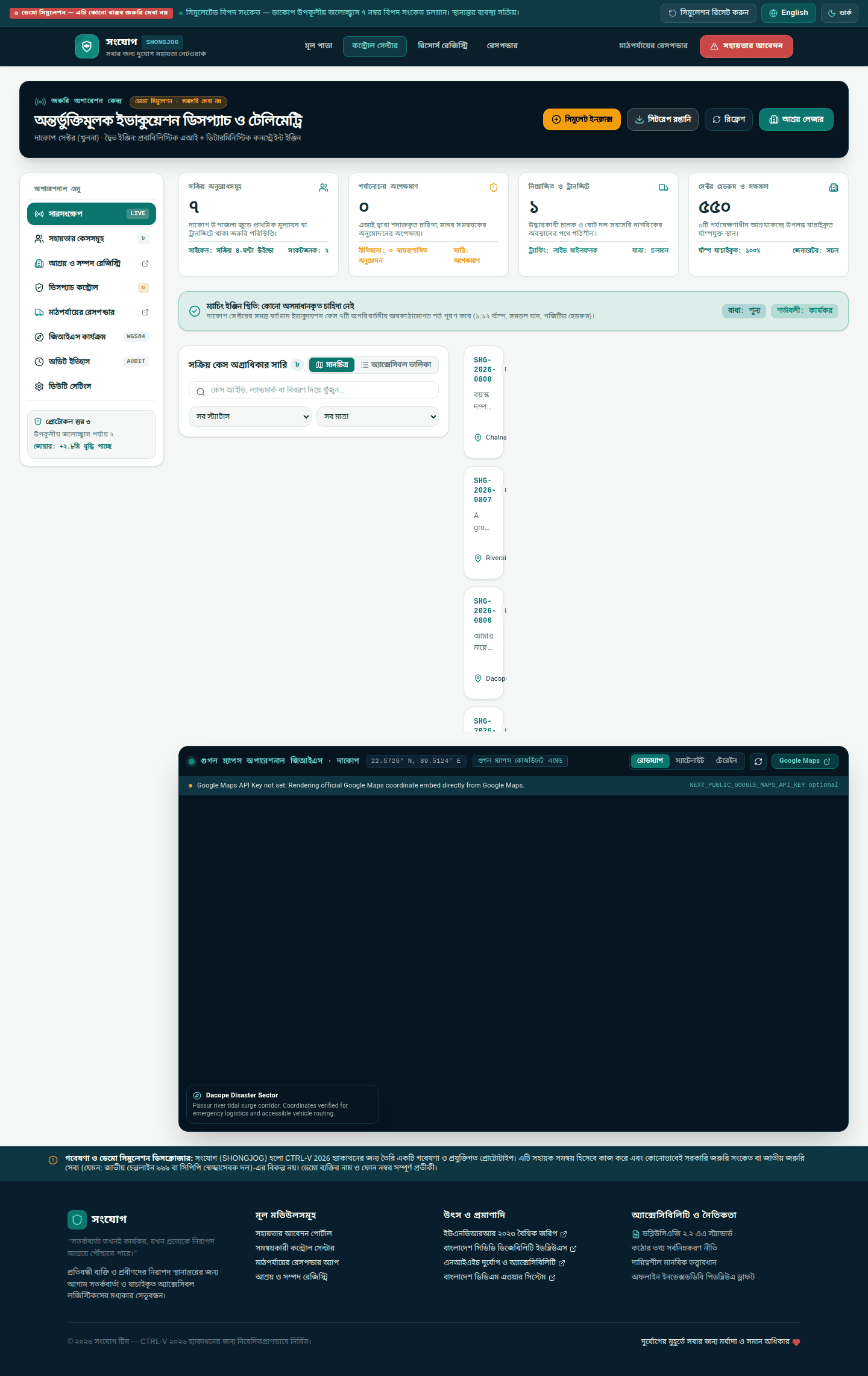
- Operational Command Center: A centralized dashboard provides assistance-case management, resource monitoring, dispatch control, responder coordination, and activity history.
- Google Maps Integration: Geographic views help coordinators understand where assistance is needed and where resources and responders are located.
- Human-in-the-Loop Dispatch: A structured workflow allows coordinators to review requests, verify requirements, check resource suitability, and authorize assignments.
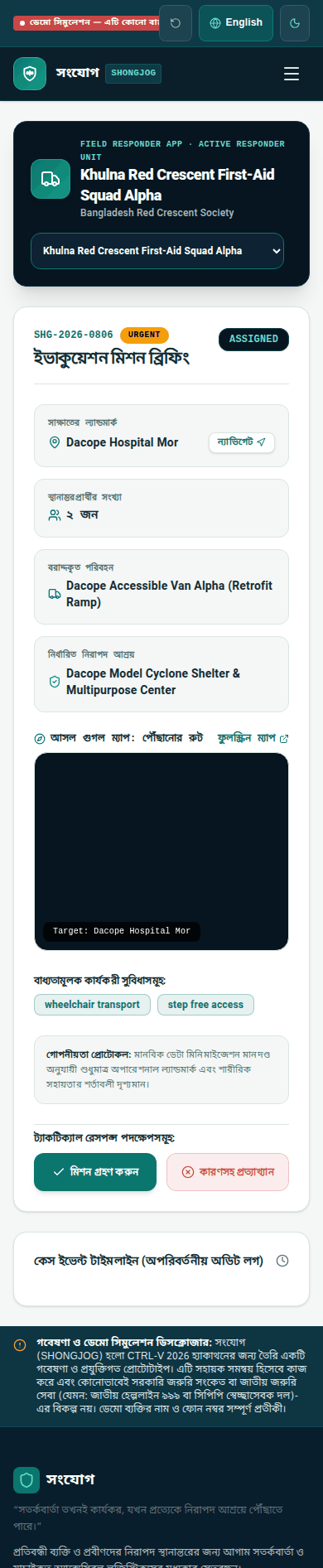
- Field Responder Portal: Responders can access assigned cases, navigate to locations, accept or update assignments, and report assistance progress.
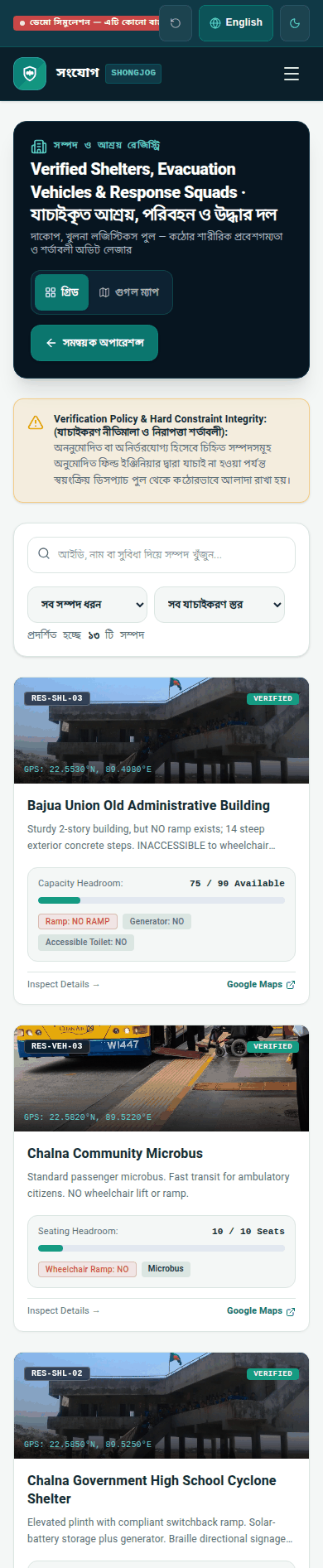
- Resource Registry: Emergency resources can be registered, updated, verified, reserved, and assigned.
- Offline-Friendly Request Drafting: Citizens can prepare request information when connectivity is unreliable and continue when access becomes available.
The goal is to make emergency coordination more organized while ensuring that accessibility requirements are considered before assistance is assigned.
How we built it
We built SHONGJOG as a full-stack web application using a modern development architecture.
Frontend and user experience
- Next.js and React for the application structure and routing.
- TypeScript for type-safe development.
- Responsive layouts for desktop, laptop, tablet, and mobile.
- A centralized English–Bangla localization system.
- Noto Sans Bengali and Hind Siliguri typography for readable Bangla content.
- A consistent institutional design system focused on clarity, accessibility, and emergency operations.
Backend and data management
- API routes for assistance requests, assignments, dispatch operations, and responder actions.
- Prisma ORM and a relational database schema.
- Transaction-based resource reservation.
- Conditional database updates to protect resource capacity during simultaneous dispatch requests.
- Explicit assignment state transitions and responder authorization.
- Audit records to support operational accountability.
Geographic coordination
- Google Maps integration for geographic visualization.
- Roadmap, Satellite, and Terrain views.
- Location-based case, resource, and responder information.
- Direct Google Maps navigation links for field responders.
Accessibility and reliability
- English and Bangla translation parity.
- Locale-aware number formatting.
- Mobile navigation drawers and touch-friendly controls.
- Voice dictation support where the browser provides the required speech functionality.
- Offline request drafting.
- Automated unit, integration, and browser-based testing.
We designed the dispatch process around human authorization rather than allowing automated systems to make potentially unsafe emergency decisions independently.
Challenges we ran into
One of our biggest challenges was understanding that emergency assistance is not simply about assigning the nearest available resource.
A resource may be geographically close but physically unsuitable. A vehicle may not support a wheelchair user, a shelter may lack step-free access, or a boat may not provide safe boarding conditions.
We therefore needed to represent accessibility requirements and physical constraints as part of the coordination process.
Other major challenges included:
1. Preventing resource overbooking
When multiple coordinators attempt to assign the same resource simultaneously, ordinary read-then-write logic can create race conditions. We addressed this with conditional database updates and transaction-based assignment operations that protect available capacity.
2. Building a meaningful bilingual experience
Translating only headings and navigation labels was not enough. Forms, validation messages, dashboard tables, status labels, dialogs, notifications, and dynamic content all needed consistent Bangla support.
3. Making the interface usable on smaller devices
Emergency coordination tools must remain functional on mobile screens. We had to adapt complex tables, navigation, dispatch controls, and geographic views without simply shrinking the desktop interface.
4. Balancing detailed information with usability
Coordinators need enough information to make responsible decisions, but too much information can slow them down. We focused on visual hierarchy, operational status indicators, structured workflows, and clear action controls.
5. Handling unreliable connectivity and external services
Location services and browser capabilities may not always be available. We designed transparent fallback states and offline-friendly request drafting so that the interface does not falsely imply that unavailable services are working.
Accomplishments that we're proud of
We are proud that SHONGJOG grew beyond an information website into a coordinated product with distinct workflows for citizens, coordinators, and responders.
Our major accomplishments include:
- A centralized operations command center with eight operational sections.
- A structured, human-authorized dispatch workflow.
- Accessibility-aware request and resource coordination.
- Transaction-safe resource reservation logic.
- A bilingual interface with 154 English and 154 Bangla translation keys.
- Responsive verification across 12 viewport widths.
- Google Maps geographic integration.
- Citizen request intake and responder assignment workflows.
- A resource registry and operational activity history.
- A clean source submission package designed to remain below the 5 MB competition limit.
Our reported automated verification includes 28 passing Vitest tests and 40 passing Playwright test runs across four browser/viewport projects, alongside successful TypeScript checks and production compilation.
Most importantly, we are proud of the principle behind the platform: accessibility should be considered before dispatch, not after someone has already been left behind. **
What we learned
Building SHONGJOG taught us that inclusive emergency response requires more than a map, a request form, or a fast assignment algorithm.
We learned that:
- Accessibility requirements must be represented in operational data, not treated as optional notes.
- The nearest resource is not necessarily the most suitable resource.
- Human authorization is essential when physical safety and emergency decisions are involved.
- Database concurrency is a real-world operational concern, not just a technical detail.
- Localization must cover the entire user journey, including errors and dynamic content.
- Responsive design is essential when people may need to use the platform on different devices and under stressful conditions.
- Trust depends on verified information, transparent system states, and accountable actions.
We also learned to distinguish a working software demonstration from a fully deployed emergency service. SHONGJOG is designed to support coordination, but real-world operation requires partnerships, verified resource data, field testing, and integration with appropriate emergency-response organizations.
What's next for SHONGJOG - Emergency Response & Coordination Platform
Our next goal is to move SHONGJOG from a competition-ready platform toward a field-tested humanitarian coordination solution.
We plan to:
- Pilot with coastal communities: Work with local organizations and disaster-response stakeholders in areas such as Dacope and Khulna to validate the workflows against real community needs.
- Build verified resource networks: Collaborate with shelters, volunteer groups, transport providers, and local authorities to maintain accurate resource availability and accessibility information.
- Strengthen low-connectivity support: Explore SMS, USSD, assisted telephone intake, and more reliable offline synchronization for communities with limited internet access.
- Improve geographic intelligence: Incorporate verified local geographic information and safer route considerations without presenting unverified routes as guaranteed safe.
- Expand accessibility testing: Work with people with different mobility, communication, and accessibility needs to evaluate the platform in realistic scenarios.
- Strengthen deployment infrastructure: Move toward a production database, reliable hosting, secure authentication, backups, monitoring, and operational support.
- Develop accountable data and AI assistance: Explore multilingual request interpretation and decision-support features while keeping safety-critical verification and dispatch authorization under human control.
Our long-term vision is simple:
*A more inclusive emergency response ecosystem where every request is understood, every resource is appropriately matched, and no one is overlooked because of their accessibility needs. ***
SHONGJOG — Connecting people to help, when every connection matters. **
Built With
- google-maps-javascript-api
- google-maps-platform
- next.js
- node.js
- playwright
- prisma-orm
- progressive-web-app
- react
- rest-api
- sqlite
- tailwind-css
- typescript
- vitest
- web-speech-api
