-
-
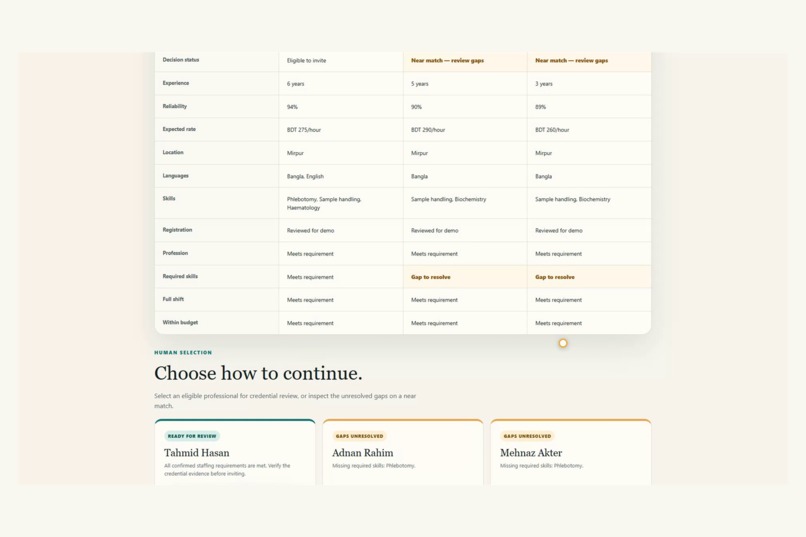
Evidence-led candidate comparison with visible gaps
-
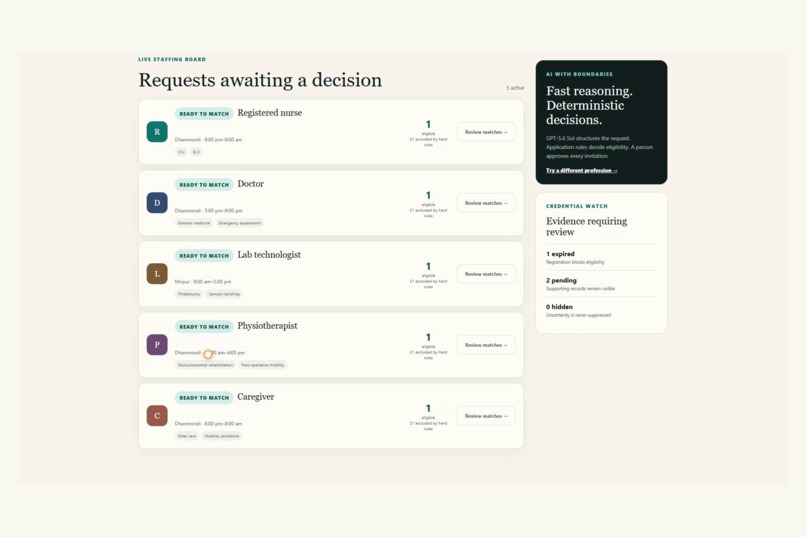
Five-profession healthcare staffing dashboard
-
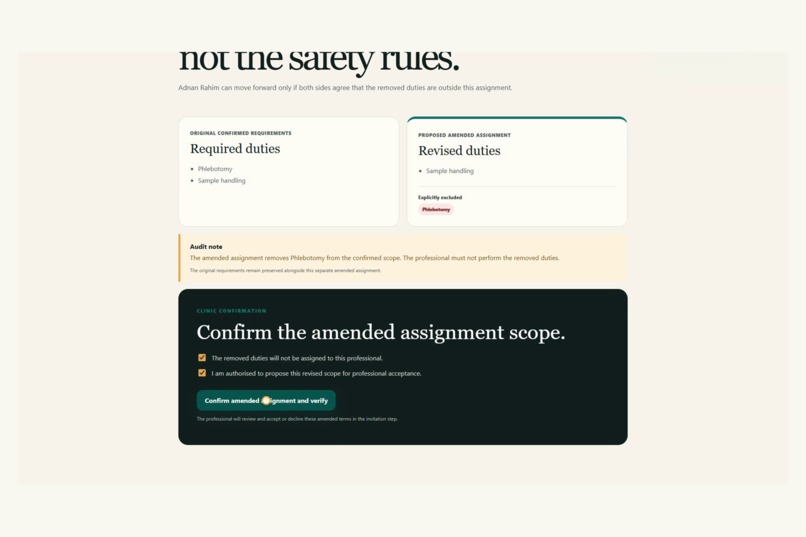
Human-controlled amended assignment workflow
-
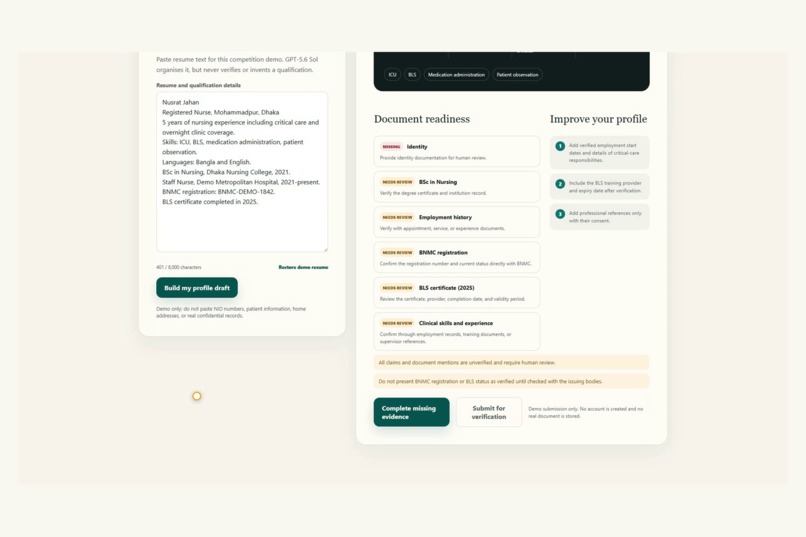
AI-assisted professional resume and evidence intake
Inspiration
Small clinics and diagnostic centres in Bangladesh may need temporary professionals on short notice. Finding someone is only part of the problem: the coordinator must translate the need into exact requirements, compare registration, skills, availability, and cost, keep uncertainties visible, and obtain agreement from both sides.
Generic job boards expose profiles but do not make that decision process accountable. ShohojSheba explores what a verified-workforce workflow could look like when AI accelerates the work without becoming the decision-maker.
What it does
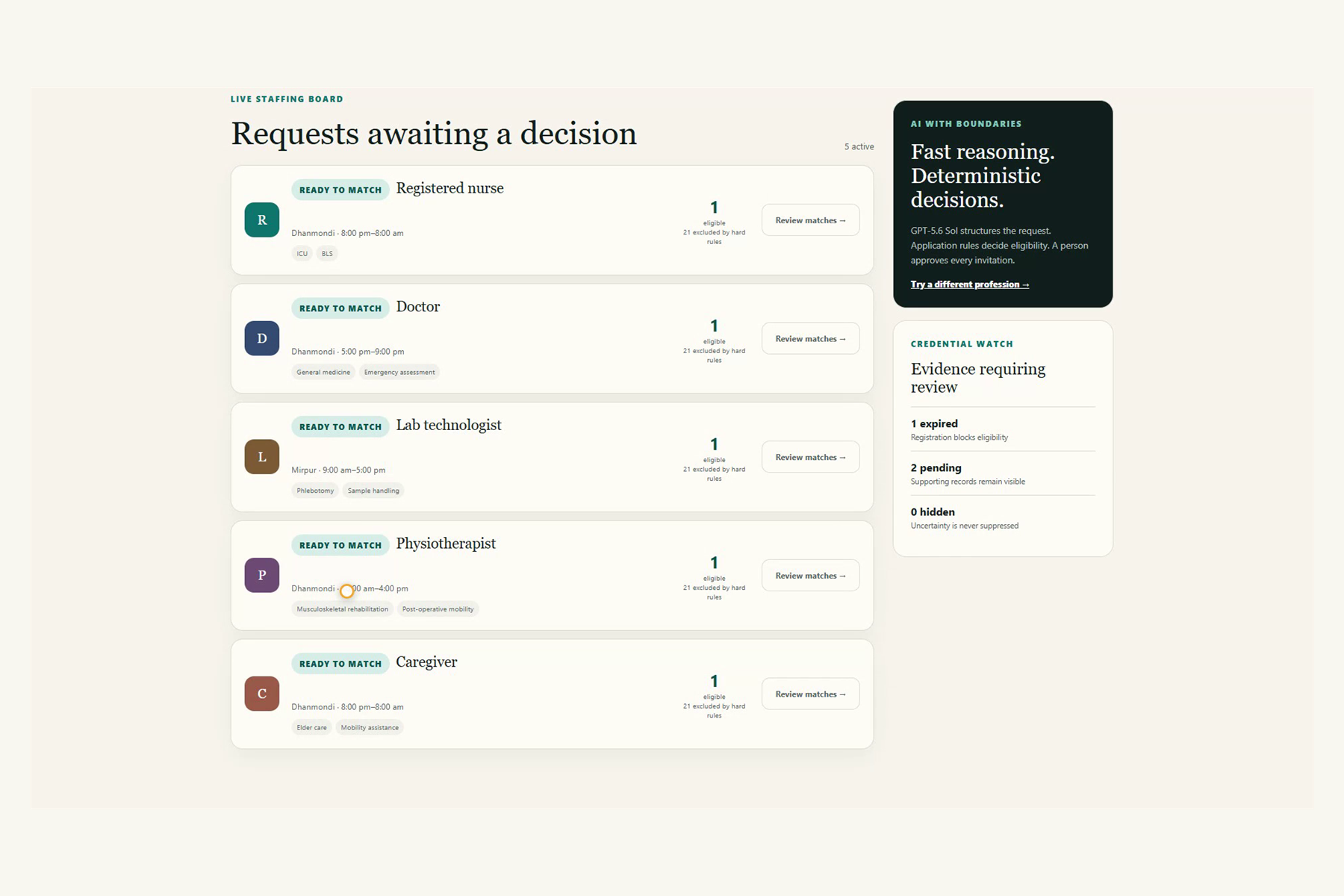
ShohojSheba demonstrates end-to-end staffing journeys for doctors, registered nurses, laboratory technologists, physiotherapists, and caregivers.
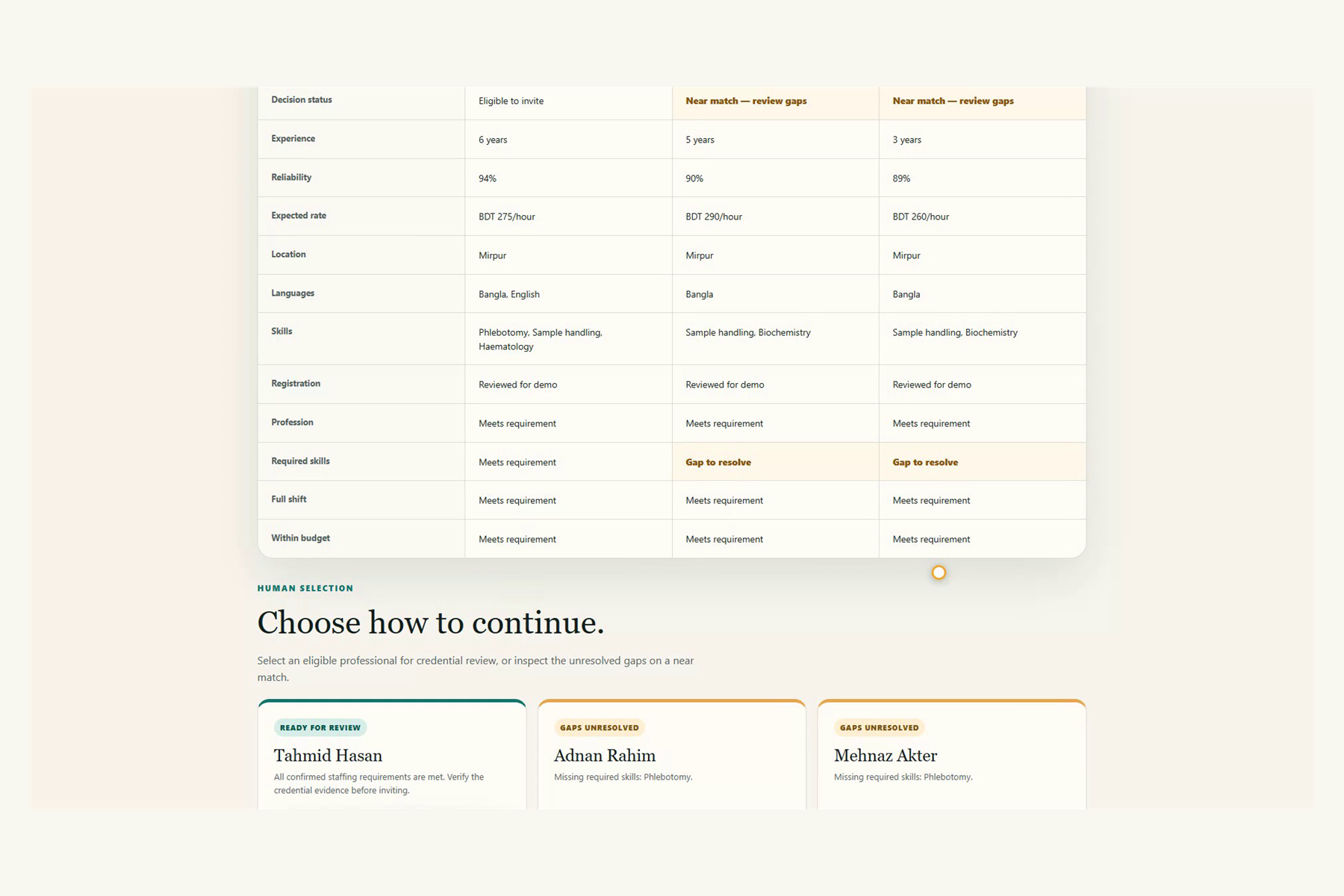
A clinic can describe a shift naturally, review GPT-5.6-structured requirements, and receive a deterministic shortlist. Only professionals who pass profession, reviewed registration, skills, full-shift availability, and budget requirements receive a score. Near matches remain visible with their exact gaps and can be compared side by side.
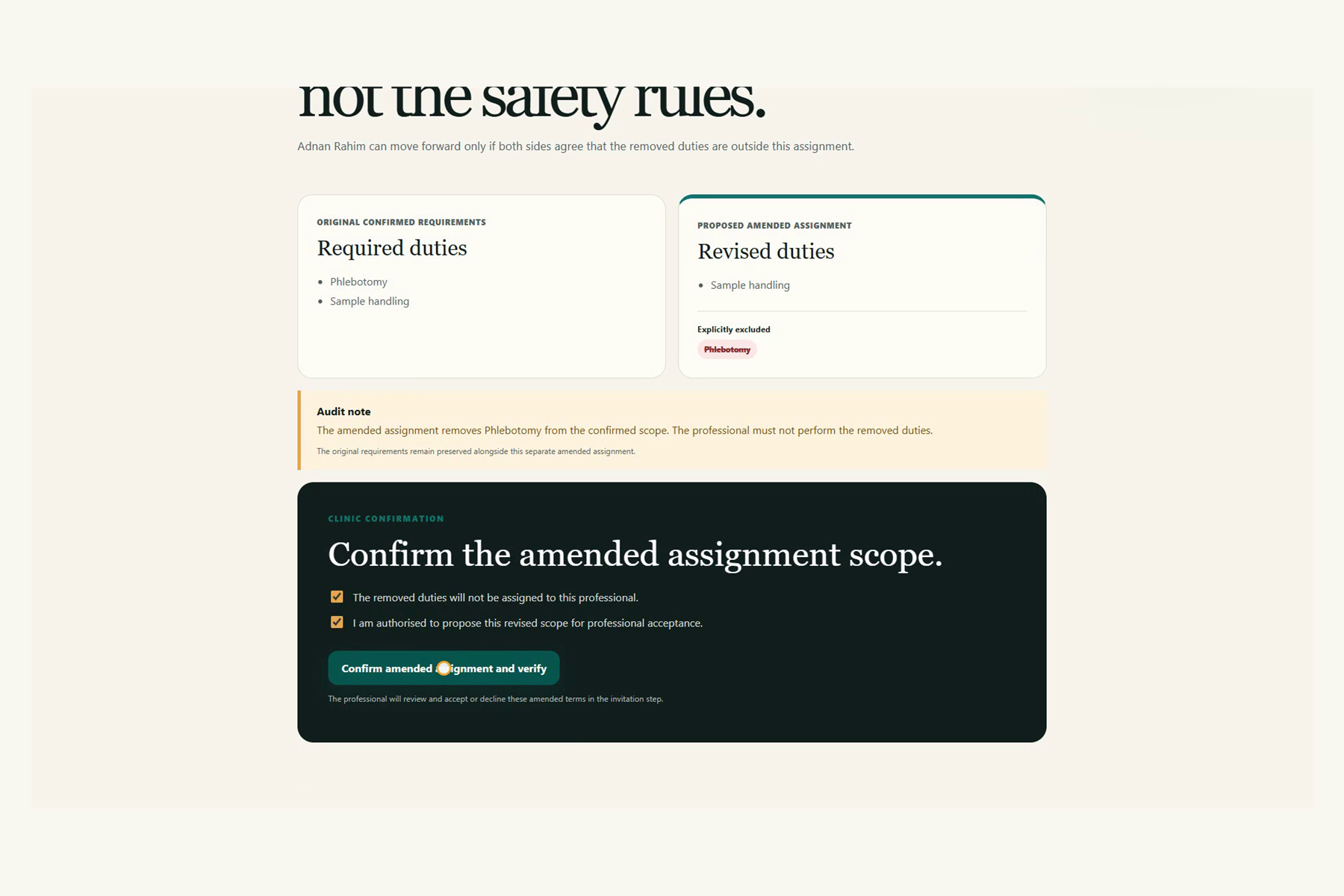
When a near match fails only because of an assignment duty, an authorised coordinator may propose a separately recorded amended assignment that explicitly removes that duty. The original requirements remain visible, every non-negotiable rule must still pass, and the professional later accepts or declines the amended terms.
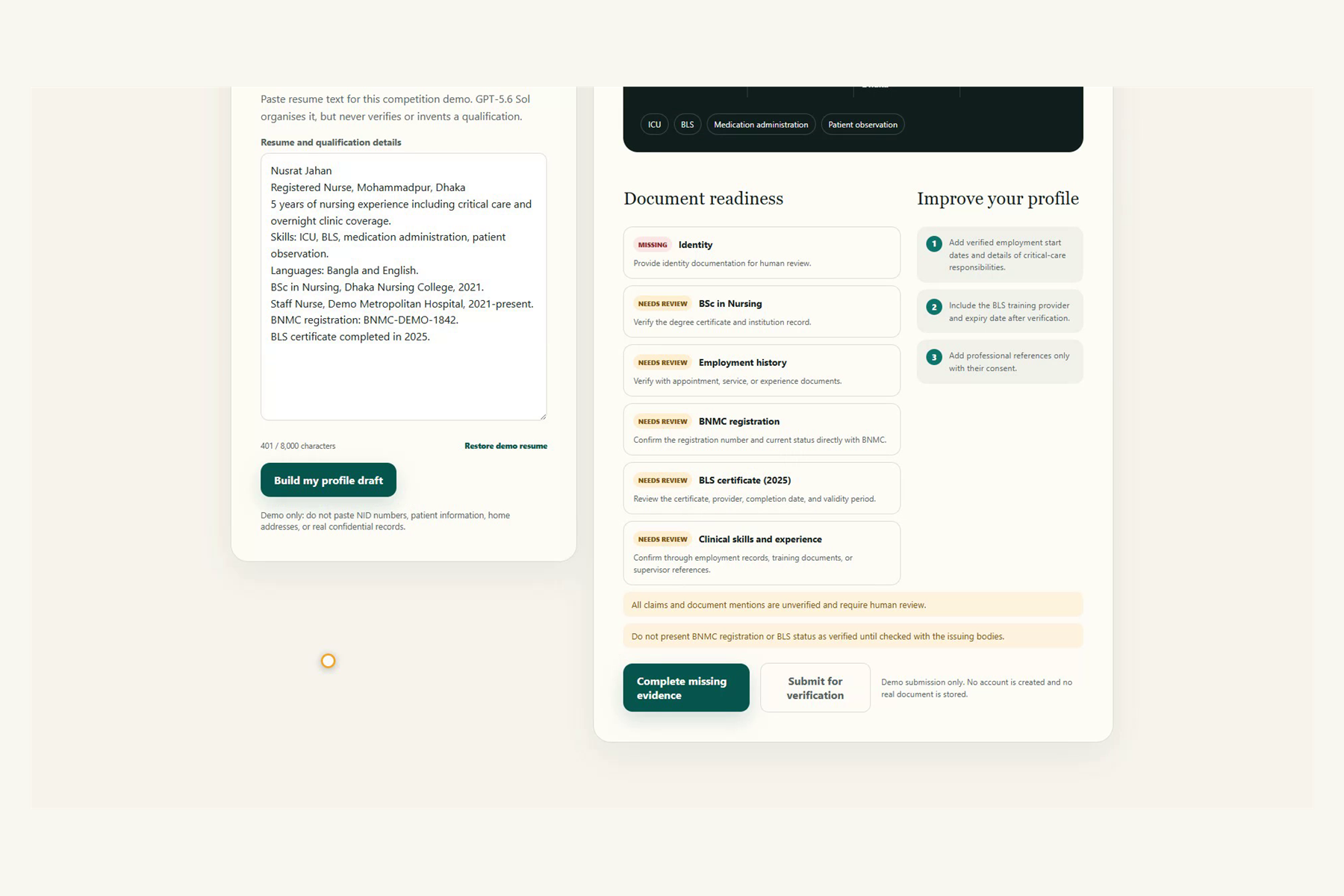
The clinic reviews synthetic credential evidence, confirms an invitation, and hands the decision to the professional. A staffing brief is created only after professional acceptance. A separate professional onboarding flow uses GPT-5.6 to organise a doctor or nurse resume into a draft profile, missing-evidence checklist, and ethical improvement advice.
How we built it
ShohojSheba is a typed Next.js and React application with a deterministic in-memory repository of fictional data. Pure domain services own eligibility, scoring, credential review, amended assignments, invitations, and assignments. This makes the competition journey reproducible while keeping the persistence boundary replaceable.
GPT-5.6 Sol is integrated through the OpenAI Responses API for three bounded workflows:
- natural-language staffing-request extraction;
- an evidence-grounded shortlist briefing; and
- professional resume-to-profile intake.
All three use strict JSON schemas, server-side credentials, validation, visible source labels, and disclosed deterministic fallbacks. GPT-5.6 cannot change eligibility, fabricate credentials, send an invitation, or accept work.
Codex was the primary engineering workspace. It translated the founder's product and healthcare-workflow decisions into the architecture, application routes, domain services, interface, tests, browser QA, deployment, and repair loops. The dated commit history, decision log, and build log preserve that collaboration.
Challenges we ran into
- Separating eligibility from ranking so a high score could never hide a failed hard requirement.
- Keeping human-confirmed requirements consistent through comparison, credential review, invitation, acceptance, and assignment routes.
- Designing flexibility for near matches without creating a generic safety override.
- Preserving credential provenance without implying that AI verified a government record.
- Making the demo reliable when API access, quota, browser caching, or deployment-runtime behavior changed.
Accomplishments we are proud of
- Five coherent healthcare staffing scenarios instead of a single scripted card.
- Three live GPT-5.6 workflows with strict structured outputs and honest fallbacks.
- Transparent comparison of one recommended match and at least three same-profession near matches per category.
- A negotiated amended-assignment workflow with separate clinic confirmation and professional acceptance.
- A complete no-login judge journey from request to final staffing brief.
- Forty-eight automated tests, two successful production build targets, live API checks, and mobile validation across eight judge-facing routes.
What we learned
AI is most useful here when it organises messy information and explains evidence—not when it owns eligibility or the final decision. Deterministic rules, visible uncertainty, and explicit human transitions made the product both safer and easier to understand.
We also learned that the difficult part of an AI product is not only the model call. Continuity, recovery paths, clear labels, responsive comparison, and deployment behavior determine whether the result feels like a complete product.
What's next
The competition prototype intentionally excludes authentication, payments, durable storage, real registry integrations, contact exchange, attendance, disputes, and production notifications.
The next healthcare phase would add verified organisation accounts, professional consent, durable audit records, availability management, secure document review, and registry integrations. The longer-term ShohojSheba engine could support legal, accounting, engineering, and education services, with profession-specific verification and ethical rules rather than one generic freelancing marketplace.
Built With
- ai
- api
- cloudflare
- codex
- gpt-5.6
- healthcare
- next.js
- openai
- outputs
- react
- responses
- sol
- structured
- typescript
- vitest
- workers

Log in or sign up for Devpost to join the conversation.