Inspiration
Customer operations represent one of the most significant, friction-heavy bottlenecks for modern commercial enterprises globally. Whether dealing with a nimble, fast-growing startup or a massive, multi-tiered conglomerate, support channels are consistently overwhelmed by the sheer volume of daily inbound traffic.
The core issue lies in how people communicate. Real-world customers do not write structured queries; they communicate using highly emotional language, loose phrasing, and complex colloquial scripts—such as Banglish (phonetic Bengali written using the Latin alphabet). Traditional, rigid rule-based chatbots completely shatter when exposed to this type of natural, fluid human text, forcing frustrated users to queue endlessly for human intervention.
We built Shoduttor.ai out of the necessity to bridge this exact gap: to engineer an advanced intelligence layer capable of gracefully digesting the unpredictable, messy ways humans communicate while simultaneously protecting internal support teams from burnout.
What it does
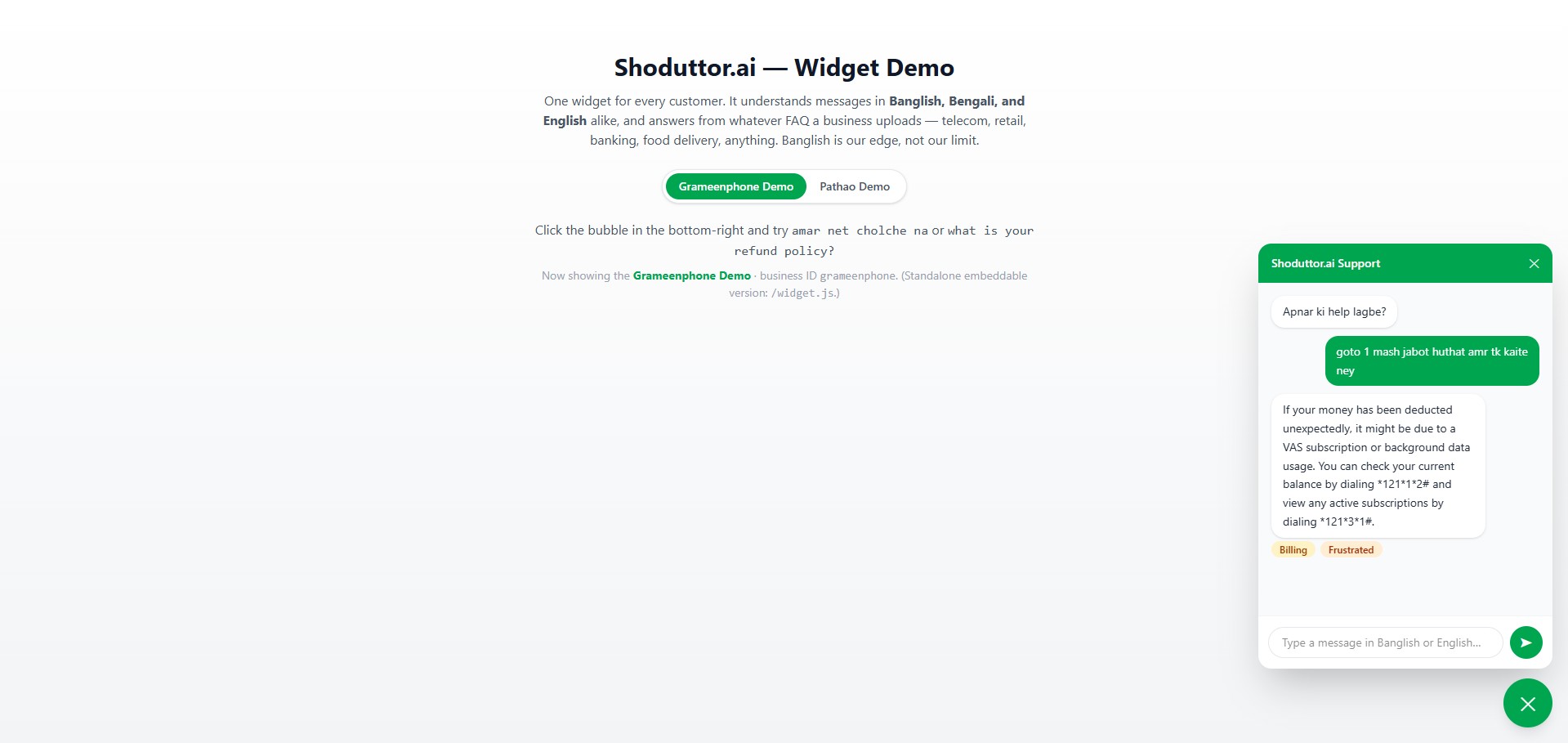
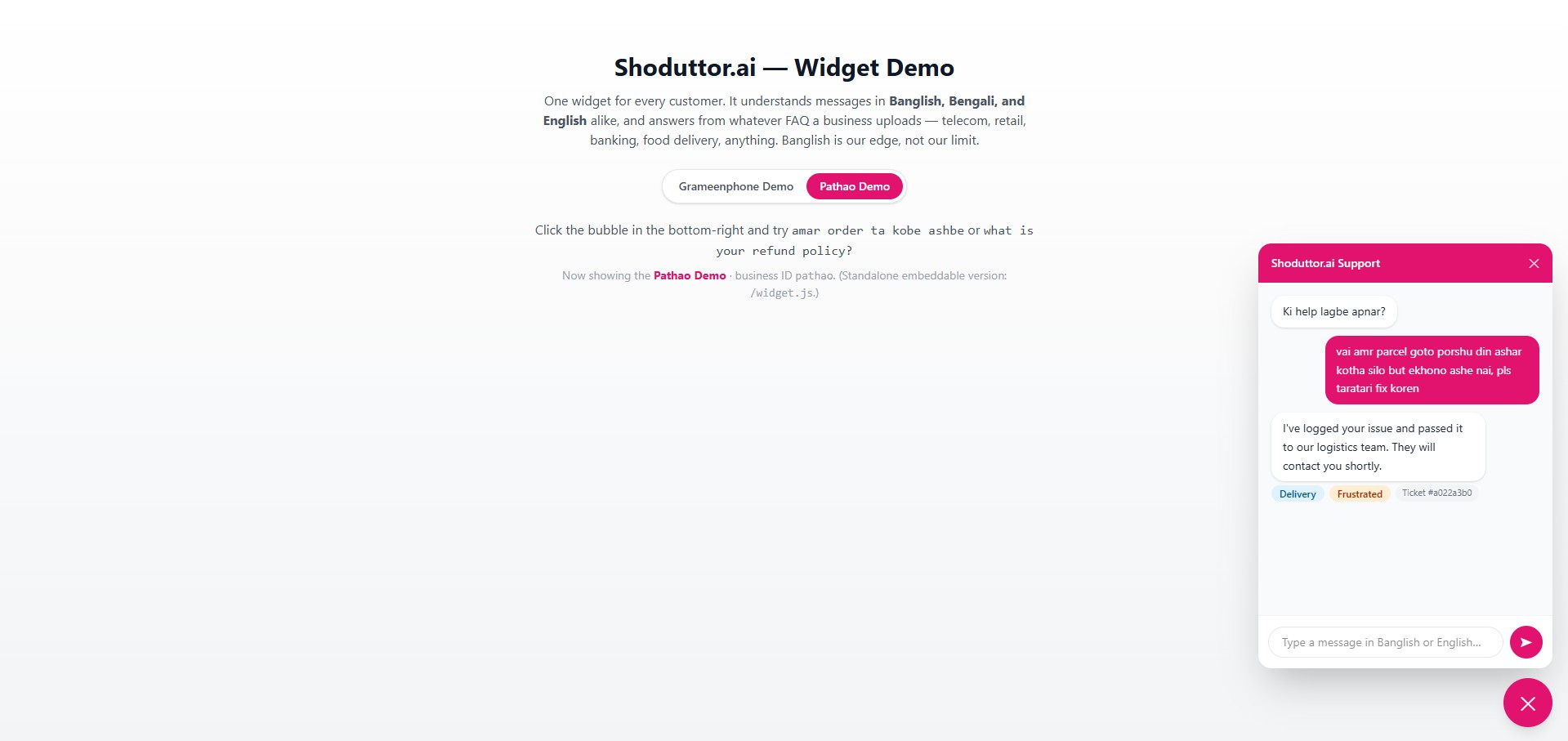
Shoduttor.ai functions as an automated frontline defense layer for enterprise customer success, operating via an embeddable asynchronous chat widget that can be injected into any consumer-facing corporate ecosystem with a single script tag.
Instead of forcing developers to spend weeks hand-crafting thousands of conditional logic paths or mapping hardcoded keywords, Shoduttor.ai utilizes an elegant, automated zero-configuration pipeline:
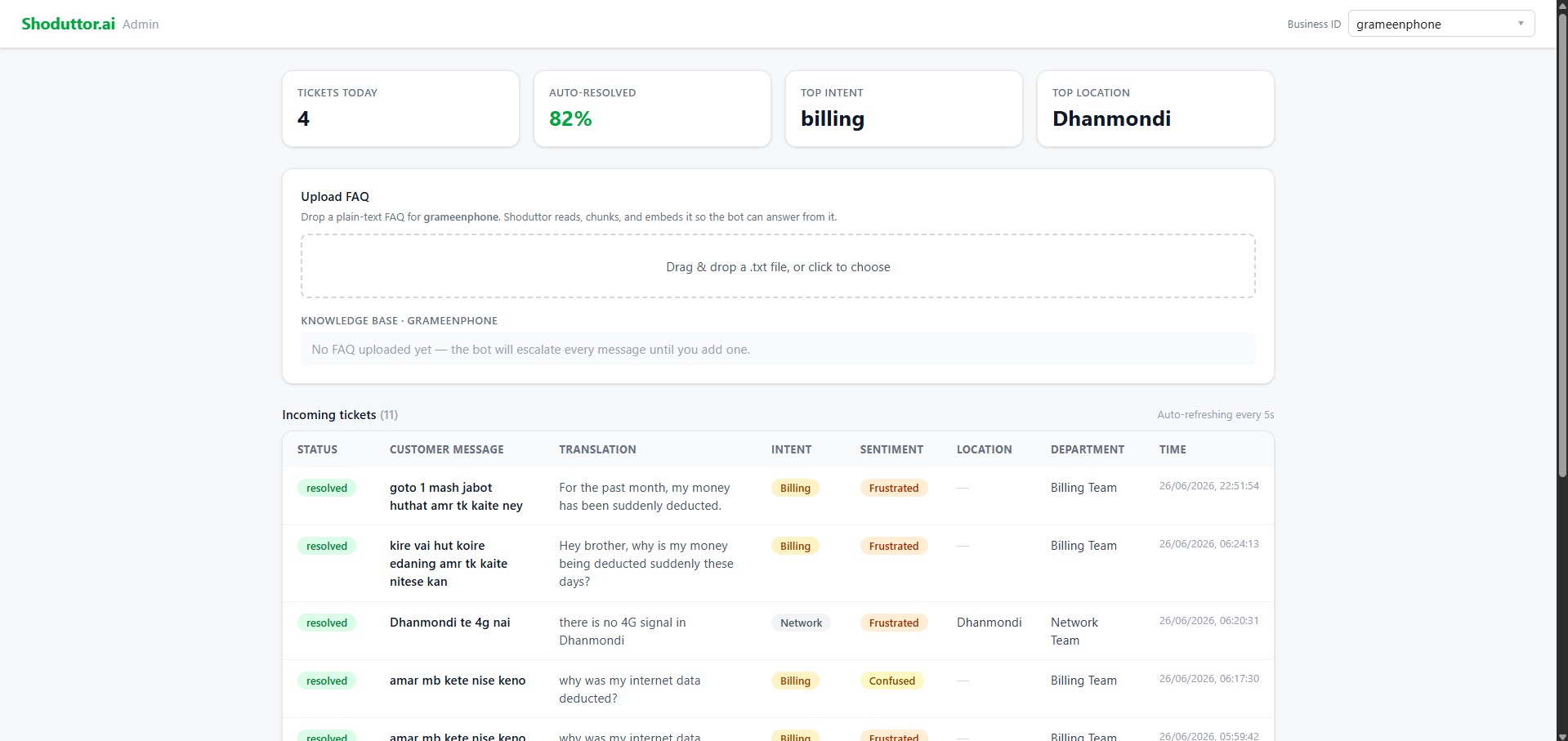
- Instant Knowledge Capture: Business administrators can simply drag and drop unstructured knowledge fragments—ranging from loose, unformatted
.txtfiles of standard business FAQs to expansive corporate policy frameworks and updated product catalog spec sheets. The system automatically ingests, normalizes, chunks, and indexes this information on the fly. - Multilingual Semantic Parsing: The minute a client engages with the chat widget, our engine parses the underlying intent. If a customer sends an unstructured, highly frustrated message in a mixed script like Banglish, the platform handles it seamlessly.
- Automated Contextual Resolution: The AI matches the user's intent against the company’s specific vector knowledge base to output immediate, contextually accurate answers, aiming to resolve the query entirely without human oversight.
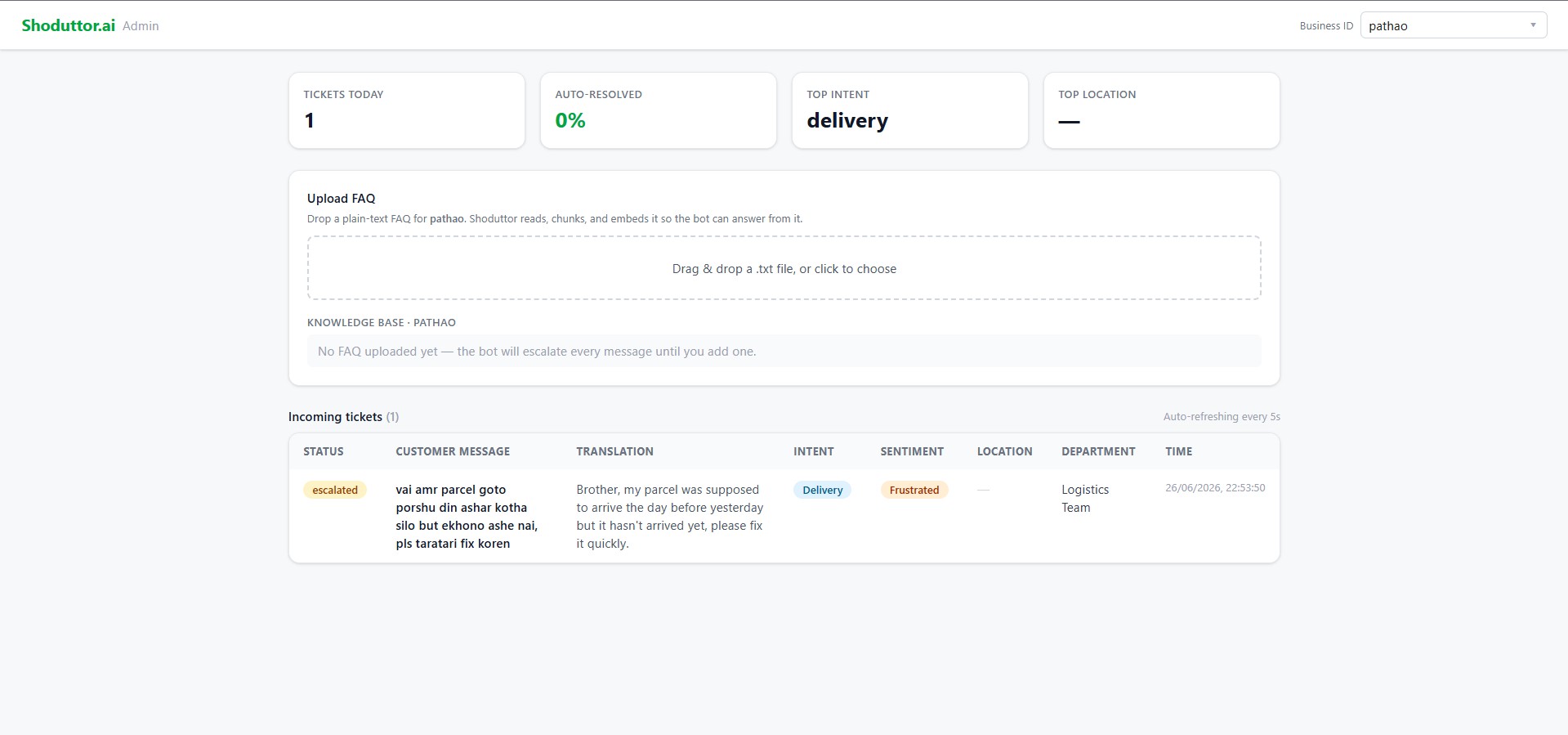
- Intelligent Escalation & Triage: When a dispute requires human judgment or falls outside the bounds of the safe knowledge profile, the platform acts as an expert dispatcher. It performs live sentiment analysis, extracts deep context, auto-assigns the ticket to its corresponding specialized department (such as the Billing Team or Network Support), and presents a clean, coherent English translation directly to the admin panel alongside the original text.
How we built it
Our engineering architecture was built from the ground up to support highly concurrent data streams, low-latency machine inference, and a pristine administrative interface:
- The Interface Layer (Frontend): Crafted using React, Vite, and JavaScript to build a modern, high-speed single-page application dashboard. This setup ensures that incoming ticket feeds stream into the admin display smoothly, maintaining crisp data layout structures.
- The Orchestration Layer (Backend): Powered by a highly scalable Node.js and Express.js API environment that manages application routing, controls automated webhooks, and orchestrates background communication protocols.
- The Storage & Embedding Architecture: Leveraged Supabase (PostgreSQL) to store application state, structural schemas, historical ticket logging metrics, and text metadata. We deployed OpenAI’s text-embedding models to generate dense vectors of the uploaded company documentation for real-time document search.
- The Intelligence Processing Unit: Utilized OpenAI’s large language models to handle real-time semantic classification, phonetic code-switching translation, precise intent routing, and contextual text synthesis.
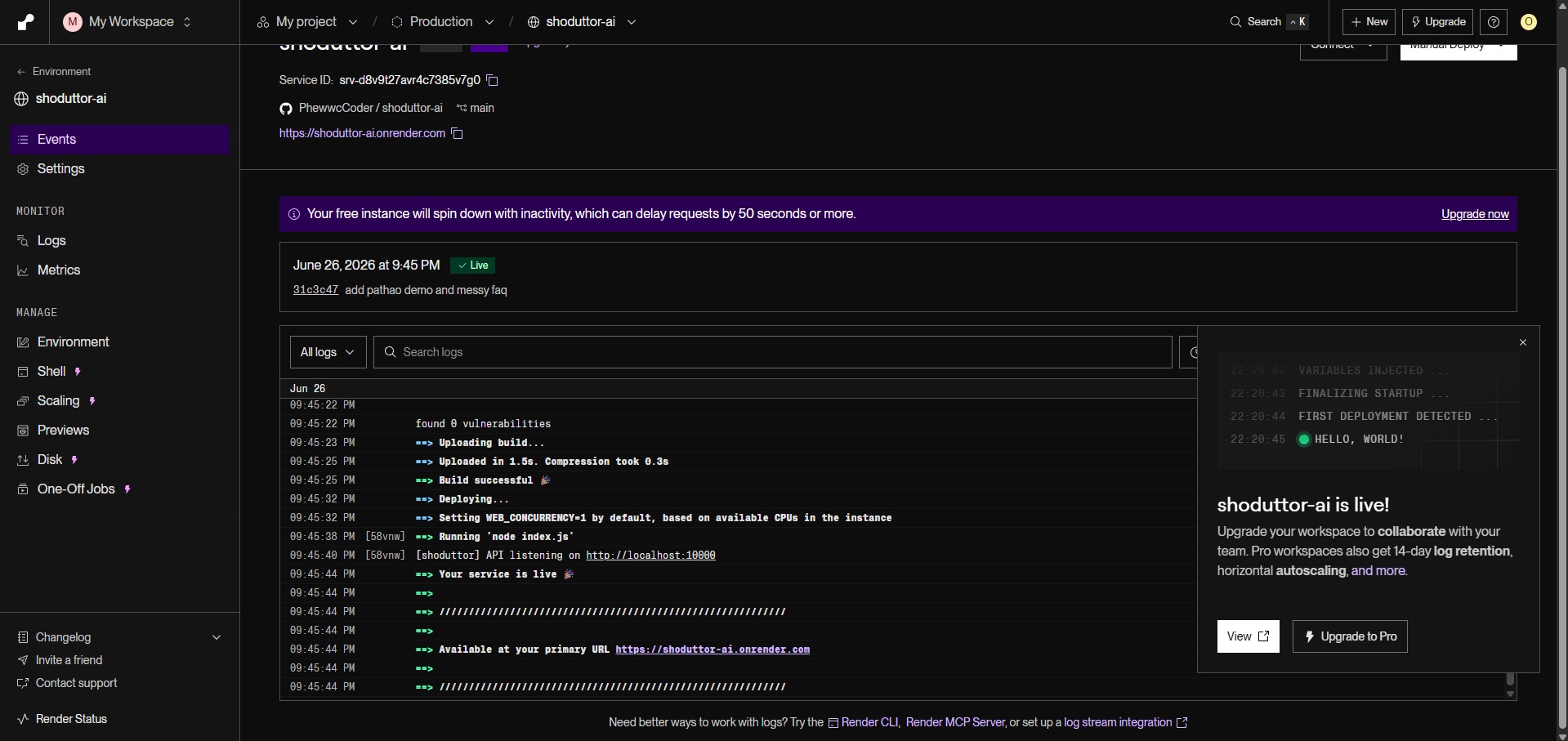
- Infrastructure Deployment: The dynamic backend architecture is hosted on Render to guarantee server availability, while the fluid UI is deployed via Vercel to provide an optimized global edge distribution network.
Challenges we ran into
Engineering an engine capable of handling messy, informal mixed languages like Banglish proved to be a significant computational hurdle. Standard, out-of-the-box Natural Language Processing (NLP) frameworks are built assuming clean, grammatically sound single-language datasets; they universally fail when confronted with arbitrary phonetic spellings, local slang, and shifting syntactic structures. Overcoming this required meticulous work on semantic prompt layouts, careful prompt structuring, and multi-stage classification passes to reliably extract clean intent and emotional sentiment from casual, high-friction strings.
Furthermore, processing unstructured, arbitrary text files dropped into our dashboard required building a robust document chunking strategy. We had to ensure that when a raw document is parsed, it splits cleanly at semantic boundaries rather than cutting sentences off in mid-thought, preventing data corruption during the vector retrieval stage while keeping API tokens bounded.
Accomplishments that we're proud of
- Zero-Config RAG Execution: We successfully eliminated the operational barrier to deploying custom AI. A business manager with zero programming or database knowledge can upload a text file and deploy an enterprise-grade Retrieval-Augmented Generation agent in seconds.
- Flawless Multi-Lingual Triage: We engineered a highly stable backend pipeline that smoothly reads raw, non-standard scripts, translates them accurately, identifies deep conversational context, and sorts the output to specific human support queues with near-perfect accuracy.
- Elegant Admin Optimization: Building a crisp, minimalist administrative ecosystem that balances technical complexity with aesthetic clarity, giving managers a snapshot of exactly how hard their automated agent is working for them.
What we learned
Building this platform solidified an fundamental truth: the true role of AI within heavy corporate operational environments is not to fully replace human agents, but rather to excel at perfect, high-speed triage.
Throughout this project, we gained deep, hands-on production experience in fine-tuning advanced vector retrieval pipelines, maintaining clean synchronization layers between client states and database storage during real-time streams, and transforming completely unstructured, chaotic human language into clear, highly actionable structural data tables.
What's next for Shoduttor.ai
We are actively planning to transform Shoduttor.ai from a standalone web ecosystem into a complete omnichannel customer engine:
- Universal Channel API Hookups: Expanding our lightweight widget architecture to tie directly into major global instant messaging networks—including WhatsApp Business, Facebook Messenger, and Telegram API systems.
- Advanced Analytical Engine: Integrating deeper visual reporting features, such as interactive time-series charts, to give business owners advanced visual metrics on resolution velocities and recurring system anomalies.
- Hyper-Localized Dialect Processing: Researching and fine-tuning specialized, lightweight regional text parsing layers to drive down inference latency and maximize the precision of localized slang detection across varying international corporate markets.
Built With
- apis
- cloud-services
- databases
- express.js
- frameworks
- javascript
- node.js
- openai-api
- platforms
- postgresql
- react
- render
- supabase
- vercel
- vite

Log in or sign up for Devpost to join the conversation.