-
-
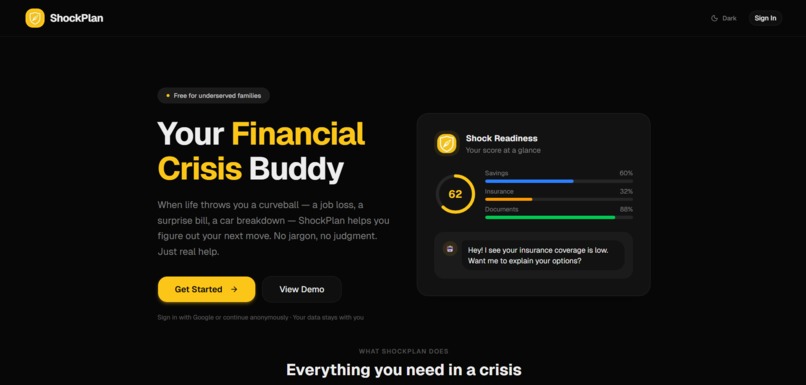
Home page
-
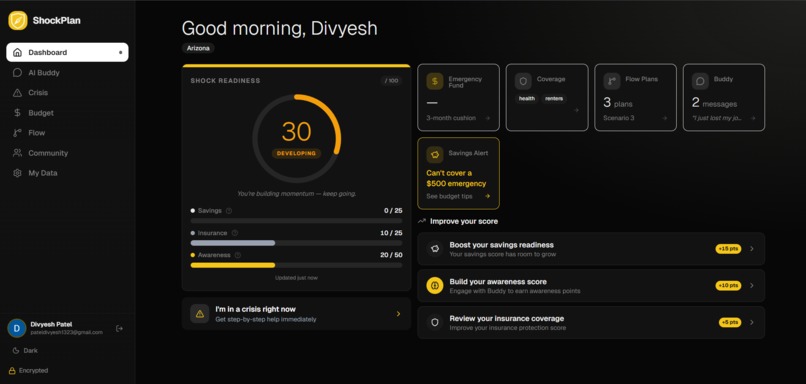
Dashboard
-
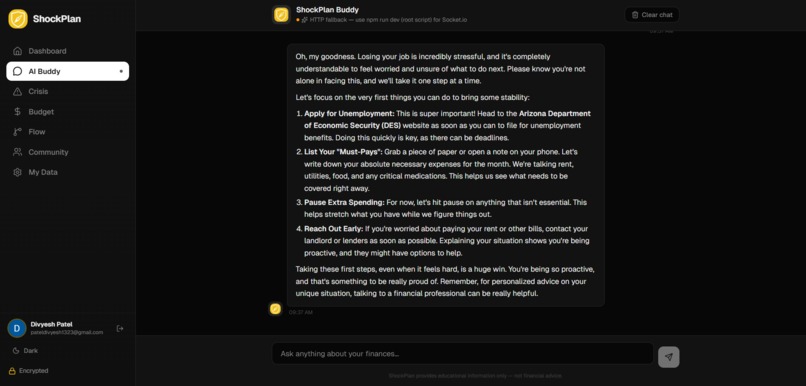
AI Buddy
-
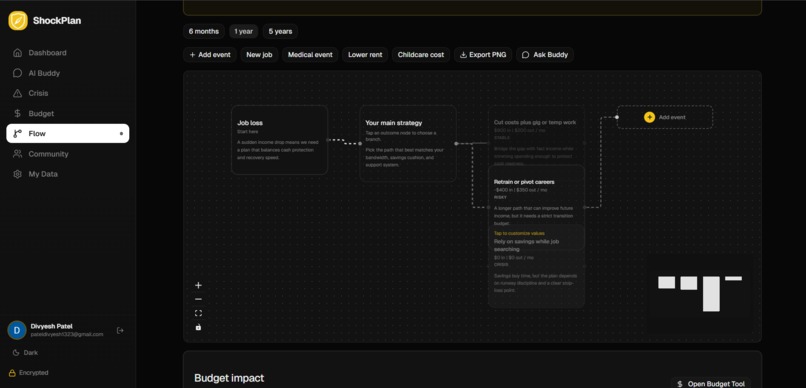
Flow
-
Community
ShockPlan
Elevator Pitch
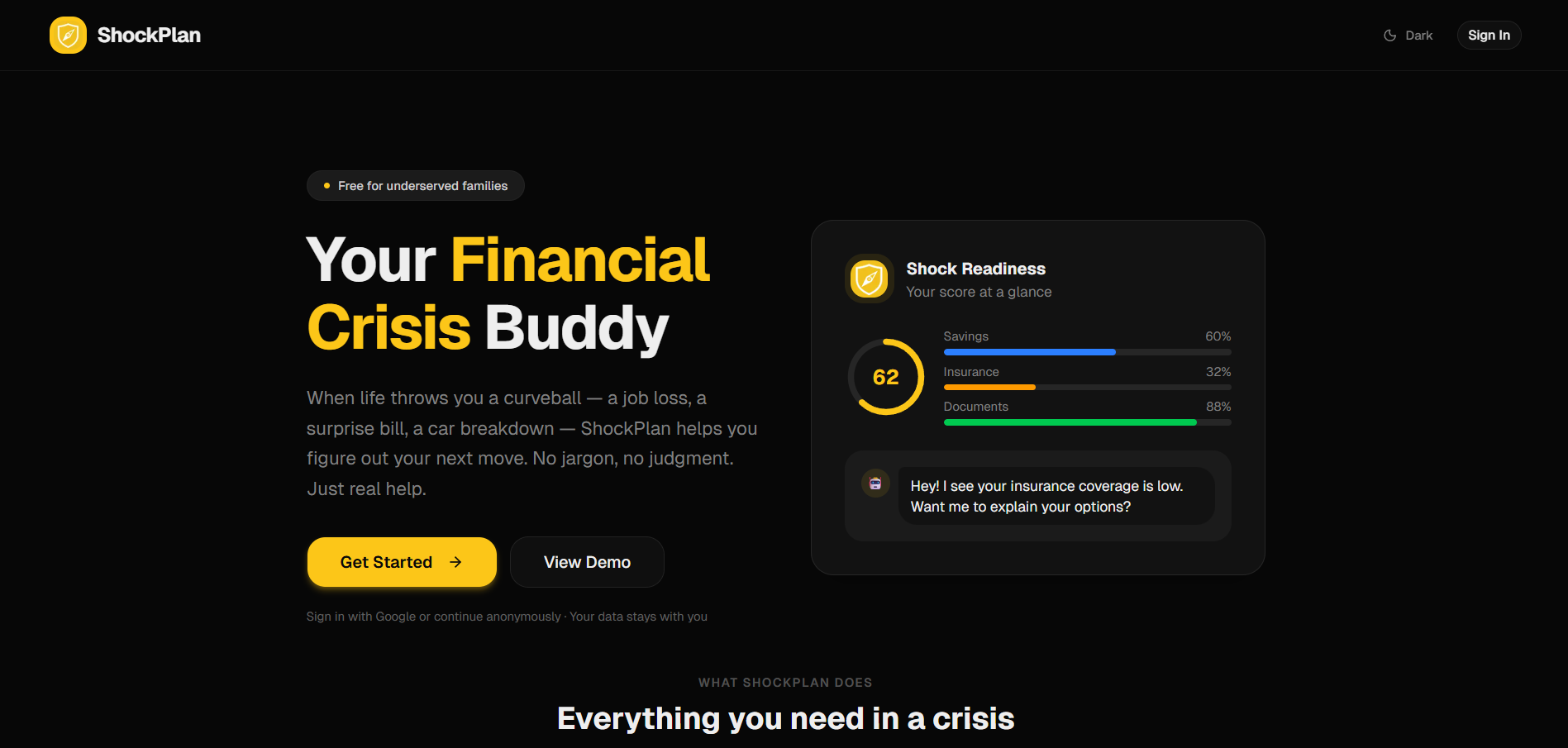
37% of Americans can't cover a $400 emergency expense (Empower, 2024), and 59% can't cover $1,000 (Bankrate, 2025). The Federal Reserve's own data shows 31% of adults lack $500 in savings (Fed SHED Report, 2024). When a crisis hits - a job loss, a medical bill, an eviction notice - they Google frantically, get overwhelmed by generic advice, and make costly panic decisions. ShockPlan changes that. It's a free, AI-powered crisis co-pilot that gives you a step-by-step playbook in the first 10 minutes, calculates exactly how many weeks your cash will last, maps your recovery as a visual decision tree, and provides a personal AI buddy that knows your specific situation. No financial jargon. No account required. Just open it, tell it what happened, and start recovering.
Inspiration
We started with a simple question: what happens when someone who lives paycheck to paycheck faces a sudden financial crisis?
The answer is bleak. They search "what to do after losing my job" and get 50-page articles full of jargon. They don't know what bills to pay first, how long their cash will last, or what government benefits they qualify for. They make decisions in panic mode - dipping into predatory payday loans, missing rent to pay a medical bill, or simply freezing because every option feels impossible.
We've all been there or know someone who has. A first-generation college student whose family lost income during COVID. A gig worker one car accident away from financial ruin. An immigrant family who doesn't know the system well enough to navigate it under pressure.
Existing financial tools assume you already have stability. Mint tracks your spending when things are normal. Nerdwallet compares credit cards you're not going to qualify for. Nobody builds for the moment everything falls apart.
ShockPlan is built for that moment.
What it does
ShockPlan is a connected pipeline of four tools that guide you from crisis to recovery:
Crisis Playbooks - Select your crisis (job loss, medical bills, eviction, car accident, natural disaster) and get an instant action plan organized by urgency: what to do in 10 minutes, 24 hours, and 7 days.
Emergency Budget Mode - Enter your cash on hand and bills. ShockPlan calculates your financial runway in days/weeks, which bills to pay first vs defer vs cut, and a week-by-week cash projection with sliders to adjust in real time.
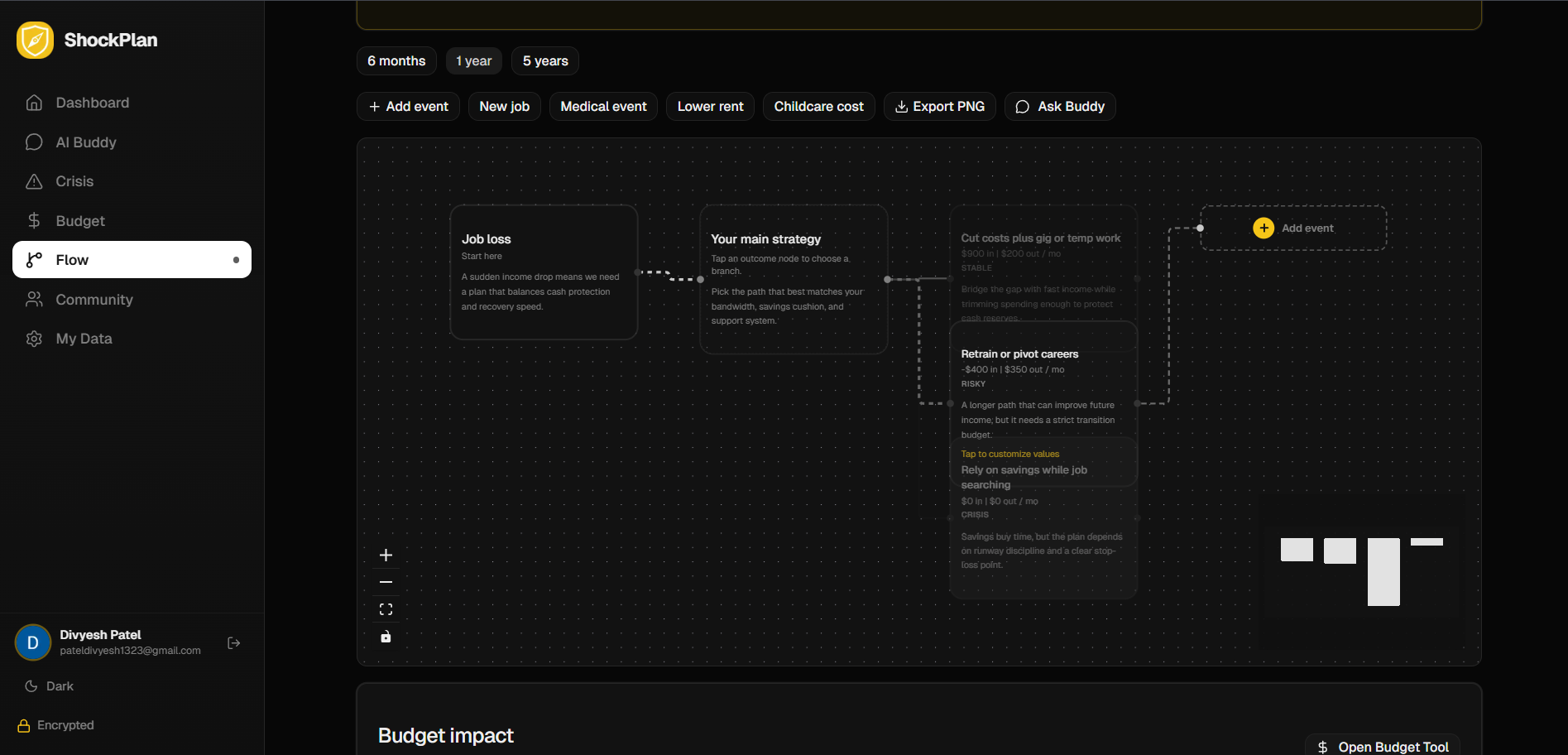
Flow of Life Planner - A visual decision tree where you map your recovery strategy. Choose between paths with different risk/reward, add life events, draw connections, track status, and see projected financial impact for each decision. Export as PNG to share with a case worker.
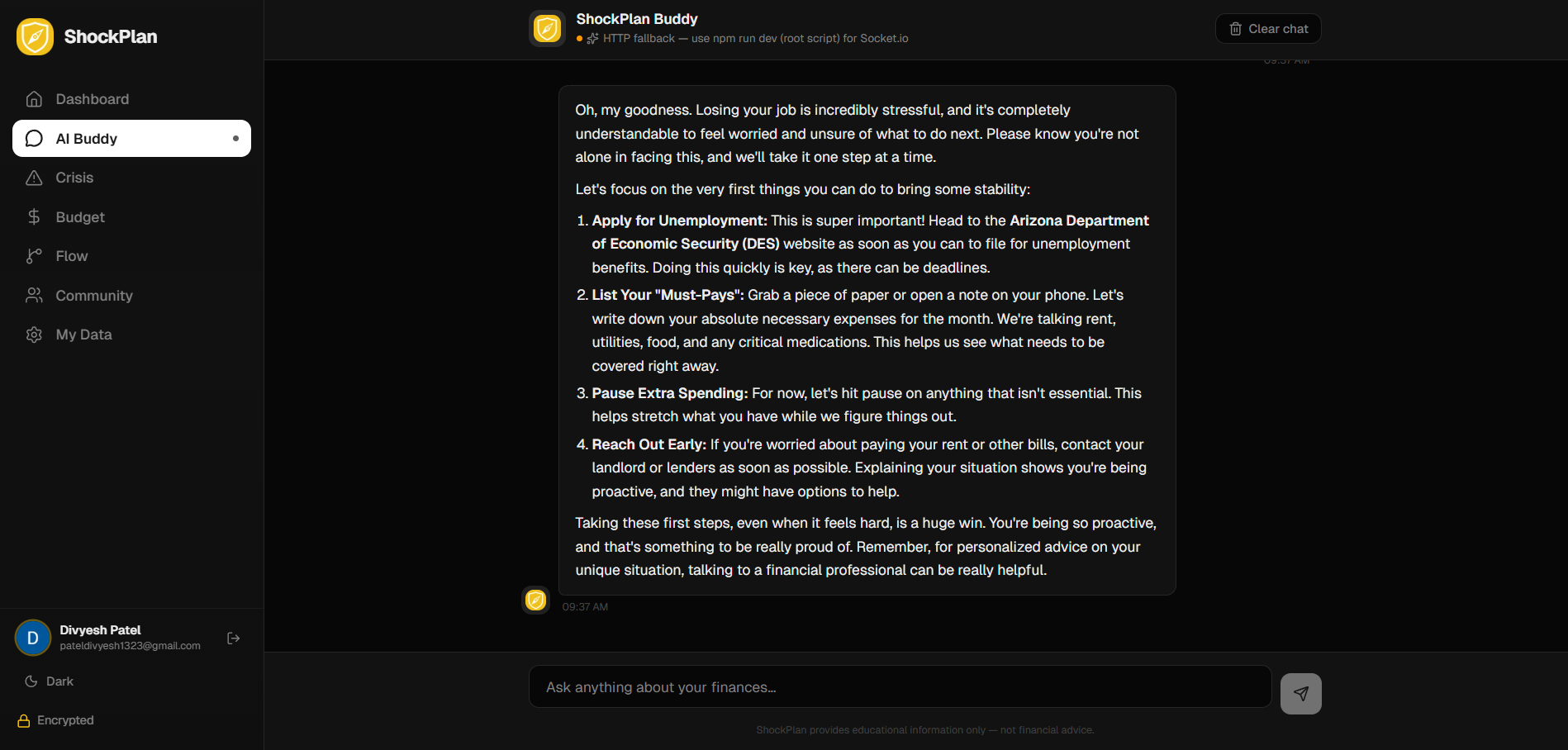
AI Buddy - A personal financial assistant powered by Gemini + RAG that knows your household, budget, crisis, and recovery plan. Advice is specific to your situation, not generic. Includes long-term memory across sessions.
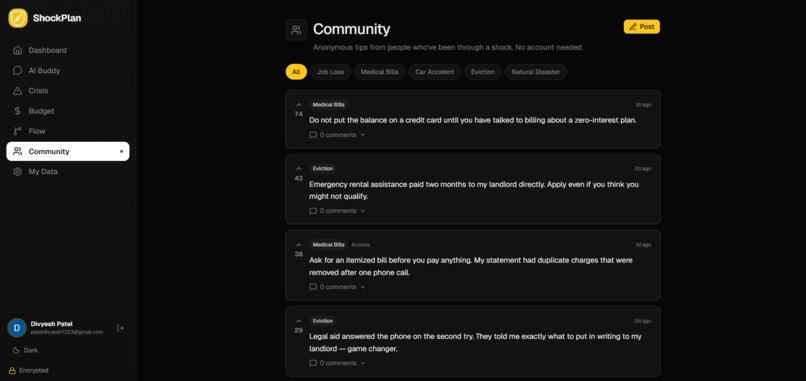
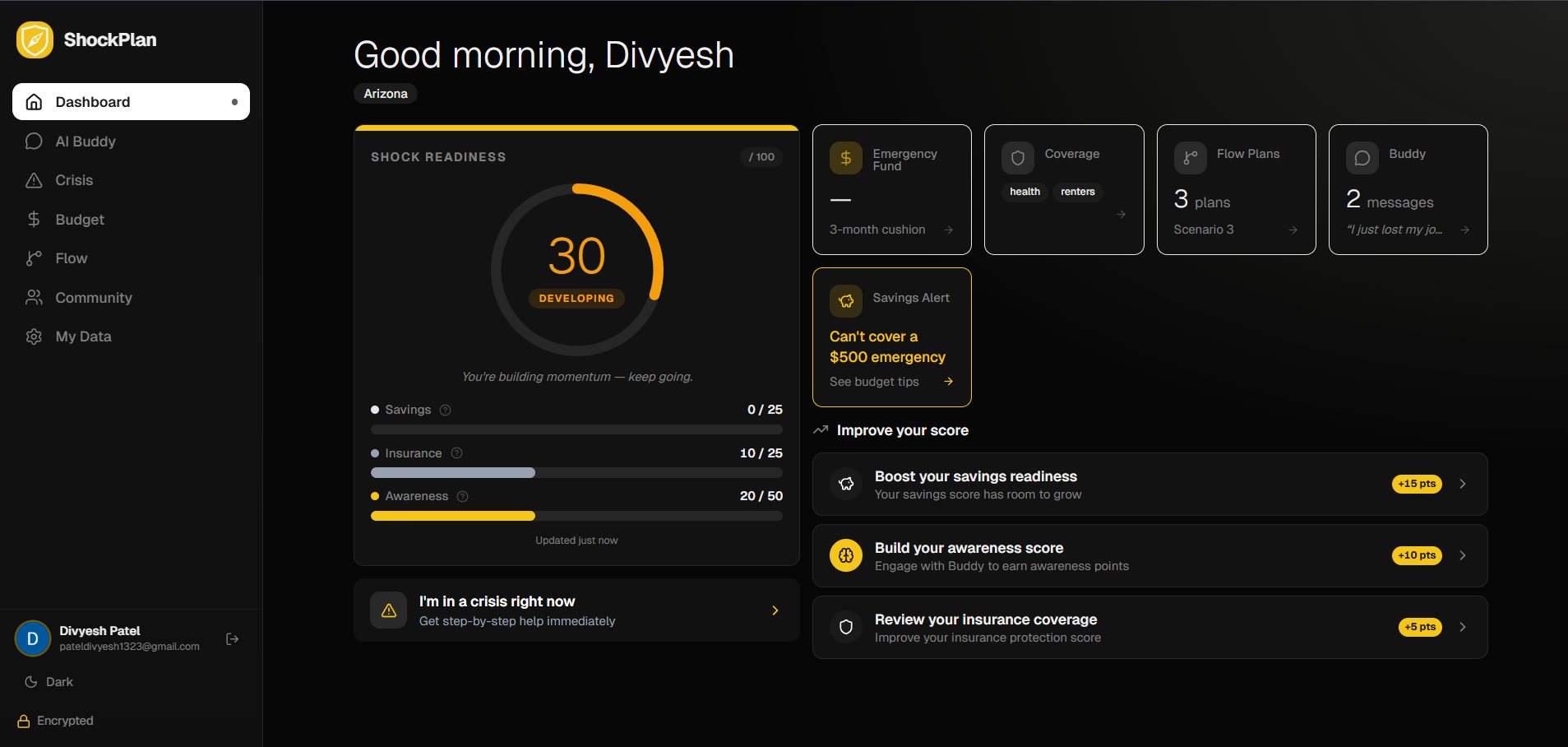
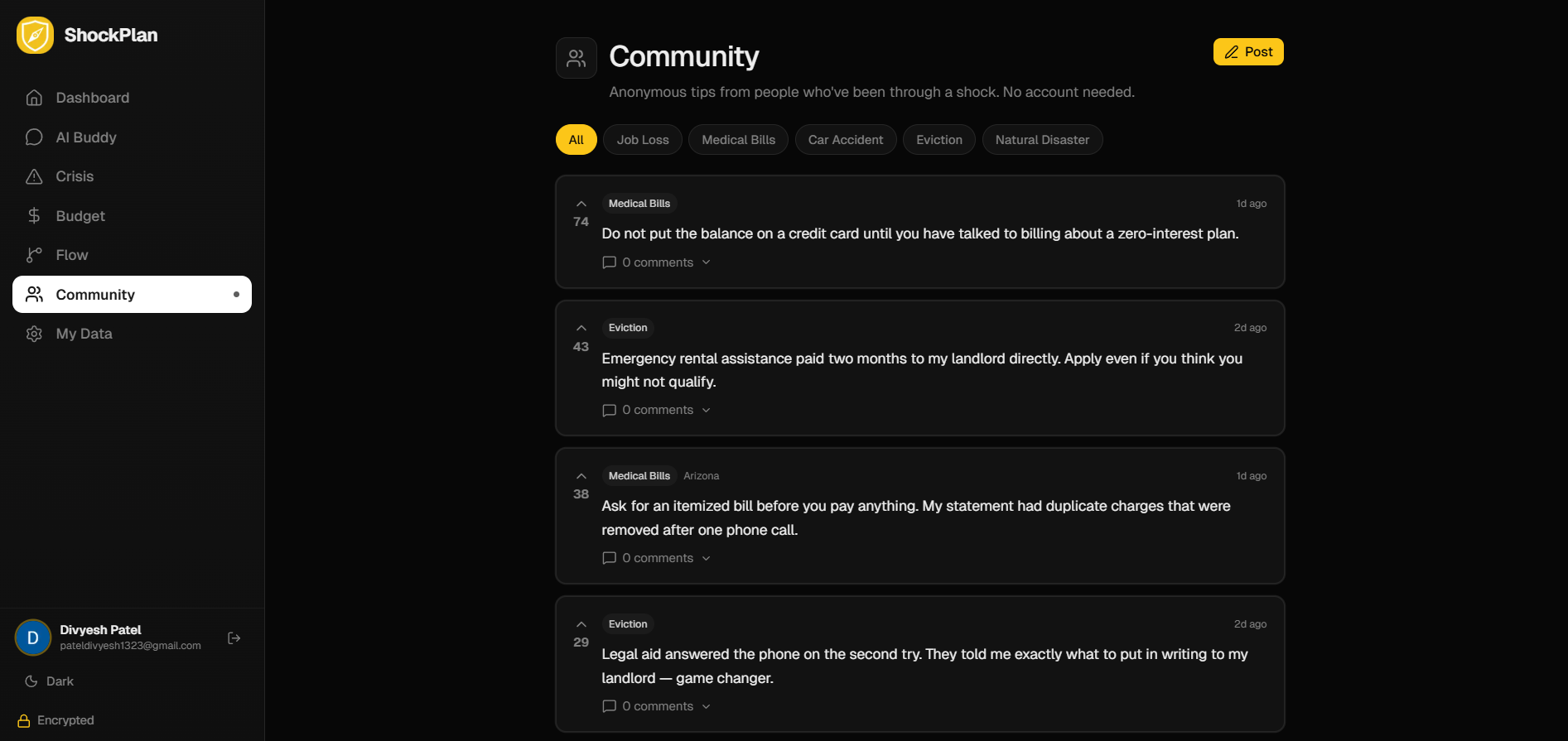
Community Board + Readiness Score - Anonymous community tips from people who've been through it, plus a 0-100 readiness score measuring how prepared you are before crisis hits.
The key differentiator: these aren't separate tools. Click "Plan my recovery" from any crisis to auto-create a Flow of Life scenario. Click "Crisis budget" to jump into emergency mode. The AI Buddy has access to all your data. Everything connects.
How we built it
Frontend: Next.js 16, React 19, Tailwind CSS v4, shadcn/ui. React Flow (@xyflow/react) powers the visual planner with custom node types, drag-and-drop, and connection drawing.
Backend: Next.js API routes + a custom server wrapping Socket.io for real-time AI chat streaming.
Database: MongoDB Atlas (free tier) with Mongoose. Six collections covering users, profiles, scores, chats, flow plans, and community posts.
AI Layer: Google Gemini via LangChain. Pinecone for RAG with llama-text-embed-v2 embeddings. The context builder injects the user's profile, budget, flow plan, and retrieved knowledge chunks into every prompt. A separate Pinecone index stores long-term conversation memory.
Identity: Dual system - fully anonymous via device ID (no account wall), with optional Auth0 login that syncs and migrates data across devices.
Design: Monochrome palette with single yellow accent (#F5C518).
Challenges we ran into
Crisis-to-Flow pipeline: Getting the crisis playbook, budget tool, and flow planner to share context required careful state architecture. We solved it with URL query params that auto-create matching scenarios, plus a shared identity layer.
Flow position persistence: React Flow re-renders nodes on every state change, resetting dragged positions. We implemented a position-merge strategy that preserves existing positions while updating data.
Event branch attachment: Events would visually "transfer" between branches when users switched paths. We solved this by stamping each event with an attachedNodeId and letting users manually re-link by drawing connections.
Auth0 + anonymous coexistence: Supporting both identities through every API route and database query. We built a resolver that picks the best identity and a migration function that claims anonymous data on sign-in.
Real-time AI with full context: Streaming Gemini responses through Socket.io while assembling a context window from profile, budget, flow plan, and RAG results simultaneously.
Accomplishments that we're proud of
The pipeline works end-to-end: Go from "I just lost my job" to a crisis playbook, emergency budget, visual recovery plan, and AI conversation about your specific situation - all in one session, zero account setup.
The Flow of Life planner is genuinely useful: Branch between strategies, add events with real income/expense deltas, track status, draw connections, customize values, and export as PNG for a case worker.
Zero-friction design: No account wall. No email verification. Open it, tell it what happened, start planning. Auth is optional.
Context-aware AI: The buddy knows if you're a single parent with $800 cash, rent due in 2 weeks, and a plan to pick up gig work. That specificity matters.
What we learned
Design for the worst moment, not the average moment: Our users are scared, overwhelmed, and time-pressured. That drove every UX decision: immediate action items, visual plans over text walls, sliders over forms.
RAG is the right pattern for financial advice: Fine-tuning bakes in stale info. RAG keeps advice grounded and updatable while the LLM handles personalization.
Anonymous-first is hard but worth it: Dual identity through every layer was complex, but it removes the biggest barrier to adoption for our target users.
Visual planning beats text planning: People think about their future as a branching path, not a checklist. The React Flow decision tree was the feature that clicked.
What's next for ShockPlan
- Case worker mode: A view for social workers to review, annotate, and assign action items on a client's plan.
- Offline-first PWA: Cache playbooks and budget tools for users with unreliable internet.
- Expanded crisis templates: Divorce, domestic violence relocation, immigration changes, family incarceration - with culturally informed playbooks.
- Community-validated advice: Surface top-voted tips in the AI Buddy's context.
Built With
- express.js
- langchain
- mongodb
- node.js
- pinecone
- rag
- react
- socket.io
- vectordatabase


Log in or sign up for Devpost to join the conversation.