[ For Demo Access, please use the below mentioned credentials ]
Buyer (Brand / Producer) Sign up at https://novus-hackathon.vercel.app/sign-up using Google or email : takes 30 seconds. You'll be taken through onboarding to set up your brand profile.
Seller (Certified Recycler) Login at https://novus-hackathon.vercel.app/seller/login with these demo credentials:
| Email | Password |
| [email protected] | Seller@1 | | [email protected] | Seller@2 |
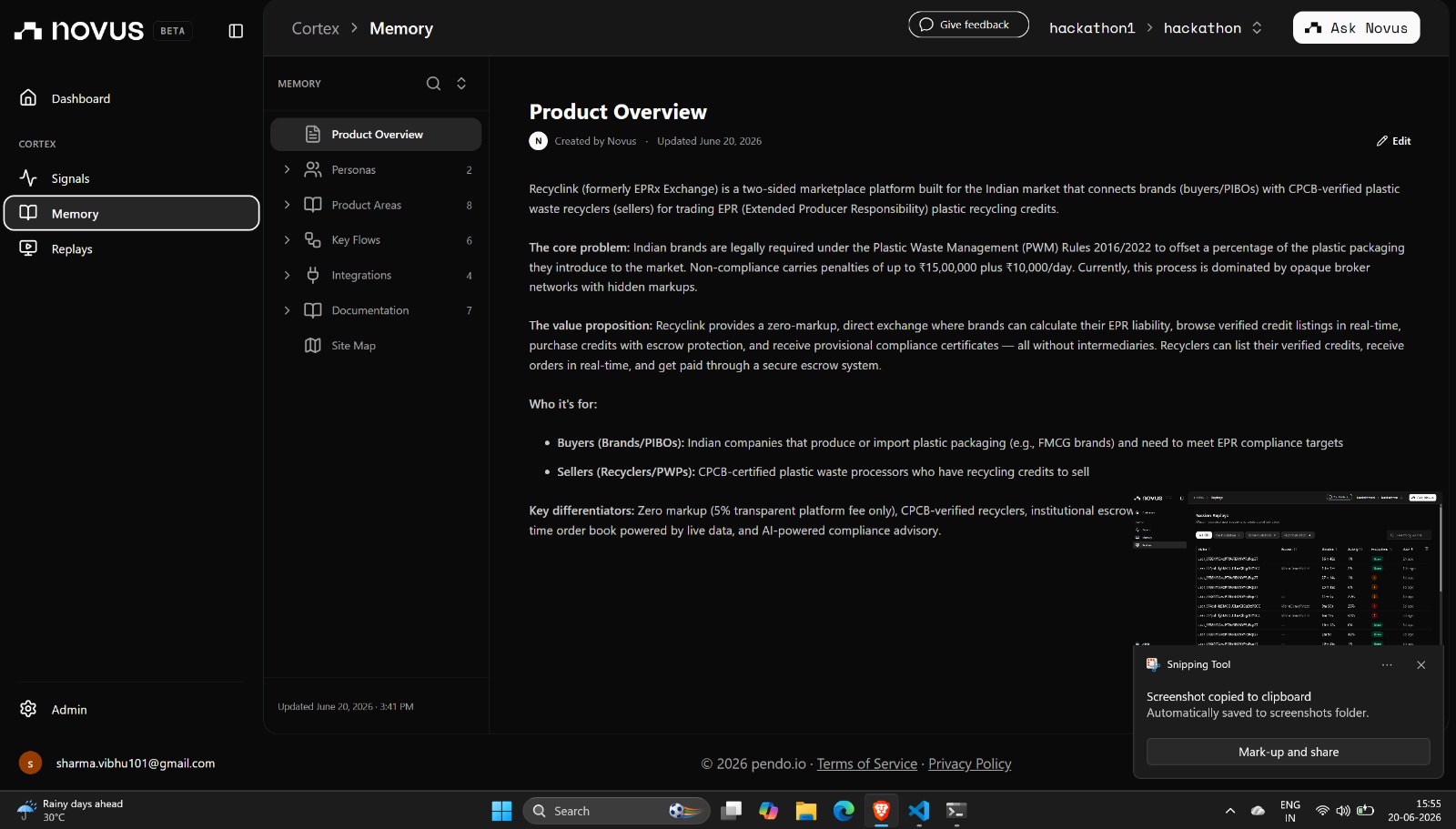
Inspiration India's EPR rules require every brand that sells plastic packaging to offset a fixed share of it — 30% for rigid plastic, 20% for flexible, 15% for multi-layered plastic — through certified recyclers. Today that entire process runs on Excel sheets, WhatsApp negotiations with brokers, and PDFs nobody can verify. Brands routinely miss their targets and get hit with penalties up to ₹15,00,000. We built Recyclink to make buying EPR credits as simple and transparent as buying a stock.
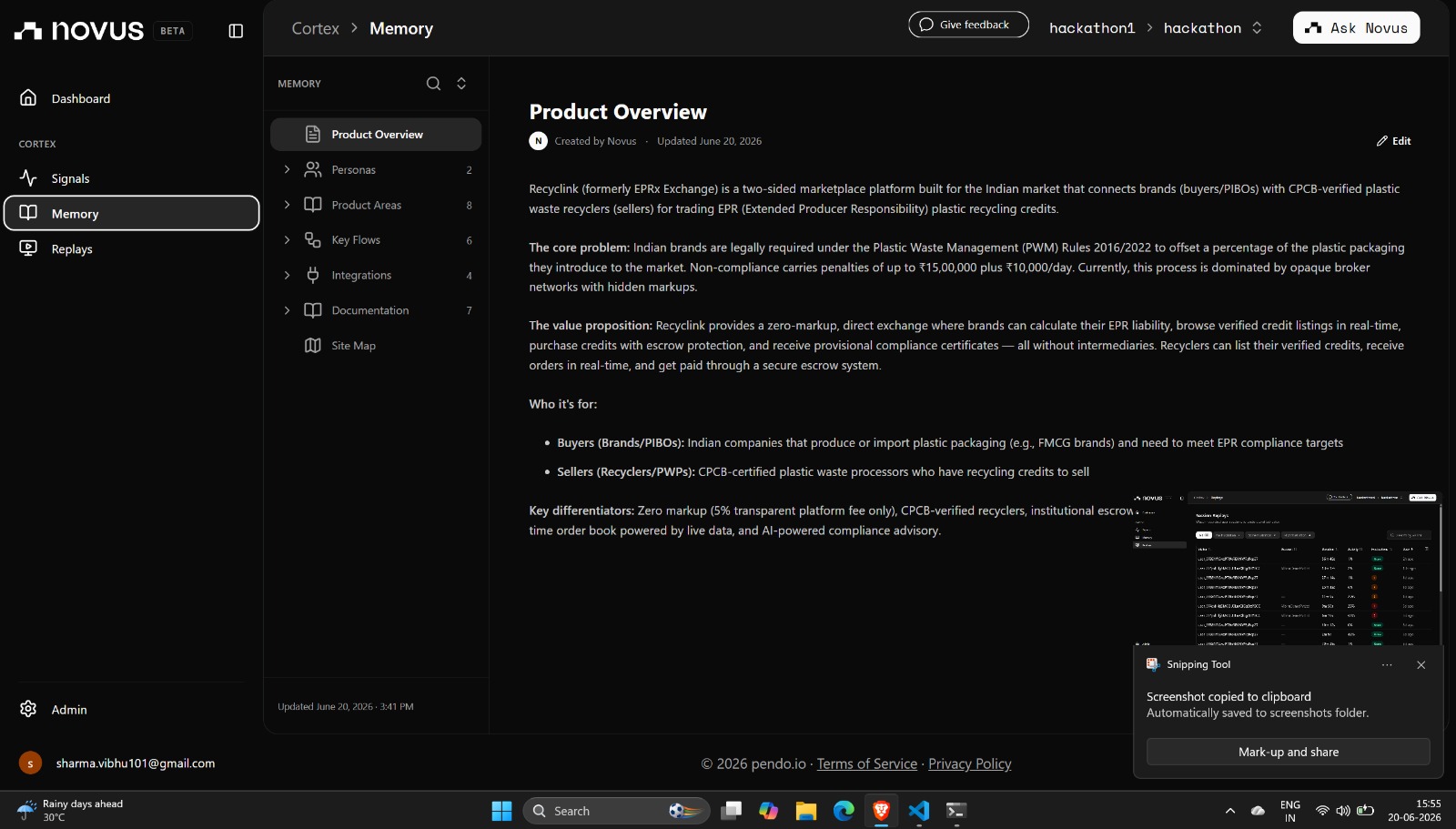
What it does Recyclink is a real-time marketplace where brands run a 3-step liability calculator to find out exactly how much of each plastic type they owe, then buy directly from verified recyclers on a live order book — no broker, no haggling. On the seller side, recyclers list their available credits, get an AI-suggested price based on live market data, and manage incoming orders from their own dashboard. Three AI features target specific friction points: a liability estimator that turns a one-line business description into a pre-filled calculator, a buyer copilot for compliance questions, and a seller pricing copilot.
How we built it We didn't start with a feature list — we started with the problem. Before any code was written, I led a full product process: framing the core problem as information asymmetry between brands and recyclers, researching the market and existing competitors, and mapping four personas — the SME brand founder under deadline pressure, the compliance manager who owns the annual filing, the recycler trying to find buyers without a broker, and the broker whose entire value is the information gap we were trying to close.
To pressure-test the idea before building, we ran user interviews with three people across these personas and walked them through an early demo. [INSERT: what they specifically liked, and the criticism(s) — e.g., "liked how fast the AI calculator felt, but found X confusing"]. That feedback shaped what we prioritized: [tie to a real decision this changed]. From there we moved into solutioning and prioritization, then a full engineering handoff — screen-by-screen flows, the liability calculation logic, and seed data — to my engineering collaborator, who built the platform while I stayed hands-on with the dashboard UX, copy, and verifying every number against CPCB's actual penalty structure.
Challenges we ran into The hardest part wasn't technical — it was making sure the product was right. CPCB's PWM Rules 2016 translate into a fairly involved formula across category percentages, financial year boundaries, and penalty tiers, and getting it wrong doesn't just mean a bug — it means the product hands a brand the wrong compliance number. We cross-checked the calculator's output against the actual regulation more than once. The second challenge was UX, not code: early versions of the dashboard showed a "0%, non-compliant" state to every brand-new user before they'd touched the calculator — which read as alarming rather than informative. We had to design for the difference between "you haven't given us data yet" and "you're actually failing compliance," everywhere it showed up in the product, not just on one screen.
Accomplishments that we're proud of A real-time, two-sided marketplace that's actually been validated — not just by us, but by people in our real target personas who used the demo and told us what worked and what didn't. Three AI features that each solve one specific friction point instead of a chatbot bolted onto the side. A liability calculator whose output we can defend against the actual CPCB rules, not an approximation. And a UI built mobile-first, because recyclers — one of our two user types — are often in the field, not at a desk.
What we learned User interviews aren't optional, even on a hackathon timeline — the feedback from our three interviews surfaced [specific friction] we'd never have caught by only looking at our own product. EPR regulation is genuinely complex, and a product like this is only as trustworthy as its weakest assumption about the rules. And AI is most useful when it solves one narrow, real problem — estimating volumes, suggesting a price — rather than existing as a general chat feature.
What's next for Recyclink CPCB portal integration so completed trades auto-file the EPR return. QR-coded certificates for audit trails. Multi-year liability tracking with carry-forward credits. Onboarding more certified recyclers across more states. And eventually, expanding the same marketplace model to e-waste and tyre EPR categories.
Built With
- claude
- clerk
- css
- next.js16
- sonner
- supabase
- tailwind
- typescript
- vercel
- zod


Log in or sign up for Devpost to join the conversation.