Release decisions in Jira are usually gut-feel. The signals that a release will slip are already in Jira — unresolved blockers, overdue issues, work nobody has touched in weeks, unassigned tickets, tickets with no description, subtasks quietly unfinished — but nobody assembles them into one verdict before the release meeting. Dashboards show counts. Nobody shows a decision.
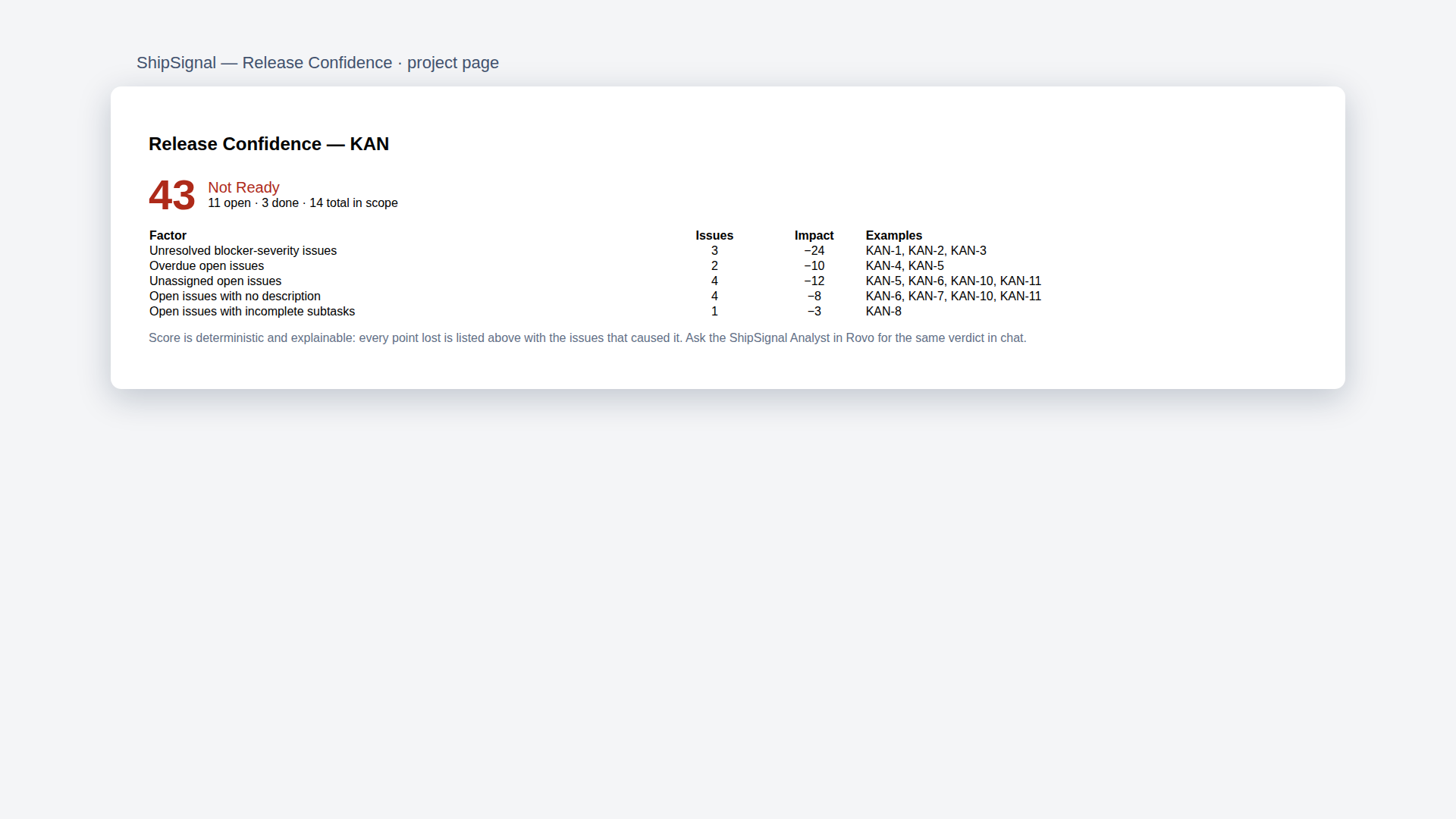
ShipSignal computes a deterministic, explainable Release Confidence Score (0–100) for a Jira project or fixVersion:
• Release Confidence dashboard (Jira project page): the score, the band (Ready / At Risk / Not Ready), and a factor-by-factor breakdown that names the exact issues behind every lost point. • Issue panel: per-issue context — unresolved blockers, subtask progress, staleness, missing fields — so a developer sees why an issue endangers the release. • ShipSignal Analyst (Rovo agent): ask "Is release 2.4 ready?", "What is blocking project KAN?", "Which issues went stale this week?" and get answers grounded in live Jira data via three reusable actions. • ShipSignal MCP server: the same three actions exposed as MCP tools, so external AI clients and Rovo Studio agents can run a release pre-flight check with the user's own permissions.
One set of actions, three audiences: humans in Jira, agents in Rovo, and external MCP clients. The scoring model is deliberately deterministic code, not an LLM guess: every point deducted is listed with its cause and the offending issue keys, and the model is covered by unit tests. AI surfaces run on Rovo, which the platform provides — the app makes no paid LLM calls.
Built entirely on Atlassian Forge (runtime nodejs24.x): jira:projectPage + jira:issuePanel Custom UI modules, a resolver backed by the Jira REST API via @forge/api, three action modules shared by a rovo:agent and a rovo:mcp module. Read-only scopes (read:jira-work, storage:app).
