-
-
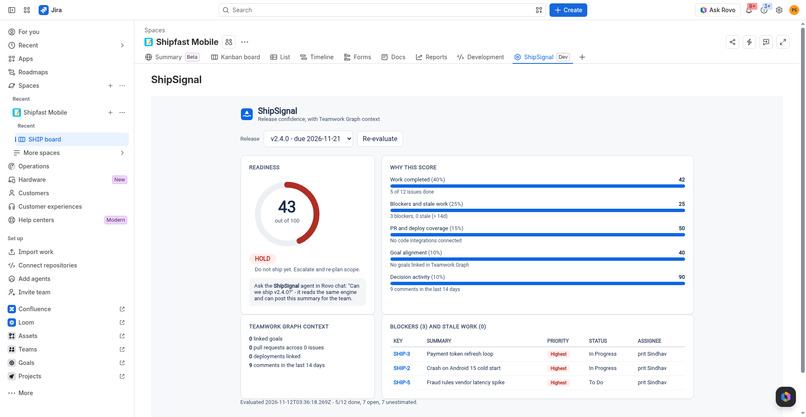
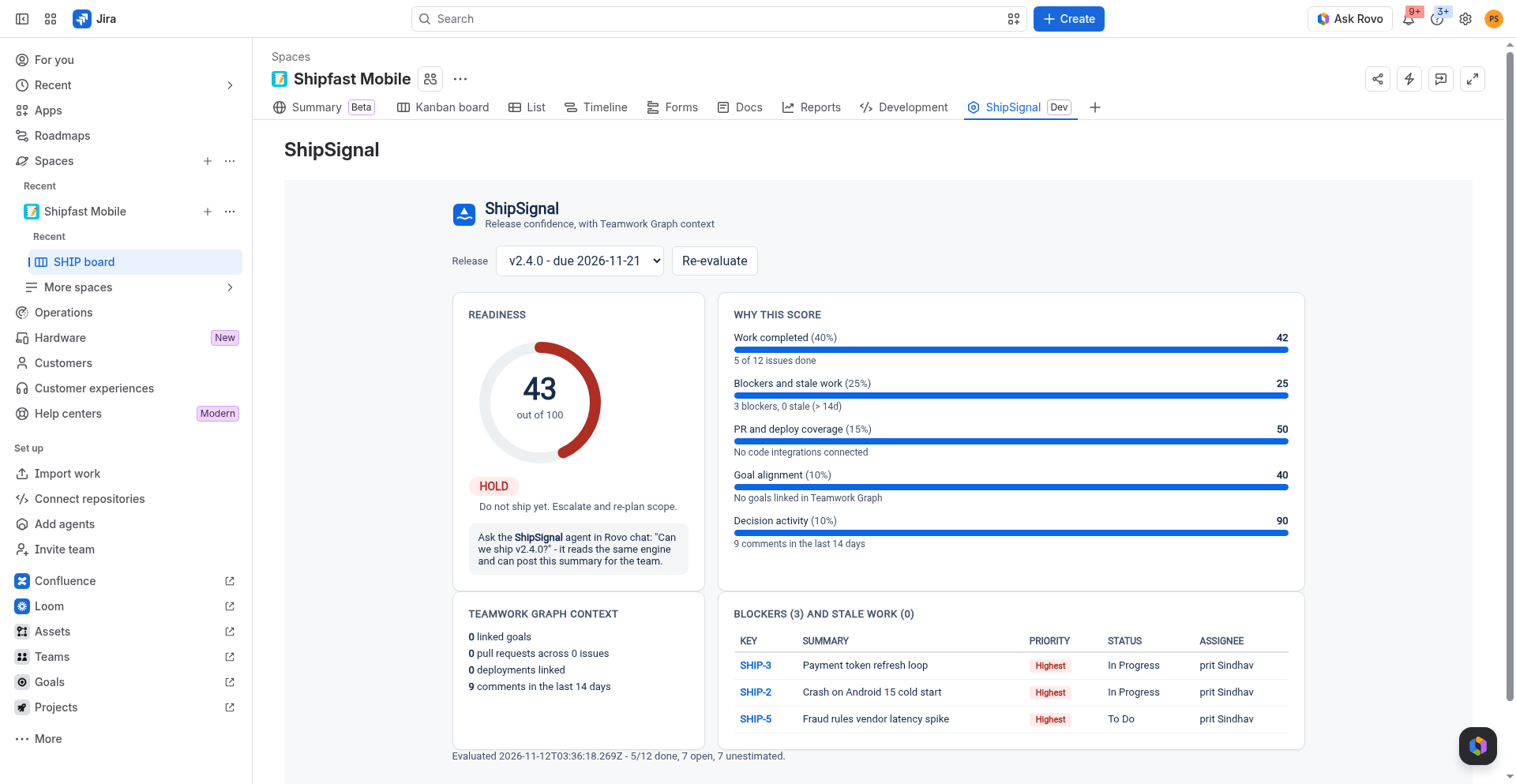
Readiness dashboard: v2.4.0 scores 43/100 with a HOLD verdict and full factor breakdown.
-
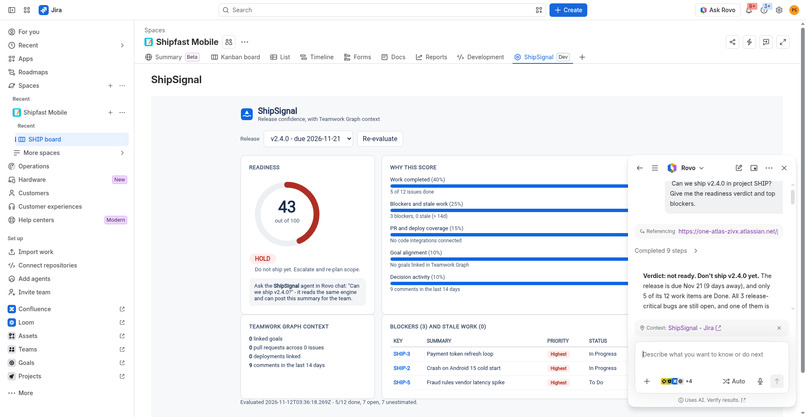
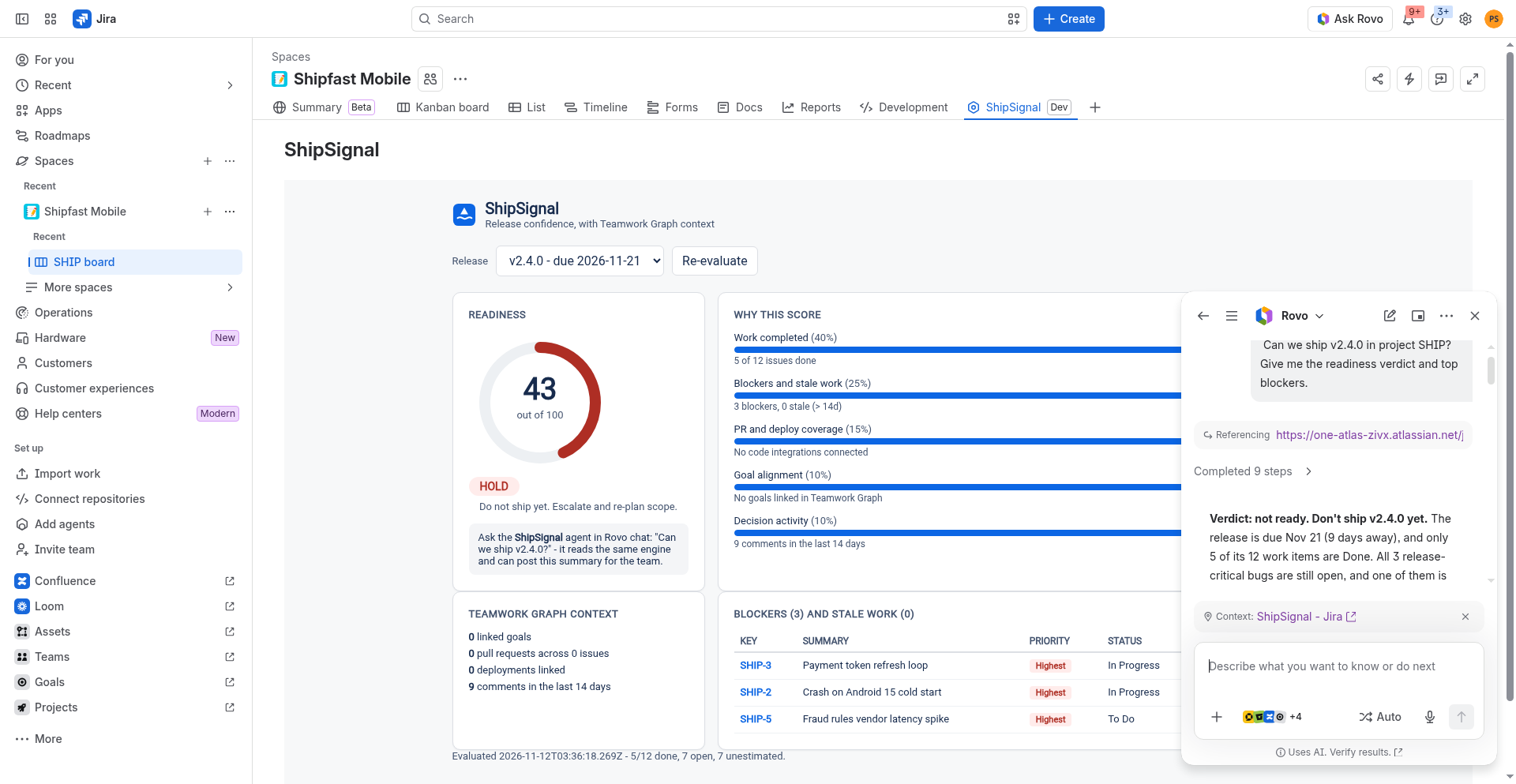
The ShipSignal Rovo agent answers in plain language with verdict, blockers and Teamwork Graph context.
-
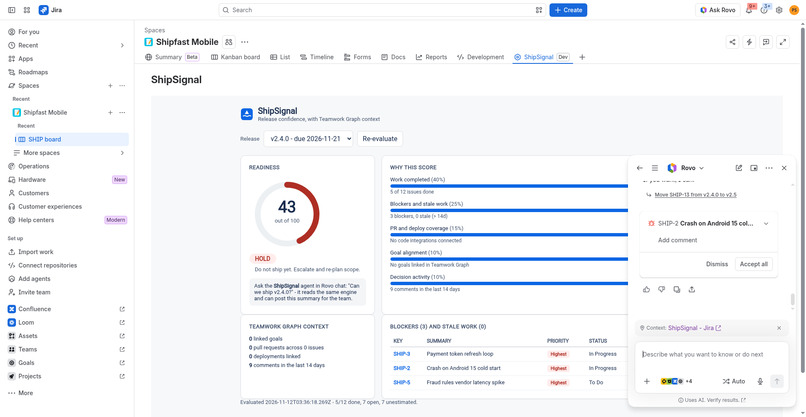
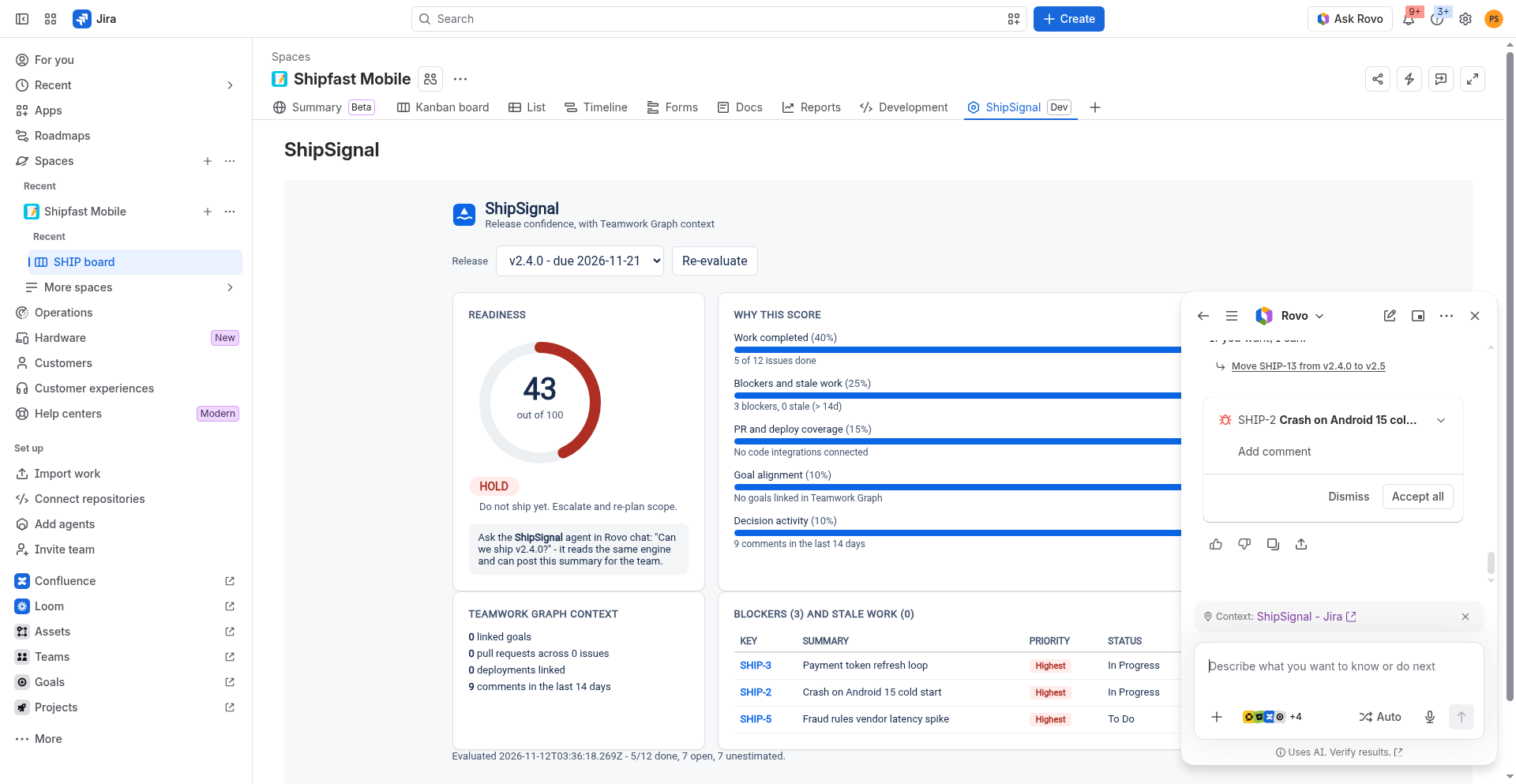
One confirmation posts the readiness summary as a Jira comment - human-in-the-loop by design.
-
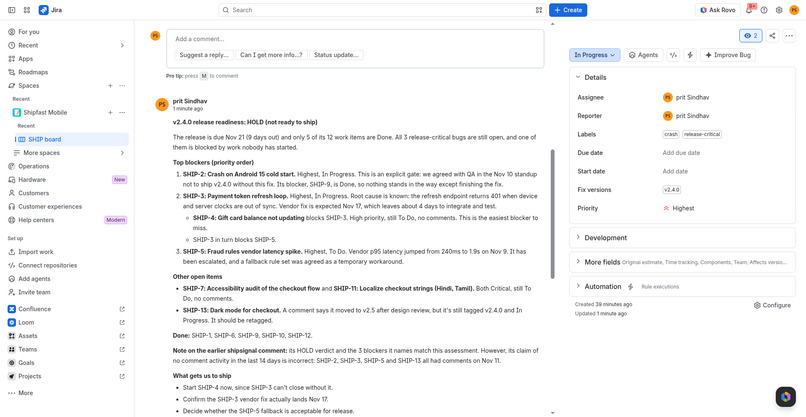
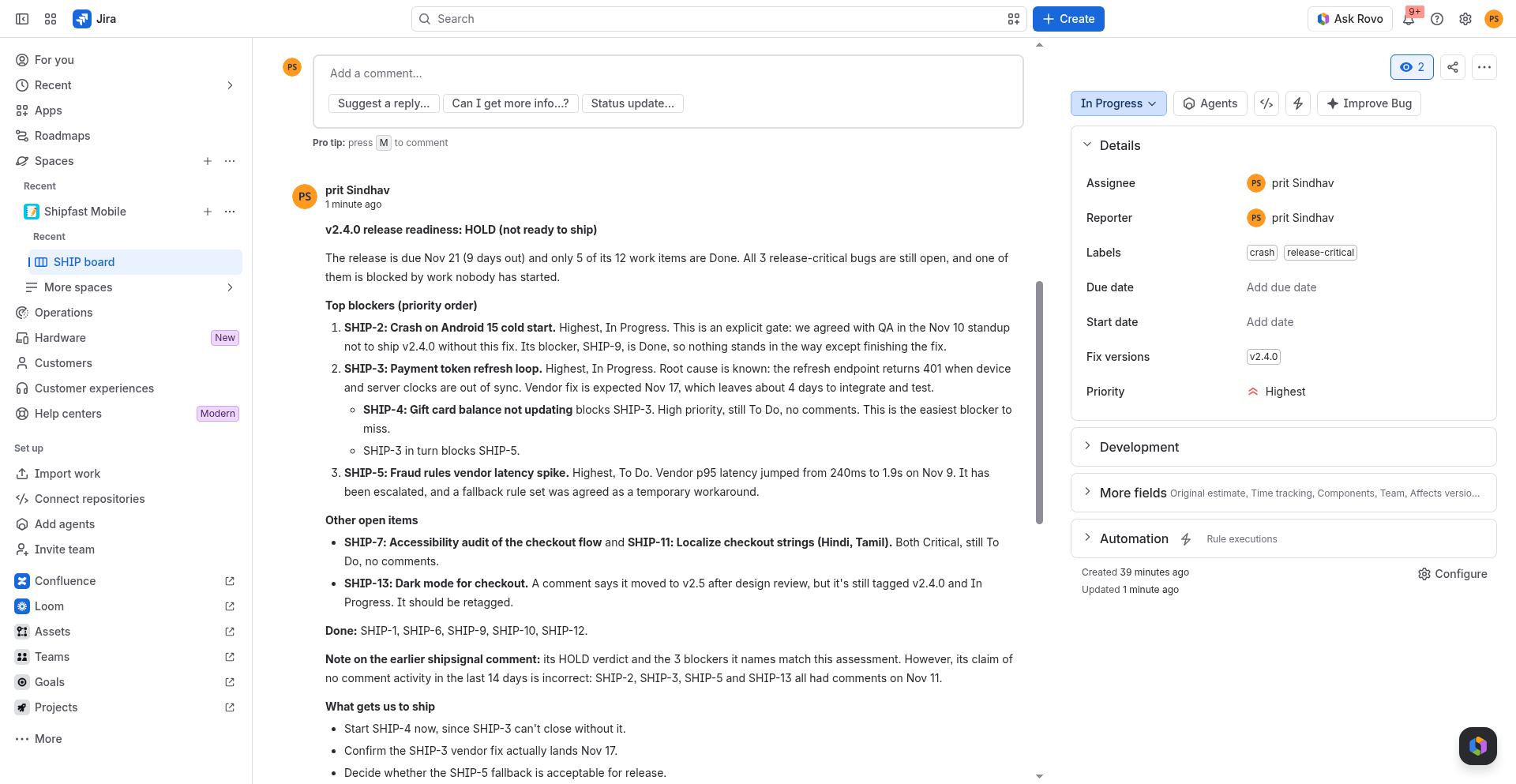
The posted readiness comment on SHIP-2, visible to the whole team.
Inspiration
Every software team asks "can we ship?" before a release. The honest answer lives in fragments: issue statuses in Jira, pull requests in GitHub, deployments in a CI tool, goals in Atlas, decisions buried in comment threads. Nobody assembles all of it before the go/no-go meeting - so teams ship on gut feel, or slip a date everyone saw coming weeks earlier. Atlassian's Teamwork Graph finally makes that context connected and queryable. ShipSignal turns it into a single, explainable answer.
What it does
ShipSignal is a Forge app that scores any Jira fix version from 0 to 100 and returns a verdict: SHIP, RISKY, or HOLD.
- Readiness dashboard (Jira project page): pick an unreleased version, get the score with a full breakdown - work completed, blockers and stale work, pull request and deployment coverage, goal alignment, and recent decision activity - each with its evidence. One click generates a realistic demo release so the app is testable on any site in under a minute.
- ShipSignal Agent (Rovo): ask "Can we ship v2.4?" in Rovo chat. The agent runs the same readiness engine, answers with the verdict and issue-key evidence, and - with your confirmation - posts the summary as a comment for the team or creates risk issues for the blockers.
- Teamwork Graph integration: the engine traverses the graph around every work item in the release - linked goals, external pull requests, deployments, and the last 14 days of discussion. This is what catches "done in Jira but the PR is still open" and "no goal linked, so nobody knows why this release matters".
- Daily release watch: a scheduled trigger re-scores every release due within 14 days and posts a warning comment when a release turns HOLD with blockers or its score drops sharply - confidence monitored continuously, not just when someone remembers to ask.
- Atlassian MCP: the readiness, blockers and context actions are also exposed as MCP tools, so any MCP-compatible agent can ask ShipSignal for a release verdict.
How we built it
Everything runs on Atlassian - no external servers. The dashboard is a Forge Custom UI project page backed by hosted resolver functions. The Rovo agent is a rovo:agent module with five typed action modules (readiness, blockers, context, comment, risk issue) and a prompt engineered for evidence-first answers; the same actions power the rovo:mcp module. Jira data comes from the Jira REST API (versions, JQL, comments, transitions). Teamwork Graph reads use curated queries via requestTeamworkGraph (jiraWorkItemGoals, jiraWorkItemLinkedExternalPullRequests, jiraWorkItemLinkedExternalDeployments, jiraWorkItemComments), wrapped per issue so the app degrades gracefully on sites without connected tools. The daily watch is a scheduled trigger that stores the last score in Forge KVS and detects drops.
Challenges we ran into
- Making the score honest: a single number is easy to game, so every factor carries its raw evidence and the app shows its work.
- Teamwork Graph data varies wildly across sites. Every graph read fails soft, so ShipSignal is useful on a brand-new site and richer as more tools connect.
- Designing agent actions that are safe: reads anytime, writes (comments, risk issues) only after explicit user confirmation in the conversation.
Accomplishments that we're proud of
- One engine, three surfaces: dashboard, Rovo agent, and scheduled watch all run the same readiness logic, so the answer is consistent wherever you ask.
- The demo-release generator means a judge can go from install to a full readiness evaluation in under a minute.
- The scoring model is transparent - every point of the 100 is traceable to specific issues, links and activity.
What we learned
Teamwork Graph changes what a Jira app can know. Once goals, pull requests, deployments and discussion are traversable from a work item, "should we ship?" stops being a meeting and becomes a query.
What's next for ShipSignal
- Trend charts from the stored daily snapshots, so teams see readiness over the whole release window.
- Release notes generation from the same context.
- Marketplace listing.
Built With
- atlassian
- atlassian-forge
- javascript
- jira
- mcp
- node.js
- rovo
- teamwork-graph
