Inspiration
Every software release sets off the same scramble: engineering ships the code, then someone hand-writes the blog post, the changelog, the LinkedIn and X posts, the customer email, maybe a demo video — slowly, off-brand, and under deadline. Worse, none of it is traceable: a marketing claim like "now 2× faster" has no link back to the diff that justifies it, so legal and PMM can't trust it, and the brand voice drifts every cycle.
We wanted to automate that grind — but the naive version ("feed the diff to an LLM, get a blog post") is exactly what you can't ship: it hallucinates, it's off-brand, and no human stands behind it. Our team builds agentic-commerce skill plugins (Medusa, Spree, Saleor, Salesforce…) and lives this pain every release. So we set out to build the governed version: turn a release diff into launch content that is provable, human-approved, and gets better every time.
What it does
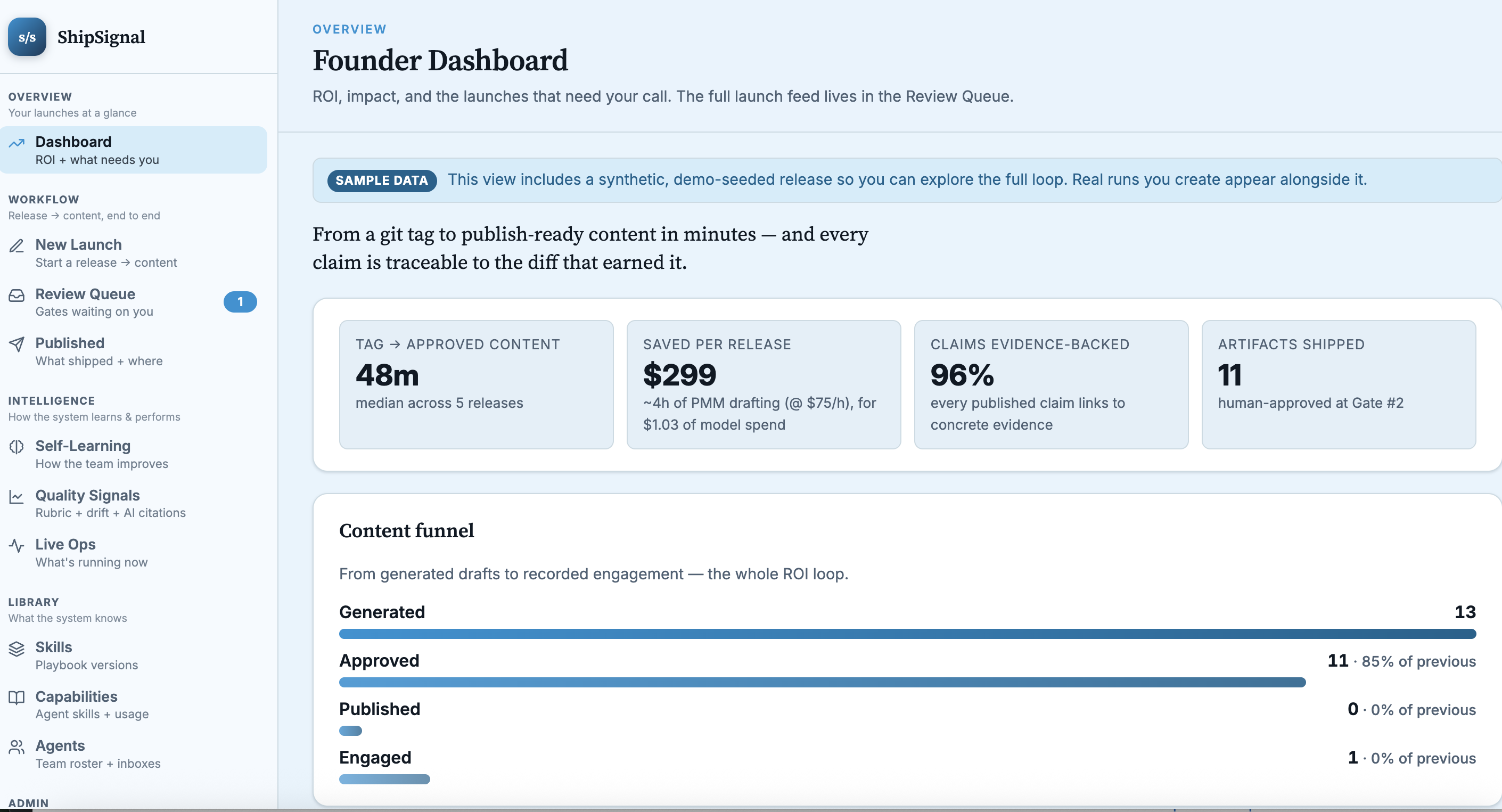
ShipSignal turns a single GitHub release diff into approved, on-brand, multi-channel launch content — release blog, changelog, social posts, customer email, and a narrated audio + video digest — with three guarantees that make it safe to actually use:
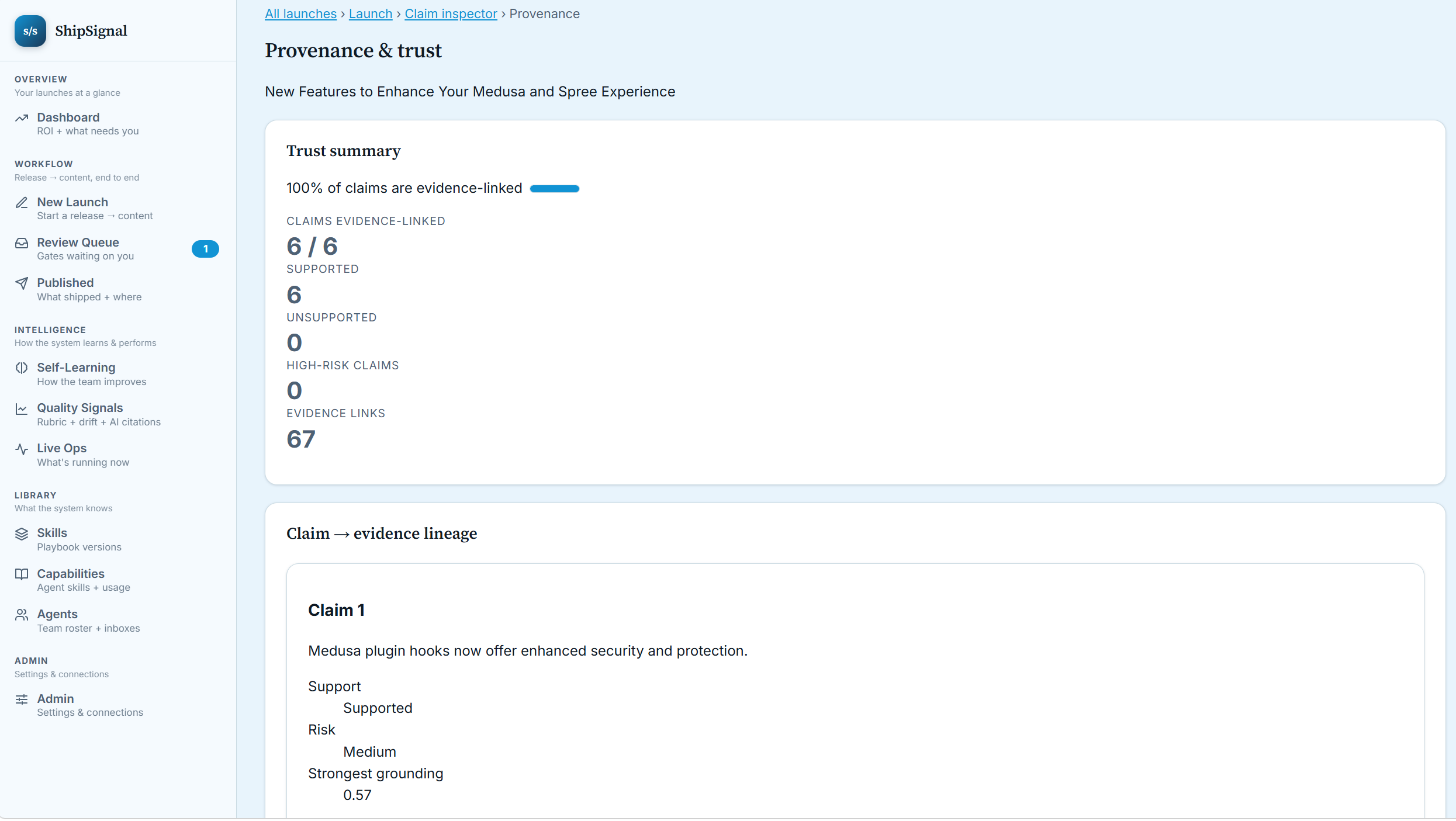
- Evidence-backed, never hallucinated. It never writes from a raw diff. It first builds an evidence-backed feature manifest; every generated claim links to the concrete code/PR/issue evidence it came from, viewable as a provenance graph in the database.
- Human-governed. Three mandatory approval gates — feature manifest → generated artifacts → skill change — plus Bedrock Guardrails and deterministic PII/secret redaction. Nothing publishes without a human.
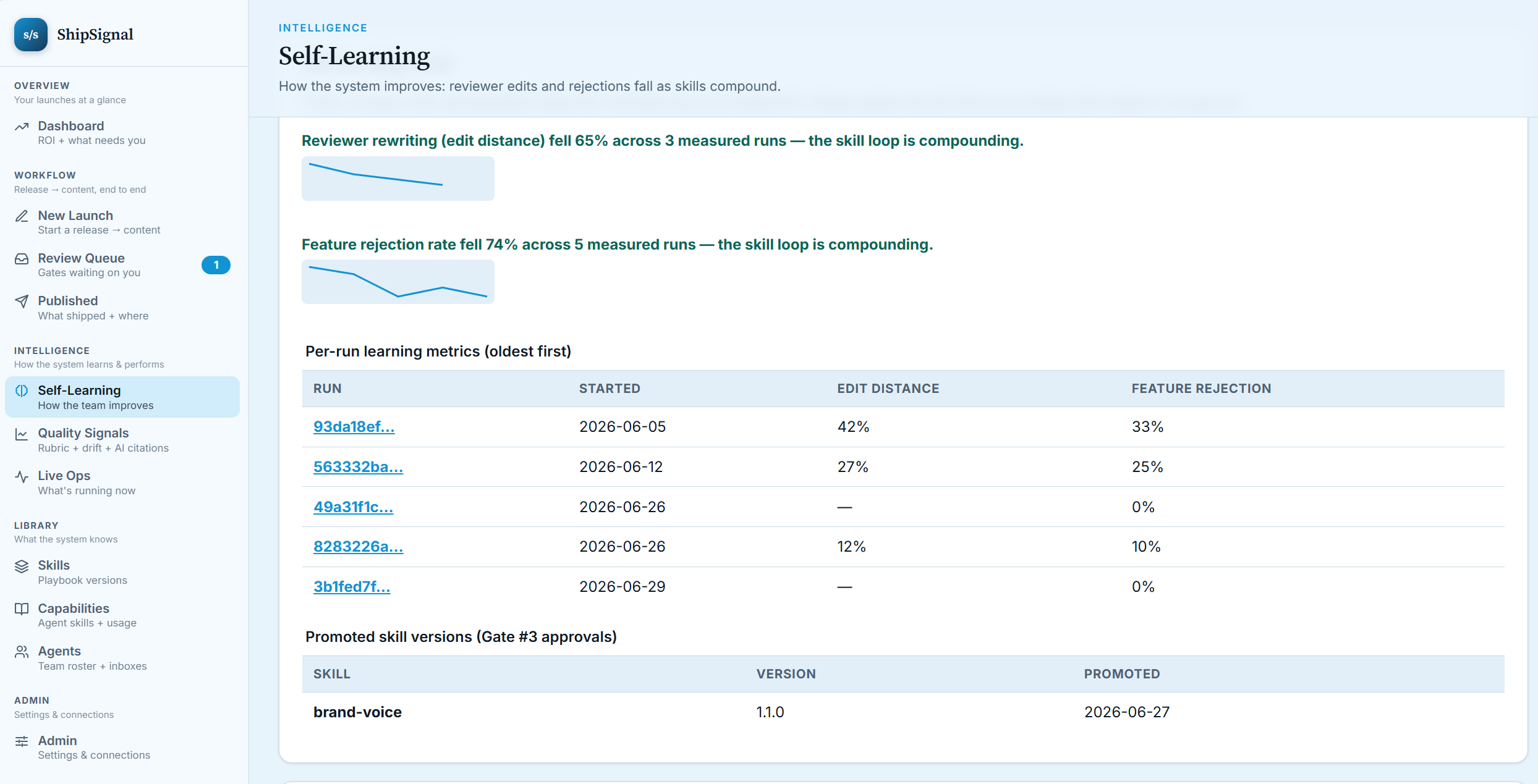
- Self-improving. Reviewer edits and rejections are mined into a proposed next-version skill; once a human approves it, the system writes better, more on-brand content on the next release. It compounds.
The payoff: diff → governed, traceable, multi-channel content, plus one-click distribution (publishing the demo video straight to YouTube). The whole loop runs on AWS, with Amazon Aurora PostgreSQL as the system of record.
How we built it
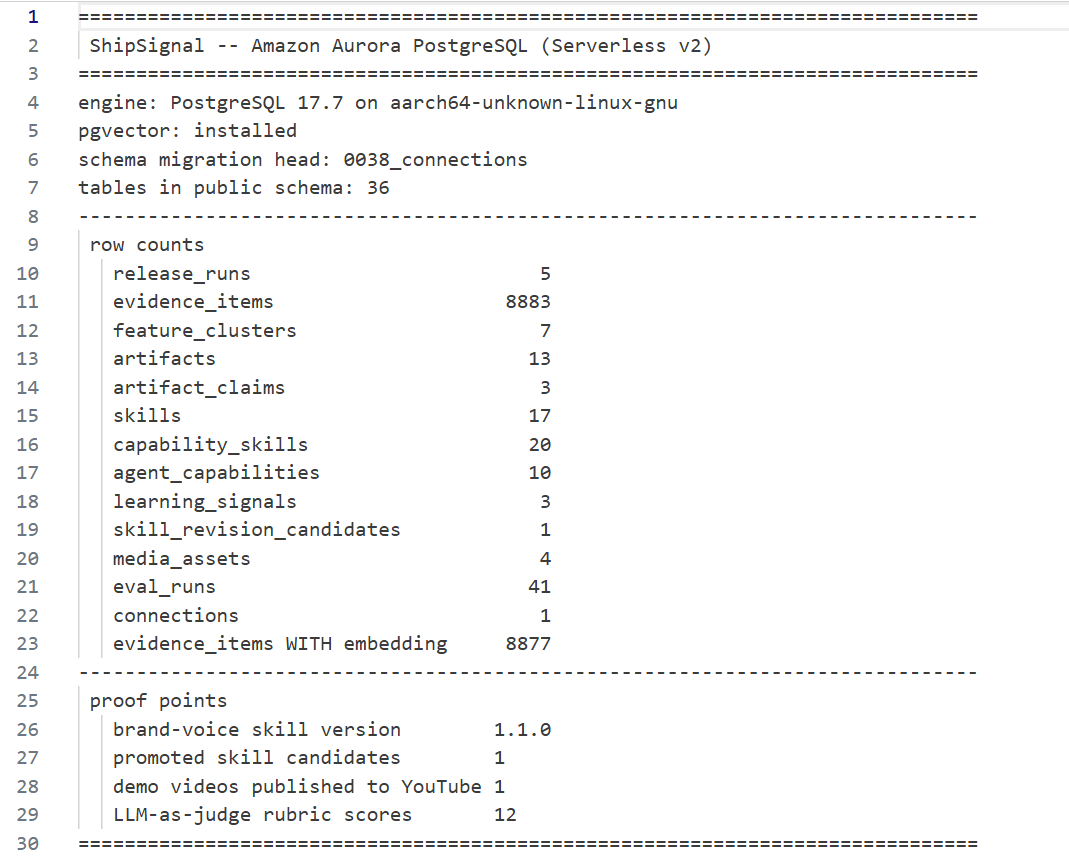
- Database (the heart): Amazon Aurora PostgreSQL (Serverless v2) + pgvector — 38 migrations. The schema is the product: a claim→evidence provenance graph,
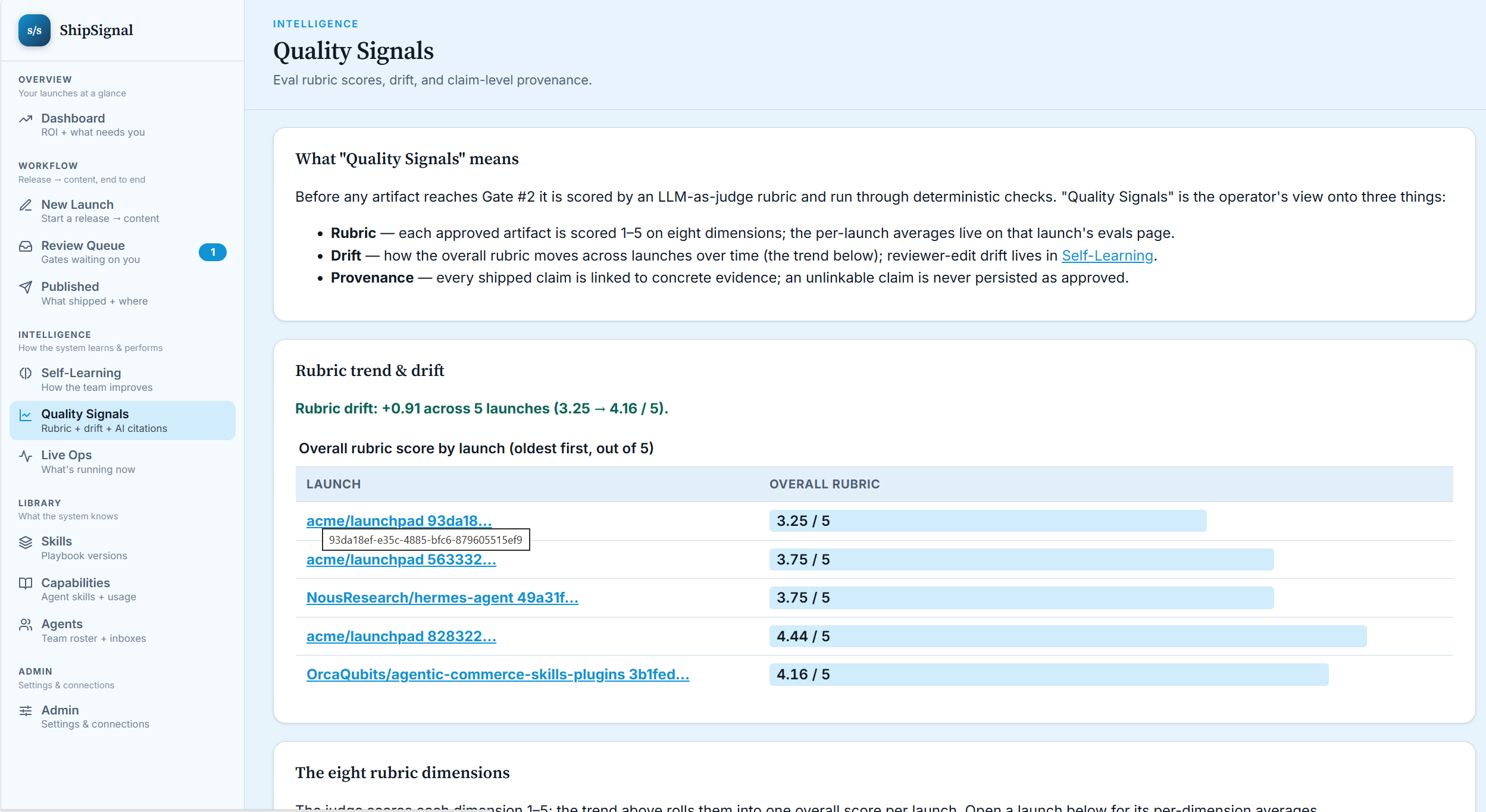
release_run_idtenancy with cascading deletes (single-delete GDPR erasure),pgvector(1536)+ HNSW semantic search, a versioned skills store, capability/agent governance maps, a self-learning ledger, and encrypted OAuth connections (AES-256-GCM, ciphertext only). - AI: Amazon Bedrock — Nova clusters evidence into features and writes the artifacts; Titan embeds evidence for pgvector retrieval; Guardrails + deterministic checks screen output; an LLM-as-judge rubric scores each artifact.
- Orchestration: LangGraph (Python) — four graphs (release-intelligence, content, media, skill-learning) with the three human gates implemented as approval interrupts.
- App: Next.js (App Router) + React 19 on Vercel — review/approval, provenance views, media preview, one-click YouTube publish, and operator-editable governance, reading Aurora over verified TLS and serving S3 media only via short-lived presigned URLs.
- Media: ElevenLabs TTS + ffmpeg → S3. Distribution: YouTube Data API via OAuth.
- CI/CD: GitHub Actions auto-deploys
mainto Vercel.
Challenges we ran into
- Bedrock quota, not access. On-demand inference quota was literally 0 for our primary account (every call throttled). We diagnosed it precisely (a quota issue, not permissions) and solved it with a cross-account architecture: Bedrock runs on a second AWS account that has Nova/Titan quota, while Aurora and S3 stay on the main account — split credentials within a single process, with IAM restored after each run.
- pgvector dimension mismatch. The schema is
vector(1536); Titan Embeddings v2 maxes at 1024, so we standardized on Titan v1 (1536) and backfilled real embeddings for 8,877 evidence rows, with verified cosine retrieval. - Real OAuth, encrypted at rest. Building a dashboard "Connect Google" flow meant CSRF state, an exact redirect-URI contract, and storing the refresh token encrypted in Aurora (write-only/sensitive handling) — plus debugging a stubborn
invalid_clientdown to the client secret. - Staying honest. Redaction before persist, claim-to-evidence linking (no unlinkable claim stored "approved"), and clearly separating what's real vs. demo.
- Serverless ↔ Aurora over verified TLS, and keeping cost near zero on Serverless v2.
Accomplishments that we're proud of
- The data model genuinely is the product — a real provenance graph, pgvector with real embeddings, versioned skills, governance-as-data, and encrypted connections across 38 deliberate migrations. Far beyond a CRUD bucket.
- Real, end-to-end, on real AWS — a live run (
OrcaQubits/agentic-commerce-skills-plugins) that goes diff → ~8,100 evidence rows → real Titan embeddings → real Bedrock Nova authoring → 20 claims, all evidence-grounded (provenance) → real ElevenLabs/ffmpeg media → LLM-as-judge eval → published to YouTube with an encrypted OAuth token. - The self-learning loop actually fired — reviewer feedback promoted the
brand-voiceskill to v1.1.0, live, with full provenance. - Shipped and deployed — live on Vercel + Aurora + S3, with CI auto-deploy, 485 TypeScript + 420 Python tests green.
What we learned
- Treat the schema as the product. Encoding tenancy, provenance, governance, and "behaviour-as-data" into Postgres (with pgvector) made the rest of the system fall out naturally — and is what makes the output trustworthy.
- Bedrock operations are subtle — model access vs. on-demand quota are different problems, model families differ (Nova was available when Claude wasn't), and embedding dimensions must match your schema.
- Human-in-the-loop is a design pattern, not an afterthought — LangGraph interrupts let us make the three approval gates first-class.
- Secrets discipline — encrypted-at-rest tokens, write-only env vars, redaction-before-persist, and never trusting model output (everything re-validated).
- For governed AI, "provable + traceable" beats "fast" — provenance and a learning loop are the moat a static generator can't copy.
What's next for ShipSignal
- Flip authoring fully live on the primary account once the Bedrock on-demand quota increase lands — it's already one env flag away (proven by the cross-account Nova run).
- Smarter skill evolution — severity-weighted clustering, cross-run recurrence, and feeding eval-score regressions back into the learning loop (design already drafted).
- More distribution channels — LinkedIn, X, Slack, and GitHub Releases publishing (already scaffolded), plus scheduled publishing.
- Outcome loop — UTM/engagement → ROI attribution so the system learns which messaging actually converts, and A/B testing of skill versions.
- Production hardening — Google OAuth app verification (out of testing mode), AWS Secrets Manager for tokens, and multi-tenant support.
Built With
- amazon-bedrock-converse-api
- amazon-web-services
- elevenlabs-tts
- github-actions-apis-/-external-services:-github-api-(diff/compare)
- guardrails)
- langgraph-platform-/-deploy-/-ci:-vercel
- oauth
- pgvector-aws-/-cloud-services:-amazon-bedrock-(nova-authoring
- postgresql
- python
- react-19
- sql-database:-amazon-aurora-postgresql-(serverless-v2)
- titan-embeddings
- youtube-data-api

Log in or sign up for Devpost to join the conversation.