What is ShipIt?
ShipIt is an AI-powered project management platform that automates the entire software delivery lifecycle using a fleet of 9 autonomous AI agents. From the moment a Jira ticket is created to the second code is deployed in production, ShipIt's agents handle requirements analysis, code scaffolding, security scanning, test generation, review coordination, deployment orchestration, and more — all powered by Gradient AI with Claude.
Teams don't just manage work in ShipIt — the platform actively drives work forward through the pipeline.
How It Works
1. Dashboard & Projects
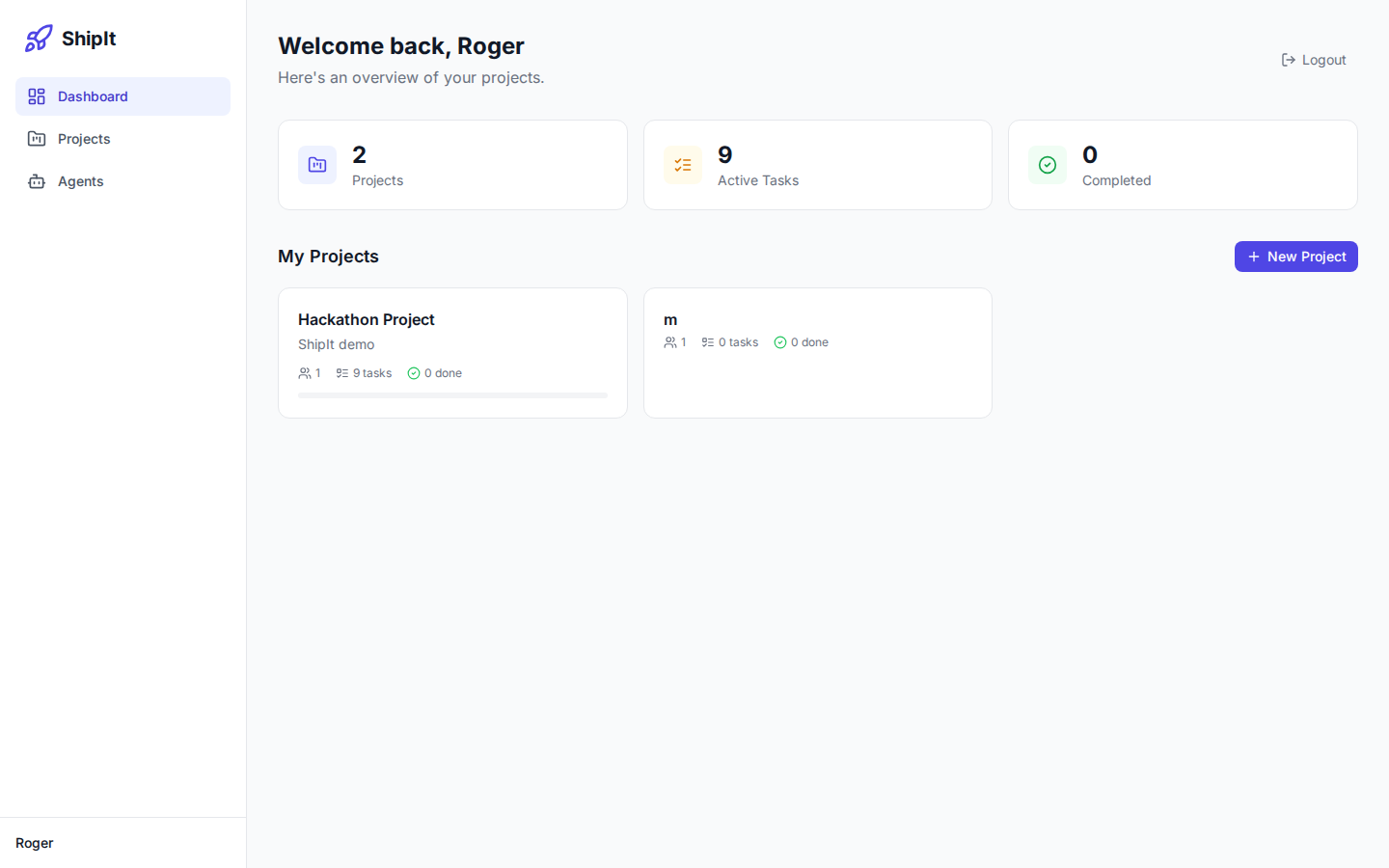
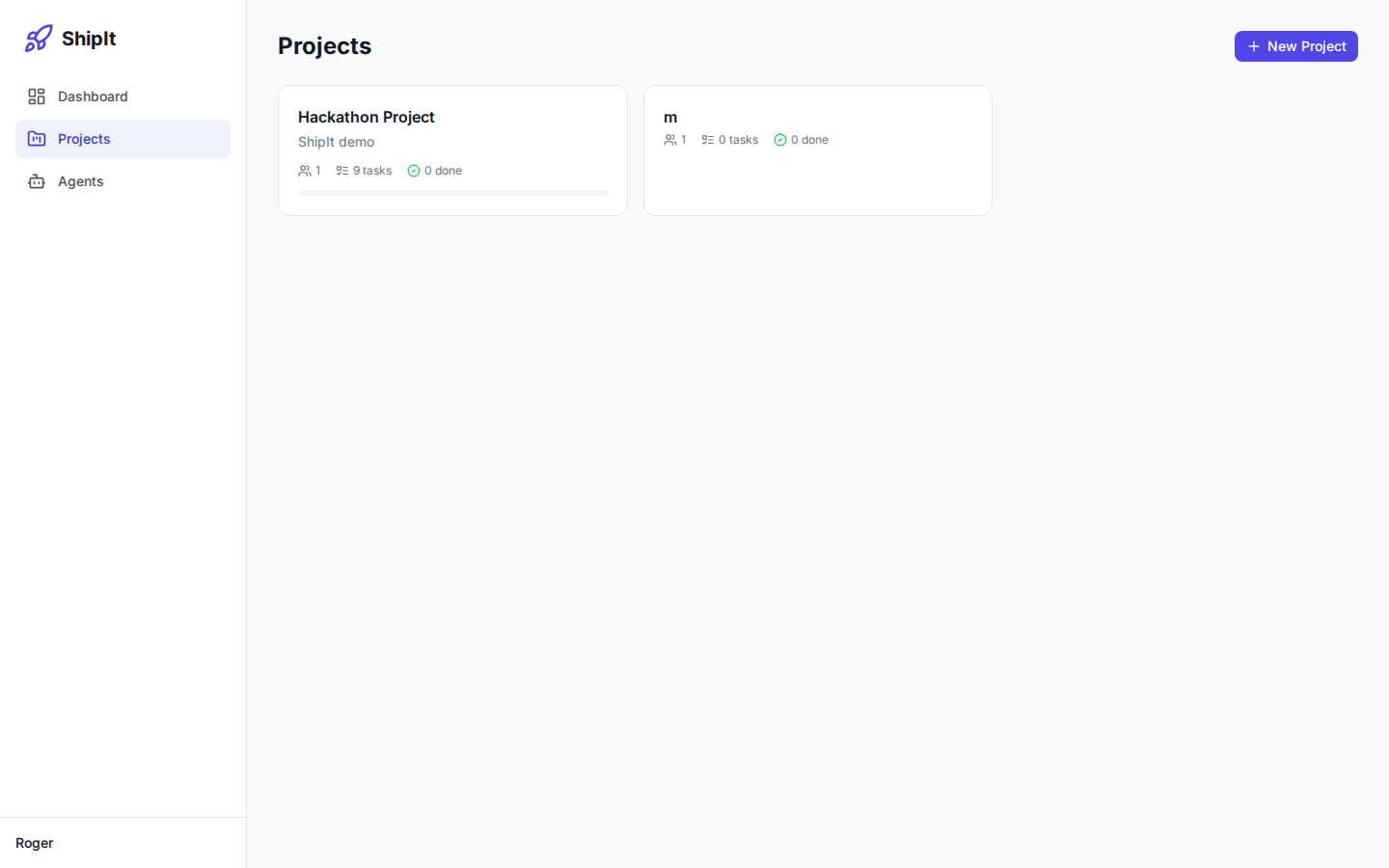
When you log in, you see all your projects at a glance with real-time task statistics. Each project card shows how many tasks are in each status — giving you an instant health check across everything your team is working on.
2. Kanban Board
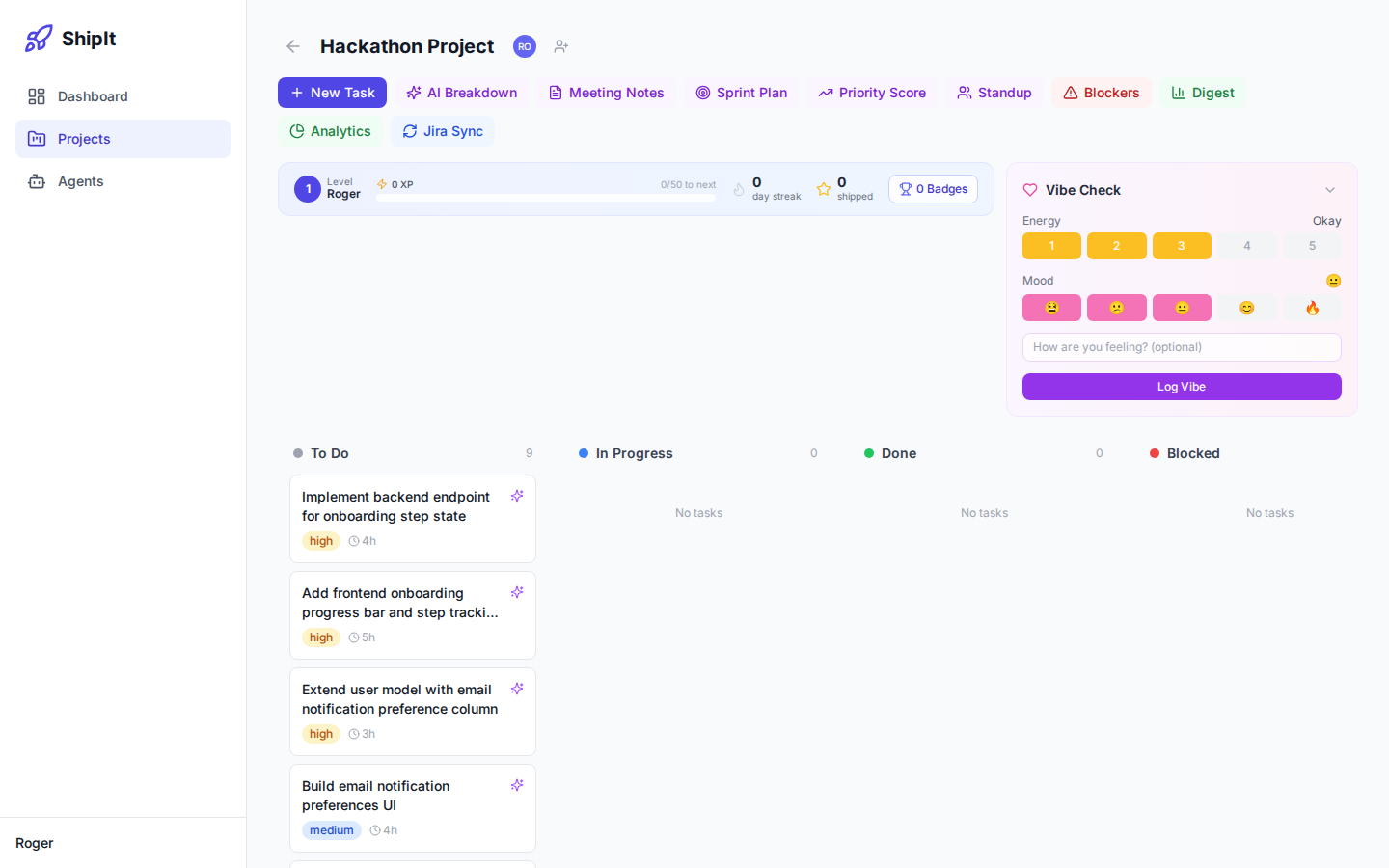
Click into any project and you get a full Kanban board with four columns: To Do, In Progress, Done, and Blocked. Drag and drop tasks between columns. When you complete a task, you earn XP and get a confetti celebration.
The toolbar at the top gives you access to all AI-powered actions — each one is a single click away.
3. AI Task Breakdown
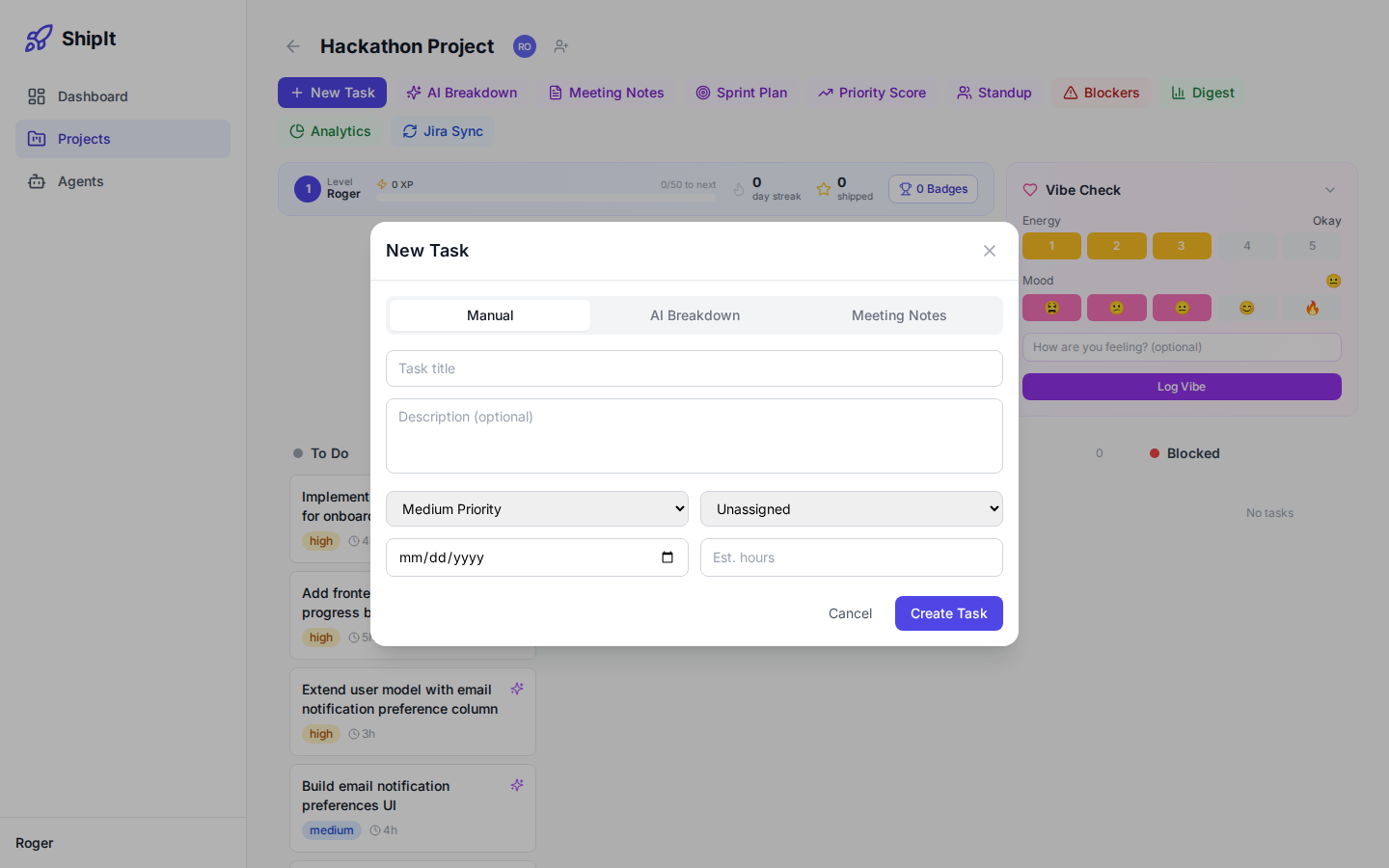
Select any task and click AI Breakdown. Claude reads the task description, understands the context, and decomposes it into actionable subtasks — each with a priority level, effort estimate in hours, and suggested assignee. One click to apply them all to your board.
This turns a vague "Build user authentication" into 5-8 concrete, assignable subtasks in seconds.
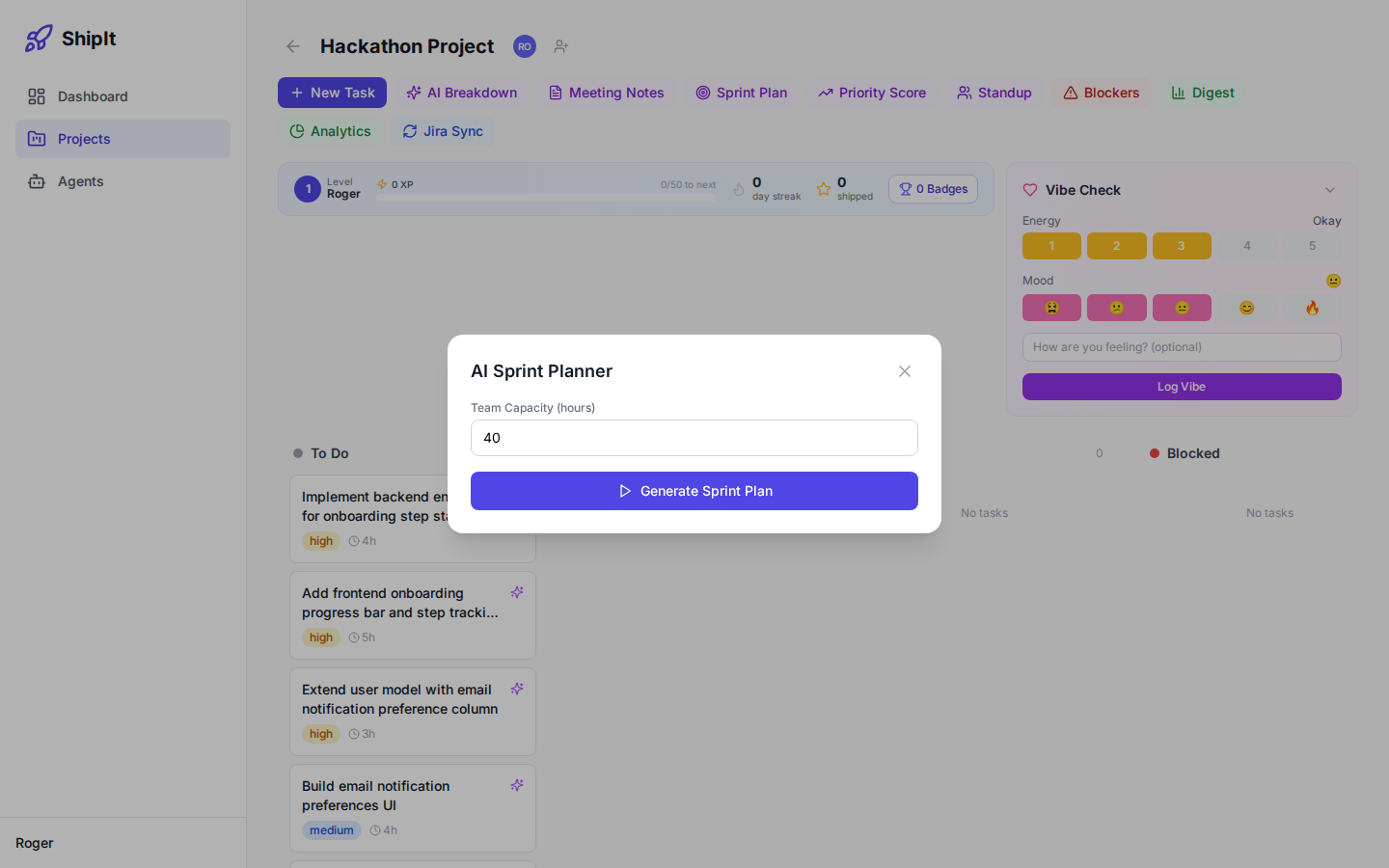
4. AI Sprint Planning
Click Sprint Plan and Claude analyzes your entire team — who has capacity, what's already assigned, which tasks have the highest priority. It generates a sprint plan that:
- Assigns the right tasks to the right people
- Respects capacity limits (no one gets overloaded)
- Defers lower-priority work with explanations
- Calculates utilization percentage
- Writes the sprint goal
5. Standup Report Generator
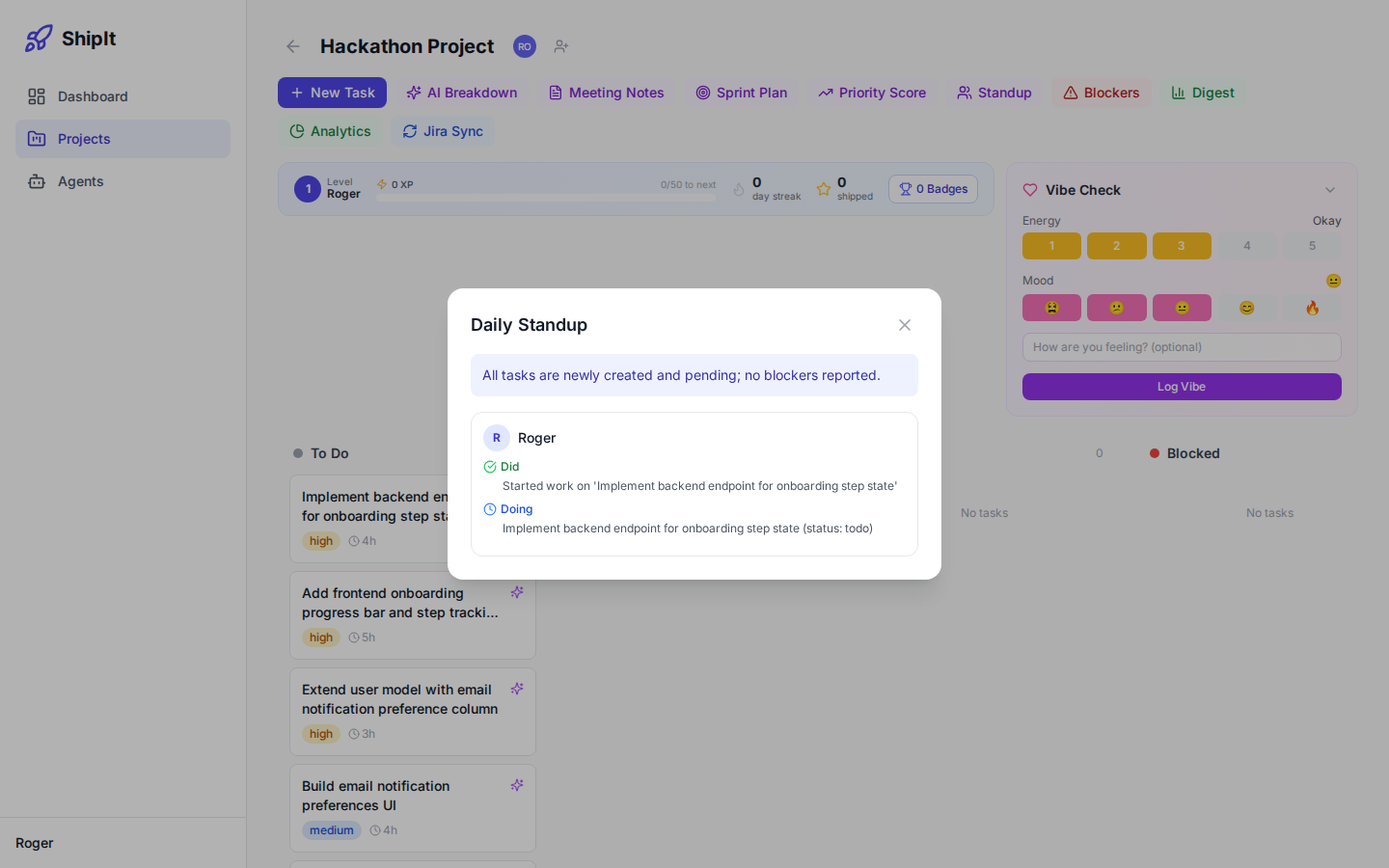
No more "what did I do yesterday?" moments. Click Standup and Claude generates a per-member report pulled directly from board activity:
- Yesterday: Tasks they moved to Done or In Progress
- Today: Tasks currently assigned and in progress
- Blockers: Any blocked tasks with context
Perfect for async teams or quick daily syncs.
6. AI Priority Scoring
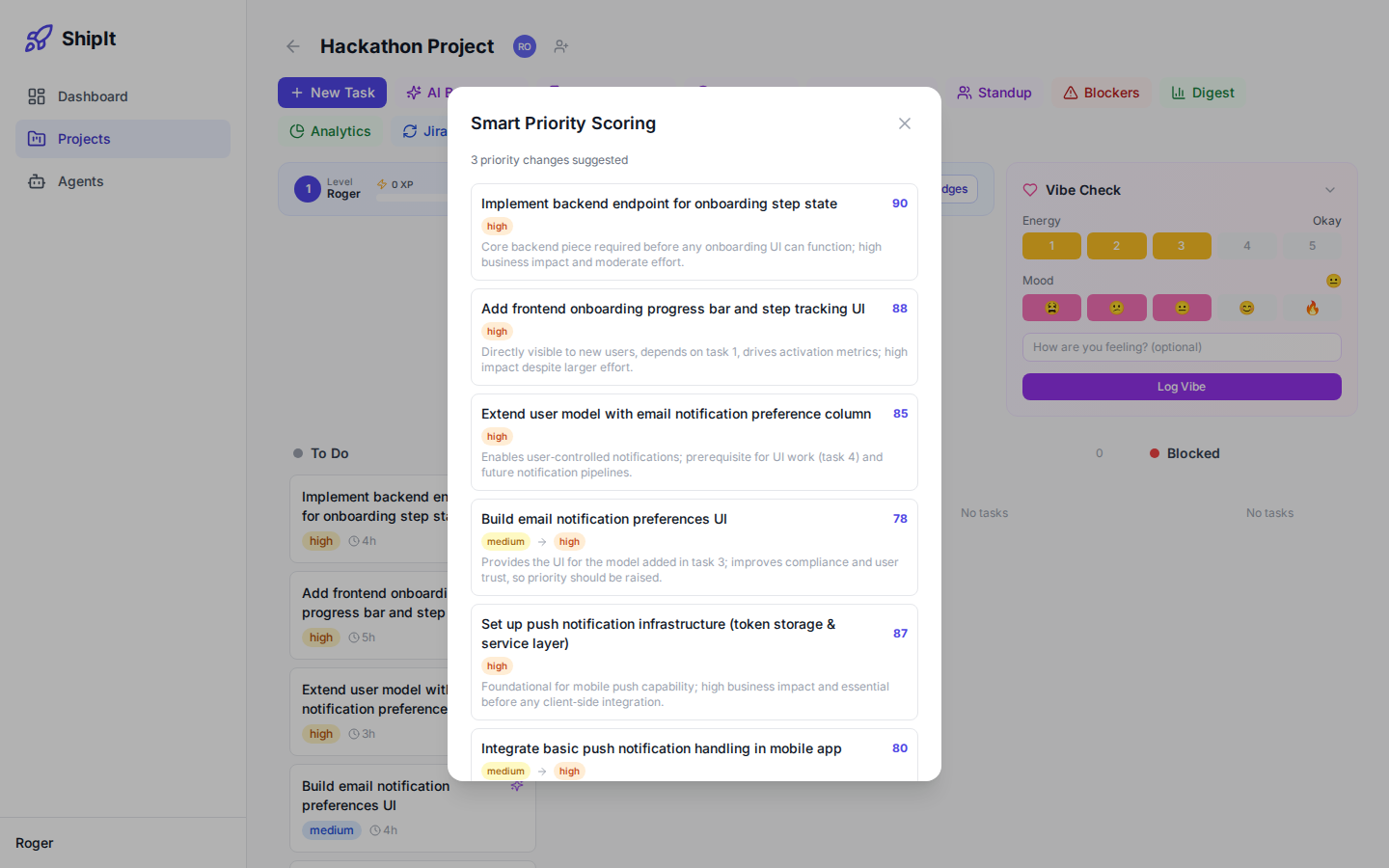
Claude evaluates every task on your board and recommends re-prioritization with clear reasoning. It catches things humans miss:
- A "medium" task that's actually blocking three high-priority tasks
- An "urgent" bug that's already been partially fixed
- Tasks that should be escalated based on due dates and dependencies
Each recommendation includes a confidence score and explanation.
7. Team Analytics
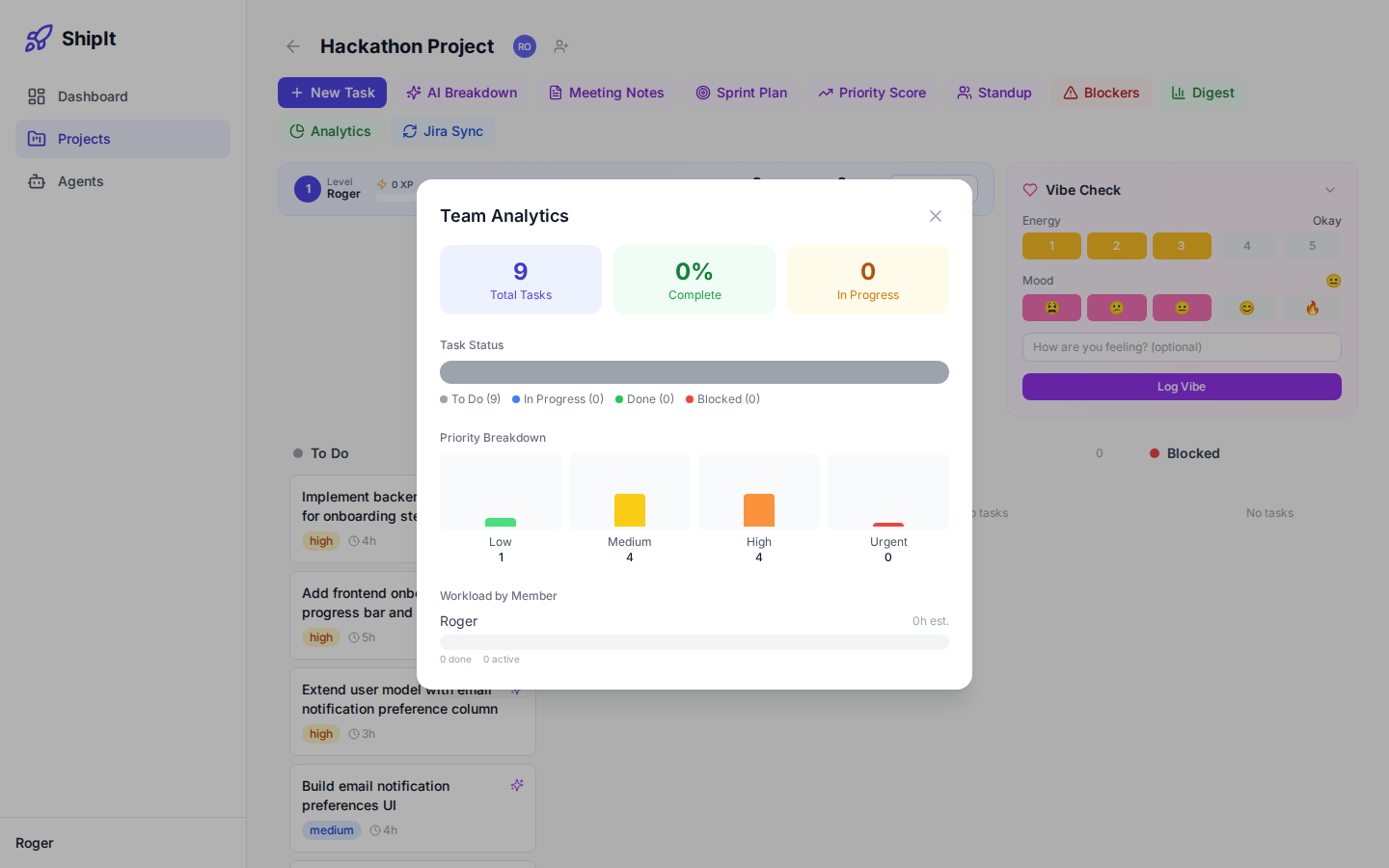
Real-time analytics powered by AI insight generation:
- Status distribution — how tasks flow through your pipeline
- Priority breakdown — are you spending time on the right things?
- Workload per member — who's overloaded, who has capacity?
- Completion rate — trending up or down?
- AI insights — Claude identifies patterns and suggests process improvements
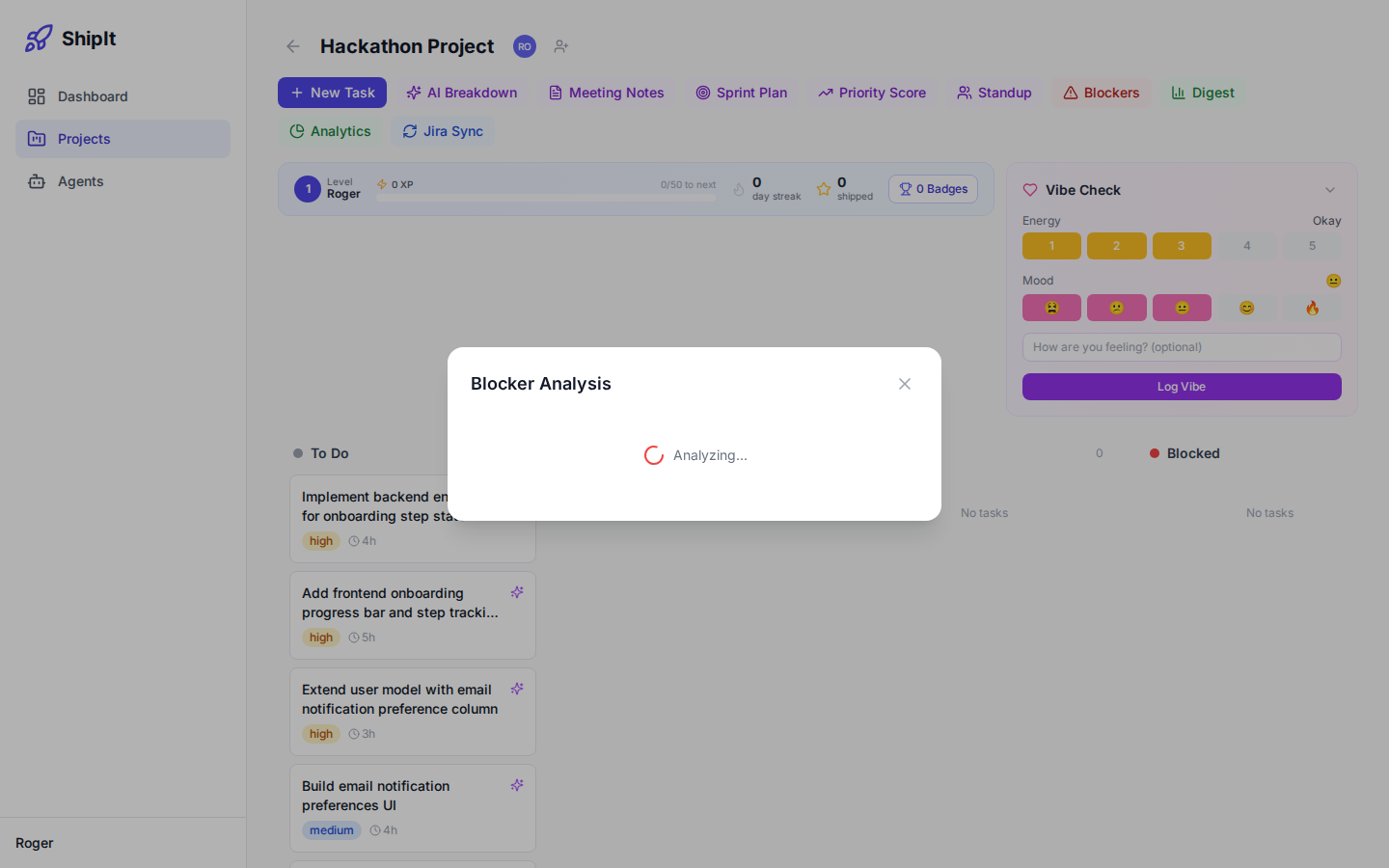
8. Blocker Detection
AI scans your board for blocked tasks, identifies root causes, rates severity (critical/high/medium/low), and suggests concrete unblocking actions. It detects:
- Dependency chains (Task A blocks B blocks C)
- Resource conflicts (same person assigned to conflicting deadlines)
- Stale blockers (blocked for >3 days with no activity)
9. Gamification
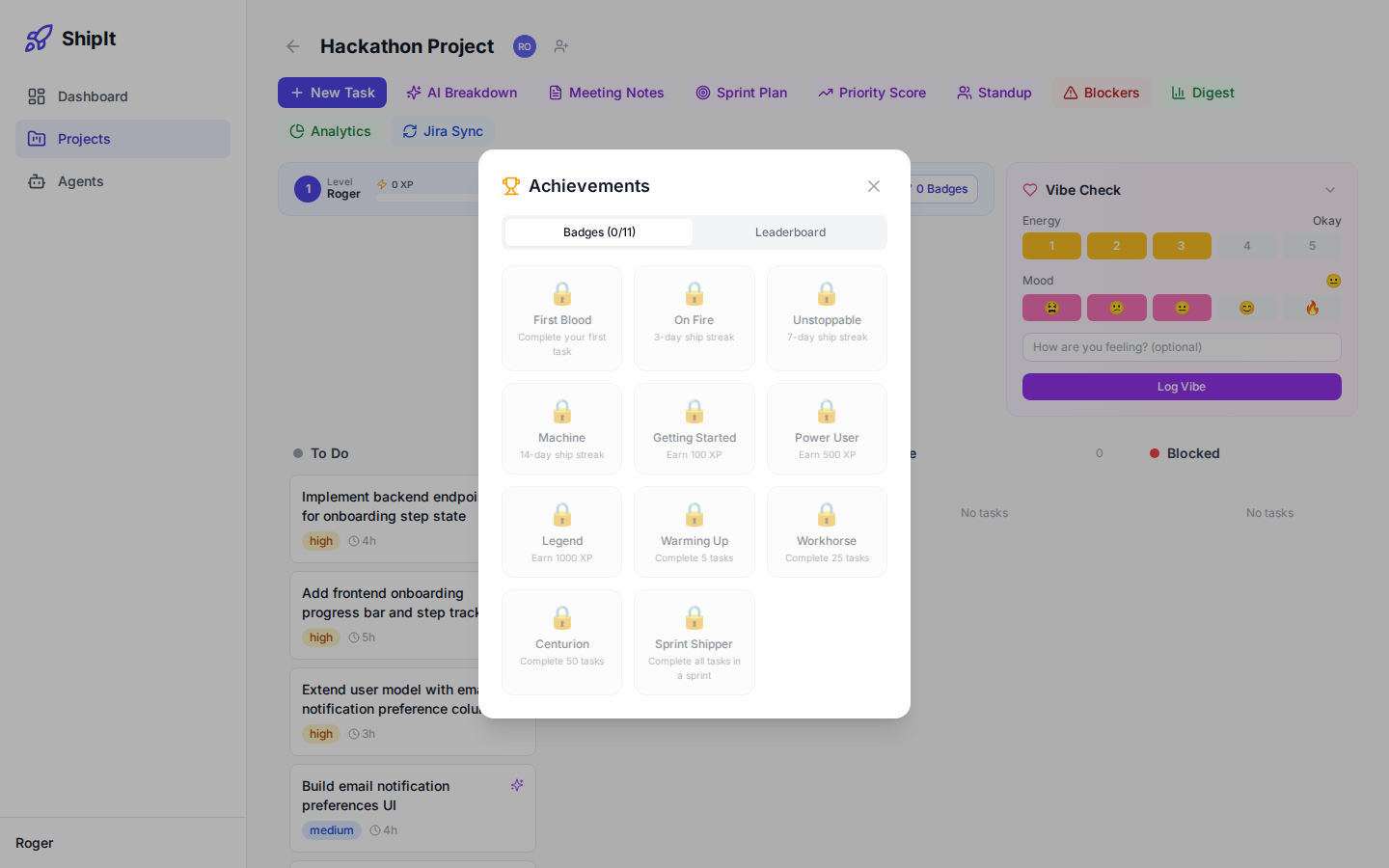
Every completed task earns XP scaled by priority (urgent = 40 XP, high = 30, medium = 20, low = 10). Features include:
- Leveling system — Level = floor(sqrt(XP/50)) + 1
- 11 achievement badges — streak badges (3/7/14 days), milestone badges (100/500/1000 XP), volume badges (5/25/50 tasks), Sprint Shipper
- Team leaderboard — ranked XP standings
- Streak tracking — consecutive days with completions
10. Jira Integration
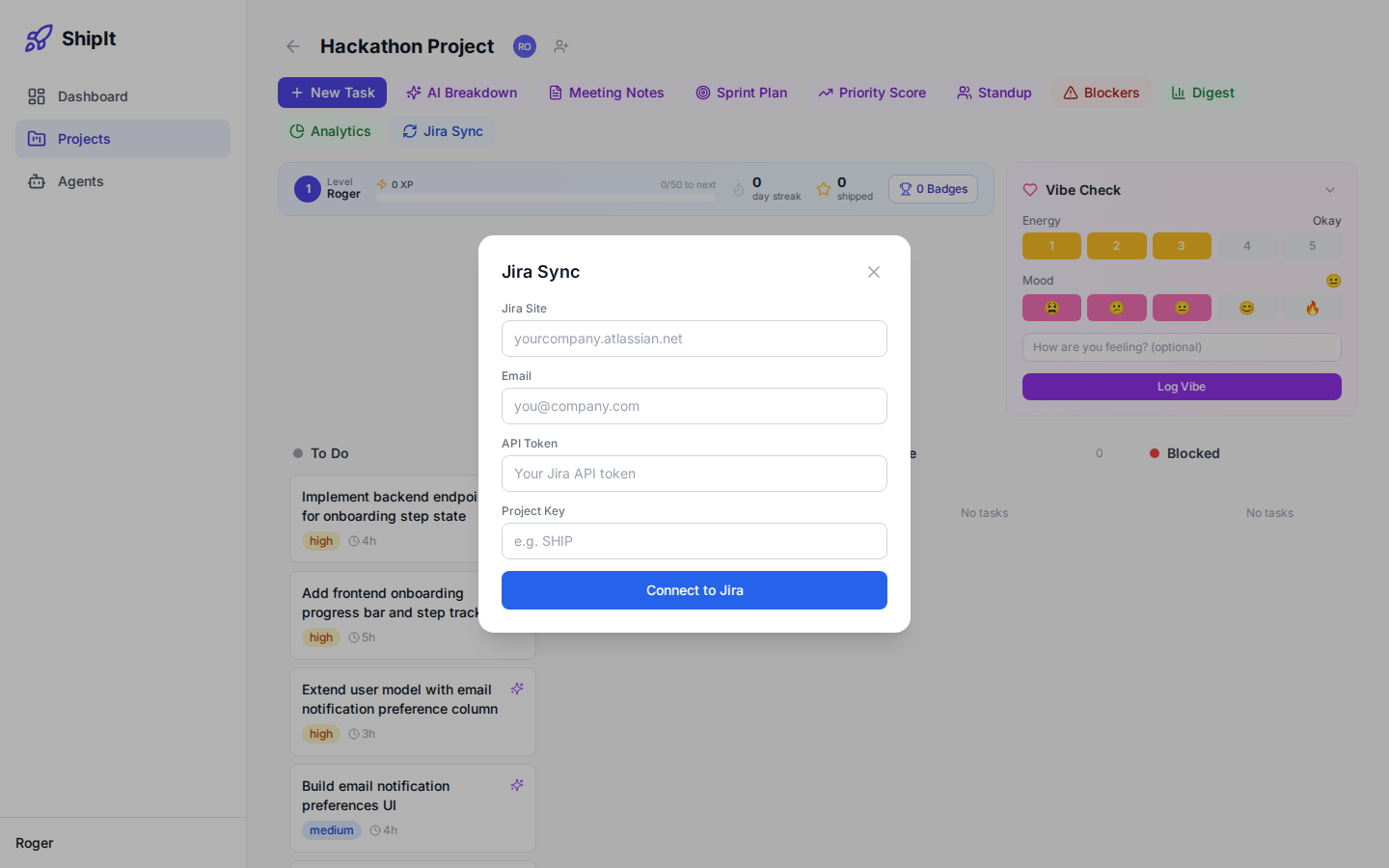
Bidirectional sync with Jira:
- Import — Pull existing Jira issues into ShipIt
- Export — Push local tasks to Jira
- Status sync — Changes in either direction stay in sync
- Sprint sync — Pull Jira sprints and manage from one place
- Meeting Notes — Paste raw meeting text, Claude extracts tasks automatically
11. The Agent Fleet
The centerpiece of ShipIt — 9 autonomous AI agents that communicate through an async event bus with 40+ event types. Each agent subscribes to specific events and publishes its own, creating automated chains that handle the entire software delivery pipeline.
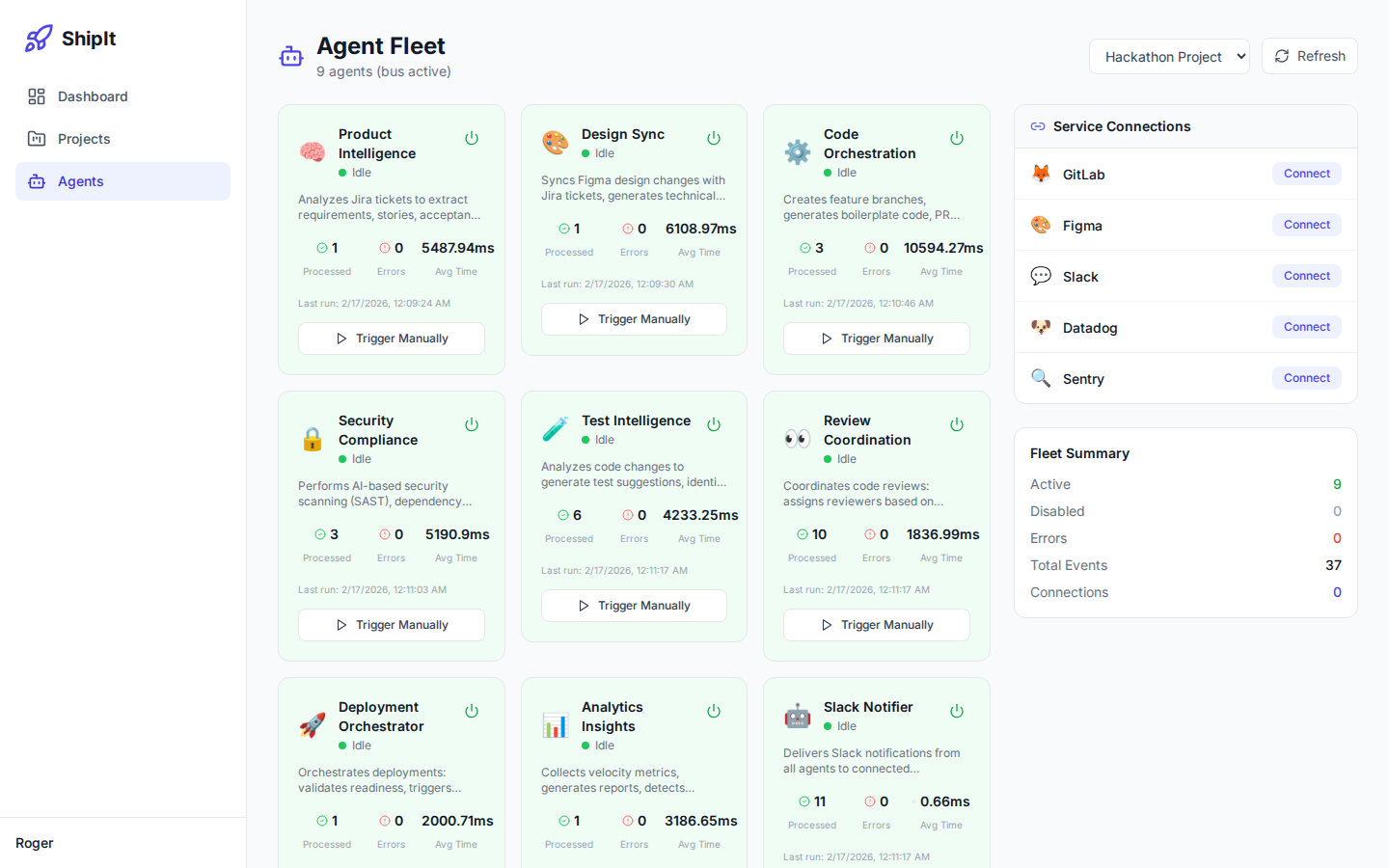
The 9 Agents
| # | Agent | Subscribes To | What It Does |
|---|---|---|---|
| 1 | Product Intelligence | Jira ticket created/updated | Analyzes requirements, extracts user stories, tags complexity, estimates effort |
| 2 | Design Sync | Figma design changed | Fetches components from Figma, generates CSS/component specs, creates GitLab issues |
| 3 | Code Orchestration | Issue assigned, requirements analyzed | Creates feature branches, generates boilerplate code, opens MRs, auto-assigns reviewers |
| 4 | Security & Compliance | PR opened, code pushed | AI-based SAST — catches SQL injection, XSS, secrets in code. Blocks merges on critical vulnerabilities |
| 5 | Test Intelligence | PR opened, security scan complete | Generates unit/integration test suggestions, identifies coverage gaps and edge cases |
| 6 | Review Coordination | PR ready for review, test report | Assigns reviewers by expertise, tracks review SLAs, sends reminders, can auto-merge |
| 7 | Deployment Orchestrator | PR merged to main | Validates readiness, triggers CI/CD, generates release notes, monitors post-deploy health via Datadog/Sentry, auto-rollback |
| 8 | Analytics & Insights | Metrics collected (scheduled) | Velocity metrics, cycle time, bottleneck detection, executive summaries, improvement suggestions |
| 9 | Slack Notifier | All notification events | Delivers notifications from every agent to Slack channels |
End-to-End Pipeline
Jira ticket created
  → Agent 1: Analyzes requirements, extracts stories
    → Agent 3: Creates branch, scaffolds code, opens MR
      → Agent 4: Scans for security vulnerabilities
      → Agent 5: Generates test suggestions
        → Agent 6: Assigns reviewers, tracks SLA
          → Agent 7: Deploys, monitors health, auto-rollback
            → Agent 8: Reports metrics, detects bottlenecks

All agents → Agent 9: Slack notifications
12. Agent Event Log
Every agent action is logged with correlation IDs for full event chain tracing. The event log renders clean, human-readable details instead of raw JSON:
- Vulnerability cards with severity badges and fix recommendations
- Test suggestions as structured lists with edge cases
- Review assignments with complexity scores and auto-merge eligibility
- Deploy status with health check results and release notes
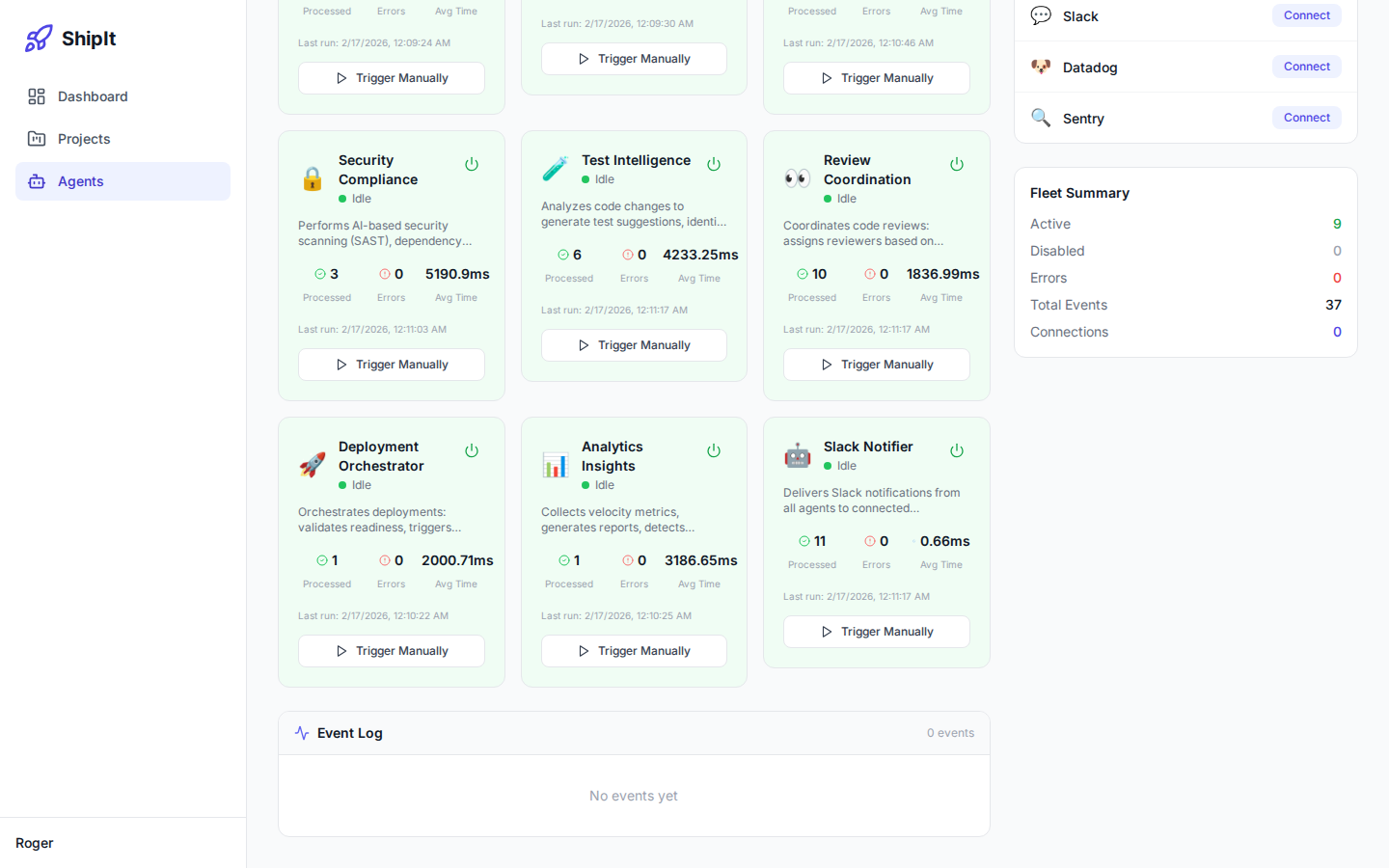
13. Service Connections
Teams connect their own instances per project — no shared credentials:
- GitLab — branches, MRs, pipelines, code diffs
- Figma — file monitoring, component extraction
- Slack — channel notifications, DMs
- Datadog — monitor status for post-deploy health
- Sentry — error tracking for deployment verification
- Jira — bidirectional task sync
Each connection can be tested independently. Credentials are masked in the UI with reveal-on-demand.
How We Use Gradient AI
Every AI feature is powered by Gradient with Claude (Haiku 4.5 and Sonnet models):
| Feature | Gradient Usage |
|---|---|
| Task Breakdown | Claude decomposes tasks into subtasks with priorities and effort estimates |
| Sprint Planning | Claude analyzes team capacity and recommends sprint assignments |
| Standup Reports | Claude generates per-member standup updates from board state |
| Priority Scoring | Claude evaluates tasks and recommends re-prioritization with reasoning |
| Meeting Notes | Claude parses raw meeting text into structured, actionable tasks |
| Daily Digest | Claude summarizes project activity, highlights stuck and at-risk tasks |
| Requirements Analysis | Agent 1 uses Claude to extract stories, acceptance criteria, complexity |
| Security Scanning (SAST) | Agent 4 uses Claude to detect SQL injection, XSS, secrets, OWASP Top 10 |
| Test Generation | Agent 5 uses Claude to suggest unit tests, integration tests, edge cases |
| Review Analysis | Agent 6 uses Claude to assess PR complexity and auto-merge eligibility |
| Release Notes | Agent 7 uses Claude to generate human-readable release notes from commits |
| Bottleneck Detection | Agent 8 uses Claude to identify process bottlenecks and suggest fixes |
| Design-to-Code | Agent 2 uses Claude to generate technical implementation specs from Figma data |
| Burnout Detection | Claude analyzes team mood/energy trends to detect burnout risk |
All AI calls go through Gradient's agent endpoint with structured JSON output parsing and graceful fallbacks.
Architecture
                        +-------------------+
                        |   React + TS      |
                        |   Frontend        |
                        +--------+----------+
                                 |
                        +--------v----------+
                        |  FastAPI Backend   |
                        |  (async Python)    |
                        +--------+----------+
                                 |
              +------------------+------------------+
              |                  |                   |
     +--------v------+  +-------v--------+  +-------v--------+
     | Gradient AI    |  |  SQLite/PG DB  |  |  Event Bus     |
     | (Claude)       |  |  12 models     |  |  40+ event     |
     |                |  |                |  |  types          |
     +----------------+  +----------------+  +-------+--------+
                                                     |
              +------+------+------+------+------+------+------+------+
              |      |      |      |      |      |      |      |      |
            Ag.1   Ag.2   Ag.3   Ag.4   Ag.5   Ag.6   Ag.7   Ag.8   Ag.9
              |      |      |      |      |      |      |      |      |
              v      v      v      v      v      v      v      v      v
            Jira  Figma  GitLab GitLab GitLab GitLab GitLab   DB   Slack
                                                      Sentry
                                                      Datadog
Tech Stack
| Layer | Technology |
|---|---|
| Frontend | React 18, TypeScript, Tailwind CSS, Vite |
| Backend | FastAPI (async), Python 3.11+ |
| Database | SQLAlchemy (async) + SQLite (dev) / PostgreSQL (prod) |
| AI | Gradient AI Platform — Claude Haiku 4.5 + Sonnet |
| Agent System | Custom async event bus, 9 agents, pub/sub architecture |
| External APIs | GitLab REST v4, Figma REST, Slack Web API, Datadog, Sentry |
| Deployment | Docker Compose, DigitalOcean App Platform |
Why Not Just Use Jira or Trello?
Because they don't do anything. You do everything.
Jira, Trello, Asana, Linear — they're all digital filing cabinets. You create a ticket. You move it across columns. You assign it. You write the PR description. You remember to run security checks. You chase reviewers. You write release notes. You deploy. You monitor. You report.
ShipIt does all of that for you.
| Jira / Trello / Asana | ShipIt | |
|---|---|---|
| Task breakdown | You manually create subtasks | AI decomposes tasks into subtasks with effort estimates in one click |
| Sprint planning | You drag cards into a sprint and hope for the best | AI analyzes team capacity, assigns tasks to the right people, defers low-priority work, writes the sprint goal |
| Branch creation | You switch to GitLab, create a branch, open an MR | Agent auto-creates branch, scaffolds boilerplate, opens MR, assigns reviewers |
| Security scanning | You buy a separate tool (Snyk, SonarQube) | Agent scans every push with AI — SQL injection, XSS, secrets — blocks merges on critical vulns |
| Test suggestions | You write tests from scratch | Agent reads the diff and generates unit tests, integration tests, and edge cases |
| Code review | You ping people on Slack and wait | Agent assigns reviewers by expertise, tracks SLAs, sends reminders, auto-merges when approved |
| Deployment | You run a pipeline and hope nothing breaks | Agent triggers CI/CD, monitors Datadog/Sentry post-deploy, auto-rolls back if errors spike |
| Release notes | You write them by hand from memory | Agent generates them from commit history |
| Standup reports | 15-minute meeting where nobody remembers what they did | One click — AI generates per-member reports from board activity |
| Priority management | You guess | AI evaluates every task with reasoning — catches hidden blockers and misranked priorities |
| Analytics | You export to a spreadsheet | AI generates real-time insights, detects bottlenecks, predicts sprint completion |
| Team wellbeing | Not their problem | Pulse tracking with AI burnout detection and recommendations |
| Gamification | Non-existent | XP, levels, 11 badges, streaks, team leaderboard |
| Tool integration | 15 tabs open | Jira + GitLab + Figma + Slack + Datadog + Sentry in one event stream |
The fundamental difference: Jira is a tool you work in. ShipIt is a platform that works for you. Your job is to write code and make decisions. Everything else — the scaffolding, the scanning, the reviewing, the deploying, the reporting — agents handle it.
Why This Matters
Agents drive work forward — A Jira ticket doesn't just sit there. It gets analyzed, a branch gets created, code gets scaffolded, security gets scanned, reviewers get assigned, and deployment happens — automatically.
AI understands your context — Every AI feature uses your actual project data. Sprint planning knows your team's real capacity. Priority scoring considers blocking relationships. Security scanning reads the actual code diff.
No tool-switching tax — Jira, GitLab, Figma, Slack, Datadog, and Sentry all feed into one event stream. Your team sees everything in one place.
Human-in-the-loop — Agents are configurable per project. Every action is logged with correlation IDs. Critical decisions (like blocking a merge) create visible, reviewable events.
Built with Gradient AI (Claude) on DigitalOcean
Built With
- next
- python

Log in or sign up for Devpost to join the conversation.