Inspiration
I built ShipGuard Sentinel after seeing a common problem that almost every software engineer faces. A Jira ticket is marked Done, unit tests pass in CI, but deploying to production still causes a major outage.
When I looked into why this happens, the root cause is almost always missing context trapped across different tools:
- A developer merged a breaking API change without updating the OpenAPI schema.
- The Confluence architecture doc (ADR) was months old.
- The on-call engineer responsible for the downstream service was marked out of office.
- An upstream dependency in another team's backlog was still open.
Most AI tools just give vague text answers and hallucinate assurances. I wanted to build something deterministic that gives software teams hard proof with exact entity IDs before anyone hits deploy. My rule was simple: "Receipts over Hallucinations."
What it does
ShipGuard Sentinel runs on Atlassian Forge and audits releases before code reaches production:
- Teamwork Graph Traversal: It queries the Atlassian Teamwork Graph using multi-hop Cypher queries to link Jira issues, Confluence ADRs, Compass components, Bitbucket PRs, and Opsgenie on-call schedules.
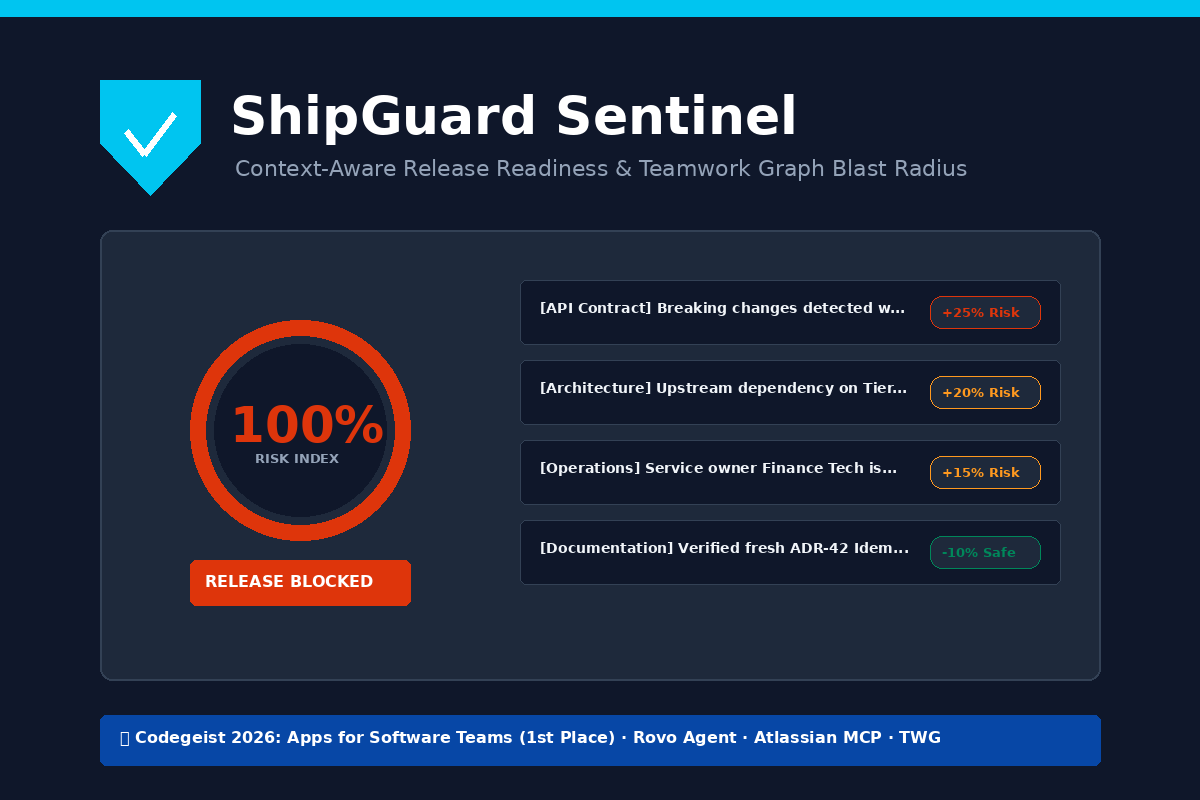
- Blast Radius Index: It calculates an exact risk score from 5% to 100%. For example, an unversioned breaking schema adds +25% risk, while a verified fresh ADR gives a -10% safety bonus.
- Cryptographic Receipts: Every single penalty and credit generates an exact receipt with entity IDs so teams can verify why a release was blocked.
- Actionable Remediation: Instead of just saying "blocked", it generates a clear 4-step checklist showing exactly what needs to be fixed.
- Rovo Agent: Developers can mention @ShipGuard Sentinel in Jira issue comments or Rovo Chat to trigger instant release audits.
- MCP Server: It exposes a full JSON-RPC 2.0 Model Context Protocol endpoint, meaning developers can check release safety directly from Cursor IDE or Claude Code before opening a PR.
How I built it
- Built completely on Atlassian Forge using the Node.js 20 runtime.
- Used the Forge Teamwork Graph API to run Cypher traversal queries across connected entities.
- Implemented native rovo:agent and rovo:action modules for seamless Jira comment interaction.
- Built a native MCP server supporting initialize, tools/list, tools/call, and batch requests.
- Created the dashboard with Atlassian Custom UI and Atlaskit design standards, with clean gauge dials and dedicated two-column receipt cards.
- Wrote 21 automated tests using the native Node.js test runner, hitting 100% pass rate in under 110ms.
Challenges I faced
- Getting multi-hop Cypher queries to traverse smoothly across five different Atlassian services without slowdowns.
- Building state-aware blocker triage so that dependency tickets that are already closed or resolved do not falsely penalize the release score.
- Making the MCP server fully compliant with Cursor and Claude Code, especially handling JSON-RPC batching and proper error codes.
What I learned
Working with the Teamwork Graph showed me that real deployment safety is not about writing more unit tests. It is about connecting code to organizational context—docs, architecture, and team rosters. When AI is grounded in real graph data, it stops guessing and becomes a reliable release gate.
What's next
- Integrating directly with Bitbucket CI/CD pipelines to automatically pause deployments if ShipGuard risk exceeds threshold.
- Adding canary monitoring hooks with Compass component scorecards.
Built With
- api
- atlassian
- confluence
- cypher
- javascript
- jira
- json
- model
- node.js