Inspiration
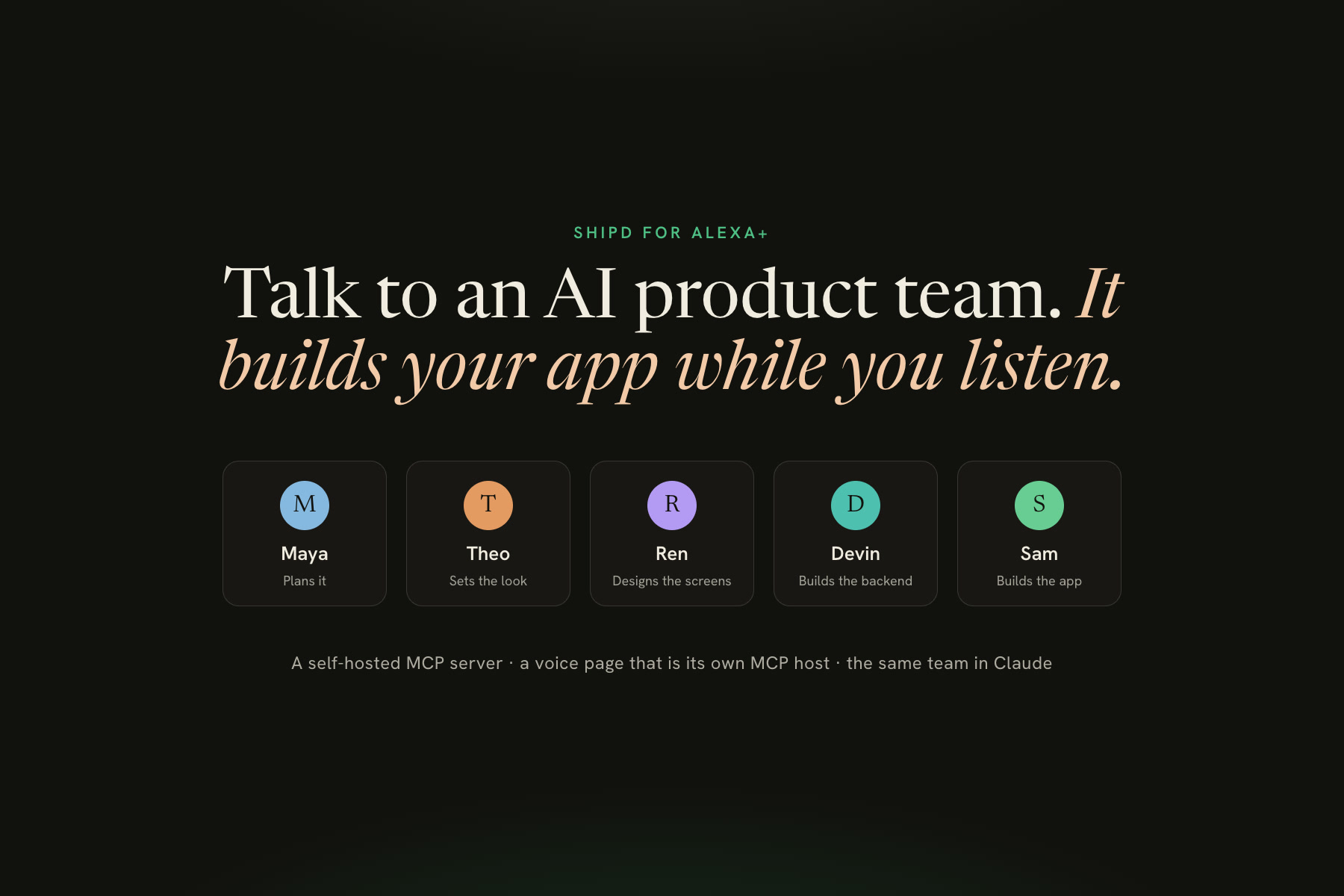
Shipd (theshipd.com) builds real apps from a description. Its AI Team works the way a small studio does: Maya writes the plan, Theo sets the art direction, Ren designs the screens, Devin builds the backend and Sam builds the app.
Before: you sat at a screen, typed a prompt into a builder and watched a progress panel.
Alexa+ asks a better question: what if you could just say what you want? A barber, a teacher or a shop owner should be able to describe their idea out loud, answer a question or two, and hear a team build it, the way they would talk to a real studio. They should also be able to say "make it darker" while the team is still working.
What it does
After: you open the voice page and talk.
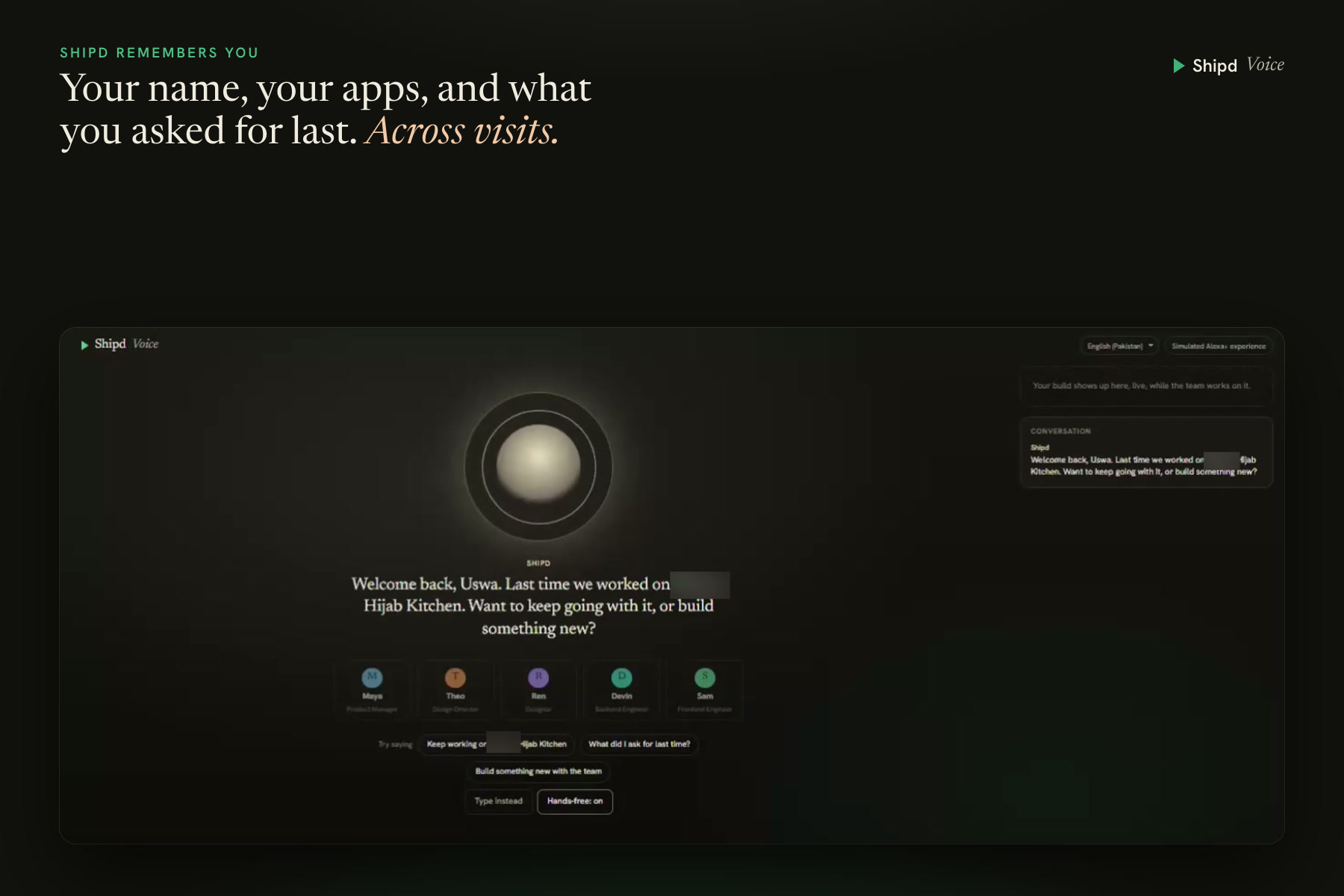
- Shipd remembers you. "Welcome back. Last time we worked on Fade Street. Want to keep going with it, or build something new?" It knows your recent apps and what you last asked for, across visits.
- You ask. "Build me a booking site for my barbershop, with the team."
- Shipd asks one question. Before it spends anything, it asks who the app is for and what it must have, with options written for your app. Answer by voice or by tapping.
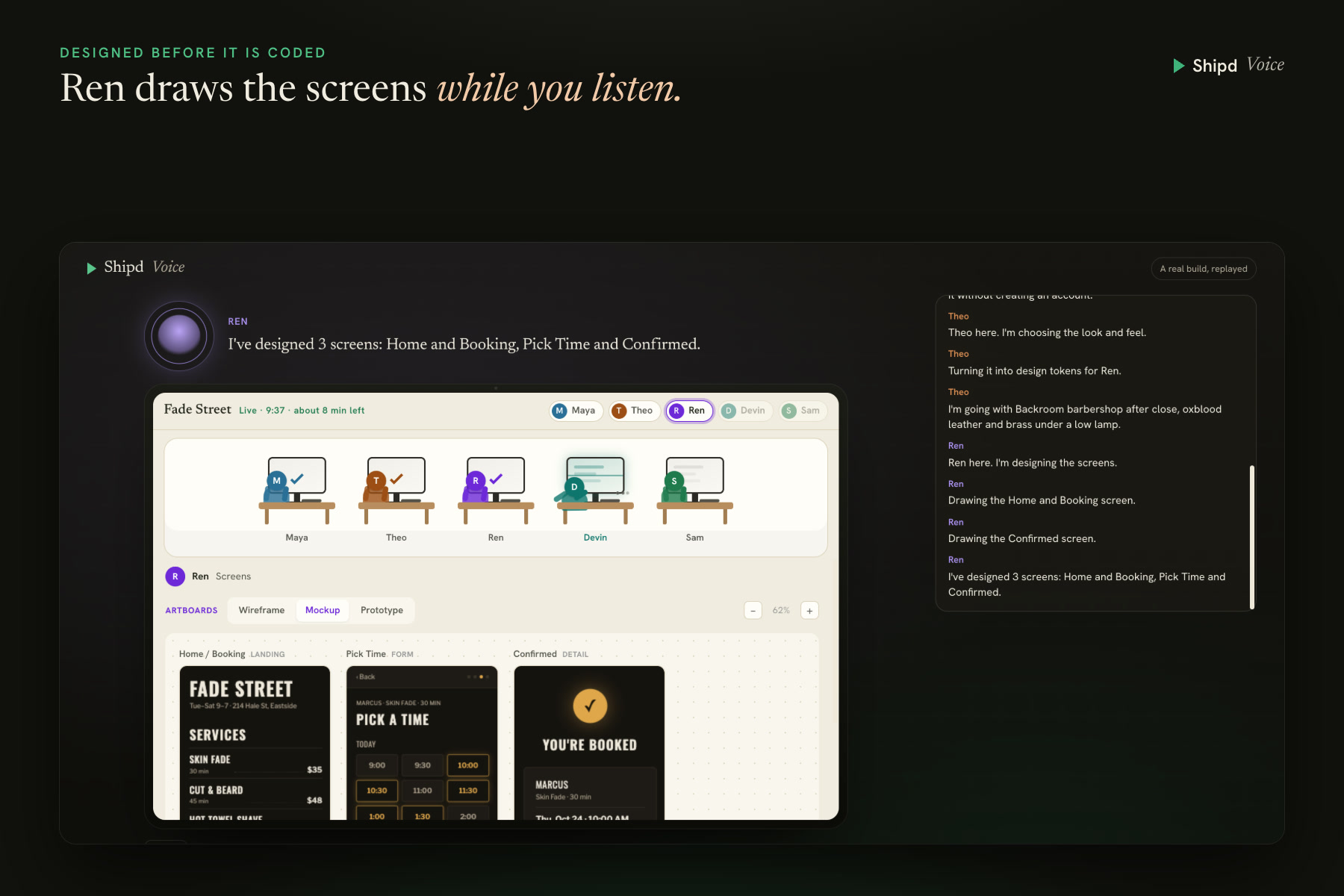
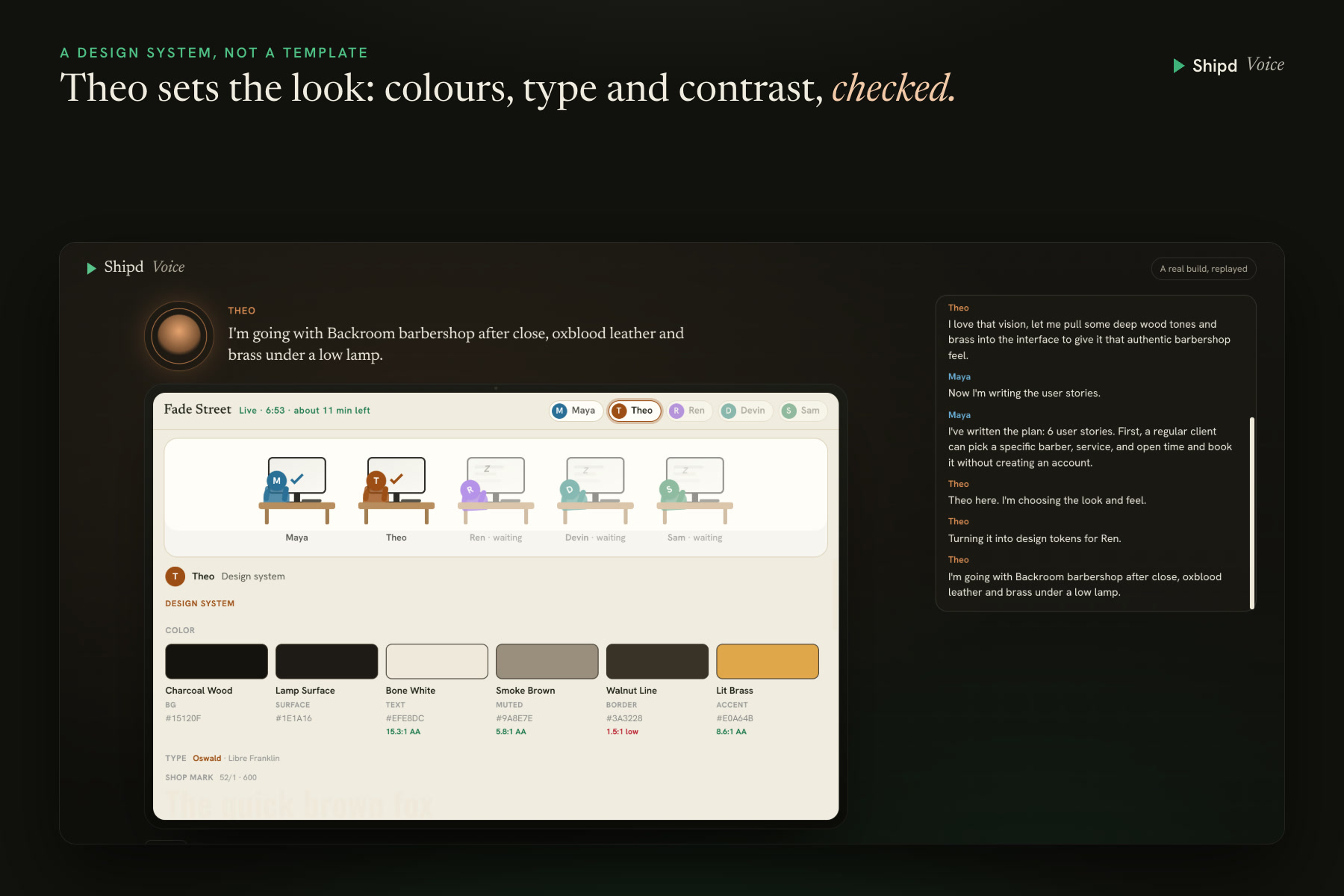
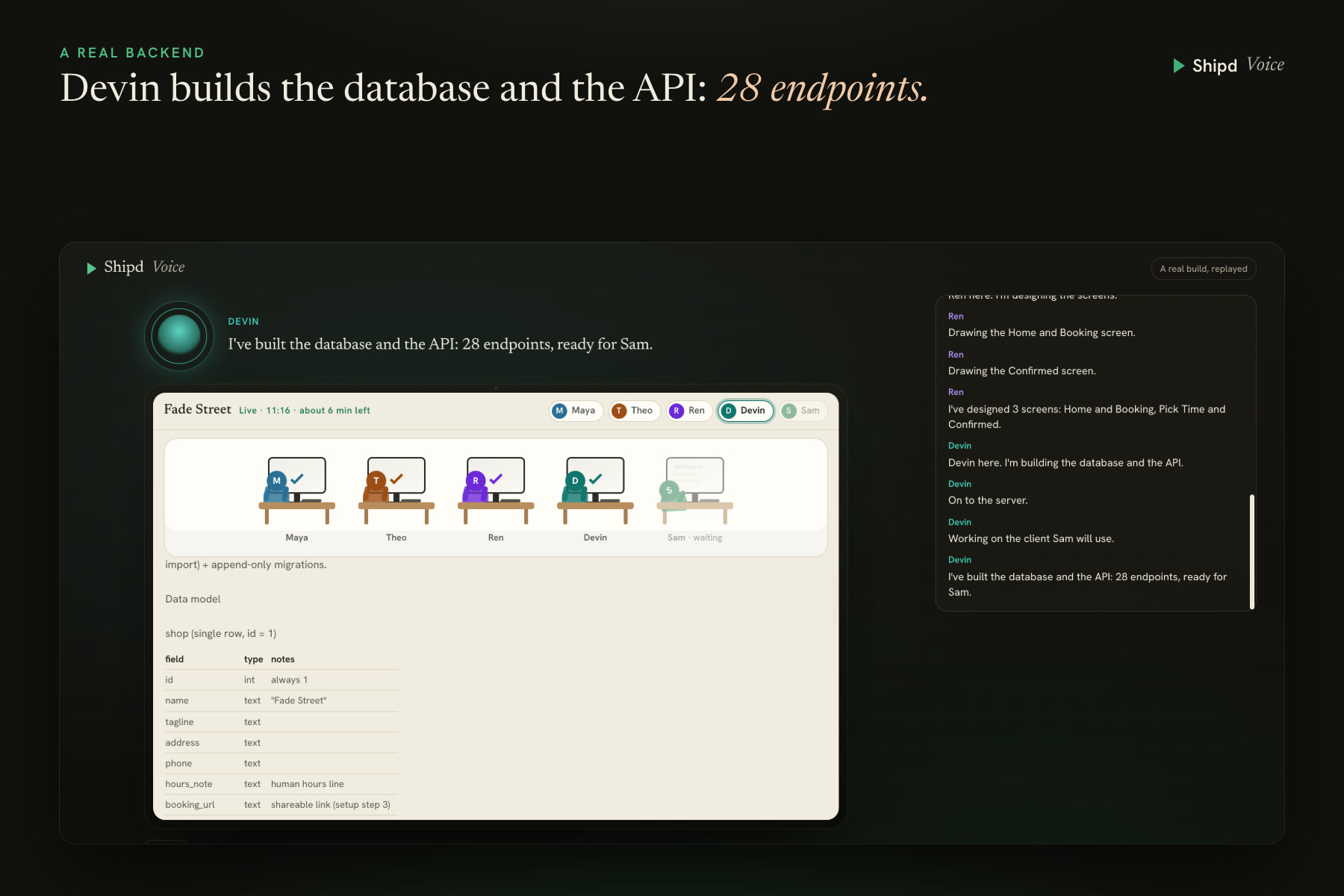
- The team builds it, out loud and on screen. Each person speaks in their own voice as they work ("It's for walk-in clients who hate waiting", "For colour, ink black with one brass accent"). Beside the conversation, an Echo Show style screen shows their actual work as it happens: Maya's plan as she types it and then her user stories, Theo's design system, Ren's screens, and the code Devin and Sam are writing.
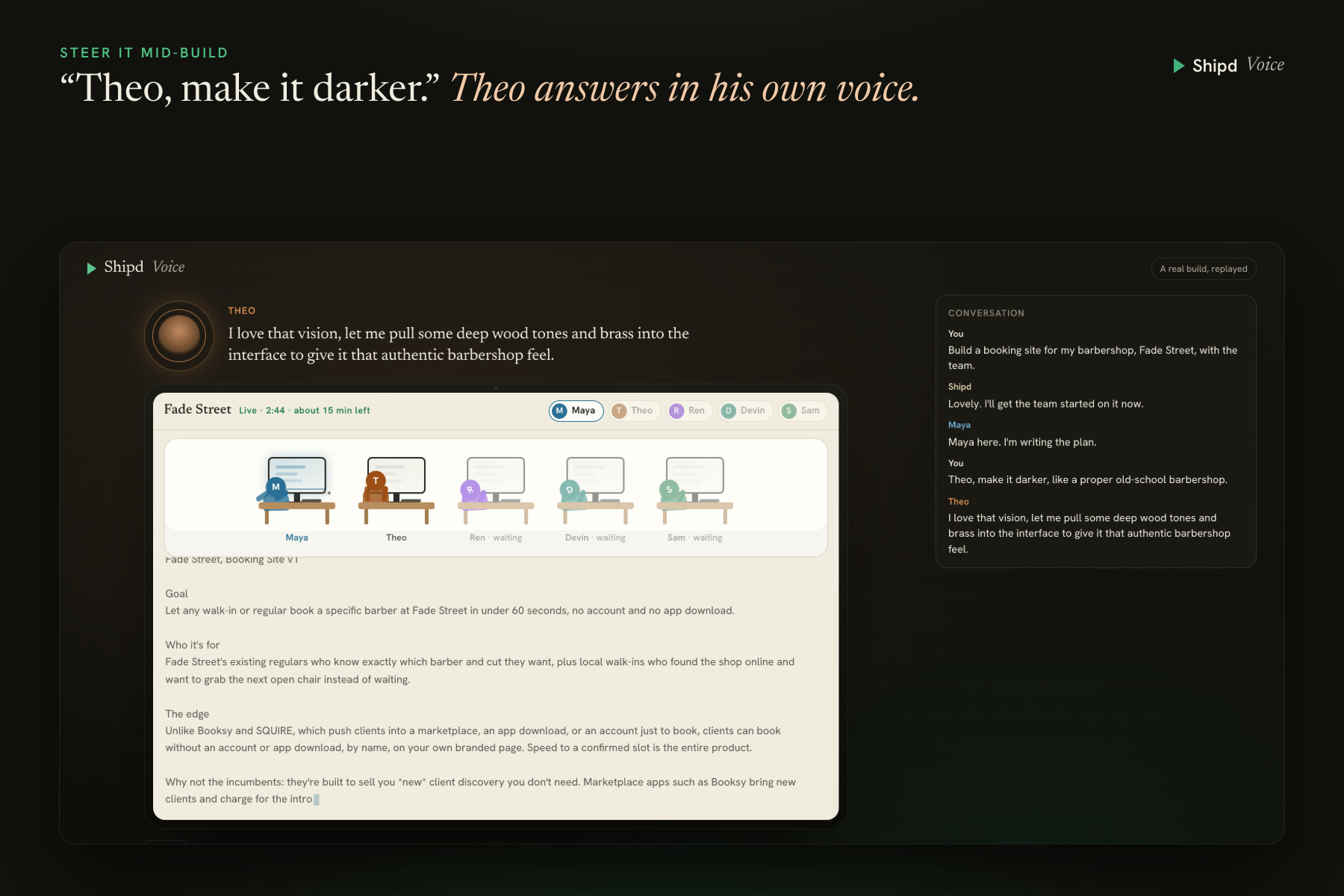
- You talk to them by name, mid-build. "Theo, make it darker." Theo answers in his own voice, honestly says who will carry it in ("My part's done, so I've passed it to Ren and Sam"), and the change lands in the rest of the build.
- You open it, change it, share it. "Open it." "Make the buttons gold." "Share it with my partner" gives a link anyone can open.
- You staff your own team. "I'd like to hire a copywriter called Ava." Shipd brings a candidate in to meet you, and she answers your questions in her own voice. Say "You're hired": she joins the team, right after Maya, and from your next build she writes her notes before Devin and Sam build from them. "Let Theo go" takes anyone off the team, and "bring Theo back" undoes it.
An agentic workflow, not single-turn Q&A. One spoken request orchestrates five AI teammates, plus anyone you hire, across services (Shipd's MCP server and builder, Claude and Amazon Polly), and Shipd keeps context across sessions: it remembers you, your apps and what you last asked for.
It is hands-free, like Alexa: after the first tap Shipd listens again by itself, you can interrupt at any time, and it starts answering about two seconds after you stop speaking.
The same MCP server in Claude. Add Shipd as a custom connector in Claude, sign in with your Shipd account, and say "build a booking site with the team". Claude asks the same question, a live card shows the team room (who is working, the team chat, a clock), and a Listen button plays the team in the same voices. In Claude's voice mode, which shows no card, Claude narrates the team's lines and points you to theshipd.com/live, where the same work view follows your build on any screen.
Real users, in their own words
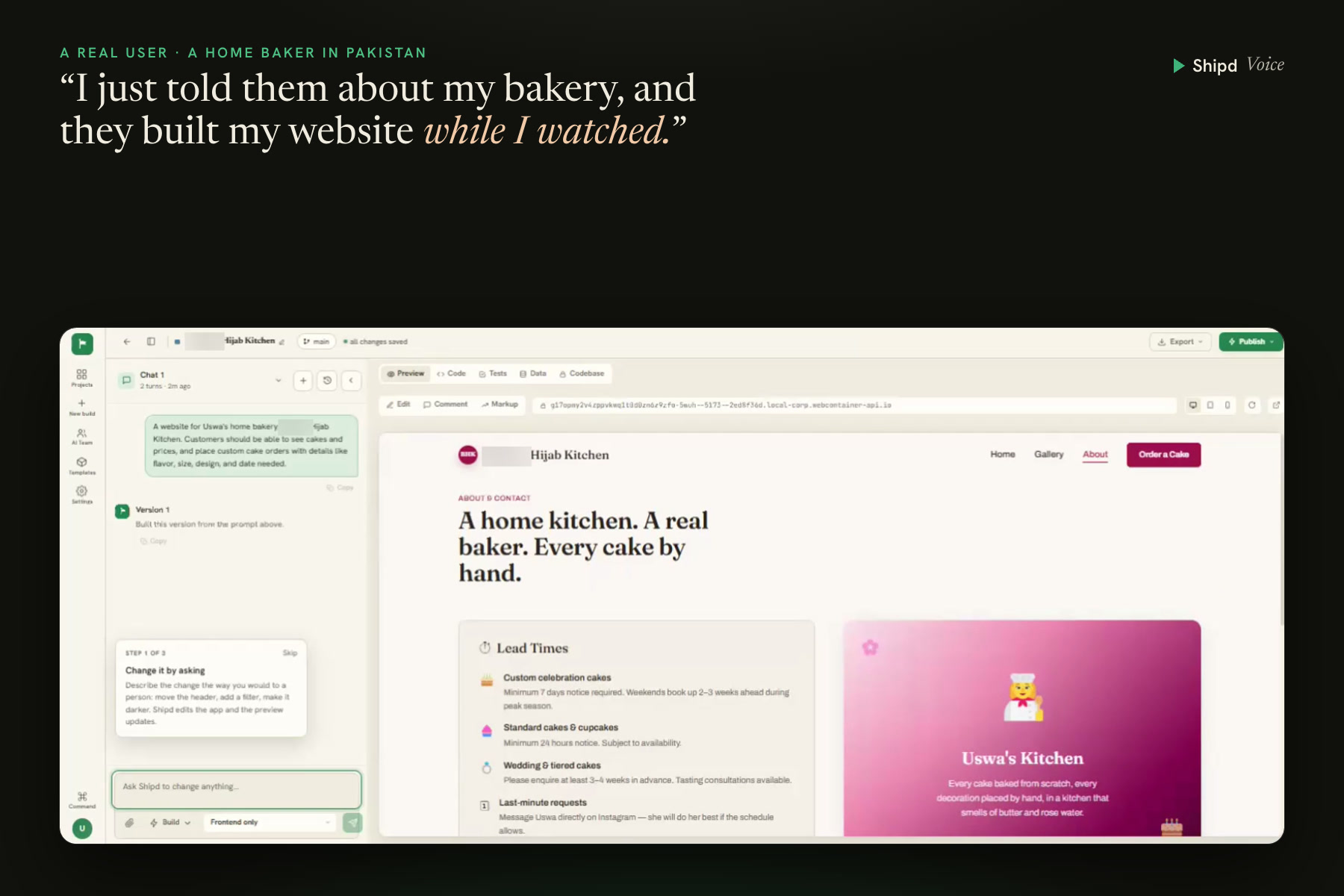
A home baker. On 16 October 2026 a home baker in Pakistan, who sells custom cakes, used Shipd for Alexa+ for the first time, on a video call, speaking English in her own accent. She asked: "Build a website for my bakery, with the team. People should see my cakes and prices, and order a custom cake for a date." The team wrote the plan (six user stories), set the look, designed four screens and built the site in about 8 minutes, talking her through it. Her words at the end:
"I just told them about my bakery, and they built my website while I watched."
When she came back later that evening, Shipd greeted her by name and remembered the app they had made together.
A legal-tech founder. In October 2026 the founder of CaseSage, a legal-tech startup, built the first version of his platform by talking to Shipd, recording himself on his own laptop. He asked for a legal platform where clients browse lawyers and consult the one they find suitable, and said he wanted it in navy blue and gold while the team was already at work; Theo answered in his own voice and passed it on. Shipd misheard the startup's name at first, so he said it again mid-build, and Ren renamed the product CaseSage without stopping. In about 16 minutes the team wrote six user stories, set the look, designed four screens (Directory, Lawyer Profile, Booking Confirmed and Client Dashboard), and Devin and Sam built the database, the API and the app. His verdict:
"I definitely use it for my startup, and I think that I don't need to hire a team of developers to build what I'm trying to make here."
And Shipd itself is live. 72 people have built apps on it so far; 133 have signed up, 62 of them in October 2026 (real external accounts only, counted on 20 October).
Why not just use Claude Code, Lovable or Bolt?
They are excellent, and they are made for someone at a keyboard: a developer in a terminal, or a person typing prompts into a browser and reading code or previews. Shipd for Alexa+ is made for the barber, the teacher and the shop owner who will never open a terminal, and who would rather just say what they want.
| Coding agents and app builders | Shipd for Alexa+ | |
|---|---|---|
| Who it is for | Developers, or people comfortable typing prompts | Anyone who can describe their idea out loud |
| How you use it | Typing, at a screen | Talking, hands-free, like Alexa |
| Who does the work | One assistant | A product team: plan, art direction, design, backend, build |
| Steering it mid-build | Stop it and start again | "Theo, make it darker," and Theo answers |
| Who is on the team | Fixed | Yours to staff: interview and hire a specialist, let anyone go, by voice |
| Before the code | Straight to code | User stories, a design system and designed screens first |
| Where it lives | Its own app | Inside the assistant you already use, through MCP |
| What you get | Code to run and host | A running app, saved, with a link to share |
And it is not a competitor to those assistants: through MCP, Claude itself can call Shipd's team, as our demo shows. When Alexa+ opens to builders, the same server becomes an Alexa+ add-on.
And why not Dots, Muse or Grok Bot?
OpenAI's Dots, Meta's Muse and xAI's Grok Bot, launched in August and September 2026, are general personal agents: they run errands, handle email and, among thousands of tasks, can build software. Shipd is the specialist that an assistant hands this one job to.
- Specialist, not generalist. One job, done end to end: a working, hosted app for a small business, with a plan, a design system, designed screens, a real database when it needs one, and a link to share.
- Open, not a walled garden. Each of those agents lives inside its own company's app. Shipd is an MCP server any assistant can call: Claude already does, and Alexa+ is the point of this entry.
- You see and steer the work. Five people work in the open, on screen and out loud, and you can redirect any of them mid-build instead of waiting for an agent to report back.
- Within reach. It works today on a free account, for a home baker in Pakistan. Muse launched in the US first, and Dots and Grok Bot on paid plans.
How we built it
The real Alexa+ MCP Toolkit is open to partners only, so we built the simulated Alexa+ experience the rules allow, and proved the same server in a second, real assistant. Every part is live on production.
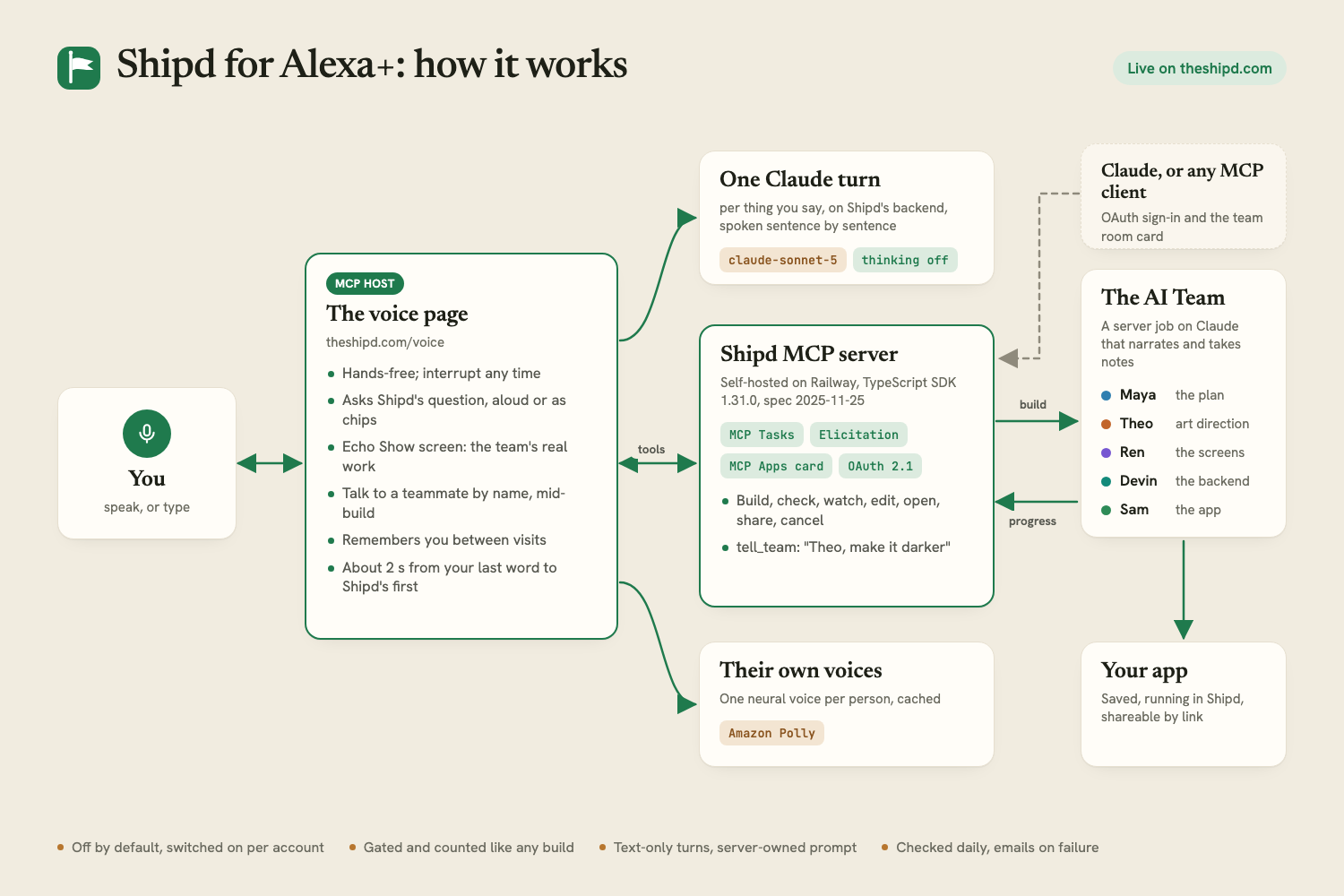
1. A self-hosted MCP server (TypeScript, official SDK 1.31.0, spec 2025-11-25, its own Railway service)
- Tools:
list_apps,build_app,build_with_team,check_build,watch_build,tell_team,edit_app,get_app_link,cancel_build,share_app,stop_sharing,speak_line(card only), and for staffing the team:team_roster,interview_candidate,hire_specialist,fire_teammate,rehire_teammate. - MCP Tasks for builds that take minutes; a client without Tasks hears at once that the build started and follows it with
check_build. - Elicitation (form mode) for the one clarifying question. Where a host has no forms (claude.ai), the tool descriptions have the assistant ask it instead.
- MCP Apps: a live build card that becomes a team room, addressed by a content hash so hosts never show a stale version.
- OAuth 2.1 for Claude: protected resource metadata (RFC 9728), authorization server metadata (RFC 8414), dynamic client registration (RFC 7591, stateless), PKCE S256, refresh token rotation and revocation (RFC 7009). Shipd API tokens for every other client.
- The server keeps no build state; every call is checked by Shipd's backend with the caller's own credentials.
2. The AI Team as a server job (Python, FastAPI)
- Maya, Theo, Ren, Devin and Sam each run on Claude, in order, and save real app versions.
- A narrator turns real milestones in each person's stream into short first-person lines. Nothing is invented.
- Each finished person's work is kept for the watchers (stories, design tokens, screens, API notes, files), and the person at work is visible as they write.
- Notes from the person ("Theo, make it darker") join every room that has not started; the person spoken to answers in one in-character sentence.
- Specialists you hire work right after the teammate they follow, through the same code the browser's Team Mode uses, and their notes go to the specialists after them, to Devin and to Sam. One who fails is said and skipped, and the build goes on.
3. The voice page (Next.js on theshipd.com), which is itself the MCP host
- Speech in: the browser's speech recognition, with "Type instead" as a fallback.
- One Claude turn per thing you say, streamed and spoken a sentence at a time.
- Speech out: Amazon Polly neural voices, one per person: Shipd (Danielle), Maya (Joanna), Theo (Matthew), Ren (Ruth), Devin (Gregory), Sam (Stephen), and Kendra or Joey for a candidate you interview or hire, through one queue so nobody talks over anybody.
- The Echo Show screen reuses Shipd's own builder components, so the work looks exactly as it does in the product.
Guardrails: everything is behind switches that are off by default and turned on per account. Voice turns are gated and counted like any build. The model receives text only, with a server-owned prompt and only Shipd's tools. A daily health check on a separate host emails us if anything a judge needs stops working.
Challenges we ran into
The highlights:
- Latency. The first version took about 19 s from the end of your sentence to Shipd's first sound, while the model needed about 1.5 s. We cut it to about 2 s: a faster model with thinking off, direct calls, streamed turns spoken a sentence at a time, and a warm-up before you speak.
- Claude's custom connectors take OAuth only. There is no field for a token, so we built a complete OAuth 2.1 authorization server, then had it security-reviewed.
- Hosts cache MCP Apps cards by address, so Claude kept showing an old card after we changed it. The card's address now carries a hash of its content.
- A reopened chat replays the original tool result, so the card looked like a fresh build starting again. It now asks where the build really is before showing anyone at work.
- Elicitation needs a session, which the SDK's stateless pattern cannot give, and nothing says so.
- Minutes of silence. The team's work carries no progress events, only text a few characters at a time, so we built a narrator that reads it.
- Accents. Chrome's speech recognition was fixed to US English, which misheard Pakistani English. We added an accent picker, guessed from the time zone, that falls back to the nearest accent the browser supports. In our first real session it still heard "bakery" as "battery".
- A deploy stops every build in flight. An unrelated merge killed our first demo recording 9.5 minutes in. We now freeze merges while recording or running a session with a real person.
Accomplishments that we're proud of
- Five AI specialists who build a real, running app while you listen, see their work, and talk to them by name.
- A team you staff by voice: in a production build, the copywriter we had just hired by interview wrote her notes, and her lines ("Who's doing your nails?", "When works for you?") appear word for word in the app Sam built.
- About 2 seconds from your last word to Shipd's first sound, measured on production.
- Every newer MCP feature in one server: Tasks, elicitation, MCP Apps and OAuth 2.1, working in our own host and in Claude.
- It is live on theshipd.com, not a mock-up, with a daily check that tells us when something breaks.
- A real build, replayed in 90 seconds with no account: theshipd.com/voice/demo. Fade Street took the team 15 minutes: a plan, a design system, three screens, a backend with 28 API endpoints and the app, with a mid-build note to Theo answered in his voice.
- Our first real users built by talking: a home baker in Pakistan made her bakery's website, and a legal-tech founder made the first version of his platform.
What we learned
- In a voice product, speed is the design. Every second of silence reads as "it's broken".
- Measure before you optimise. The model was 8% of the wait.
- Show the real work. Narrating and displaying what actually happened beats any invented progress bar.
- Two services that deploy separately must tolerate each other's versions: our voice backend once refused a tool the MCP server had just added.
- Test with real people early. One session with a home baker taught us more about accents, and about when people start talking, than a week of our own testing.
What's next for Shipd for Alexa+
- A real Alexa+ device as soon as the MCP Toolkit opens to developers.
- A ChatGPT connector on the same server.
- More languages, with Polly voices for each teammate.
- A quicker team mode for short apps.
Built With
- amazon-polly
- amazon-web-services
- anthropic-claude
- express.js
- fastapi
- mcp-apps
- model-context-protocol
- next.js
- node.js
- oauth2
- postgresql
- python
- railway
- react
- redis
- supabase
- typescript
- vercel
- web-speech-api
- webcontainers

Log in or sign up for Devpost to join the conversation.