-
-
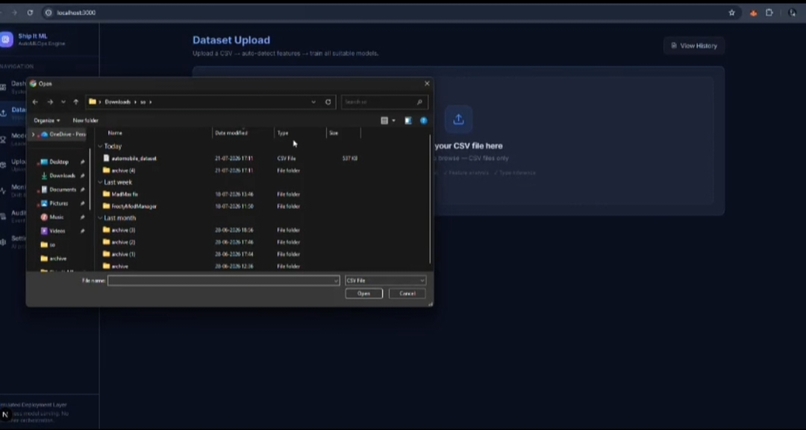
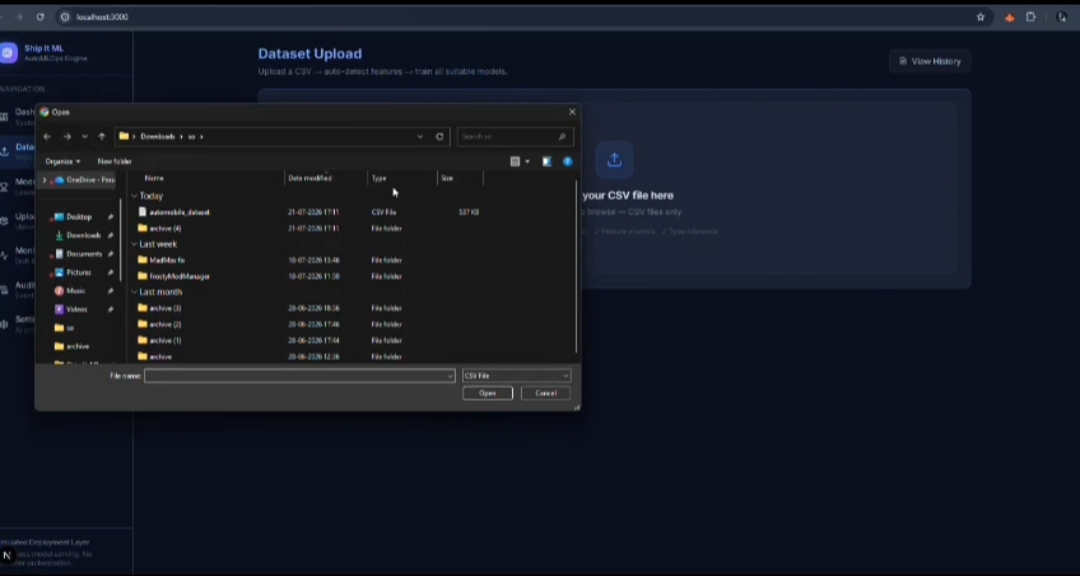
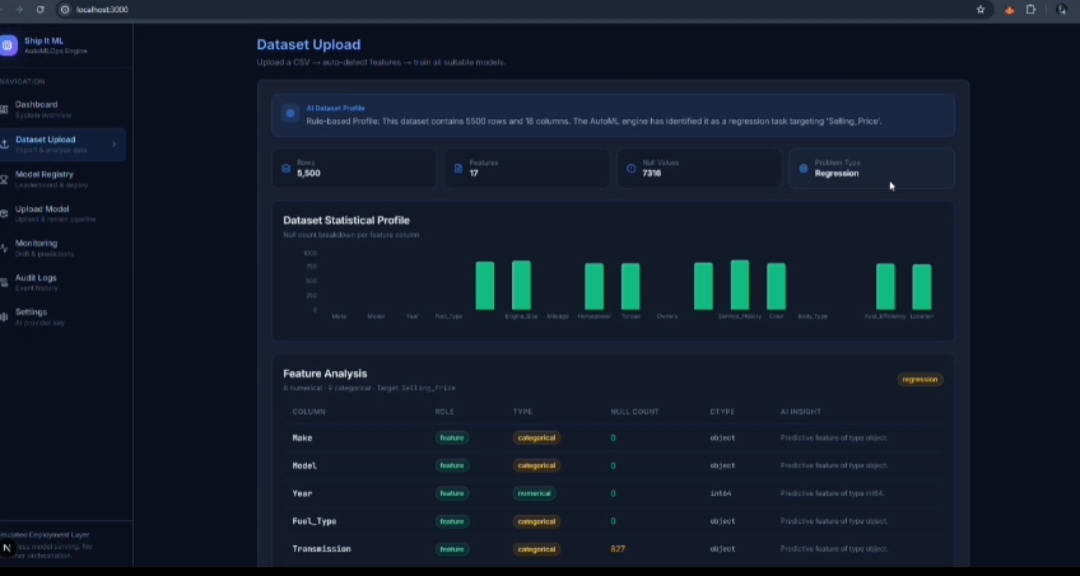
We can select datasets such as CSV files for automated training
-
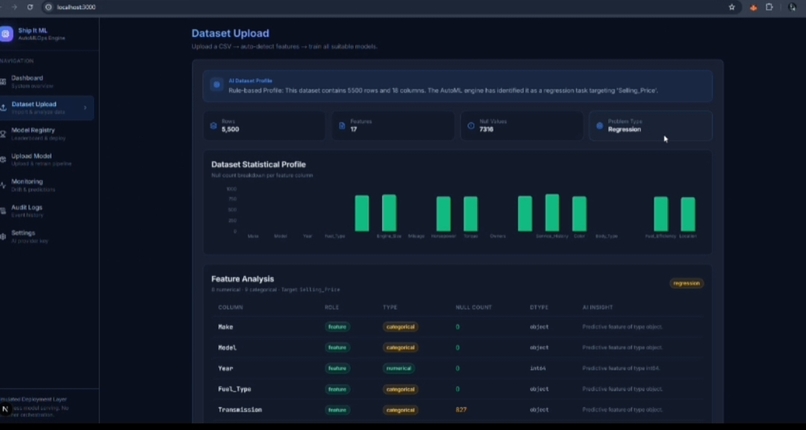
After uploading the dataset, it displays the Dataset Statistical Profile and Feature Analysis.
-
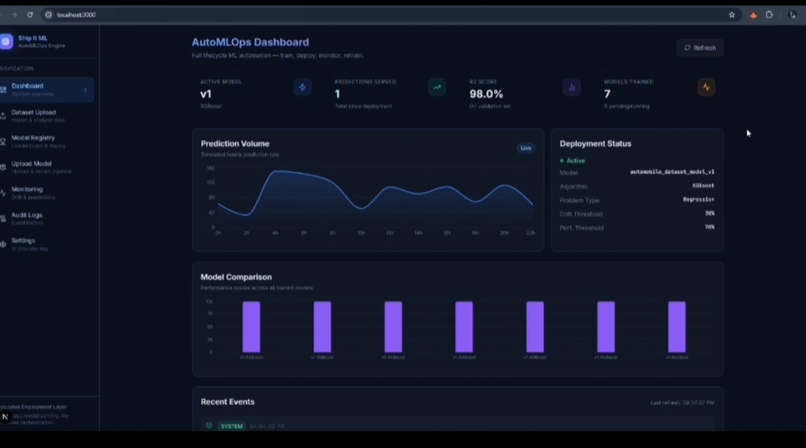
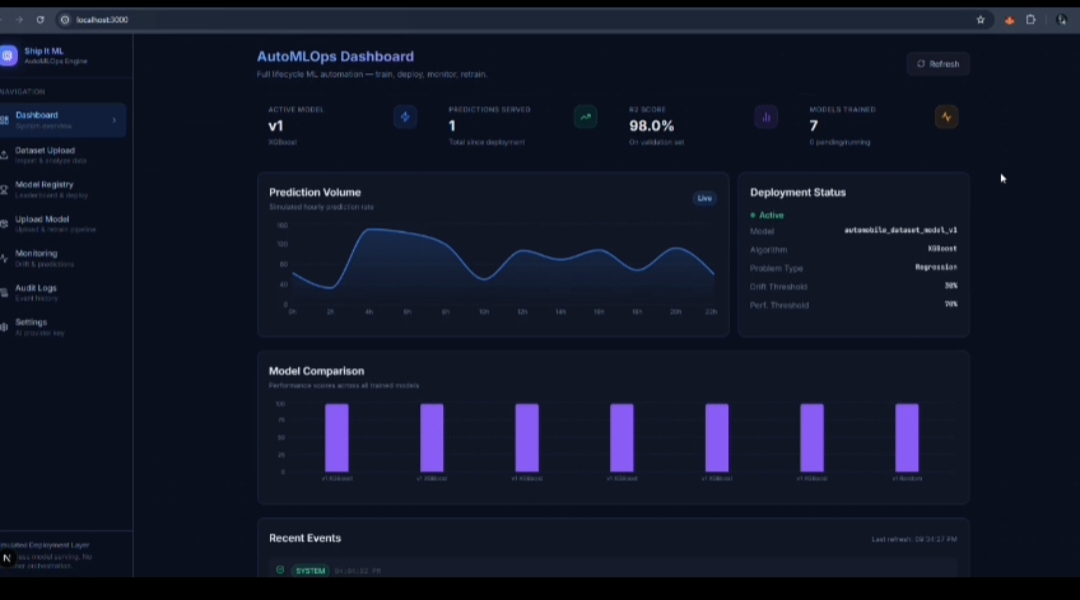
Ship IT-ML dashboard here we could check the prediction volume and Model comaprsion
Inspiration
Building a machine learning model is only the beginning. In real-world applications, teams need to handle data changes, model performance, deployment, monitoring, and retraining continuously. We wanted to solve this problem by creating Ship IT-ML, an AutoMLOps platform that automates the complete ML lifecycle.
1.Reduces manual ML deployment and maintenance work 2.Automates repetitive machine learning workflows 3.Helps maintain model performance after deployment 4.Makes the ML lifecycle easier to manage
What it does
Ship IT-ML acts as an automated ML engineer. Users provide a dataset, and the platform analyzes the data, selects suitable algorithms, trains and evaluates models, and identifies the best-performing model. The system can then deploy, monitor, detect drift, and retrain the model when required.
1.Dataset analysis and preprocessing 2.Automatic algorithm selection 3.Multiple model training and comparison 4.Best-model selection 5.Experiment and model tracking 6.Model deployment 7.Performance monitoring 8.Data and model drift detection 9.Automated retraining
How we built it
We combined machine learning with MLOps tools to create an end-to-end automated pipeline. The system separates the different stages of the ML lifecycle so that models can move smoothly from experimentation to deployment and continuous monitoring.
- Backend:Python and Flask
- ML: Scikit-learn and automated model training
- Experiment Tracking: MLflow
- Data Versioning: DVC
- Deployment: Docker
- Automation: CI/CD/CT workflows
- Monitoring: Model performance and drift detection
- Pipeline: Data → Training → Evaluation → Deployment → Monitoring → Retraining
Challenges we ran into
The biggest challenge was making the system flexible enough to work with different datasets and machine learning problems. Connecting automated training with deployment, monitoring, drift detection, and retraining also required careful workflow design.
- Handling different dataset structures
- Automating model selection
- Maintaining reproducibility
- Connecting multiple MLOps stages
- Detecting changes in data and model performance
- Designing reliable automated retraining
Accomplishments that we're proud of
We are proud of building more than just an AutoML system. Ship IT-ML connects AutoML with MLOps, creating a continuous workflow from raw data to a monitored and maintainable deployed model.
- Built an end-to-end AutoMLOps workflow
- Automated model training and comparison
- Integrated experiment and model tracking
- Added deployment and monitoring capabilities
- Implemented drift detection
- Created an automated retraining workflow
What we learned
This project helped us understand that a machine learning model is not complete when training finishes. A production ML system requires continuous management, monitoring, and improvement.
1.Practical CI/CD/CT concepts 2.Model and data versioning 3.ML experiment tracking 4.Containerized deployment 5.Model monitoring 6.Drift detection 7.Automated retraining 8.End-to-end ML lifecycle management
What's next for Ship IT-ML
Our next goal is to make Ship IT-ML more autonomous and scalable. We want the platform to make more intelligent decisions throughout the ML lifecycle while supporting production-level deployments.
1.AI agents for autonomous ML pipeline management 2.Advanced data and model drift detection 3.Champion-vs-challenger model evaluation 4.Explainable AI for model decisions 5.Cloud-based deployment 6.Real-time monitoring and alerts 7.Support for more ML algorithms and datasets 8.Fully automated continuous training and deployment
Built With
- ci/cd
- ci/ct
- docker
- dvc
- git
- github
- grafana
- machine-learning
- mlflow
- python
- scikit-learn


Log in or sign up for Devpost to join the conversation.