-
-
icon
-
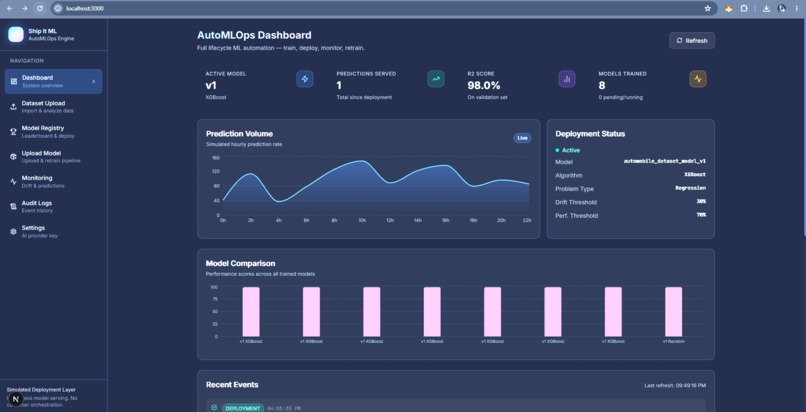
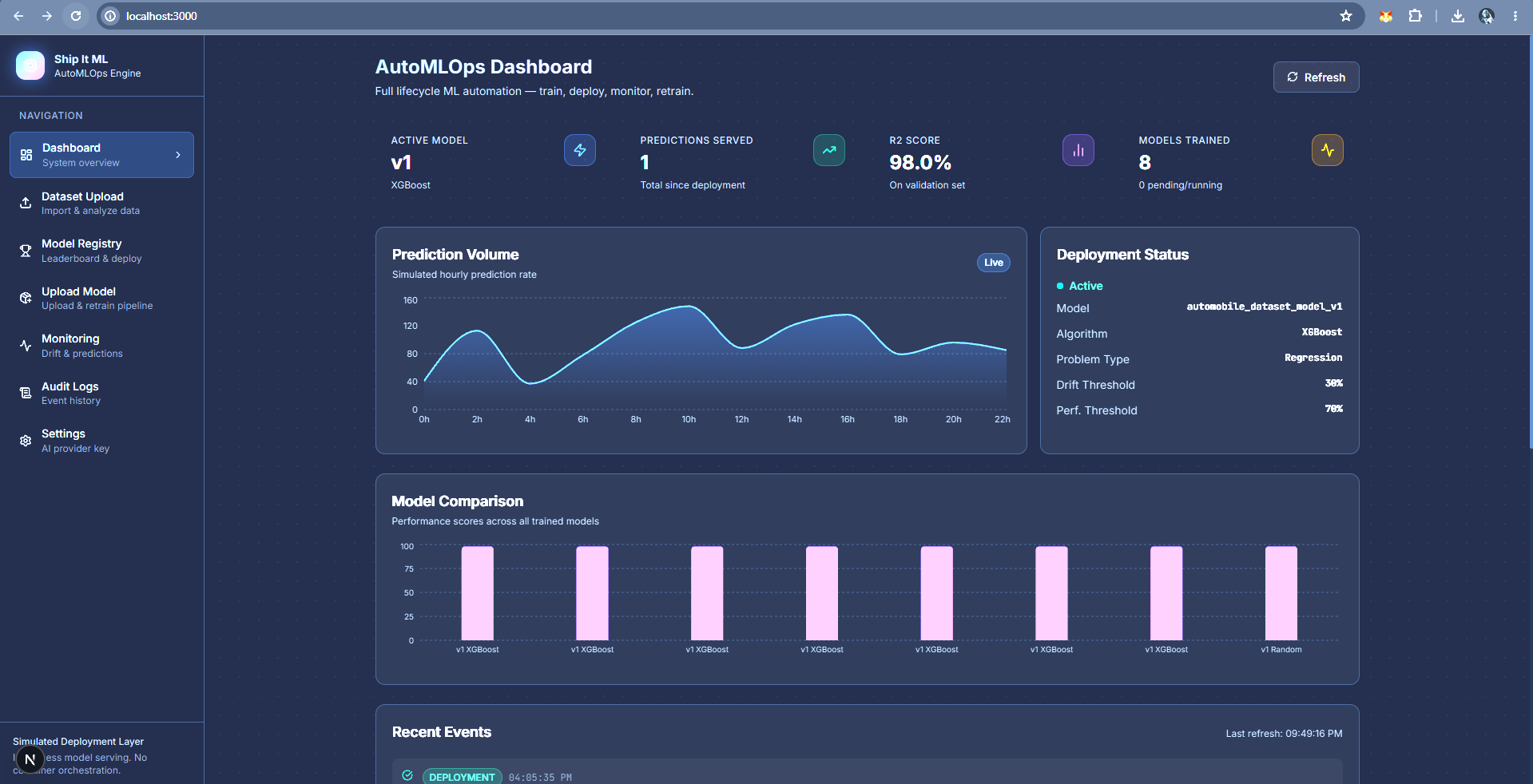
dashboard
-
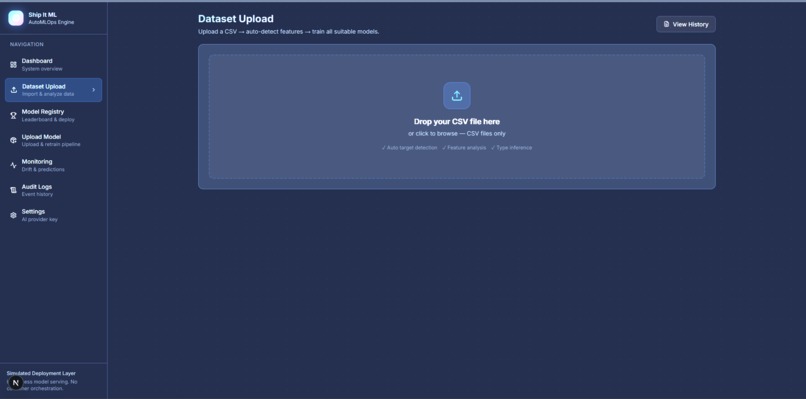
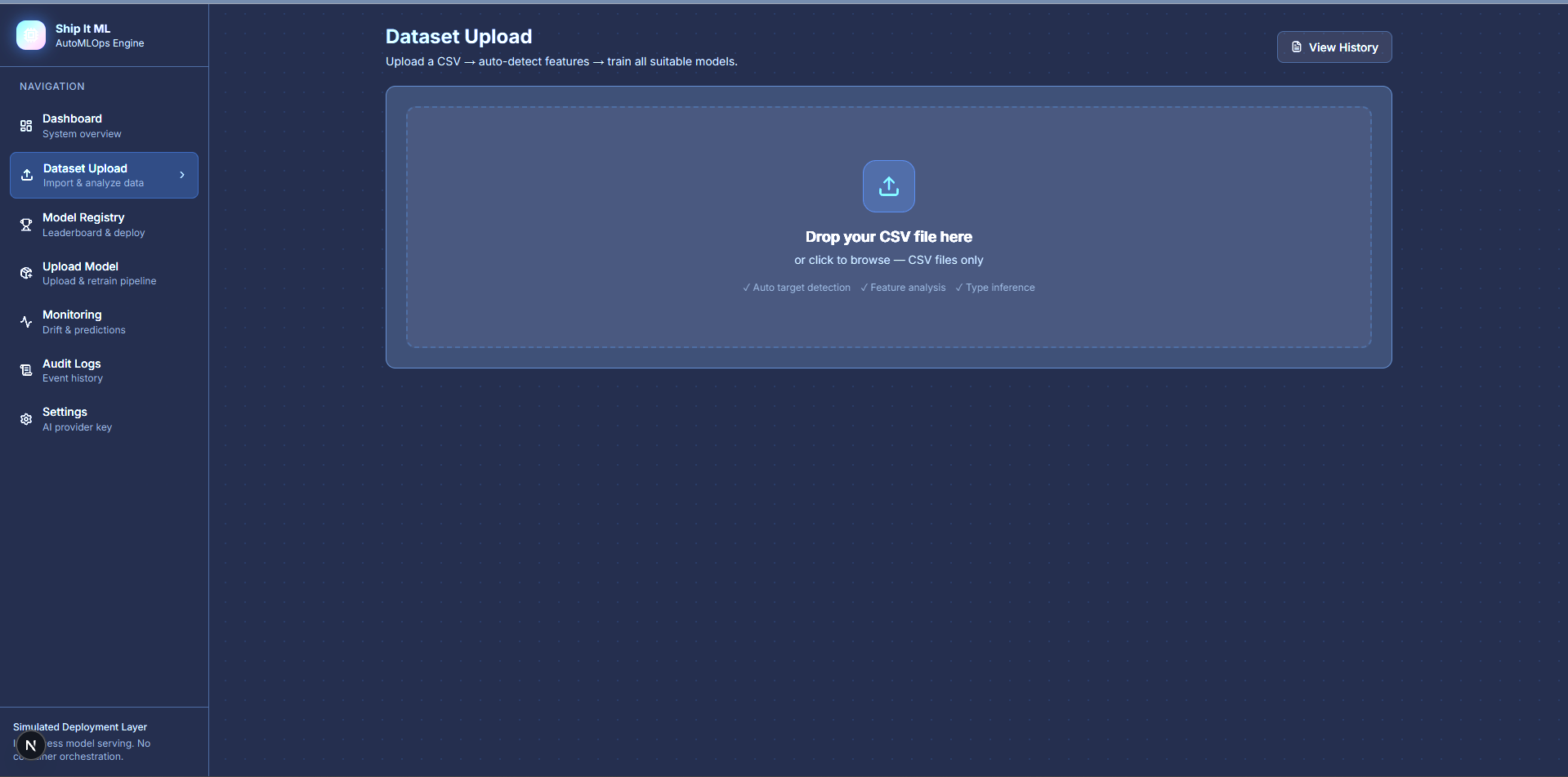
Upload any CSV data set here
-
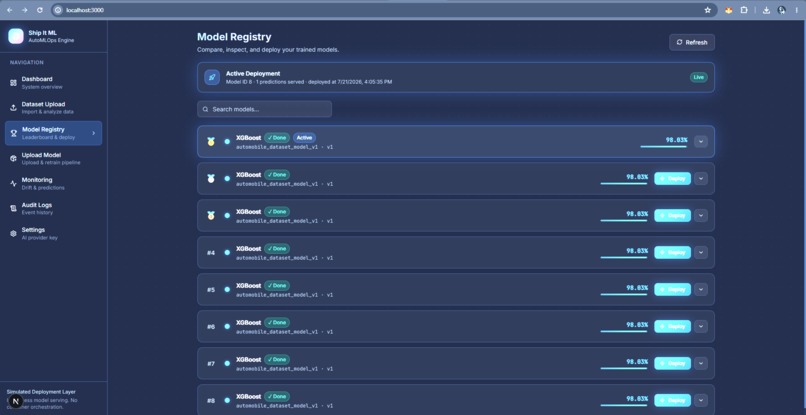
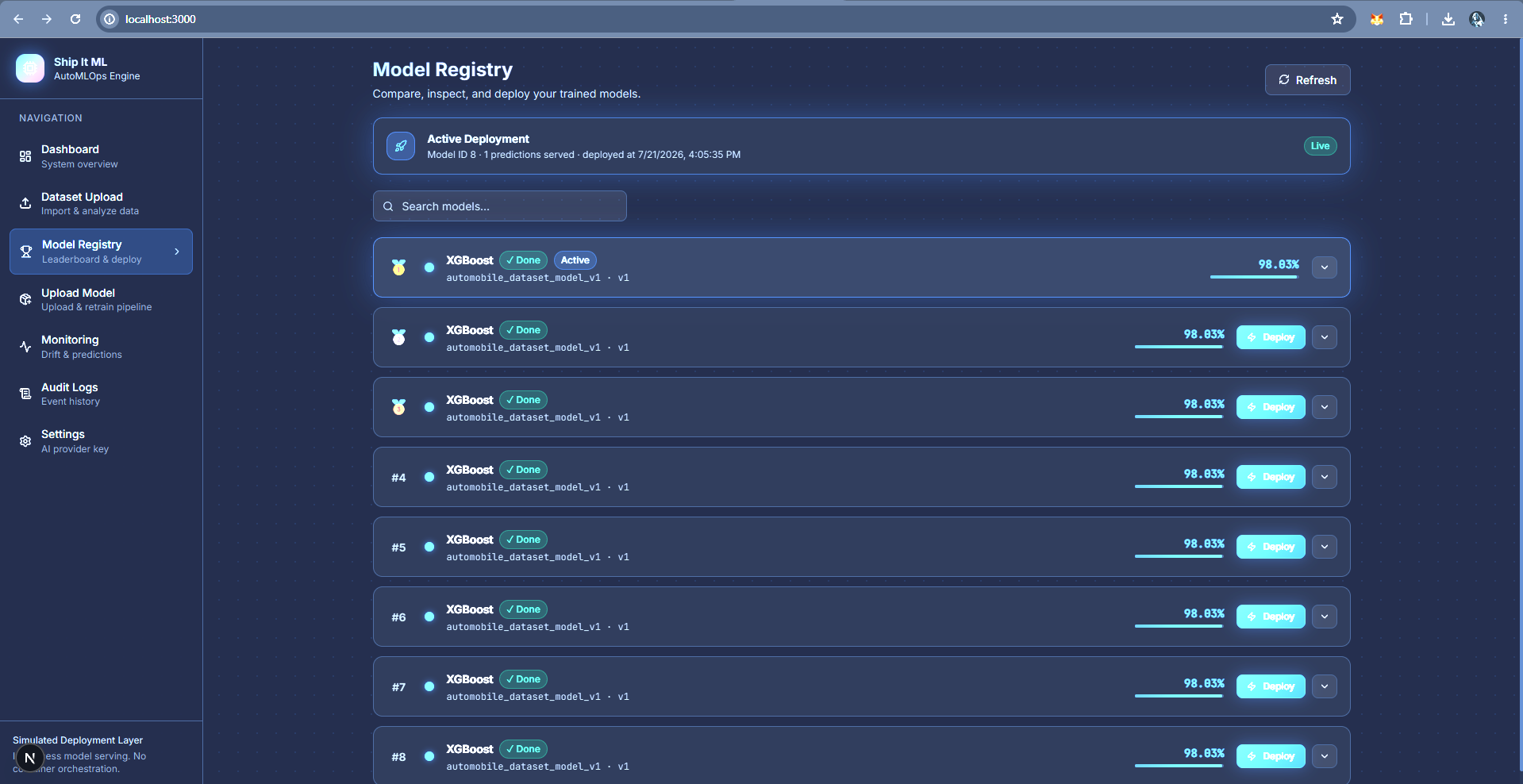
trained ml models will be here
-
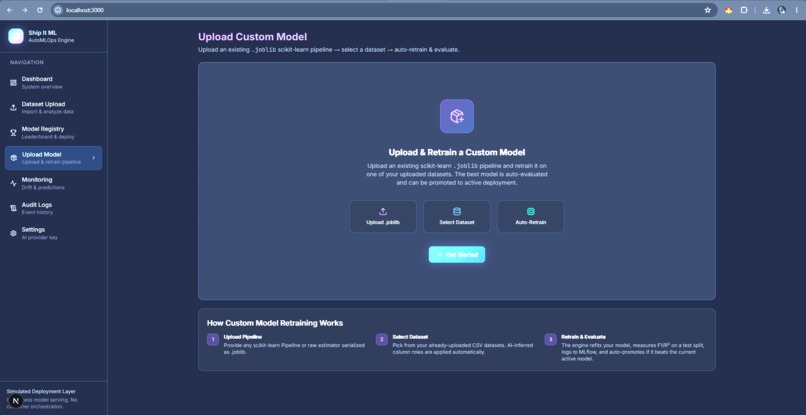
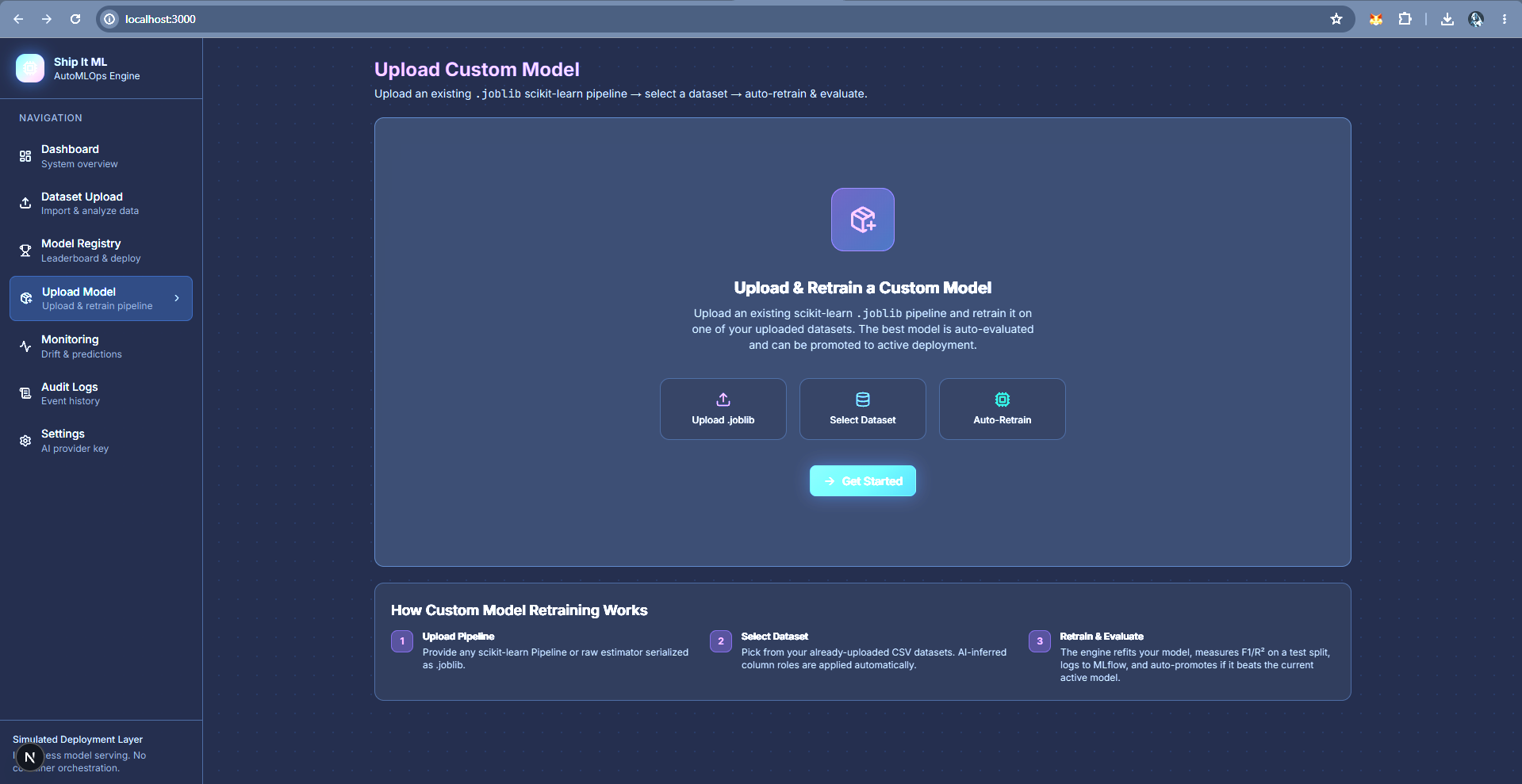
here we can upload a ml model and updated data set to retrain it
-
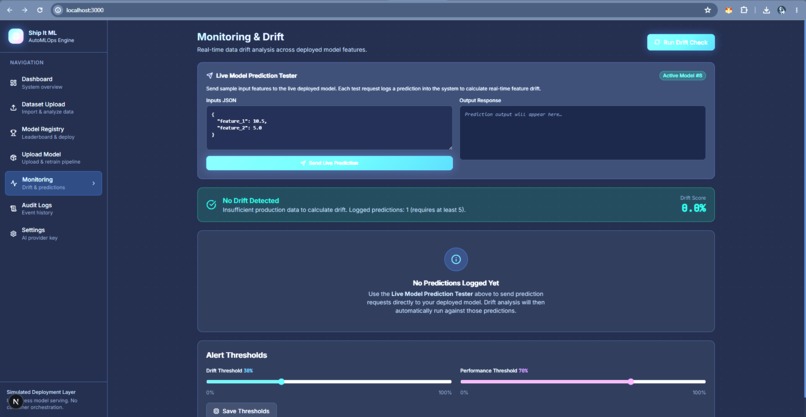
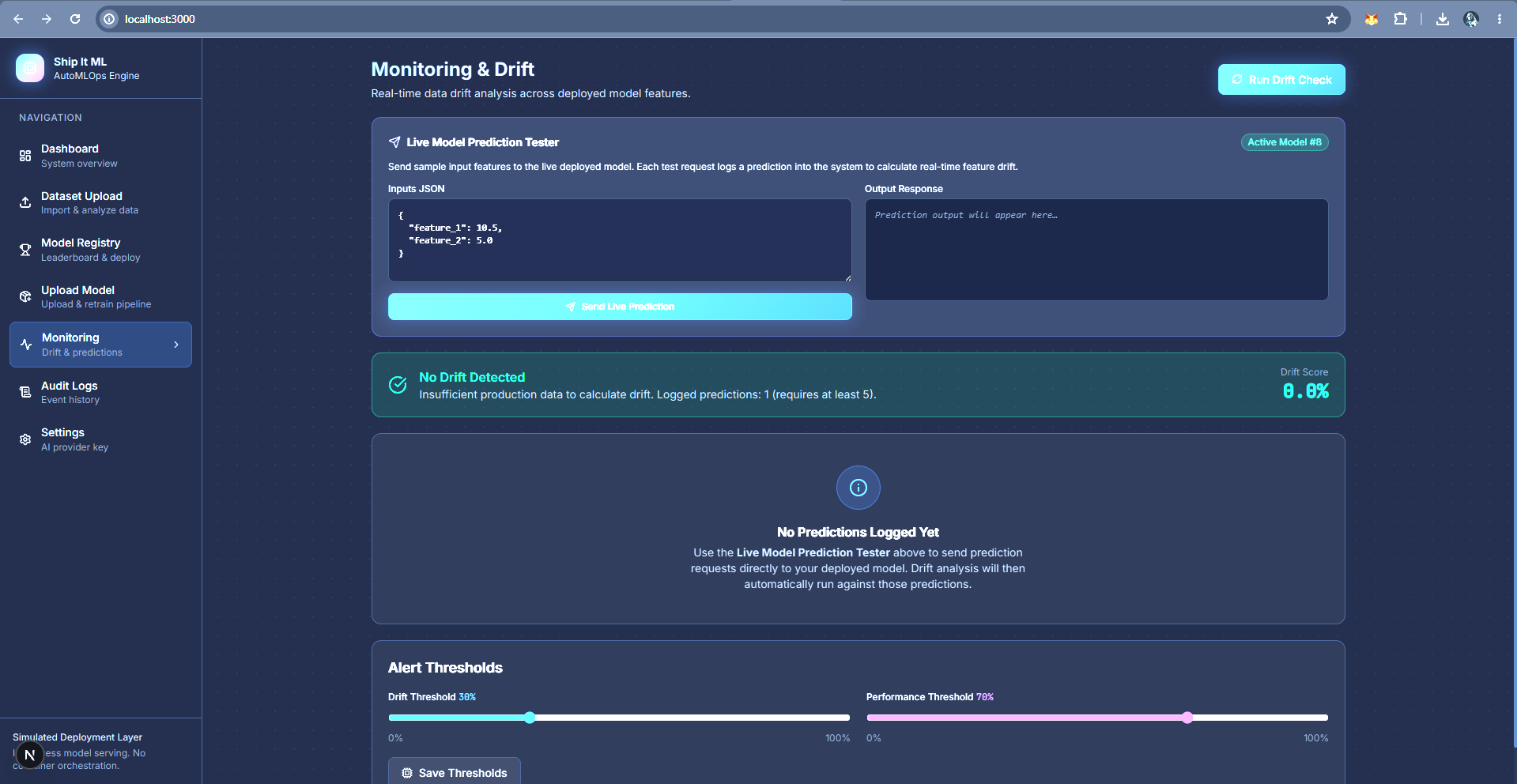
here data drift is monitored upload 5 json inputs to calculate data drift
-
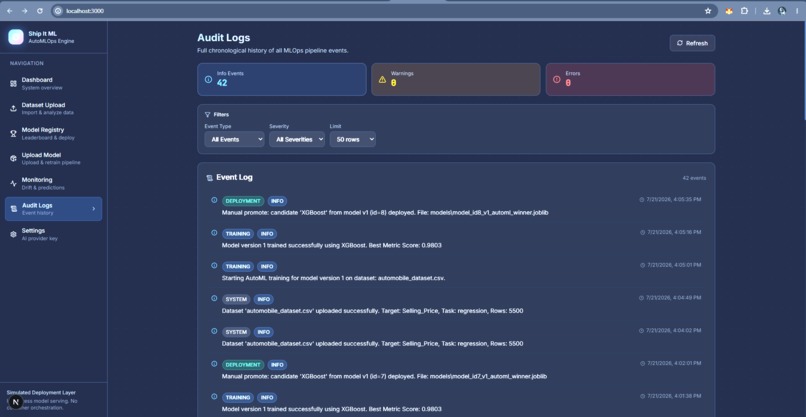
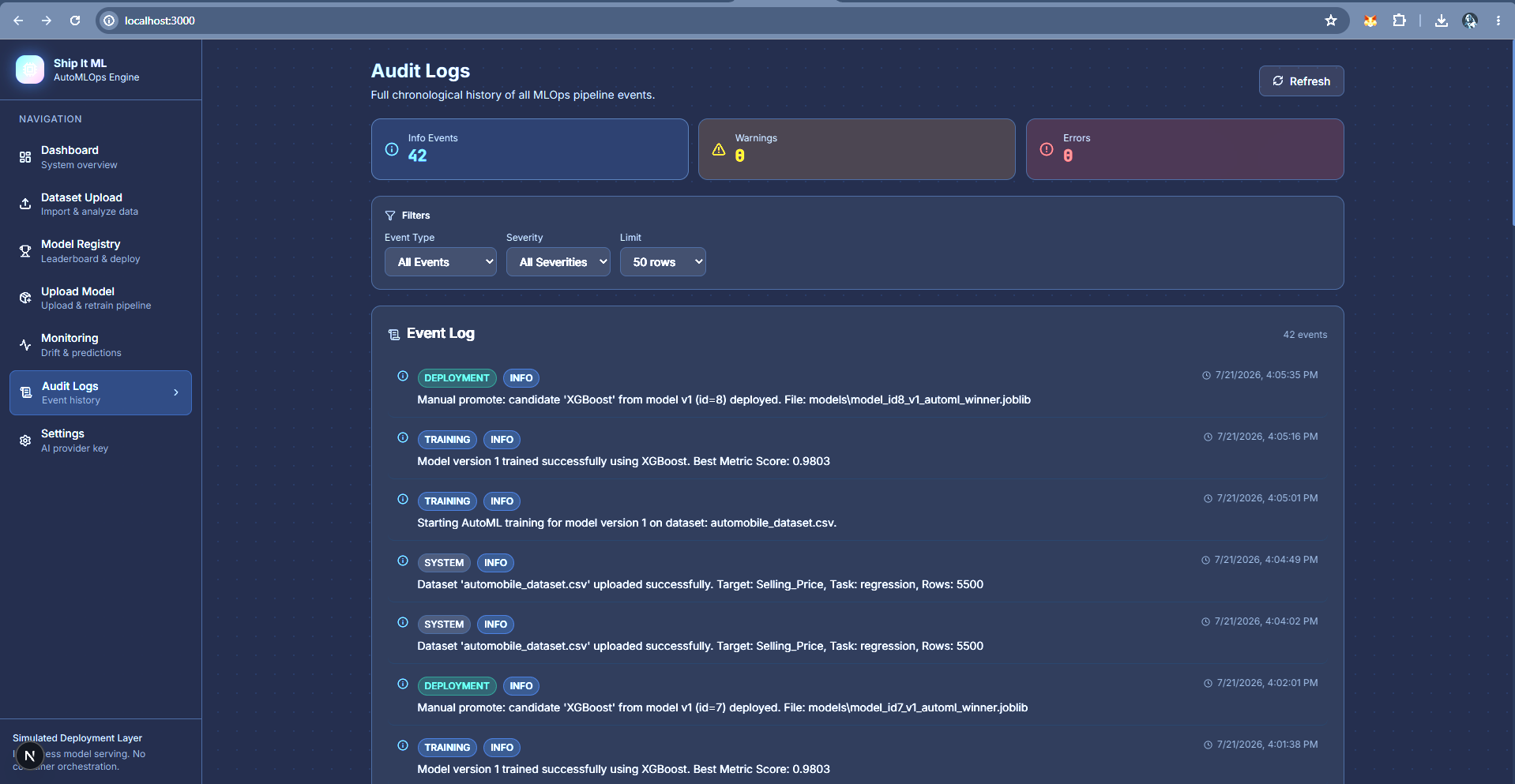
each and every task done will be logged here
-
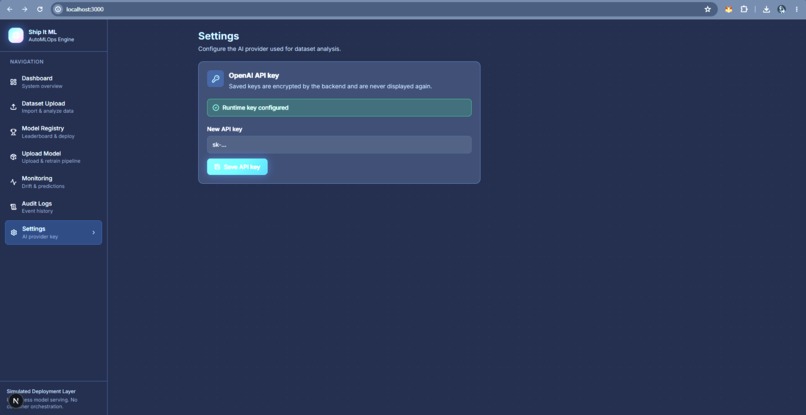
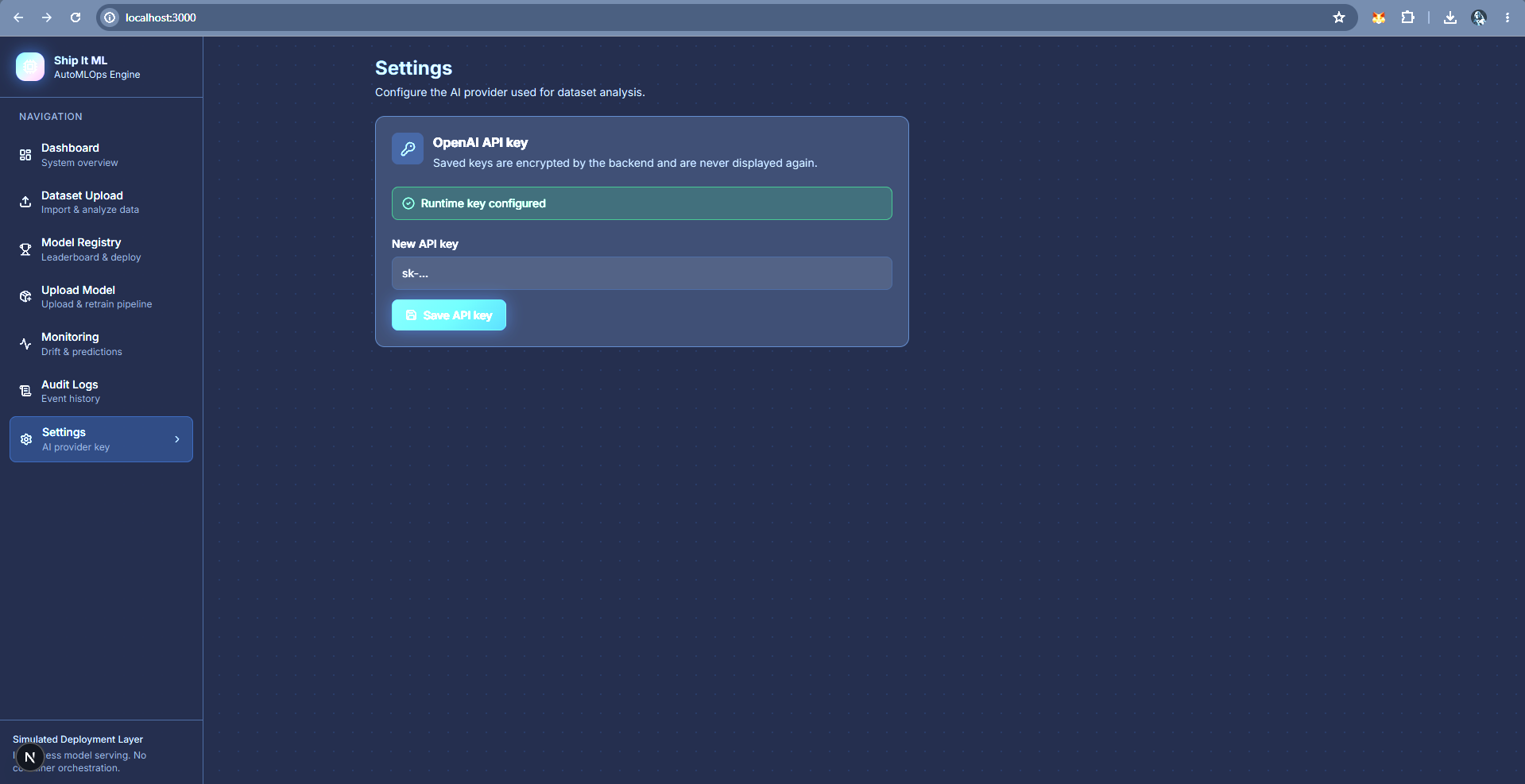
provide the open api key here
Inspiration
Building a machine learning model is only the beginning. The real challenge starts after deployment—monitoring model performance, detecting data drift, managing versions, and retraining when the model becomes stale. Most existing workflows require multiple disconnected tools, making MLOps difficult for students, indie developers, and small teams.
We wanted to simplify that process by creating a single platform that automates the entire machine learning lifecycle—from training to deployment, monitoring, and retraining—so developers can focus on building intelligent applications instead of managing infrastructure.
What it does
Ship-It ML is an end-to-end AutoMLOps platform that streamlines the complete lifecycle of machine learning models.
🚀 AutoML Training
Upload a dataset and automatically train multiple machine learning algorithms including:
- Random Forest
- XGBoost
- LightGBM
- Decision Tree
- Logistic Regression
The platform evaluates every model and automatically selects the best performer based on validation metrics.
📦 Model Registry & Deployment
Every trained model is versioned and stored in a centralized registry, making it easy to compare, deploy, and roll back models whenever needed.
📊 Live Prediction API
Once deployed, models can receive live prediction requests directly through the application.
📈 Real-Time Drift Detection
Incoming production data is continuously compared against the original training distribution. When significant feature drift is detected, the system alerts the user before prediction quality begins to degrade.
🔄 Automated Retraining
If drift exceeds a configurable threshold, Ship-It ML automatically launches a retraining pipeline, evaluates the updated model, and prepares it for deployment.
🤖 AI Dataset Insights
Using GPT-5.6, Ship-It ML analyzes uploaded datasets and generates:
- Plain-language summaries
- Dataset quality reports
- Missing value analysis
- Feature observations
- Actionable recommendations
If no API key is configured, the application falls back to a heuristic analysis so the feature remains usable.
📜 Audit Logs & Monitoring
Every important action—including deployments, predictions, retraining events, and model changes—is recorded for transparency and debugging.
How we built it
The frontend was built using Next.js, creating a responsive dashboard for dataset uploads, model management, monitoring, and deployment.
The backend uses FastAPI with SQLAlchemy to expose REST APIs and manage model metadata, prediction logs, and deployments.
Our machine learning pipeline leverages:
- scikit-learn
- XGBoost
- LightGBM
- pandas
- NumPy
GPT-5.6 powers our AI Dataset Insights feature, transforming raw datasets into readable summaries and recommendations.
Codex accelerated development by helping us:
- scaffold backend API endpoints
- integrate GPT-powered dataset analysis
- build and refine the AutoML pipeline
- implement drift detection logic
- troubleshoot frontend/backend integration
- optimize and refactor production code during development
Challenges we ran into
One of the biggest challenges was making the entire pipeline work automatically rather than as independent features.
Detecting feature drift reliably required establishing baseline statistics from training data while simultaneously collecting live production predictions. Designing a system that could accurately compare these distributions without generating false positives took multiple iterations.
Another challenge was orchestrating the retraining workflow. Once drift is detected, the application must retrain models, compare performance against the current production model, register a new version, and prepare it for deployment—all while keeping the dashboard synchronized.
Integrating multiple ML libraries with a consistent training interface and presenting the results cleanly in the frontend also required significant refinement.
Accomplishments that we're proud of
We're proud that Ship-It ML works as a complete end-to-end MLOps workflow instead of demonstrating isolated features.
A user can:
- Upload a dataset
- Automatically train multiple models
- Select the best-performing model
- Register and deploy it
- Send live prediction requests
- Monitor prediction statistics
- Detect feature drift
- Automatically retrain when needed
- Review every deployment through audit logs
We're especially happy with the AI-powered dataset insights, which make uploaded datasets immediately understandable without requiring users to manually inspect every feature.
What we learned
This project taught us that MLOps is far more than model training.
We gained practical experience with deployment pipelines, version management, monitoring production models, and handling model drift—topics that are often overlooked in traditional machine learning projects.
We also learned how AI coding assistants like Codex can dramatically accelerate development by helping scaffold APIs, debug integration issues, and speed up implementation, allowing us to focus more on architecture and product design.
What's next for Ship-It ML
We see Ship-It ML evolving into a complete production-ready MLOps platform.
Our roadmap includes:
- Support for deep learning models (TensorFlow & PyTorch)
- Explainable AI with SHAP and LIME
- Time-series forecasting support
- Automated hyperparameter optimization
- Kubernetes-based deployment
- Multi-user workspaces and team collaboration
- Role-based authentication
- Cloud model serving
- Advanced monitoring dashboards
- Email and Slack notifications for drift and retraining events
- CI/CD integration for continuous model deployment
Our goal is to make production-ready MLOps accessible to everyone—from students building their first ML application to startups deploying models at scale.
Built With
- ai
- codex
- database:
- evidently
- fastapi
- gpt5.6
- lightgbm
- lucide-icons
- mlflow
- next.js-16-(react-19
- numpy
- pandas
- pydantic-v2
- recharts)-backend:-fastapi-(python-3.10+)
- sqlalchemy
- sqlite
- tailwind-css-v4
- uvicorn-ml-&-analytics:-scikit-learn
- xgboost

Log in or sign up for Devpost to join the conversation.