-
-
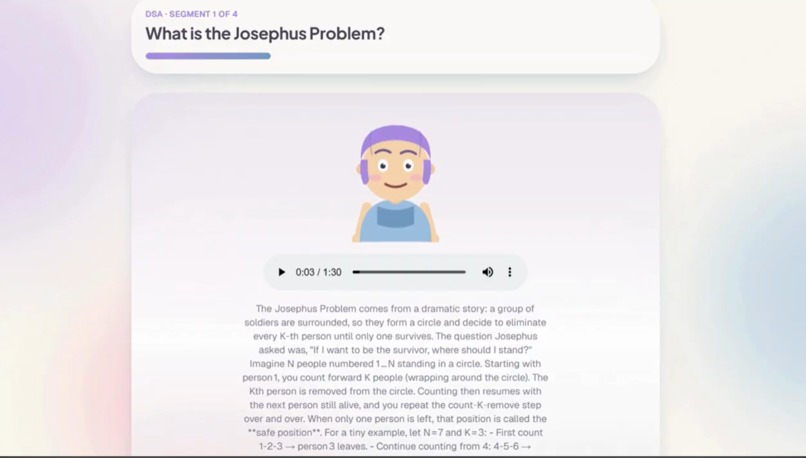
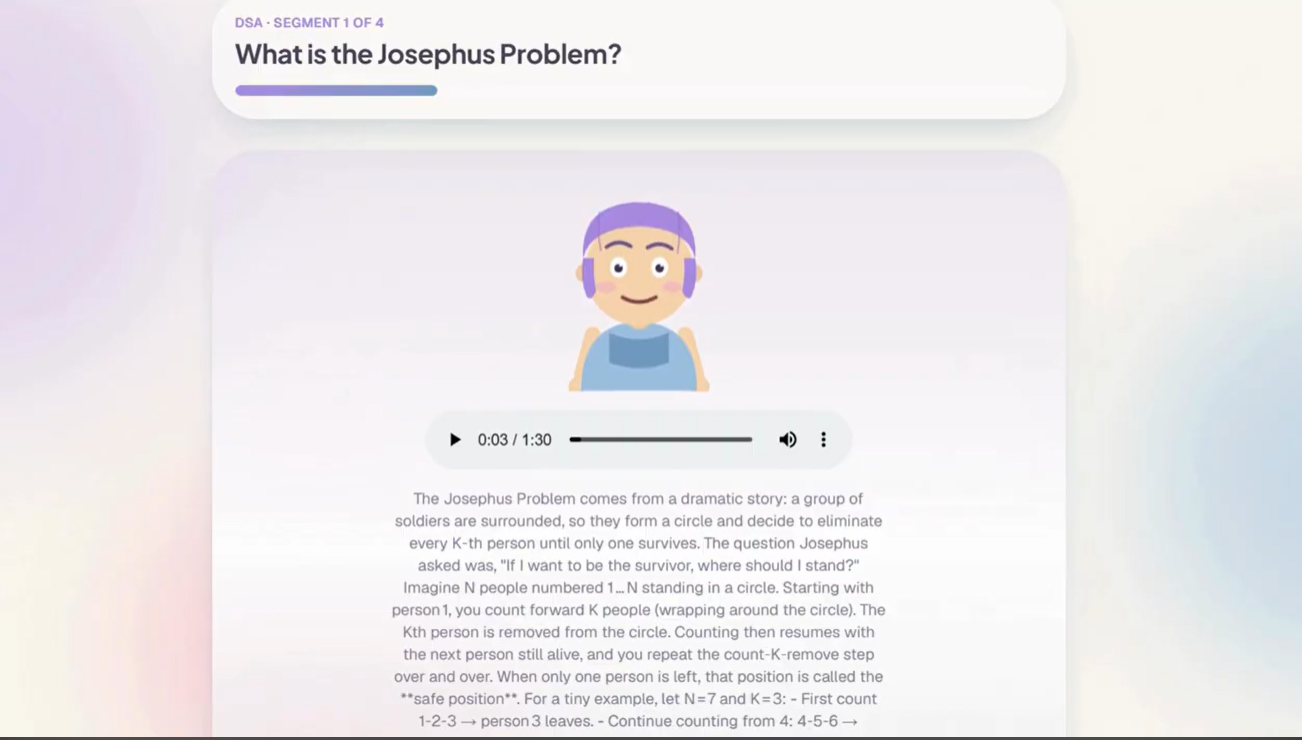
our teacher
-
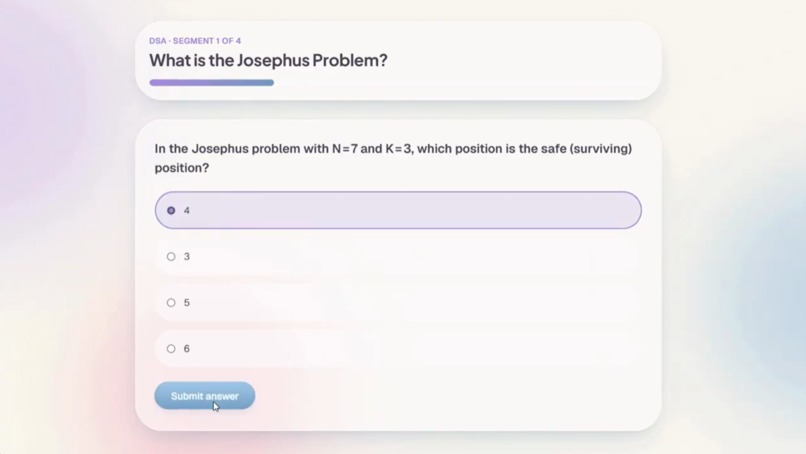
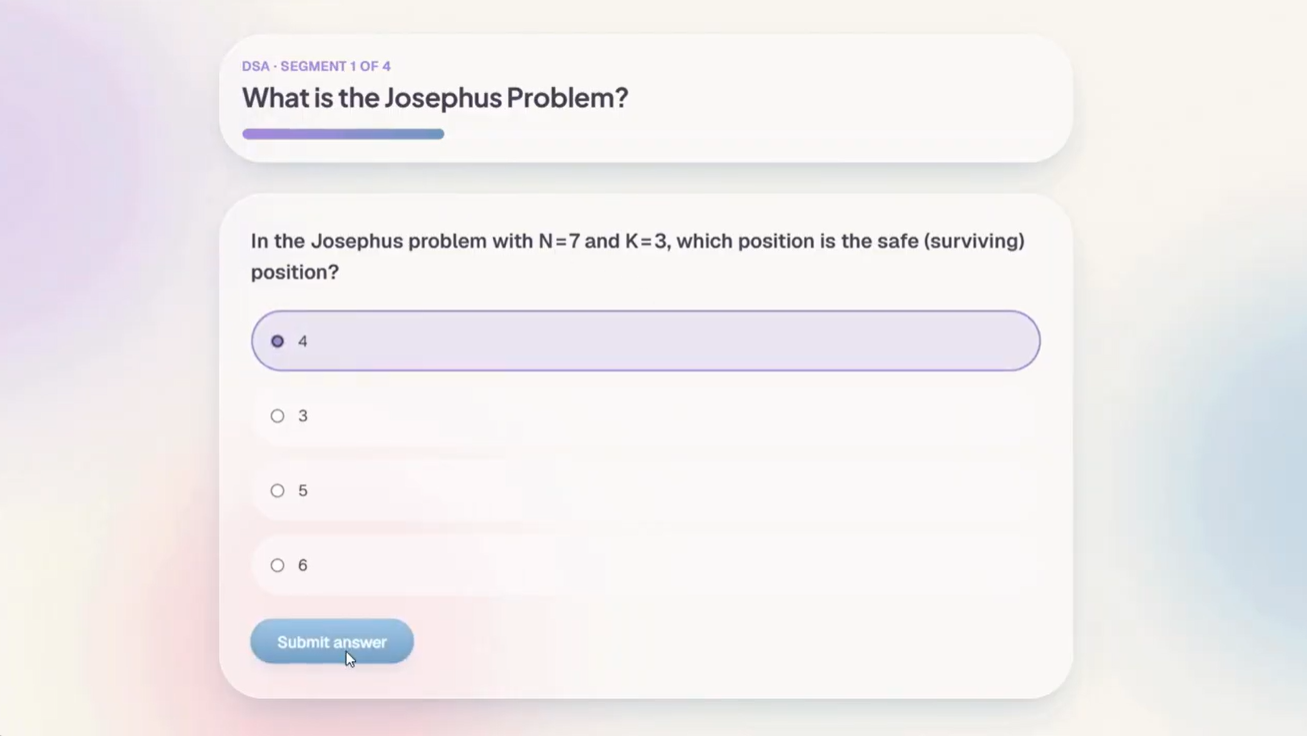
personalised tests
-
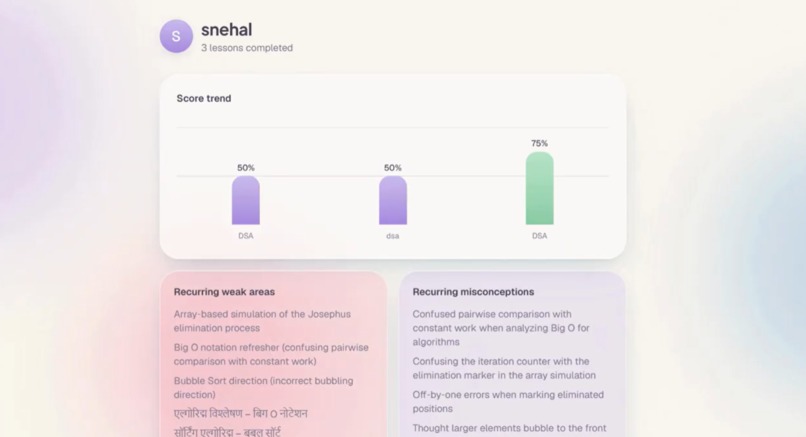
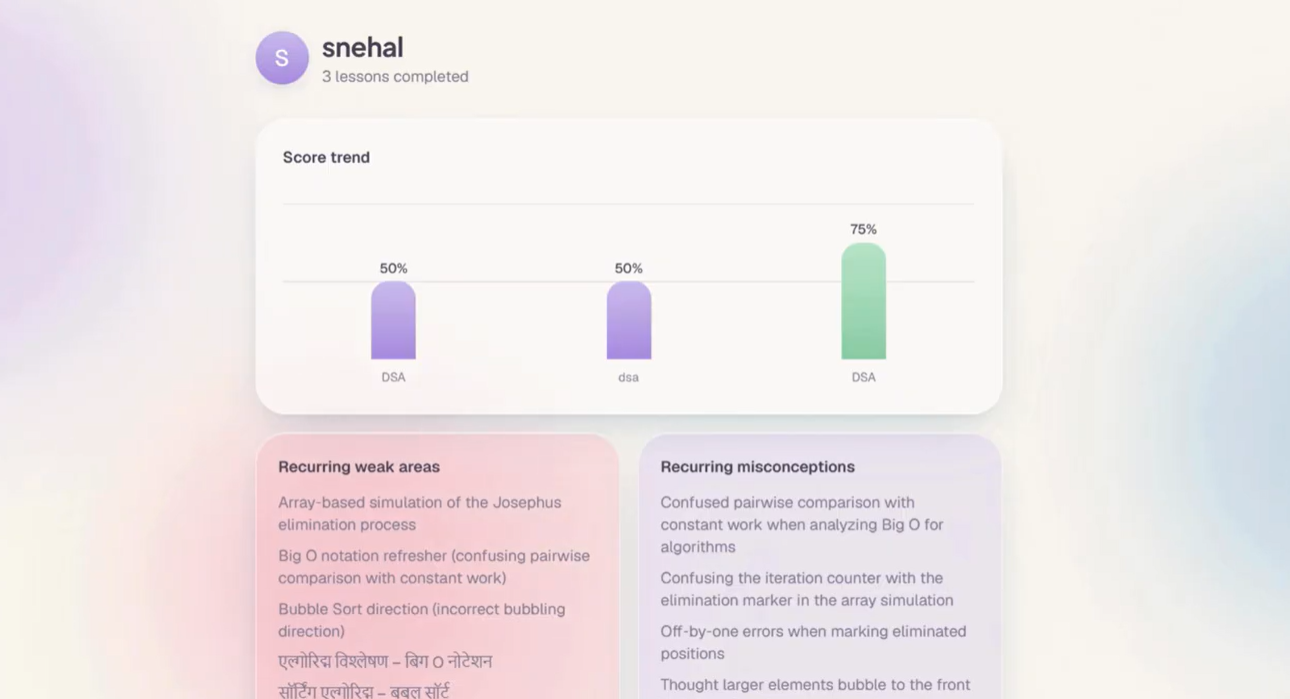
personalised score board
Inspiration
Most AI tutors can give you the right answer. But getting an answer isn't the same as understanding.
We were inspired by something a good human teacher does naturally: when a student gets an answer wrong, they don't simply say “incorrect.” They figure out why the student thinks that way, then explain the concept differently.
We wanted to bring that teaching process into AI.
That led us to Shiksha AI — an AI teacher designed not just to answer questions, but to understand misconceptions, adapt its teaching, and remember how a learner progresses.
What it does
Shiksha AI runs a complete teaching loop:
Understand → Plan → Explain → Question → Evaluate → Adapt → Continue
Students can enter a topic or upload a PDF, DOCX, or PPTX. Shiksha AI creates a lesson grounded in their material and teaches it one concept at a time.
After each explanation, it asks a comprehension question. If the student gets it wrong, the AI doesn't simply mark the answer incorrect. It identifies the specific misconception behind the answer and re-teaches that concept using a genuinely different analogy.
It also remembers the learner's weak areas and recurring misconceptions, allowing future lessons to proactively address previous struggles.
Shiksha AI additionally supports English, Hindi, and Hinglish, voice-based teaching, subject-aware visuals, an animated teacher avatar, progress tracking, and a final learning report.
How we built it
Shiksha AI is a full-stack application built with Next.js, TypeScript, Tailwind CSS, Python, and FastAPI.
For intelligence, we use Groq-hosted LLMs with structured JSON outputs: a larger model handles lesson planning and adaptation, while a faster model handles comprehension evaluation.
Uploaded learning material is processed through a RAG pipeline using document parsers, local sentence-transformer embeddings, and ChromaDB, allowing lessons to stay grounded in the student's own material.
Learner history is stored using SQLite and SQLAlchemy, while KaTeX, Mermaid, Recharts, and syntax highlighting allow the teacher to choose appropriate visual formats for different subjects.
Voice is powered by edge-TTS, and the frontend includes an illustrated SVG teacher with animated expressions, gestures, and lesson audio synchronization.
Challenges we ran into
The hardest part wasn't generating explanations — it was making the AI behave like a teacher rather than a chatbot.
We had to design a structured teaching state machine so the AI would know when to explain, when to test understanding, when to diagnose a misconception, and when to re-teach instead of simply moving forward.
Another challenge was ensuring that re-teaching was actually different from the original explanation. We explicitly designed the adaptation step to target the diagnosed misconception from a new angle.
We also had to balance rich features such as RAG, multilingual voice, visuals, persistent learner memory, and an animated avatar while working within limited development time and free-tier AI resources.
Accomplishments that we're proud of
Our biggest accomplishment is that the complete adaptive teaching loop works end-to-end.
Shiksha AI doesn't just detect that an answer is wrong — it can identify a named misconception and generate a targeted re-teaching explanation.
We're especially proud of the persistent learning memory. In testing, a misconception from one session could influence the lesson plan of a later session, creating a genuine sense of continuity between lessons.
We're also proud that the system can teach from a student's own documents while supporting multilingual explanations, voice, interactive visuals, and personalized progress reports in one application.
What we learned
We learned that building an AI tutor is less about making the AI know more information and more about designing the right learning process.
A correct answer doesn't tell us whether a student understands something. Their reasoning does.
We also learned that personalization becomes much more meaningful when the system remembers specific learning failures, rather than just storing a score or completion percentage.
Most importantly, we learned that AI becomes much more useful in education when it is designed around the learner's thought process instead of simply generating more content.
What's next for Shiksha AI
Our next goal is to make Shiksha AI even more deeply personalized.
We want to add stronger long-term learner modeling, spaced repetition based on individual misconceptions, richer assessment of reasoning, and better adaptation to different learning styles and difficulty levels.
We also want to explore classroom and teacher-facing features, where educators could identify common misconceptions across an entire class while students still receive individually adapted instruction.
In the longer term, we envision Shiksha AI becoming a personal learning companion that grows with the student — remembering what they understand, what they struggle with, and how they learn best.
Because the best AI teacher isn't the one that knows every answer. It's the one that knows how to help you understand.
Built With
- chromadb
- csspython
- fastapi
- gpt-oss
- groq
- next.js
- pexels
- sentence
- sqlite
- tailwind
- typescript


Log in or sign up for Devpost to join the conversation.