-
-
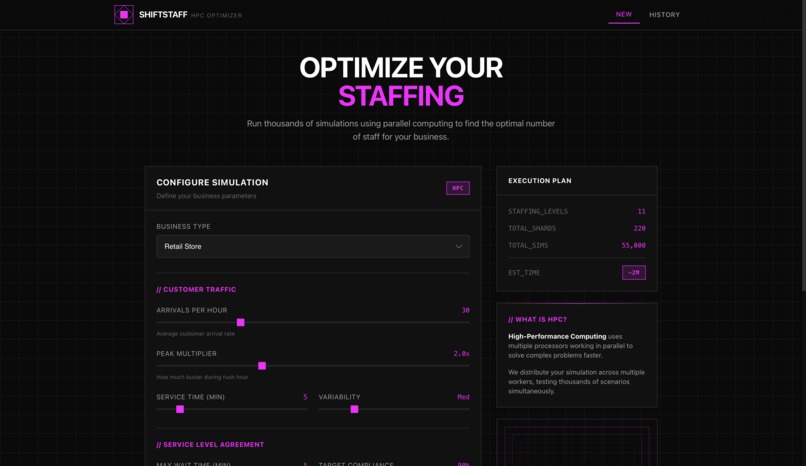
Homepage
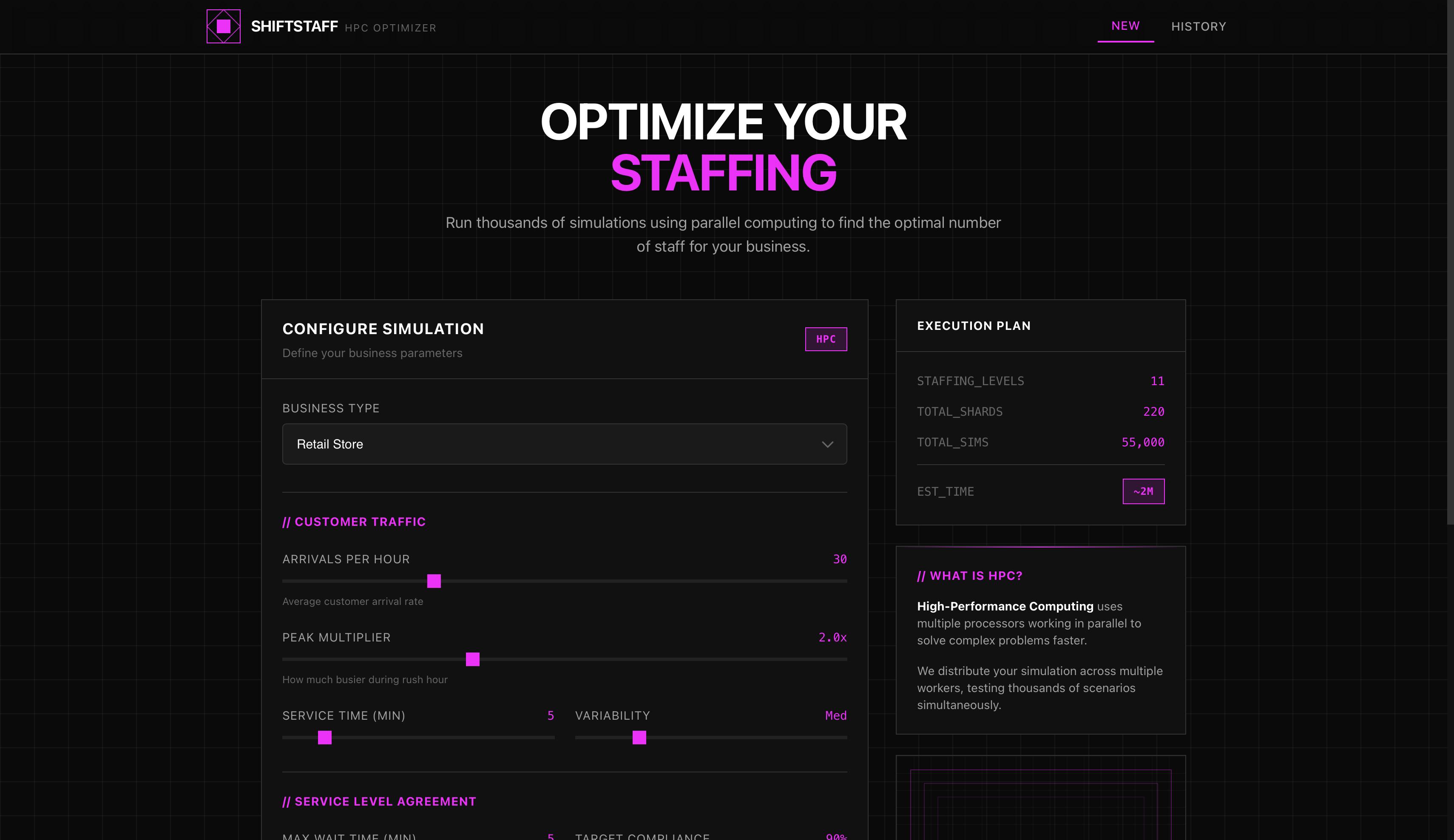
Inspiration
Every shift manager faces the same impossible question: "How many people do I need today?" Schedule too few and customers wait in frustrating lines. Schedule too many and you're wasting payroll. Most managers rely on gut instinct or simple averages, but customer traffic is unpredictable. We wanted to bring the power of computational simulation to this everyday problem, making supercomputer-grade analysis accessible to someone who's never written a line of code.
What it does
ShiftStaff lets any manager answer staffing questions with confidence. You describe your business (a cafe, clinic, call center), tell us your traffic patterns and service goals, and we run thousands of "what-if" simulations in parallel. In seconds, you get a recommendation: "Schedule 5 people and 91% of customers will wait under 3 minutes." You also see charts comparing every staffing option, so you can make tradeoffs between cost and service quality.
How we built it
We built a full-stack application using Next.js for the frontend and FastAPI for the backend. The core innovation is our simulated HPC architecture: jobs are submitted to a Redis queue, distributed across Celery workers running in parallel, and results are aggregated back. Each simulation uses discrete-event modeling with Poisson arrivals and variable service times. The whole system runs in Docker Compose, so anyone can spin it up with one command. We designed the UI with a dark brutalist aesthetic to reflect the computational power under the hood. Cursor was used to help with a lot of this.
Challenges we ran into
Getting the parallel execution model right was tricky. We had to carefully design the sharding system so simulations could run independently and results could be aggregated correctly. Database synchronization between workers caused early bugs. We also spent time making the UI genuinely accessible to non-technical users while still conveying that serious computation was happening behind the scenes.
Accomplishments that we're proud of
We built a working HPC simulation that actually demonstrates parallel computing concepts. The system handles thousands of simulations, tracks progress in real-time, and produces statistically meaningful recommendations. We're also proud of how friendly the interface turned out. A coffee shop manager with no technical background can use it in under a minute and understand the results.
What we learned
HPC isn't about specific hardware. It's a pattern: divide work, run in parallel, combine results. We learned how to implement job queues, worker pools, and result aggregation using accessible tools like Celery and Redis. We also learned that explaining complex systems to non-experts is as much a design challenge as a technical one.
# What's next for ShiftStaff
We'd love to connect to real scheduling systems so recommendations flow directly into workforce management tools. Adding historical data analysis would let us learn a business's actual traffic patterns instead of relying on estimates. And we want to deploy on real cloud infrastructure with auto-scaling workers, so simulations that take seconds today could handle million-scenario analyses for enterprise customers.

Log in or sign up for Devpost to join the conversation.