
A clearer volunteer handoff
Primary Graphiques theme: Social Impact & Community Innovation.
A student society or community-event organiser revises a rota after a change in the plan. The spreadsheet can show the new assignments but leaves the organiser to discover consequences and explain them individually. NCVO's guidance supports timely updates, accessible processes and clear responsibilities; it does not establish the frequency or cost of this particular problem.
Proposed service
Keep the existing rota as the input. The organiser reviews the previous and revised versions in a local workspace, resolves visible staffing issues with the affected people's agreement, and gives each person a short before/after card in their preferred channel. No new volunteer accounts are required. Printed cards support people who cannot or do not want to use a shared online tool.
The prototype implements the review interaction: validated imports, evidence of changes, uncovered-headcount and overlap checks, manual assignment repair, personal printable notices and portable exports. It does not notify anyone or coordinate concurrent organisers. All demonstration data is fictional.
Practical implementation
Use stable shift IDs and distinct volunteer labels in an existing spreadsheet. One organiser owns the revision; people confirm changes before a final plan is shared. The exported CSV returns to the existing workflow. Data stays on the organiser's device, with clearing for shared devices. Static HTTPS hosting and modern browsers suffice; there is no per-review inference or backend service.
The intended contribution is a review and communication step between a revised spreadsheet and the people affected. It makes consequences visible and creates a personal explanation. This is not a claim that no scheduling product has similar features. It fits a small event's existing files rather than requiring migration to another platform.
Risks and proposed validation
Same-name volunteers need distinct labels. The tool knows neither qualifications nor actual availability. Time zones, daylight-saving transitions and travel buffers need organiser attention. Saved browser data and exported files need care on shared devices.
Proposed validation: ask organisers to review equivalent revisions using their current method and this prototype. Compare correctly identified issues and volunteers' comprehension of the cards; inspect accessibility and consent practices. This study has not been conducted. There are no pilot users, fabricated testimonials or claimed savings.
Sources are in research.md. The runnable prototype and recorded walkthrough support this service concept.
Inspiration
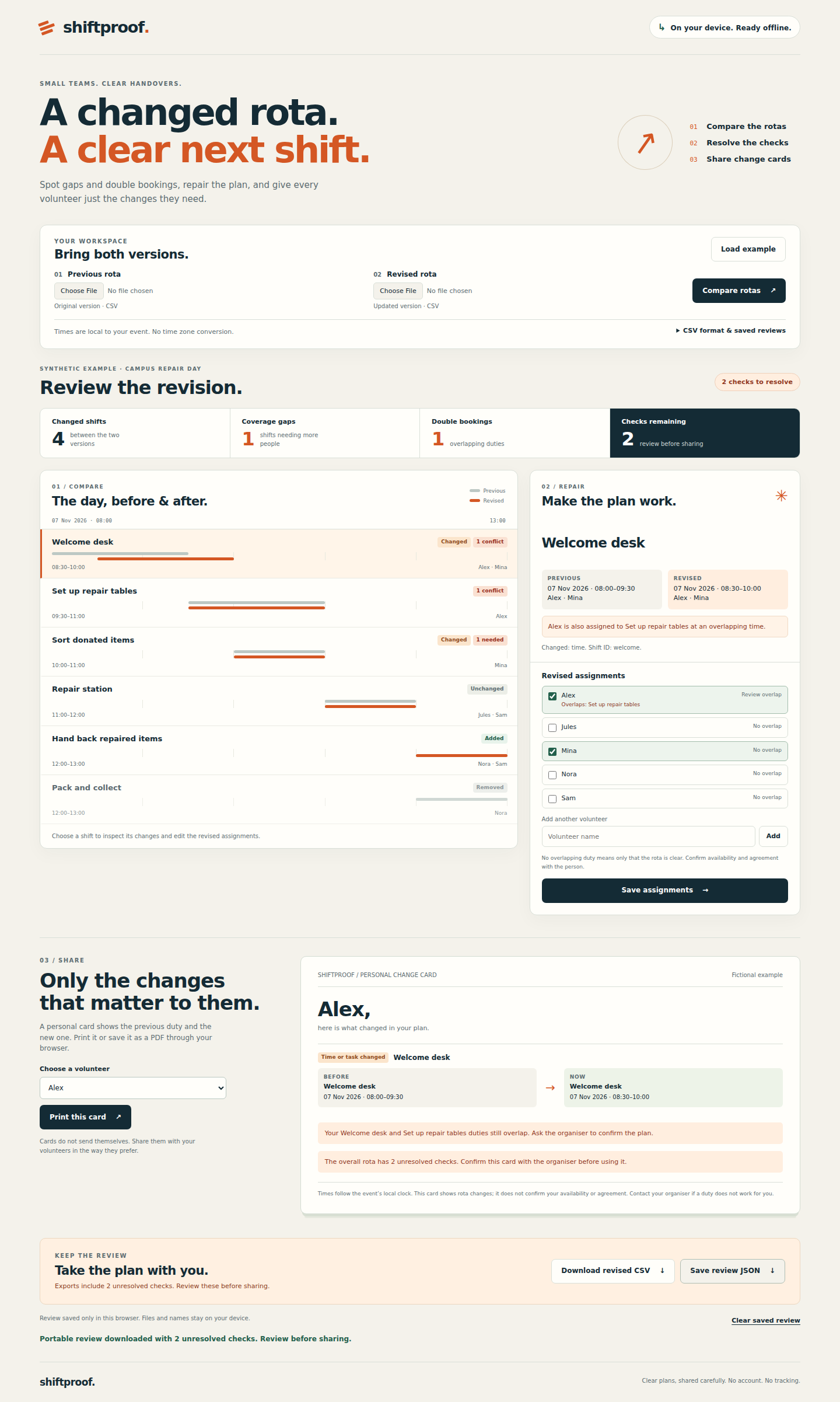
A small edit to a volunteer rota can change more than one cell. Move the welcome desk by half an hour and someone may now have two duties at once. Remove an assignment and the organiser needs to notice the gap, find a suitable replacement and explain the change clearly.
NCVO's volunteer guidance recommends timely, accessible communication about important changes. Shiftproof explores a practical way to support that: review the consequences first, then produce a short personal notice.
What it does
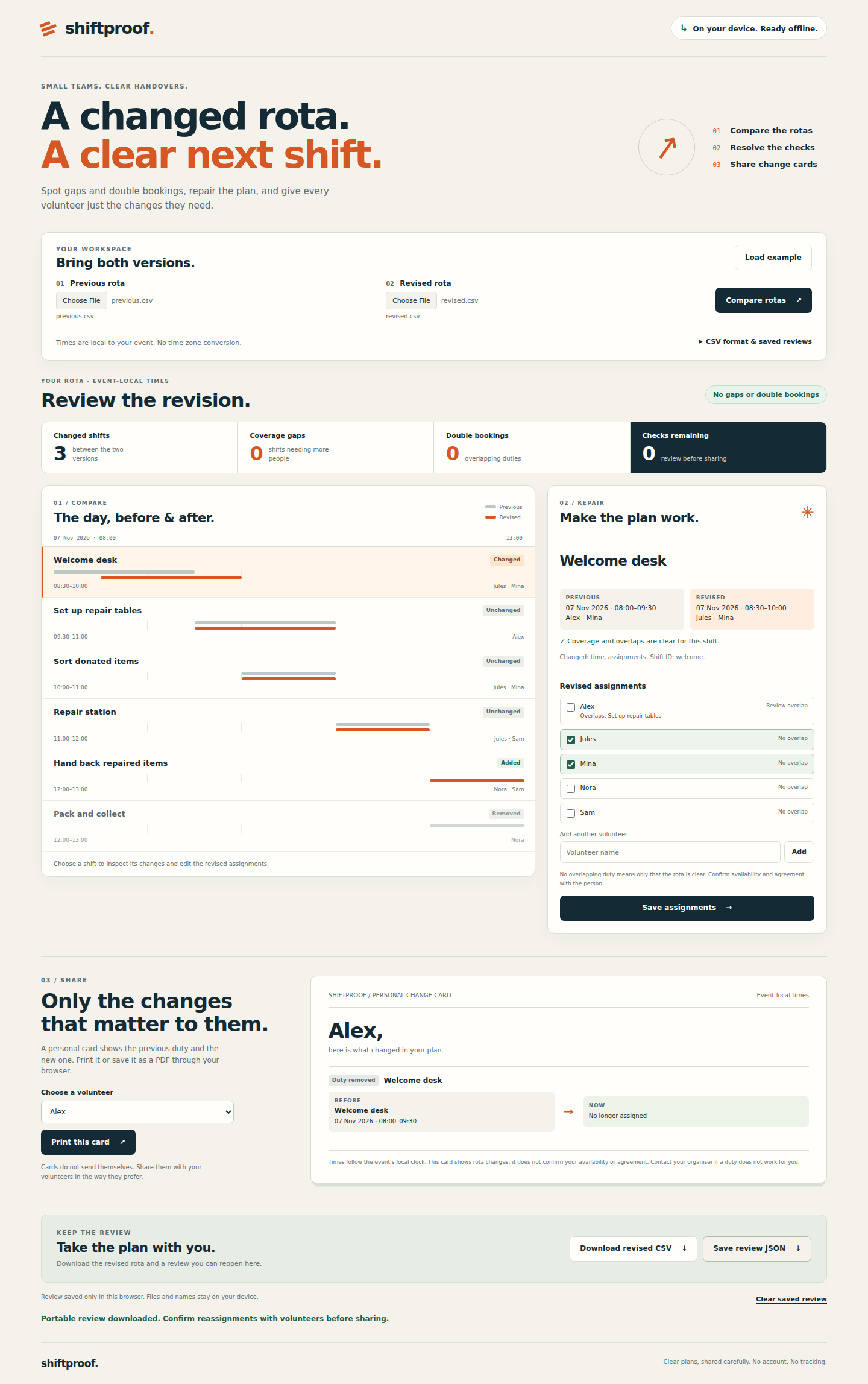
An organiser loads the previous and revised CSV rotas. Shiftproof compares stable shift IDs, shows added and removed duties, and highlights changes to times, tasks, capacity and assignments. It detects missing headcount and overlapping duties, including shifts crossing midnight.
The organiser edits assignments and immediately sees the consequences. A person with no conflicting loaded duty still needs to agree to the reassignment. The app never claims to know real availability.
Individual cards show just that person's before-and-after duties. The organiser can print a card, export a repaired CSV or save a portable review. Unresolved staffing issues remain visible when sharing.
How it was built
Plain HTML, CSS and JavaScript. Parsing and comparison run on the device. A service worker caches the app after the first visit, so reviewing a rota can continue without a connection. There is no runtime AI, external service, account, backend or paid compute.
OpenAI Codex assisted with the idea, code, design, research, documentation and browser verification. All product code and the fictional demonstration dataset were created on October 4, 2026 UTC. No pre-existing project code or templates were used. Primary guidance is linked in the public repository.
Challenges
Reliable file handling matters more than a happy-path animation. CSVs can contain quoted commas, reordered headers, impossible dates and duplicate IDs. Unsafe strings need to remain text, exported spreadsheet cells need protection, and failed imports must preserve the current review.
The other design challenge was communicating limits: loaded rota data is not an availability database, adjacent shifts may need travel time, and a drafted notice is not a sent message.
What was learned
The useful unit of work is a whole handoff: identify a change, understand its consequences, review a repair and explain it to the affected person. A small graphical tool can make that loop understandable without a model or cloud integration.
What's next
Test the workflow with actual volunteer organisers before making impact claims. Explore role qualifications and travel buffers only if real users need them. The current prototype uses fictional data and has no reported pilots or measured time savings.
Try the prototype
Live workspace · Recorded walkthrough · Source code
The walkthrough is about two and a half minutes and shows the actual prototype. Direct video file. The screenshots and walkthrough use a clearly labelled fictional campus repair-day example.
Verification
69 browser end-to-end checks passed for the release, including import rejection, comparison, conflict repair, personal notices, export, persistence and offline operation. The public HTTPS app and recorded video were checked in Chromium. Repeatable verification instructions are in the repository. This is technical prototype verification; no organiser pilot, user study or measured time savings are claimed.
Built With
- css3
- html
- javascript
- service-worker

Log in or sign up for Devpost to join the conversation.