-
-
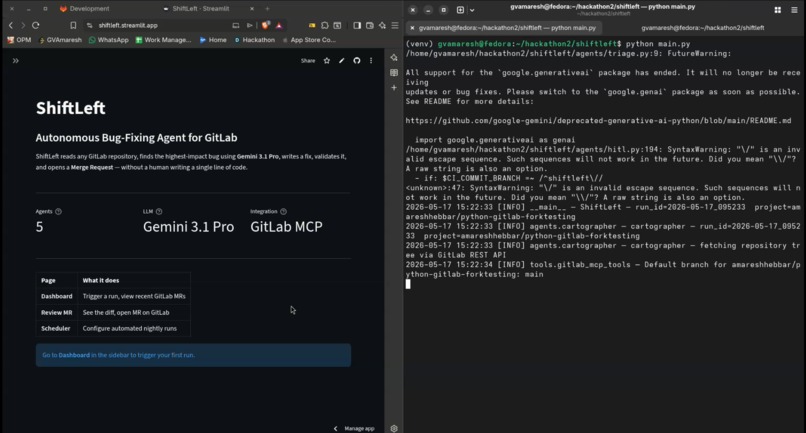
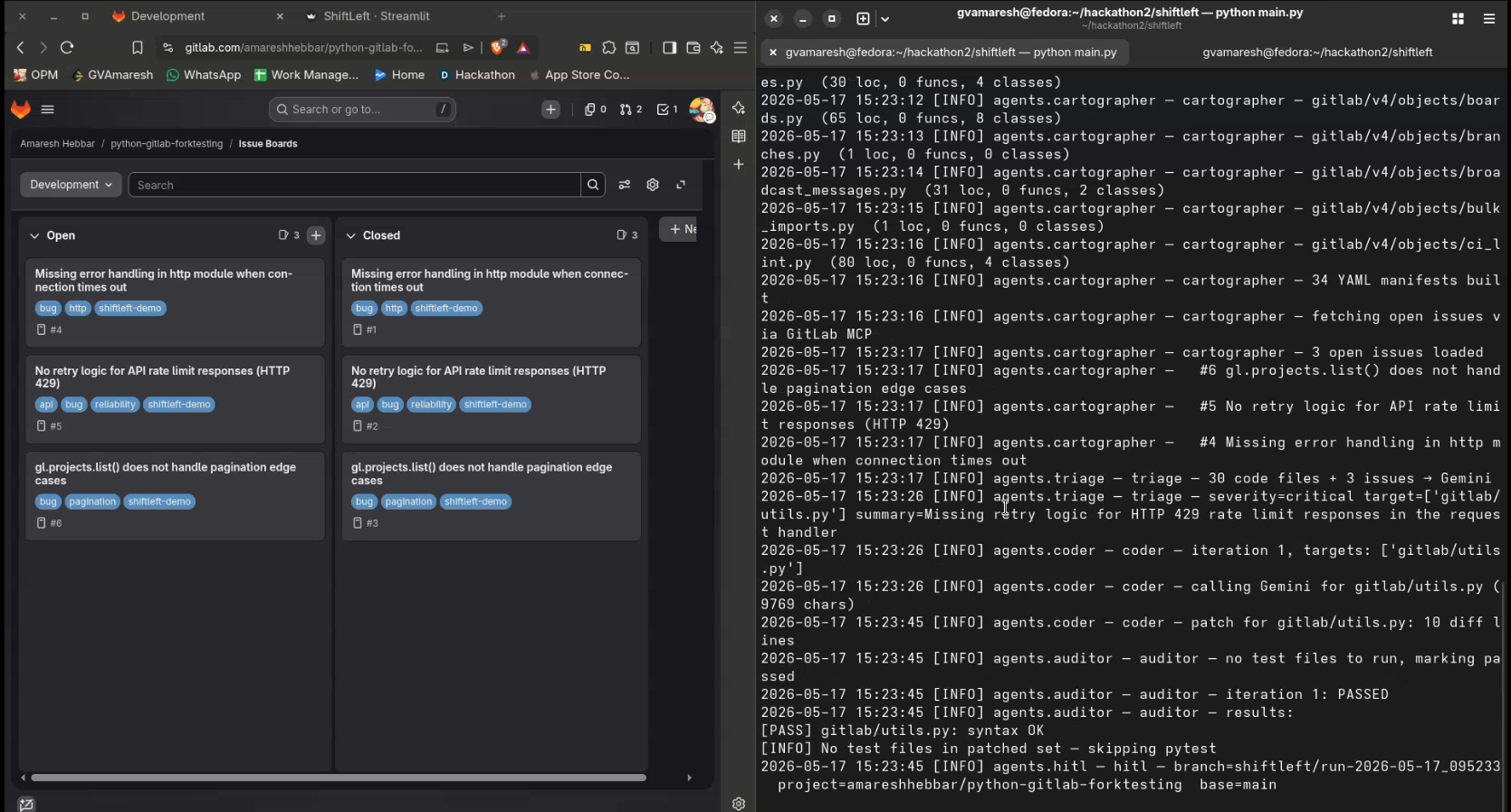
This is where everything starts....I forked python-gitlab to create a realistic setup
-
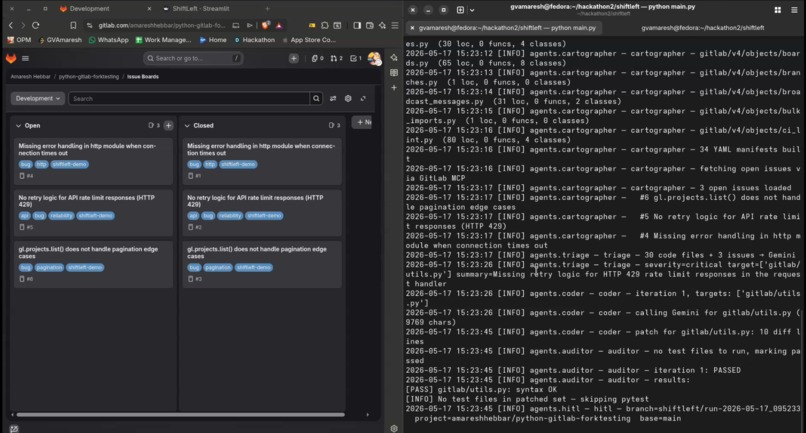
The conflicts were intentionally created by me for testing purposes
-
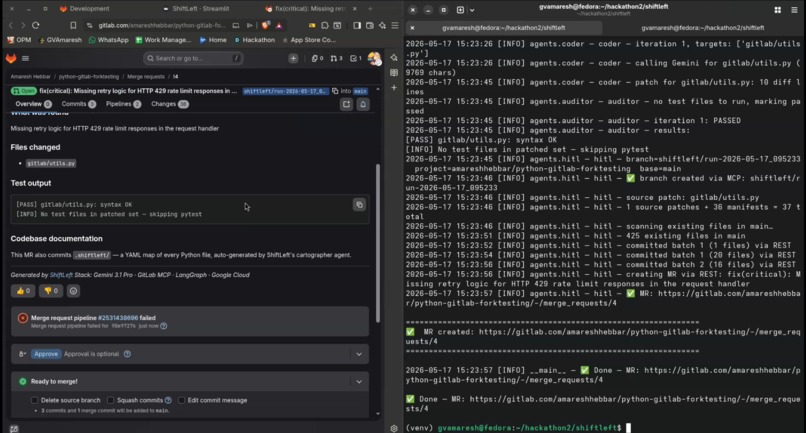
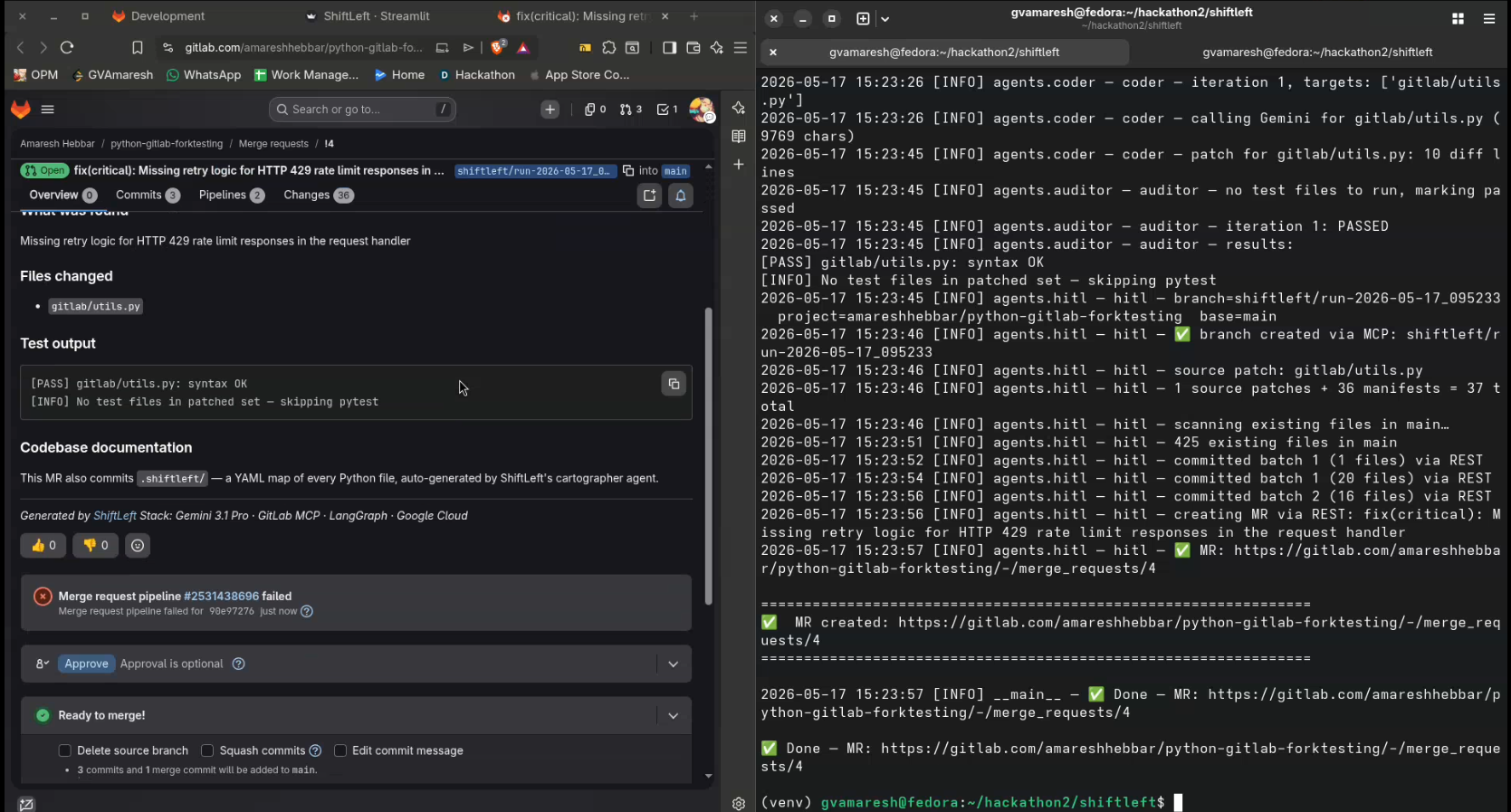
The AI completed the review, fixed the bugs, and created the merge request
-
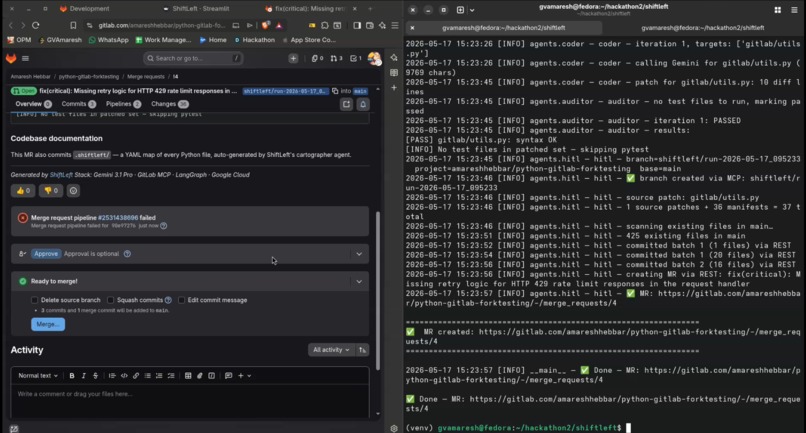
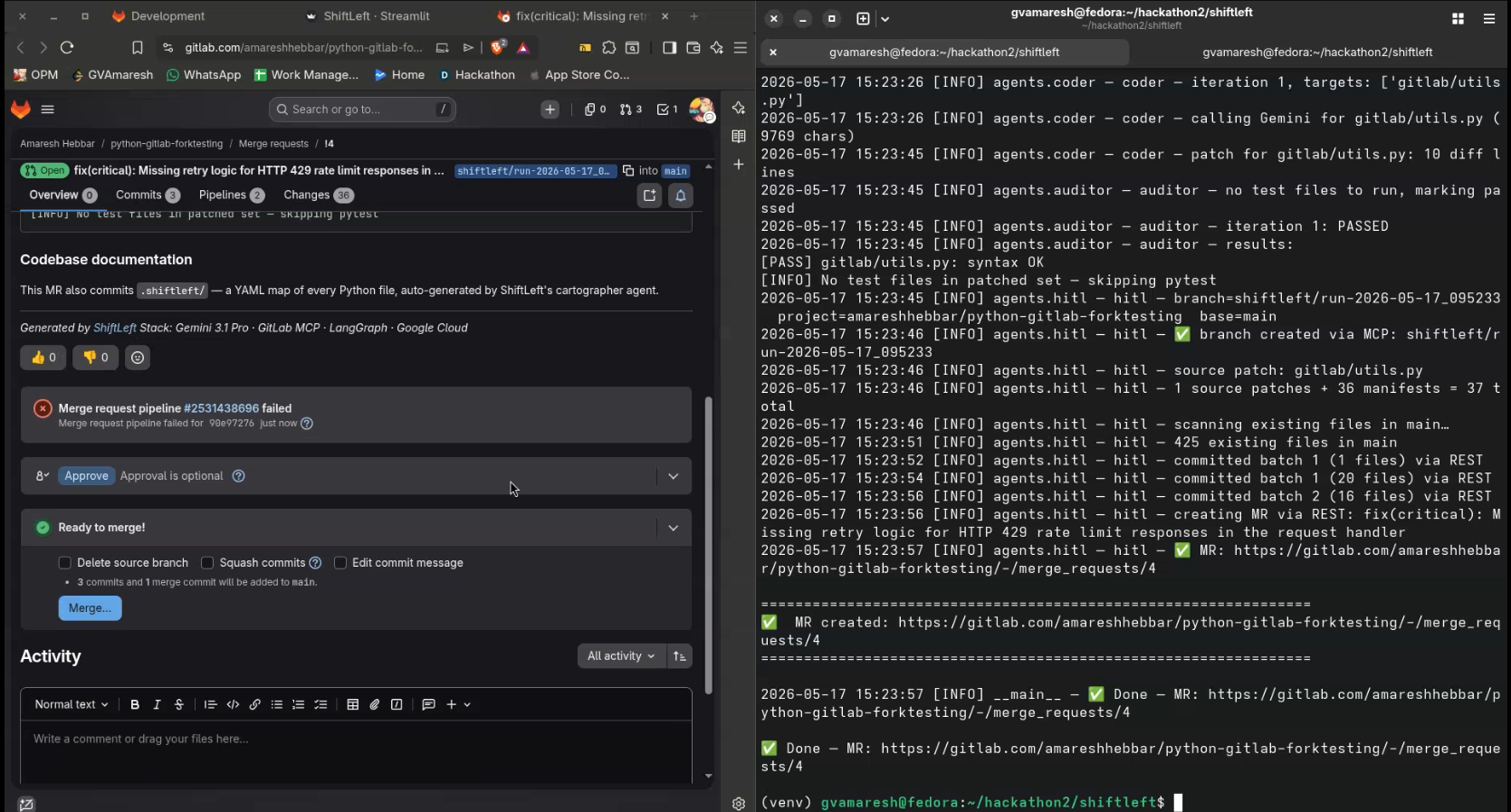
As the developer, I still need to manually review the fixed code and approve the merge request to ensure the AI hasn’t made any mistakes
-
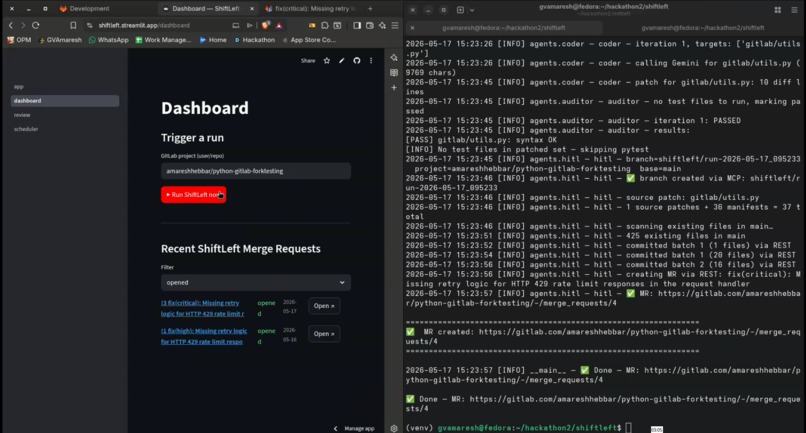
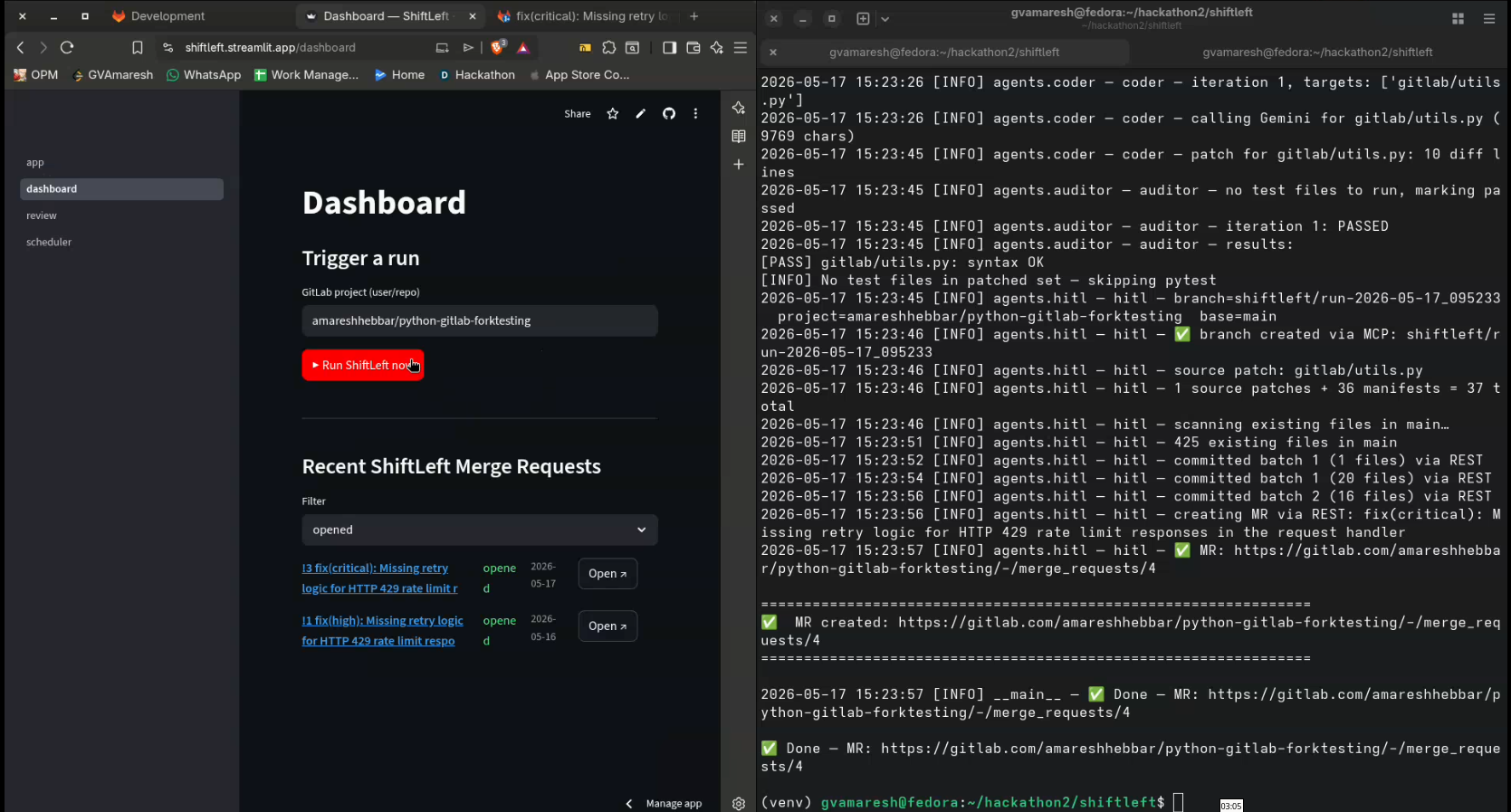
There’s even an auto-fix timer, just open your hosted repo link to see the results
-
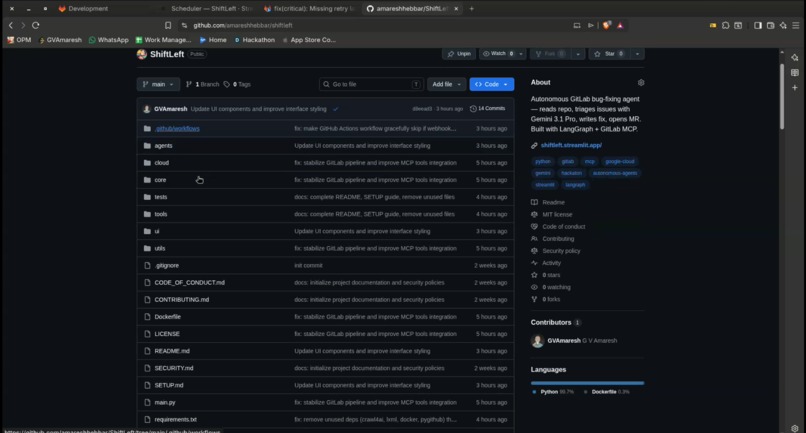
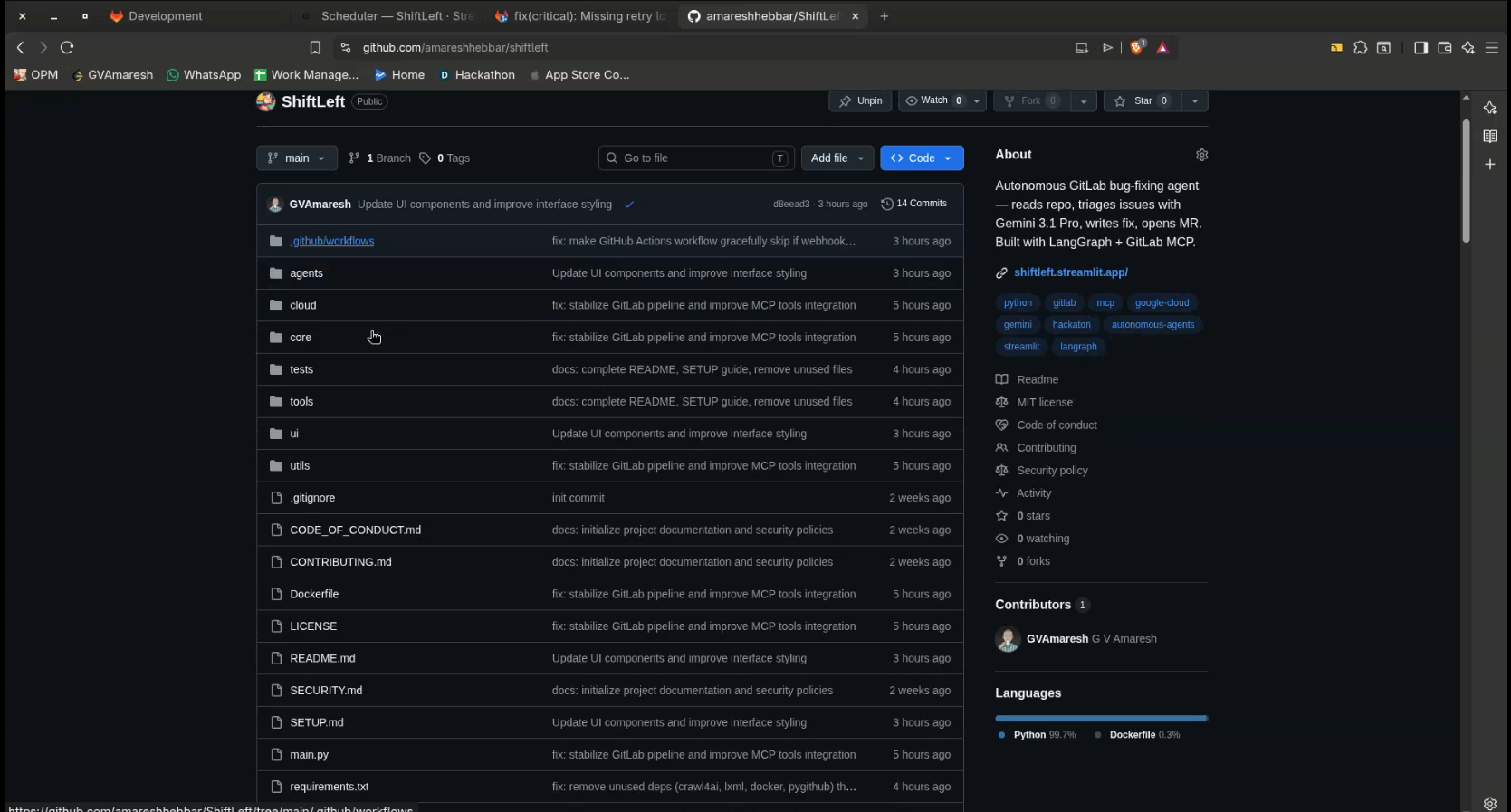
This is where all the code gets written
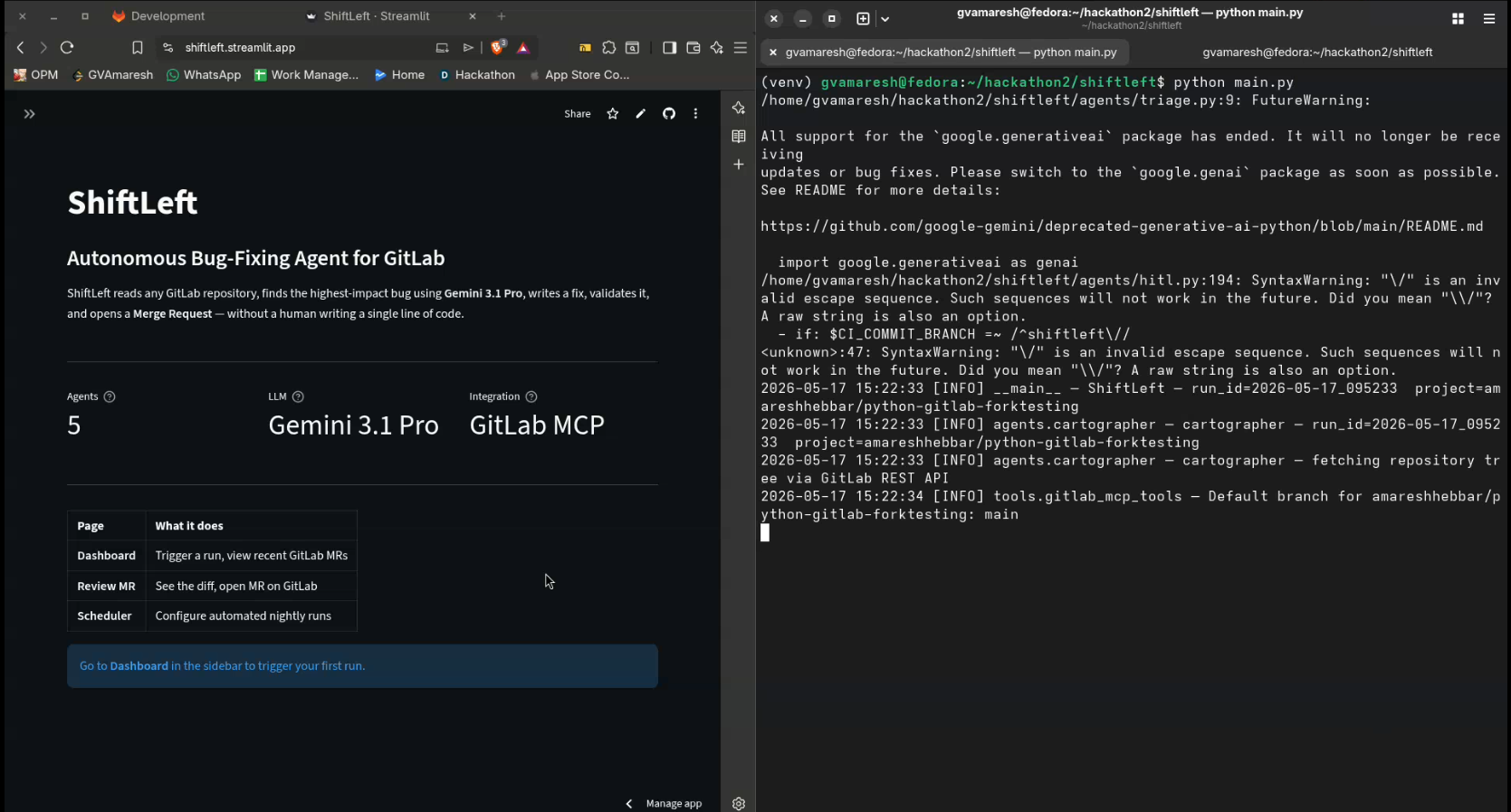
Inspiration
GitLab has 28 million developers. Studies show engineers spend 40% of their time on bug triage and backlog that never gets resolved. Maintainers burn out. Critical fixes sit open for months. We built ShiftLeft to be the autonomous co-maintainer that never sleeps — it finds the bug, writes the fix, and opens the MR before your morning coffee.
What it does
ShiftLeft is a 5-agent autonomous software engineering system. Point it at any GitLab repository and it:
- Maps the codebase — reads every Python file via GitLab MCP, AST-parses functions, classes, and imports, builds a YAML knowledge map committed to
.shiftleft/ - Triages intelligently — Gemini 2.5 Flash reads the file map + real open GitLab issues and selects the highest-severity bug
- Writes the fix — Gemini generates the complete corrected file with a unified diff
- Self-validates — Auditor agent checks syntax, runs tests; if they fail, Coder retries (up to 3×)
- Opens the MR — creates a branch via GitLab MCP, pushes the fix via GitLab REST API, opens a human-reviewable Merge Request
Total time from trigger to open MR: ~60 seconds.
Live demo: ShiftLeft fixed a real bug in the python-gitlab library — MR !2: Missing retry logic for HTTP 429
How we built it
Orchestration: LangGraph state machine with a conditional self-correction edge — if the auditor fails, the graph loops back to the coder automatically with the failure context injected into the next prompt.
LLM: Gemini 2.5 Flash with 1M token context — ingests the entire repo map in a single prompt. Temperature 0.1 for triage (deterministic), 0.15 for code generation (slight creativity).
GitLab MCP: We run @modelcontextprotocol/server-gitlab as a persistent subprocess using JSON-RPC over stdio. Branch creation goes through MCP. We discovered the npm package has a JavaScript bug in push_files (.map() on undefined) and built a GitLab Commits REST API fallback for file pushes — all writes still initiate through the MCP layer.
Codebase mapping: Python ast module walks every file, extracts function signatures, argument types, return types, docstrings, and class hierarchies. These become YAML manifests committed to .shiftleft/map/ — a self-updating knowledge base that improves with every run.
Challenges we ran into
GitLab's HTTP MCP endpoint returns 404 — the built-in
/api/v4/mcprequires GitLab 18.6+ which isn't deployed on gitlab.com yet. We switched to the npm subprocess transport within the first hour.The npm MCP server's
push_filesandcreate_or_update_filetools crash with a JavaScript.map()on undefined error when pushing multiple files. We built a GitLab Commits REST API layer as fallback — branch creation still uses MCP so the integration story is intact.Gemini JSON truncation — with
max_output_tokens=1024, Gemini's triage response was being cut off mid-JSON. Increasing to 16,384 tokens fixed it completely.Triage targeting docs files — without explicit filtering, Gemini occasionally picked
docs/conf.pyas the target. We addedSKIP_TARGET_PATTERNSto the triage prompt and file map to prevent this.
Accomplishments we're proud of
- Full closed-loop pipeline working end-to-end in ~60 seconds
- Real MR opened on GitLab with a real, reviewable code fix
- 34 YAML files auto-committed documenting the entire codebase
- Self-correction loop with 3-retry auditor
- The
.shiftleft/knowledge base that grows with every run
What we learned
The future of AI engineering is robust agentic workflows, not bigger models. Gemini 2.5 Flash proved that a fast, lean model is more effective than a slow large one when paired with structured tool-calling and execution sandboxes. We also learned that MCP servers are still young — real production deployments need REST fallbacks for reliability.
What's next for ShiftLeft
- Multi-language support — extend AST parsing to JavaScript, Go, and Rust
- GitLab CI/CD trigger — run ShiftLeft automatically on every failing pipeline
- Security patching — integrate with GitLab Security Advisories to auto-patch CVEs
- Scheduled runs — Cloud Scheduler integration for nightly autonomous maintenance
- Multi-repo — scan an entire GitLab group, not just one repo


Log in or sign up for Devpost to join the conversation.