-
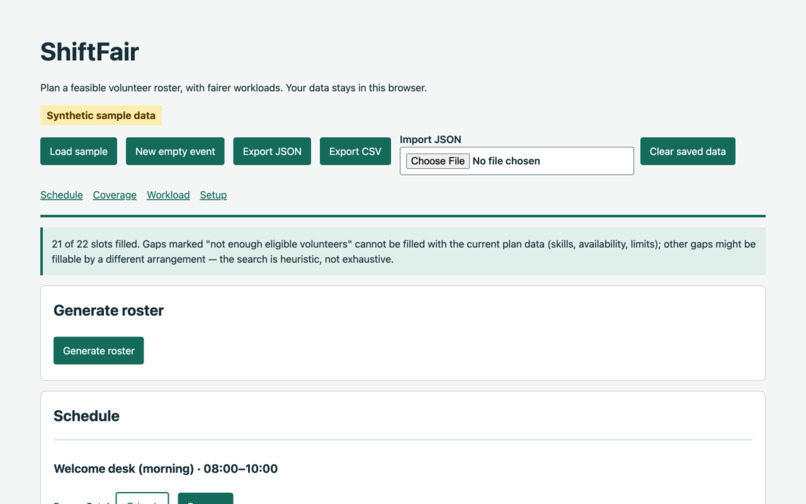
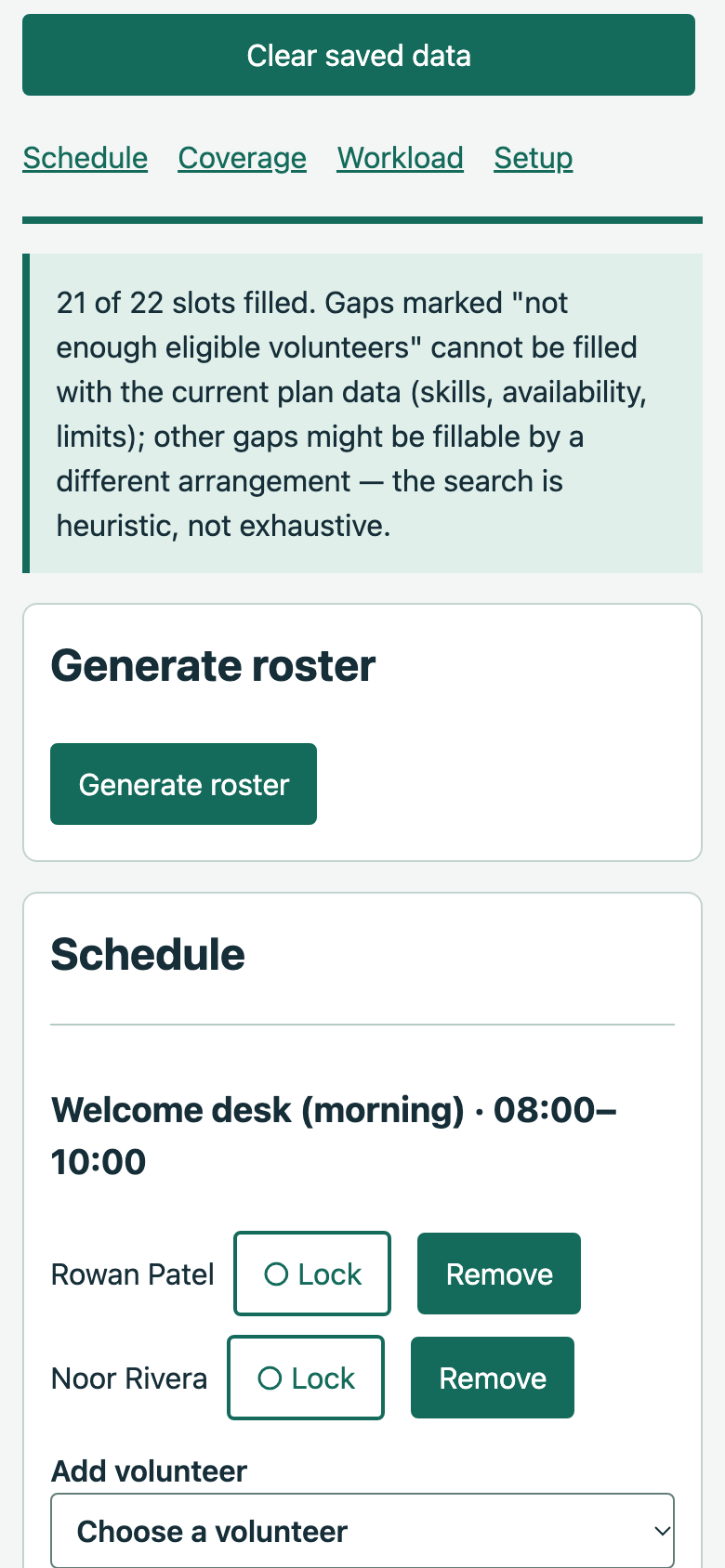
Live synthetic roster: 21 of 22 positions filled; hard constraints respected.
-
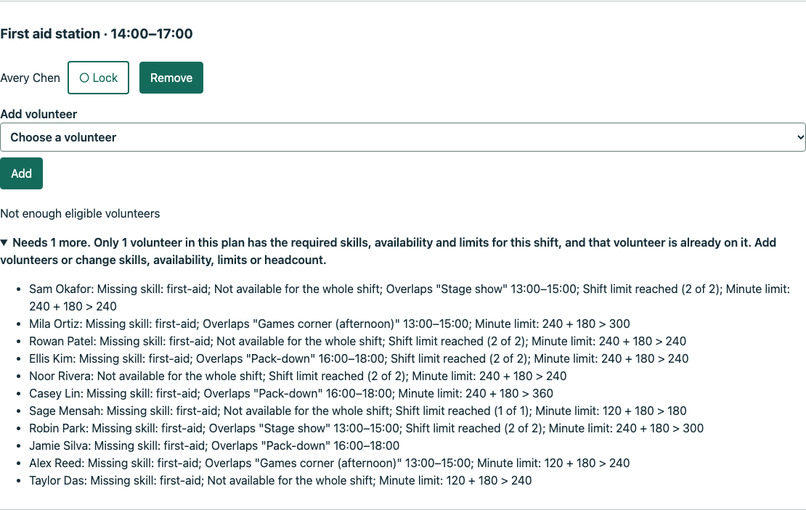
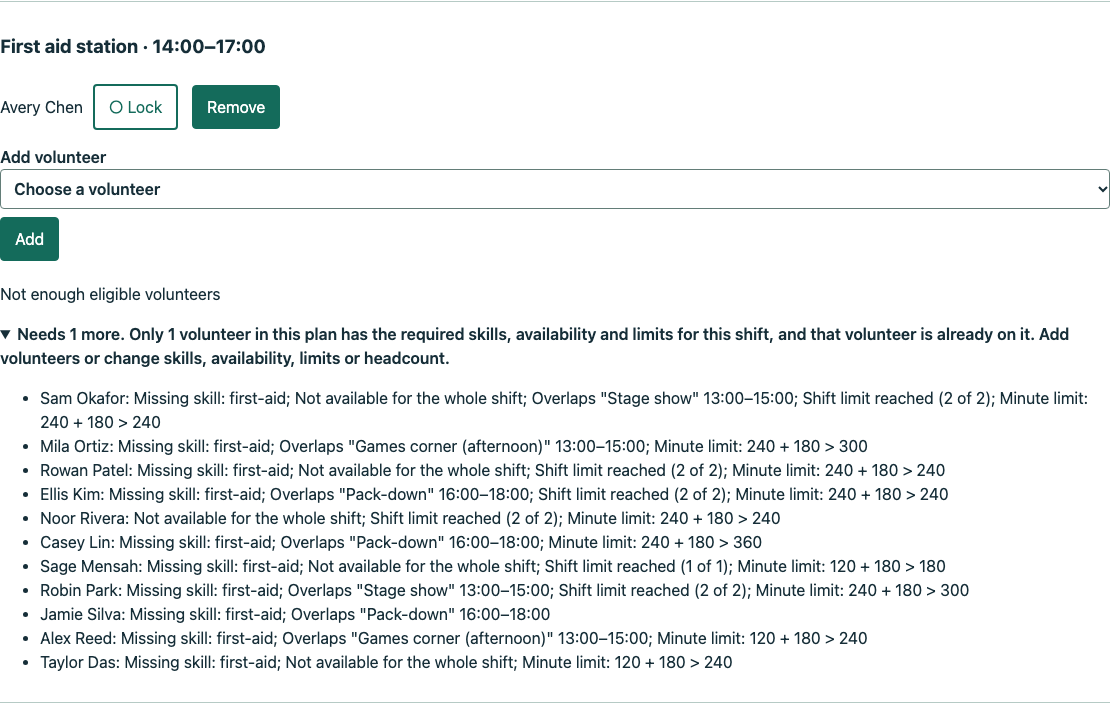
Synthetic first-aid shortage: only one eligible volunteer for two positions.
-
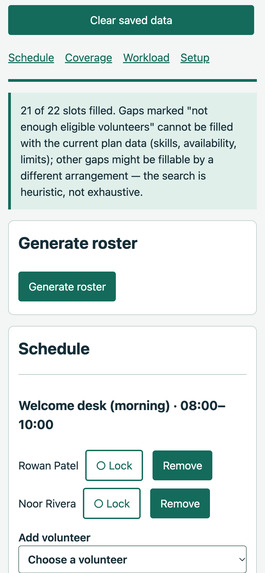
Live 390px CSS viewport; responsive schedule and controls.

Inspiration
A small event roster has several rules at once. Someone can have the right skill but be unavailable, reach a workload limit, or already be covering another role. A coordinator needs both a usable roster and an explanation of the gaps.
ShiftFair is a single-day volunteer-roster prototype for student clubs and small events. It explores a focused workflow: define the constraints, generate a roster, understand what remains unfilled, and make safe manual changes. It has not been evaluated with real coordinators, and no measured impact or user research is claimed.
What it does
Define roles and required skills, volunteers and their availability, workload caps, and shifts with a required headcount. Generate a roster and inspect coverage and each volunteer's scheduled minutes. Open an unfilled shift to see who qualifies, who could be assigned now, and who is blocked by another assignment or a limit.
Manual assignments use the same constraint checks. Valid locks survive regeneration. If an edit invalidates an assignment, the app removes it and reports the person, shift and reason. JSON saves the editable plan; CSV exports the roster with spreadsheet formula prefixes neutralized. A two-step clear action removes the saved plan.
The built-in event is clearly labeled synthetic. Its generated roster fills 21 of 22 positions: the afternoon first-aid station needs two people, but only one qualified person is available. That remaining gap is intentional and explained rather than hidden.
How it was built
TypeScript, Vite, HTML, CSS and native browser controls. Scheduling, validation, explanations and file handling are separated from the DOM interface. Node's test runner and jsdom support development tests. The deployed build is static: no backend, database, account system, runtime AI or external API is required.
The deterministic solver prioritizes constrained shifts, makes bounded repair attempts, then tries workload-balancing transfers or swaps. Availability, skills, overlap and workload caps are hard constraints. Coverage and workload balance are preferences. Reaching the search budget is reported explicitly; the app does not promise global optimality or a mathematically optimal fairness policy.
Challenges
Gap explanations must distinguish a shortage of distinct qualified people from an arrangement that might be improved. They must also distinguish volunteers who are eligible now from those actually blocked by existing assignments, including before generation or after an early budget stop.
Portable backups also need coherent limits. The final import/export bounds cover the largest supported canonical plan, with a round-trip regression, while still rejecting oversized or malformed files transactionally. Real-browser testing exposed a native Tab focus problem that DOM-only tests missed; ordinary field saves now preserve the editor controls.
Accomplishments and verification
Automated core and UI checks pass on the prepared source, along with TypeScript checking and a production build. Isolated Chromium browser checks cover generation, independent constraint assertions, keyboard editing, lock preservation, duplicate prevention, midnight endpoints, rejected imports, real JSON/CSV downloads, persistence and clearing. Touch-emulated 390 px and 320 px CSS viewports were checked. These are browser viewport checks, not physical-device or cross-browser certification.
What was learned
A bounded scheduling heuristic is useful only when its limits are visible. File validation must agree with the states the app can create, and real browser event behavior needs checking alongside unit and DOM tests.
Limitations and privacy
One local-clock day only: no overnight shifts or time-zone conversion. No collaboration server, calendar integration, notifications or automatic messages to volunteers. Extremely large plans can reach the search budget and generation can briefly block the page. Workload balance is heuristic.
Roster data stays in browser storage when available and in files the user exports. If storage is full or disabled, the app reports it and keeps the session in memory; JSON is the portable backup. There is no app telemetry or roster upload. The static host may log ordinary site requests, including IP addresses, for security. The public demo uses only synthetic data.
What's next
Evaluate the workflow with real event coordinators before adding scope, especially whether the explanations support staffing decisions and how workload preferences should be expressed. Multi-day scheduling would require an explicit new time model.
New work and credits
This is a new project started 4 November 2026 during LaunchPad Hacks; no previous submitted app was reused. Substantial AI assistance is disclosed: GPT-6.1 Sol for coordination, implementation and tests; Claude Opus 5.5 for planning, contracts, review, documentation and integration code corrections. The app itself uses no AI at runtime. Vite, TypeScript, Node.js, jsdom and their dependencies are credited under their licenses. No external dataset, images, fonts or icons are included. Volunteer names and event details are invented synthetic data.
Judge setup
Open the demo, choose Load sample, then Generate roster. Inspect First aid station for the intentional shortage. Try locks and safe manual changes, then export JSON or CSV. No app sign-in, key or install required.
