-
-
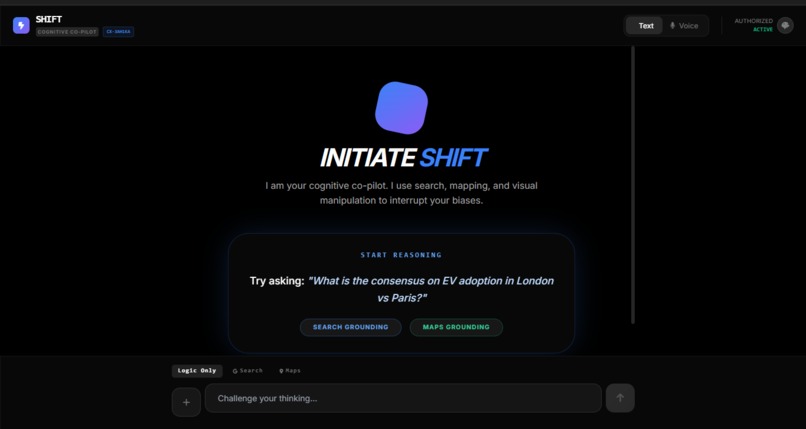
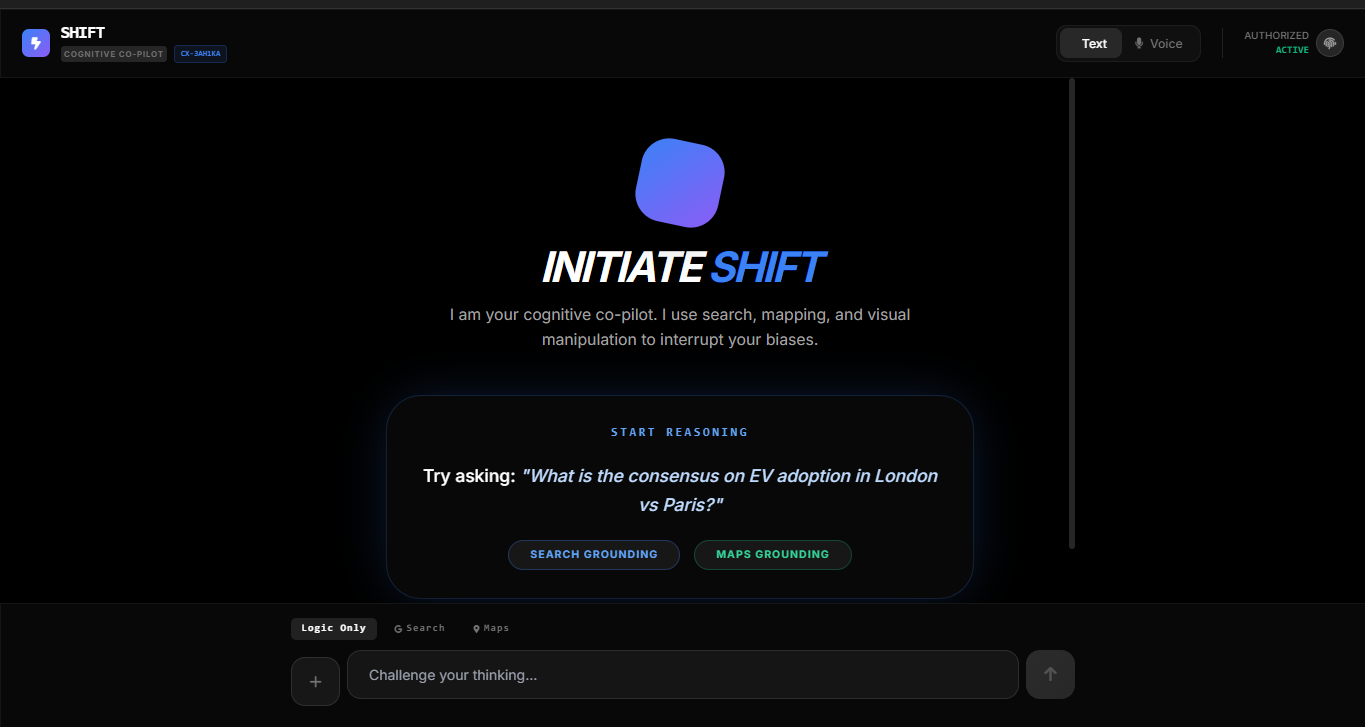
UI UX of Shift
Inspiration What it does 🧠 About the Project — SHIFT Inspiration
Every day, humans make dozens of decisions — about learning, careers, emotions, and beliefs. Most of these decisions are not limited by lack of information, but by flawed thinking: short-term bias, emotional reactions, and unchallenged assumptions.
While modern AI tools are excellent at answering questions, they rarely challenge how humans think. I wanted to explore a different question: What if AI didn’t answer us — but thought with us?
That idea became SHIFT.
What SHIFT Does
SHIFT is an AI second brain — a cognitive co-pilot designed to intervene before decisions are made. Instead of validating user input or offering surface-level advice, SHIFT analyzes the user’s thoughts to detect cognitive bias, emotional influence, and short-term reasoning.
For every interaction, SHIFT:
Identifies the underlying decision or belief
Detects flawed assumptions or biases
Reframes the situation from alternative perspectives
Highlights long-term consequences
Suggests one clear, rational next step
The goal is not productivity or motivation, but better decision quality.
How I Built It
SHIFT is powered entirely by the Gemini 3 API, using its advanced reasoning and long-context capabilities as the core intelligence layer. Rather than a simple prompt-response model, the system follows a structured reasoning pipeline: intent classification, bias detection, cognitive interruption, reframing, and actionable guidance.
The application is implemented as a lightweight web interface connected to Gemini 3 through Google AI Studio, allowing fast iteration and real-time interaction. No external datasets were required — the intelligence emerges from Gemini 3’s reasoning depth rather than retrieval.
Challenges Faced
The biggest challenge was designing AI behavior, not writing code. Most language models are optimized to be helpful and agreeable; SHIFT needed to be constructively challenging without sounding judgmental or preachy. Achieving this balance required multiple prompt iterations and careful control of tone, structure, and response length.
Another challenge was resisting the temptation to over-explain. Judges and users respond more strongly to clarity and discomfort than to long answers.
What I Learned
This project taught me that the future of AI interaction is not about more features, but better cognition. The most impactful AI systems will not replace human thinking — they will refine it.
SHIFT demonstrates how Gemini 3 enables a new category of applications: AI that acts as a thinking partner, not just an assistant. How we built it
Challenges we ran into
Accomplishments that we're proud of
What we learned
What's next for SHIFT — AI as a Second Brain
Built With
- gemni
- googleaistudio
- typescript


Log in or sign up for Devpost to join the conversation.