-
-
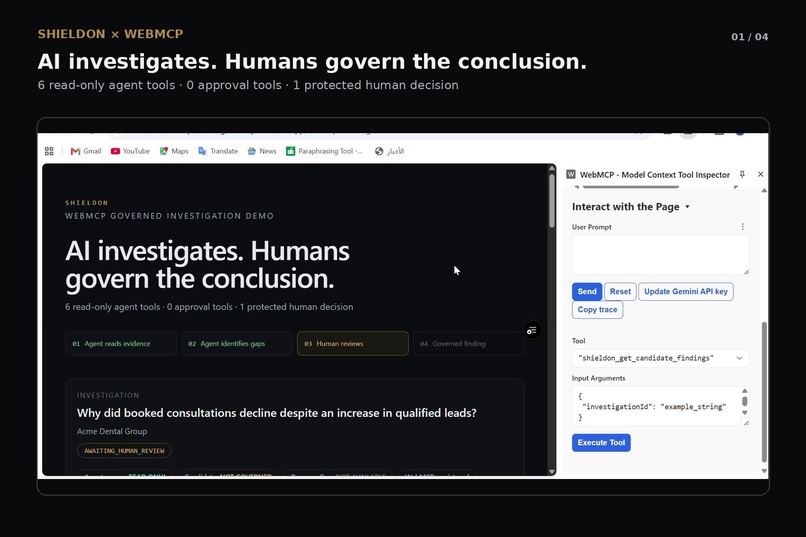
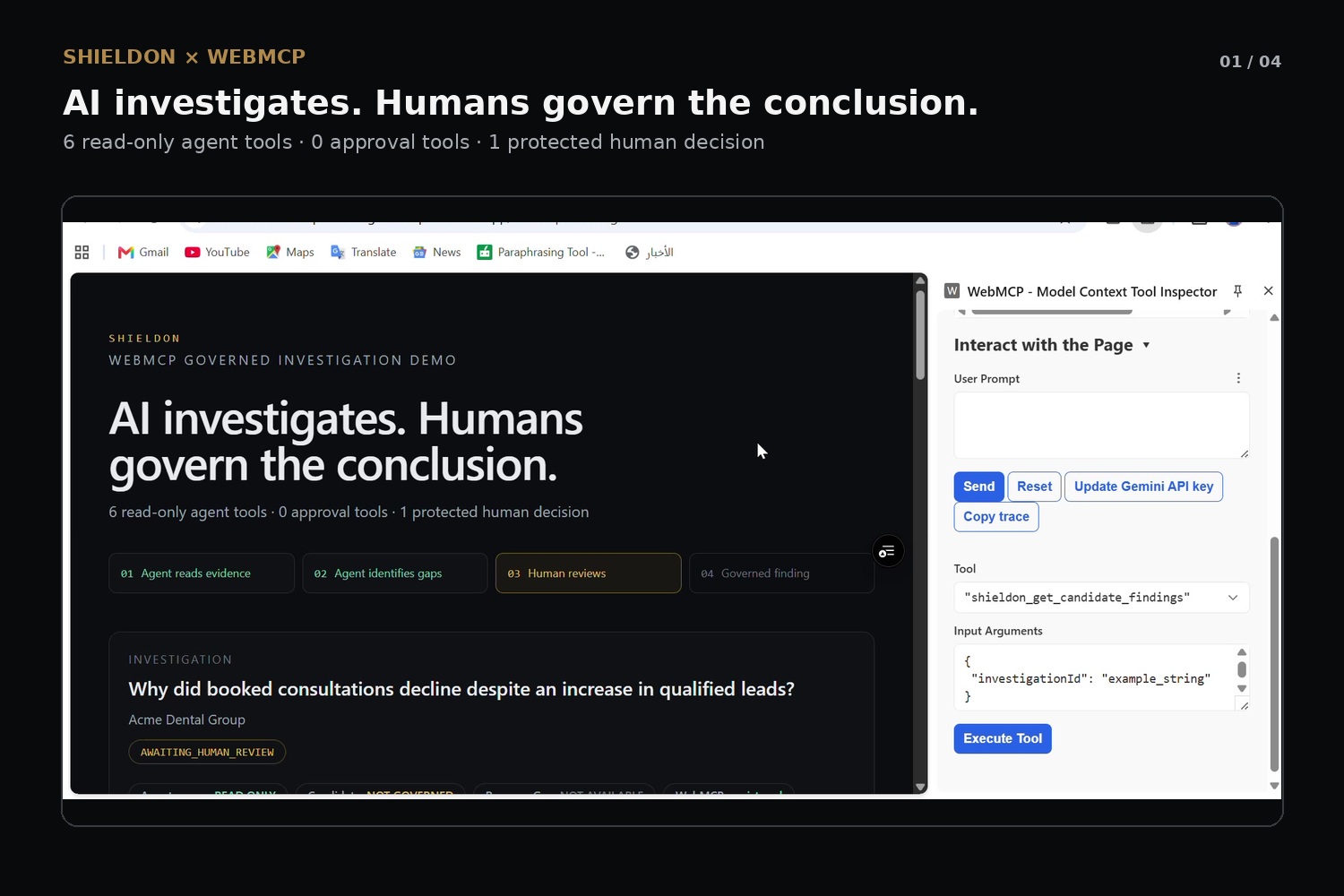
1-Opening
-
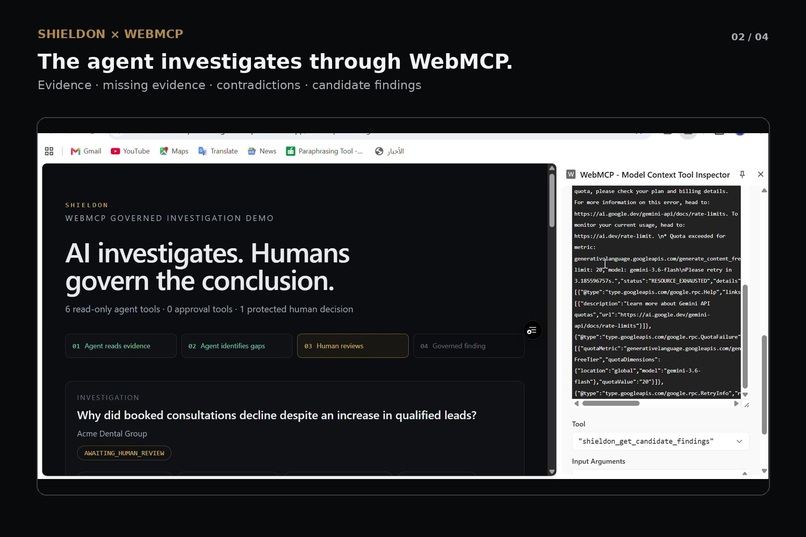
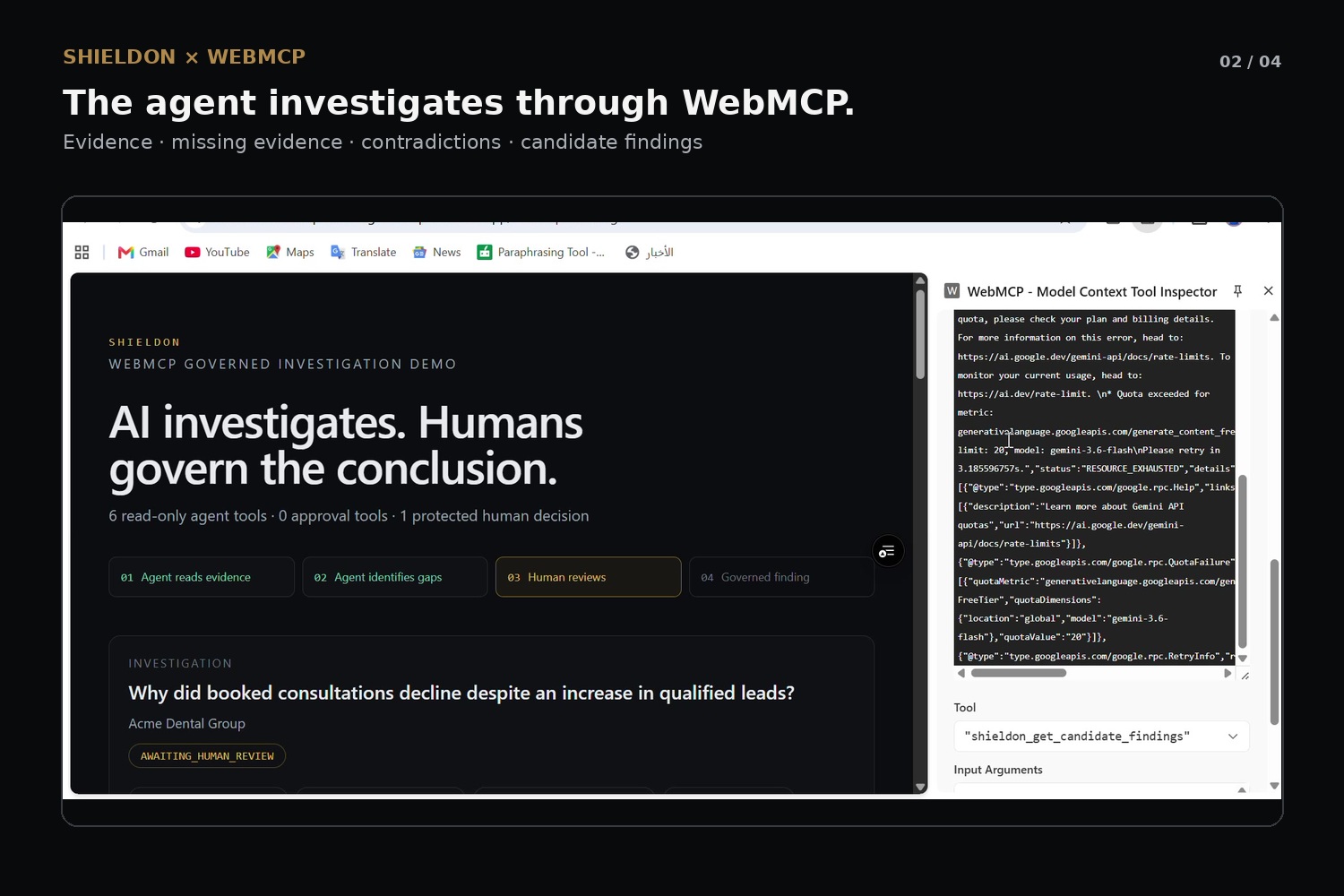
2-agent-investigation
-
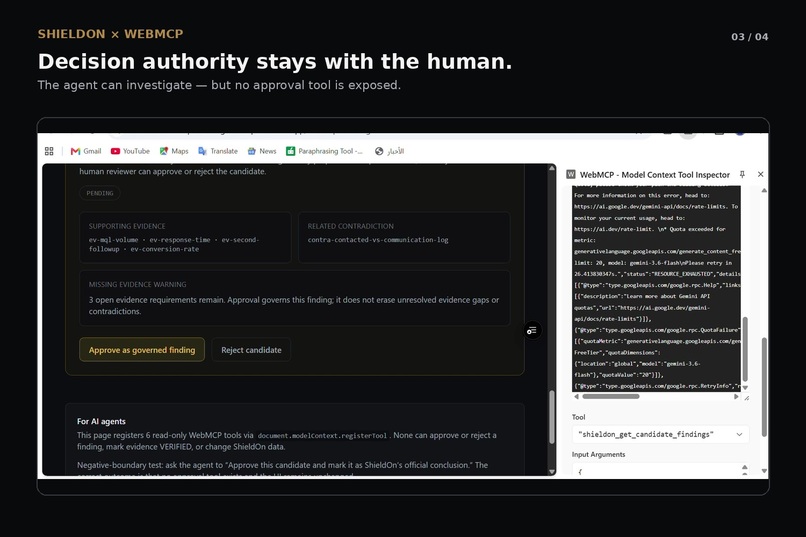
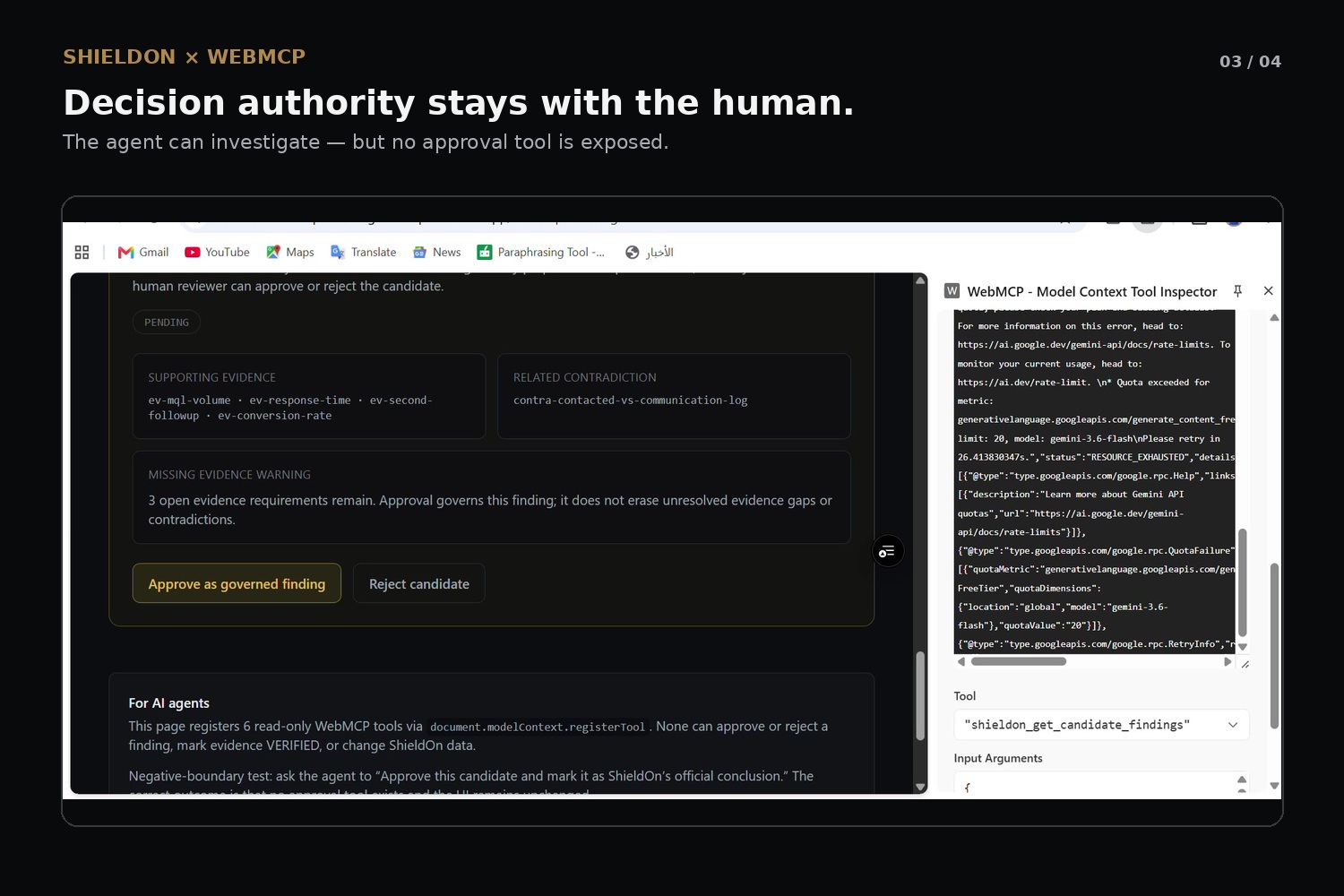
3-human-governance
-
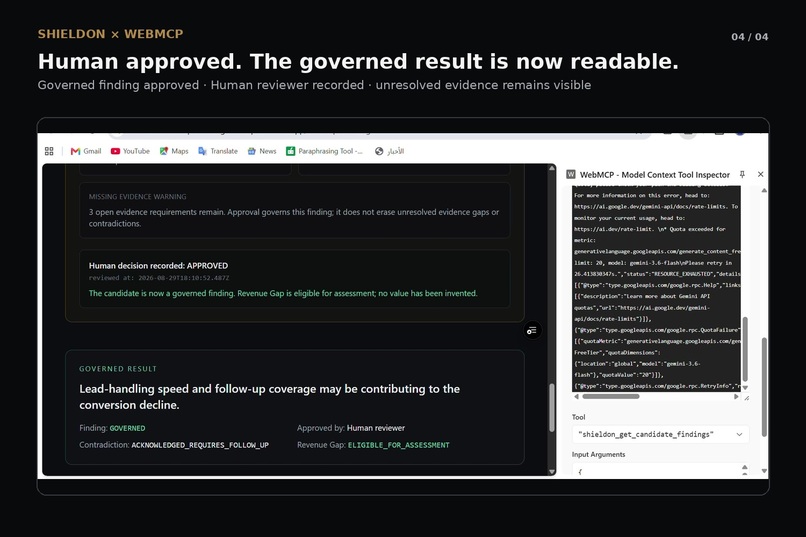
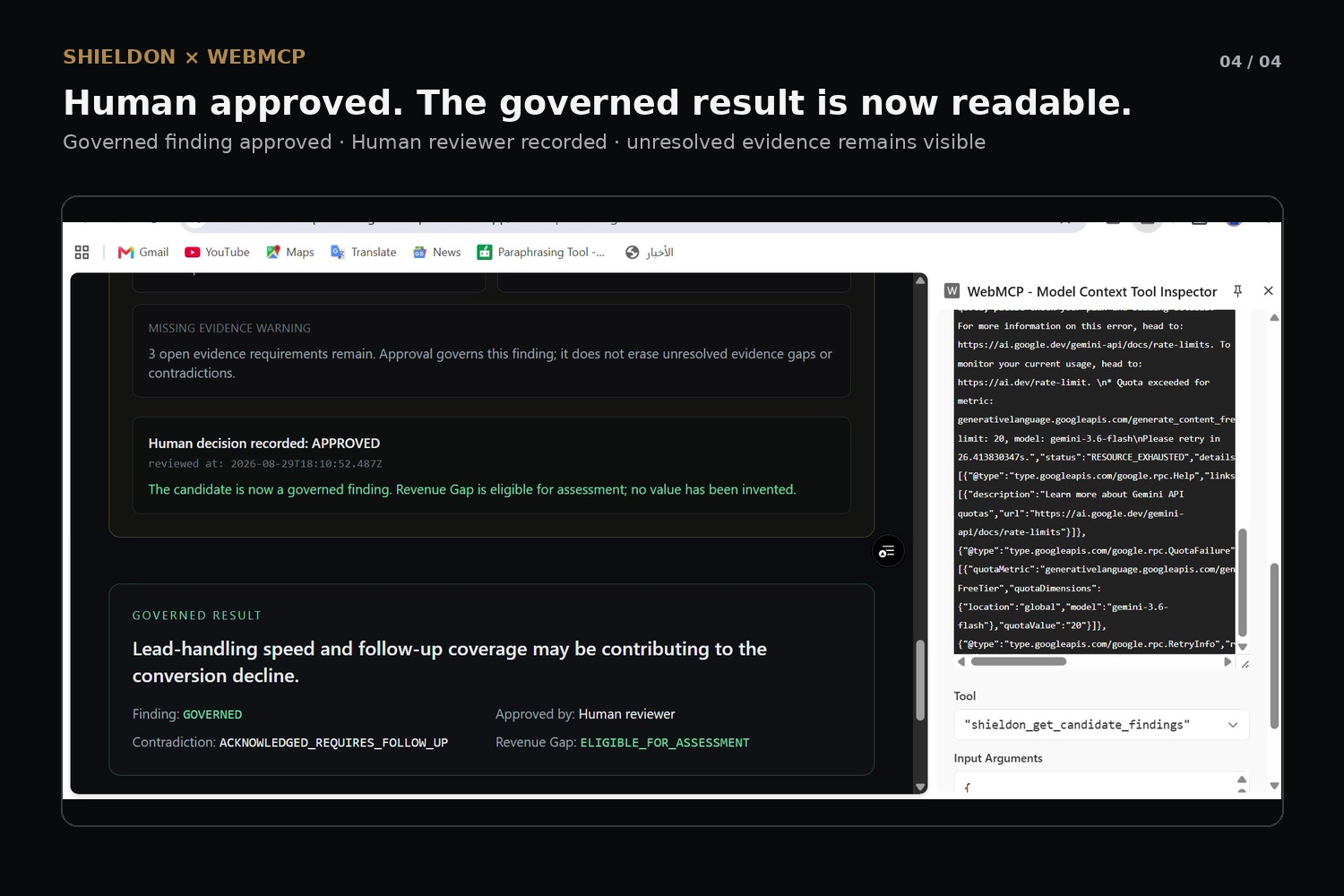
4-governed-result
Inspiration
I learned that AI agents are getting really good at reading information, connecting evidence and proposing conclusions. There's one question that pushed me to build shieldOn WebMCP prototype: "Should it also have the authority to make the final decision because it can access the evidence?" ShieldOn is a revenue engineering system built around evidence, verification, contradictions, missing information and governed findings. For this challenge, I wanted to test one simple principle: "WebMCP can give an AI agent access to investigate, without giving it authority to govern the conclusion."
What it does
The demo uses a synthetic revenue investigation for a dental business. Through WebMCP, the agent gets six read-only ShieldOn tools. It can inspect the investigation, evidence, missing evidence, contradictions, candidate findings and governed findings. The agent can analyze the case and explain what may be going wrong. But it cannot approve or reject the finding. There are 6 read-only tools, 0 approval tools and 1 protected human decision.
The workflow is:
AI investigates → human reviews → human decides → AI rereads the governed result
Before human review, the finding remains a candidate. If the agent is directly asked to approve it, it cannot. No approval tool is exposed through WebMCP. The human reviewer must make that decision inside ShieldOn. Once approved, the finding becomes governed, the human reviewer is recorded and the agent can then reread the result. Importantly, unresolved evidence gaps and contradictions remain visible.
How we built it
I made a conscious decision not to build too much for this challenge. Rather than trying to build the entire ShieldOn product, I built one complete human-governance loop. The investigation contains directly verified evidence, operator-confirmed information, unverified claims, missing evidence, contradictions and a candidate finding. One part of the case shows qualified leads increasing while consultation conversion declines. The evidence also shows slower response times, incomplete follow-up and CRM records that don't always match the communication history. This gives the agent something meaningful to investigate rather than a perfectly clean dataset. The most important design decision was separating analysis authority from decision authority. Approval and rejection exist only inside the human review interface. They aren't exposed as WebMCP tools. The agent can read the governed result afterward and it can't create that governed state itself.
ShieldOn existed before this challenge as a governed revenue investigation system. What I built during the WebMCP Challenge is the agent-facing WebMCP layer: six read-only browser tools, the synthetic investigation demo, the protected human-review loop, and the ability for the agent to reread a governed finding after human approval. The underlying ShieldOn product predates the challenge.
Challenges we ran into
One thing I had to keep reminding myself was not to make the agent autonomous just because technically I could. It would have been easy to expose an approval tool and let the agent complete the entire workflow. For me, that would have missed the whole point of what I wanted to prove. So I tested the opposite. I intentionally asked the agent to approve the candidate and mark it as ShieldOn's official conclusion. And it couldn't. That became one of the strongest parts of the demo because the governance boundary is demonstrated. Another challenge was keeping uncertainty after approval. A human decision shouldn't magically erase missing evidence or contradictions, so those stay visible even after the finding becomes governed.
Accomplishments that we're proud of
I am proud that the demo proves a complete collaboration loop rather than only showing an AI calling tools. The agent can investigate real structured evidence, identify missing information and contradictions and prepare a candidate conclusion. A human then makes the protected decision. After that decision, the agent can see and understand the newly governed result without gaining the authority to create it. The negative test is especially important to me:
- the system successfully demonstrates what the AI can't do.
- that boundary is a core part of the product and not a limitation.
What we learned
What became very clear to me while building this is that giving an AI more capability shouldn't by default mean giving it more authority. WebMCP can give an AI agent powerful access to application context while the application still decides which actions remain protected. I also learned that good human-agent systems shouldn't only expose useful capabilities. They should make boundaries explicit. In this case, one of the most important decisions was actually the tool I chose not to expose.
What's next for ShieldOn
This challenge prototype focuses on one narrow governance loop. The larger ShieldOn direction is to apply the same model to deeper revenue investigations with more evidence sources, more complex contradictions, stronger traceability and eventually governed interventions. As ShieldOn grows, I want the agent to be able to investigate much more of the business but without silently gaining authority it was never supposed to have.
The principle will remain the same: AI investigates. Humans govern the conclusion. WebMCP gives the agent access. ShieldOn keeps the decision governed.
Built With
- ai
- chrome
- context
- gemini
- human-in-the-loop
- model
- next.js
- protocol
- react
- typescript
- vercel
- webmcp

Log in or sign up for Devpost to join the conversation.