🛡️ ShieldMail AI
Explainable Phishing and Suspicious Message Analysis
💡 Inspiration
Phishing remains a serious cybersecurity challenge because malicious messages can look convincing, imitate trusted organizations, and pressure people into making quick decisions. Many users know they should be careful online, but identifying the warning signs in a suspicious message is not always easy.
We wanted to build a tool that makes suspicious-message analysis easier to understand—not just by displaying a risk score, but by explaining the warning signs behind it.
That idea led to ShieldMail AI, a cybersecurity project focused on explainable message analysis and practical safety guidance.
🚨 What It Does
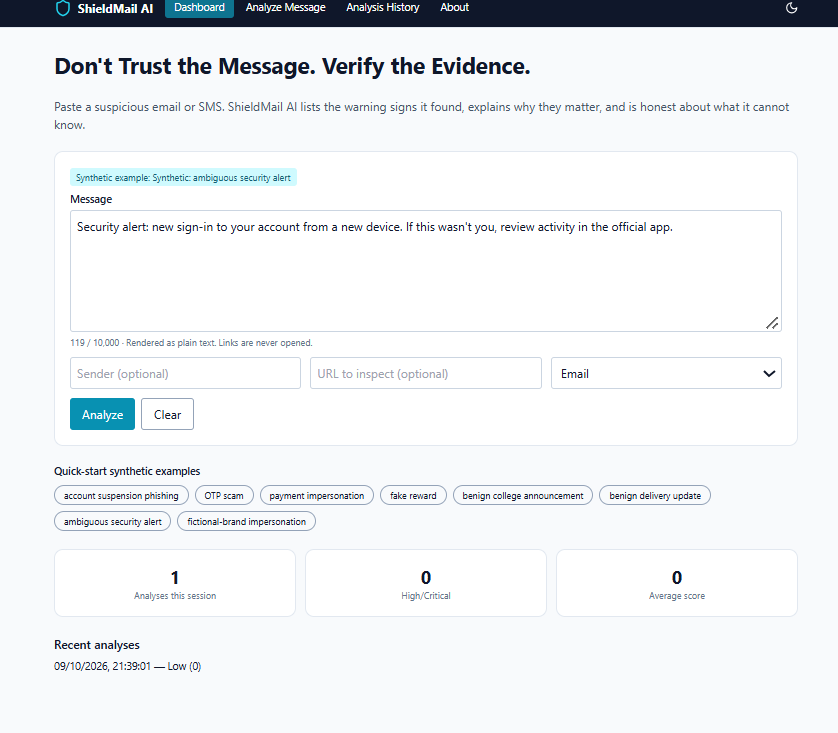
ShieldMail AI is a web application that analyzes user-submitted email or message text for suspicious patterns associated with phishing and social engineering.
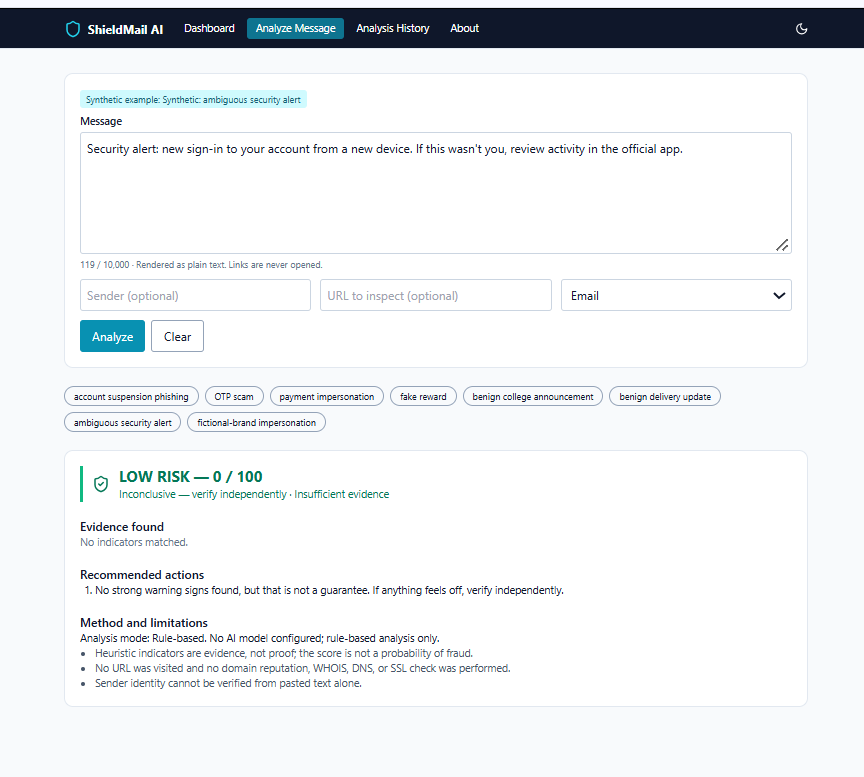
The application evaluates supported warning indicators and presents a risk assessment with findings and recommendations to help users make more informed decisions.
Key Features
- Suspicious Message Analysis: Submit email or message text for analysis.
- Explainable Risk Scoring: Calculate a heuristic risk score using detected warning indicators.
- Risk Classification: Present an overall risk category based on the implemented rules.
- Threat Indicators: Highlight patterns such as credential requests and urgency-based language when detected by the rules.
- Actionable Recommendations: Provide guidance on how to handle a potentially suspicious message safely.
- Web-Based Interface: Use the React frontend to interact with the FastAPI backend.
- API Integration: Process analysis requests through a backend API.
⚙️ How We Built It
ShieldMail AI combines a React-based frontend with a Python FastAPI backend.
The frontend provides the user interface for submitting message text and viewing the analysis results. The backend validates incoming requests and processes the submitted text using a rule-based analysis engine.
The engine checks supported indicators, calculates a heuristic risk score, and generates findings and safety recommendations. The frontend then presents the returned results in an accessible format.
Our current approach prioritizes explainability: users should be able to understand why a message was flagged instead of receiving only a label.
Technology Stack
- React + TypeScript: Frontend interface
- Vite: Frontend development and build tooling
- Python: Backend implementation
- FastAPI: API endpoints and request handling
- Tailwind CSS: Frontend styling
- Git and GitHub: Version control and project hosting
🧩 Challenges We Focused On
One of the key challenges in suspicious-message analysis is making results understandable without presenting them as absolute truth. A message can contain suspicious language without necessarily being malicious, and a convincing phishing message may not trigger every detection rule.
We addressed this design challenge by focusing on identifiable warning indicators, a rule-based risk assessment, and practical recommendations. Connecting the frontend to the backend API also required keeping the displayed results consistent with the backend's actual response.
📚 What We Learned
Building ShieldMail AI helped us bring together frontend development, backend API integration, text analysis, and cybersecurity-focused user experience.
It also reinforced an important lesson: security tools should communicate uncertainty responsibly. A risk score can help users investigate a message, but it should not replace independent verification or professional security controls.
🌟 What Makes It Different
ShieldMail AI focuses on explainable analysis rather than a score alone. Its goal is to make warning signs easier to recognize and help users understand safer next steps.
Instead of claiming that every phishing attempt can be detected, the project presents its findings as decision-support information that users can review.
🚀 Future Plans
Future improvements could include URL and domain reputation checks, email-header authentication analysis, multilingual detection, machine-learning-based classification, and broader evaluation against labeled phishing and legitimate-message datasets.
These enhancements could extend the current rule-based implementation with additional evidence and more comprehensive analysis.
🎯 Our Mission
Our goal is to make cybersecurity more accessible by helping people recognize suspicious messages, understand the reasons for concern, and make safer digital decisions.
ShieldMail AI — Understand the warning signs. Make safer decisions.
Built With
- cybersecurity
- fastapi
- github
- phishing-detection
- python
- react
- restapi
- tailwind-css
- typescript
- vite


Log in or sign up for Devpost to join the conversation.