-
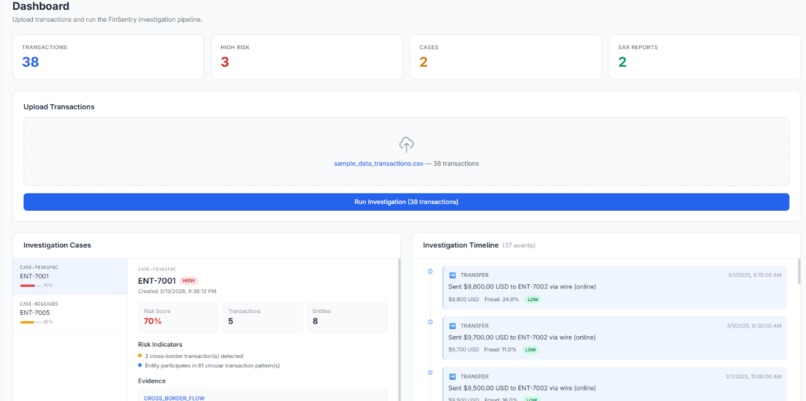
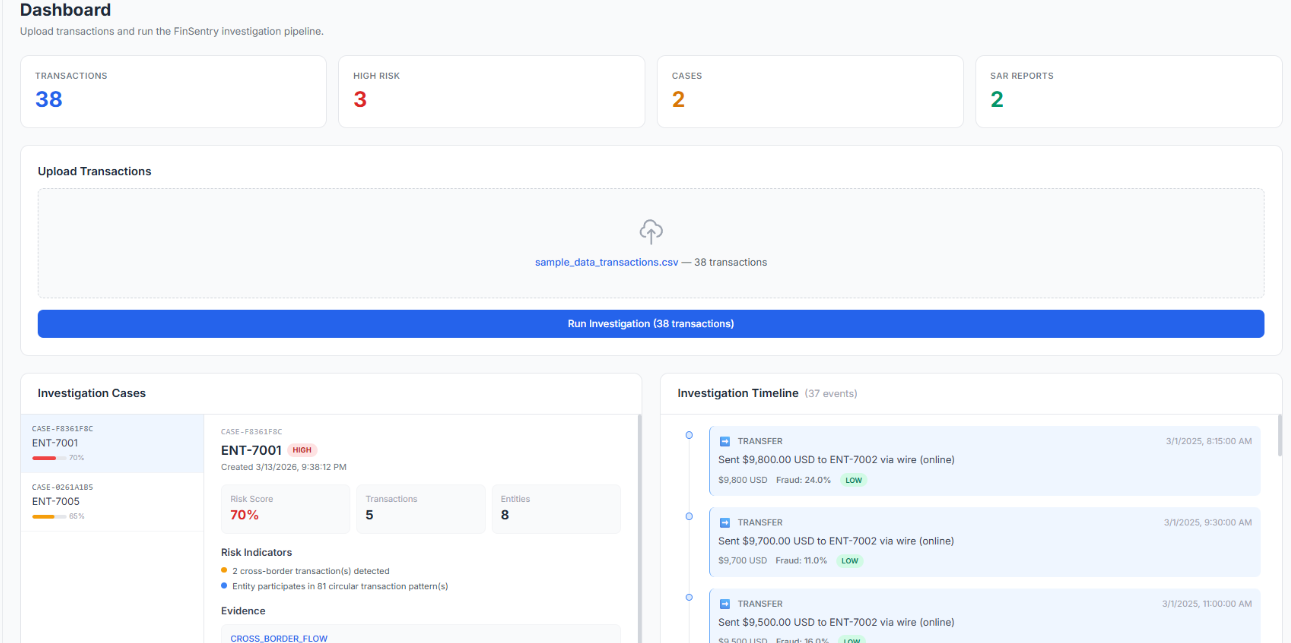
Dashboard
-
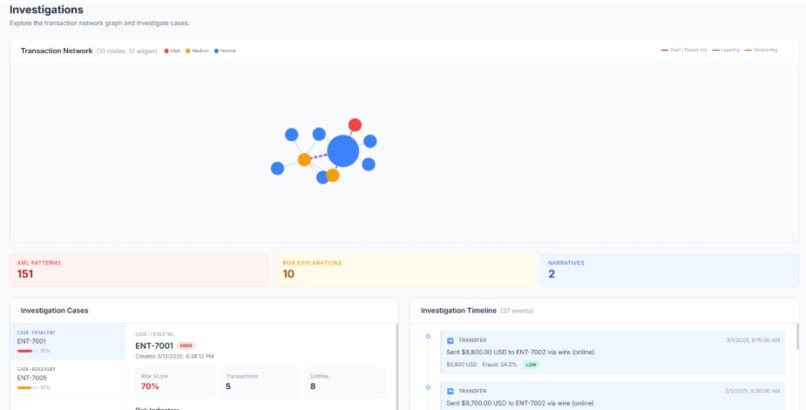
Investigation
-
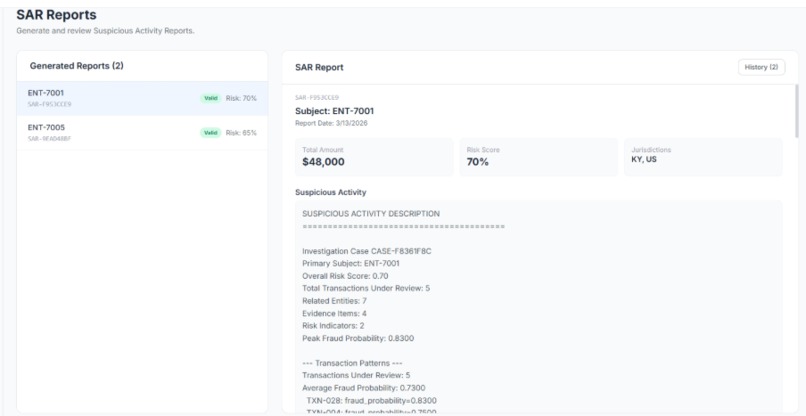
SAR reports
Shield Matrix: Inspiration:
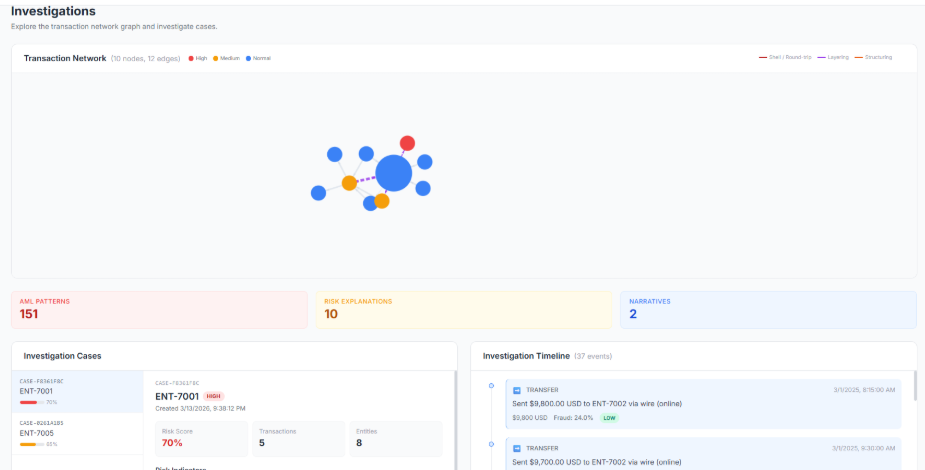
In an era where financial transactions happen at the speed of light, traditional fraud detection systems based on rigid, heuristic rules are failing. Sophisticated actors use "layering" and "structuring" to hide within the $N$-dimensional noise of global finance. We were inspired to build Shield Matrix—not just a dashboard, but a sentient intelligence environment that sees the hidden "topology" of financial crime. We wanted to give investigators the power to deconstruct complex laundering rings the moment they materialize.
What it does:
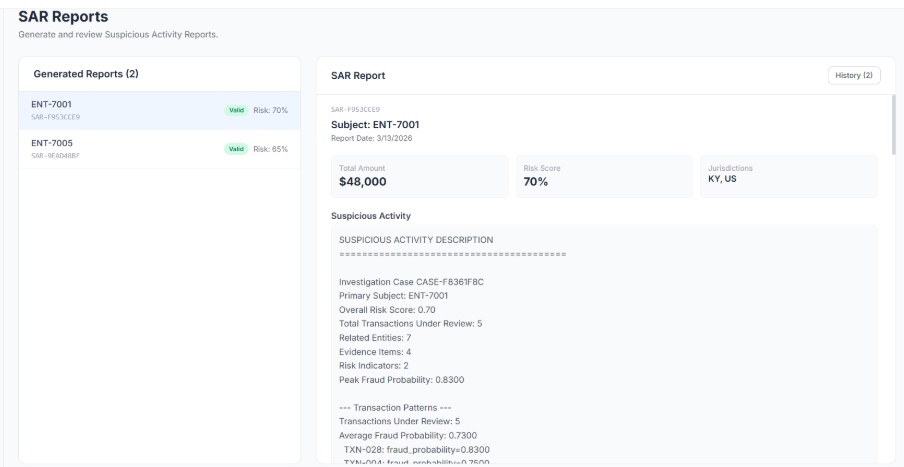
Shield Matrix is an end-to-end cyber-financial intelligence platform. It ingests raw transaction telemetry and pushes it through a multi-stage deterministic pipeline:
Anomaly Isolation: Identifies outliers in massive datasets using unsupervised machine learning. Explainable Risk Scoring: Every alert includes feature-attribution to explain why a transaction was flagged. Threat Topology Mapping: Visualizes financial flows as a dynamic graph, revealing hidden clusters and cyclical fund rotations. Dossier Management: Allows analysts to synthesize evidence into structured "Investigation Dossiers." FIR Generation: Automatically generates specialized Fraud Incident Records (FIR) for immediate regulatory compliance. How we built it We engineered a high-performance stack designed for both speed and analytical depth:
Backend Architecture: Built with FastAPI for asynchronous telemetry ingestion. The core logic is powered by a custom Anomaly Engine utilizing Isolation Forests for outlier detection. Explainable AI (XAI): We integrated SHAP (SHapley Additive exPlanations) to provide auditable insights into every risk score. Graph Engine: Leveraging NetworkX, we represent the financial ecosystem as a graph $G = (V, E)$, where $V$ represents entities and $E$ represents edges of capital flow. We calculate Degree Centrality to identify high-risk hubs: $$C_D(v) = \frac{\text{deg}(v)}{|V|-1}$$ Frontend Command Center: A modern React + TypeScript + Vite application. We utilized a custom Hacker-Corporate dark-mode identity built with Tailwind CSS for a premium, high-stakes security analyst experience. Challenges we ran into One of the primary technical hurdles was the "Graph-Reality Gap." Visualizing 10,000+ transaction vectors without overwhelming the analyst’s cognitive capacity required rigorous data pruning and intelligent UI layering. Furthermore, restructuring the entire project's module architecture to support a more modular "Dossier-based" workflow while maintaining logic integrity between the graph engine and the FIR generator was a massive architectural challenge.
Accomplishments that we're proud of Unified Logic Flow: We successfully synchronized the machine learning classification results with the graph-based entity scoring, creating a "single source of truth" for every investigation. The FIR Generator: Automating the synthesis of technical graph data into a human-readable regulatory report was a major milestone toward reducing analyst burnout. Visual Identity: Transforming a standard analytics tool into a cinematic-quality, "Hacker-style" Command Center that feels like an elite security tool. What we learned We delved deep into the mathematics of network science, specifically how PageRank and Eigenvector Centrality can be used to predict "Financial Contagion." We also learned that in the corporate security world, a model is only as good as its explainability. If an analyst can't understand the "Why" behind the "What," the intelligence isn't actionable.
What's next for Shield Matrix The roadmap for Shield Matrix is ambitious:
Real-time Ingestion: Integrating streaming pipelines for sub-second anomaly detection. Collaborative Intelligence: Enabling multi-jurisdictional dossiers for cross-border investigations. Federated Learning: Training the Anomaly Engine on encrypted datasets to protect privacy while improving global detection signatures.
Built With
- fastapi
- networkx
- npm
- numpy
- pandas
- pydantic
- pytest
- python
- react
- react-force-graph
- scikit-learn
- shap
- sqlalchemy
- tailwind
- typescript
- uvicorn
- vite


Log in or sign up for Devpost to join the conversation.