-
-
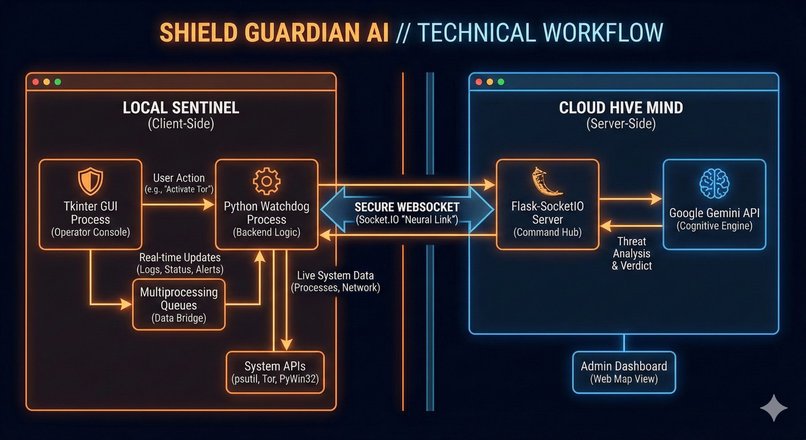
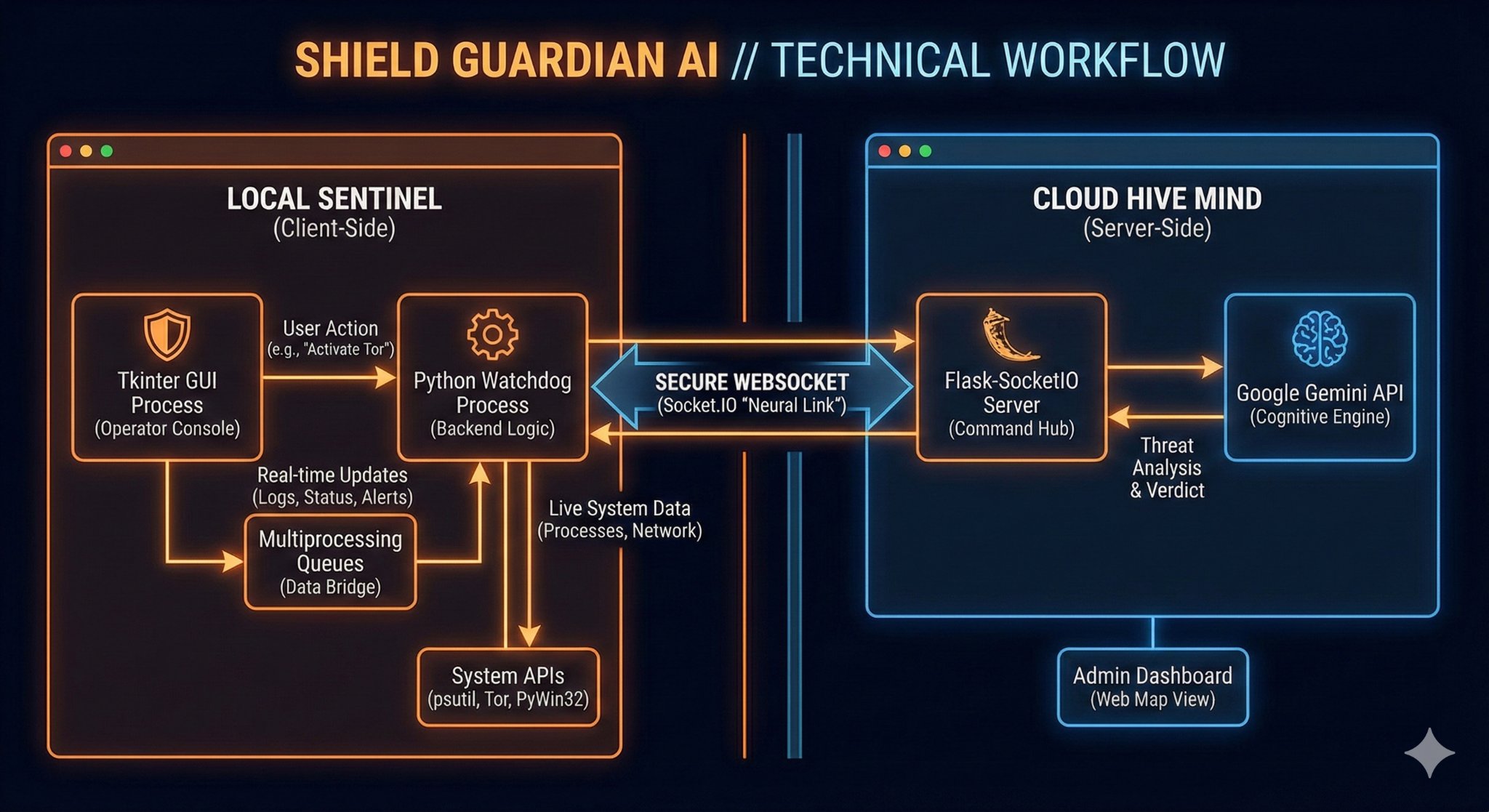
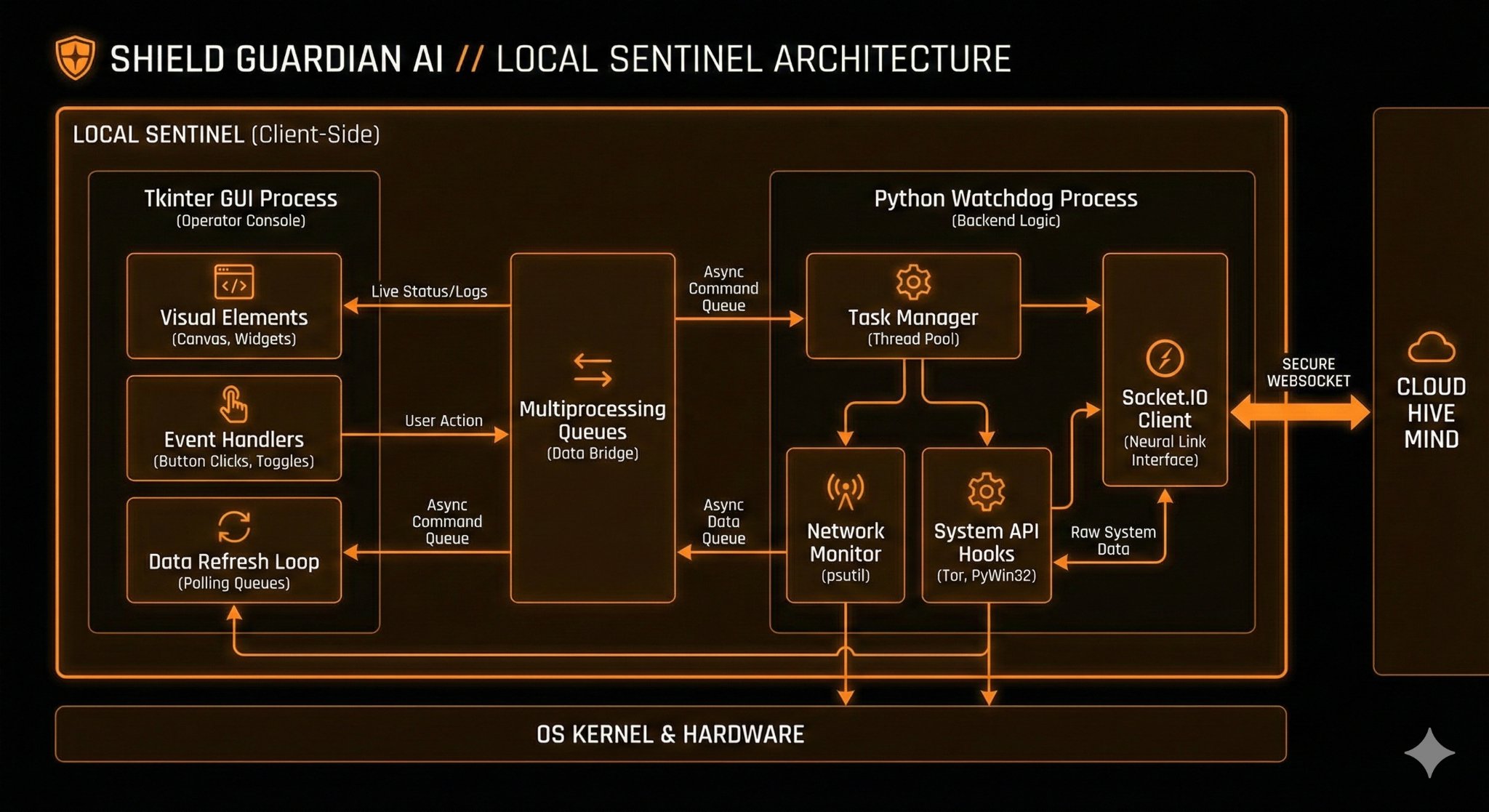
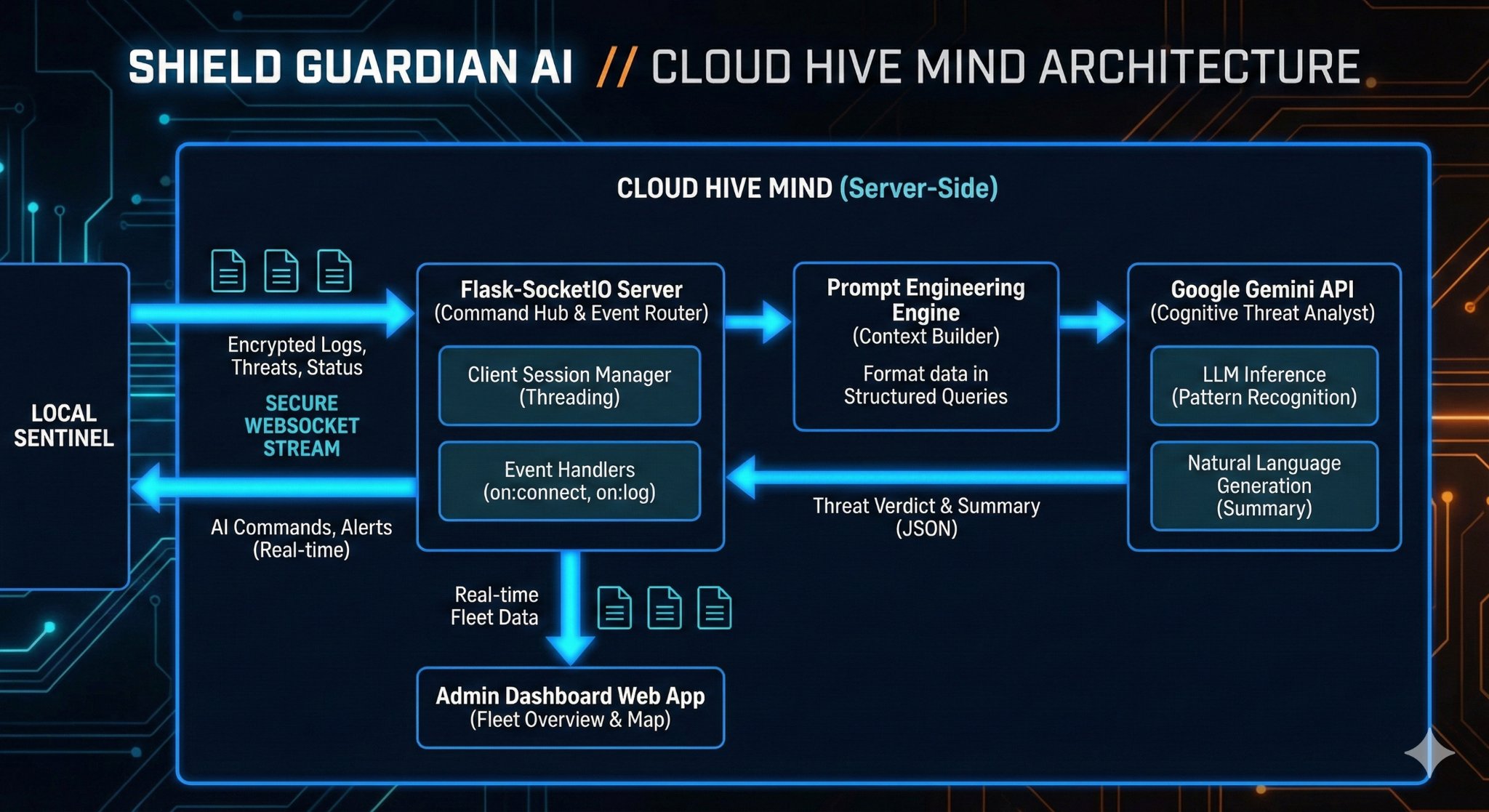
Shield project technical workflow of the application
-
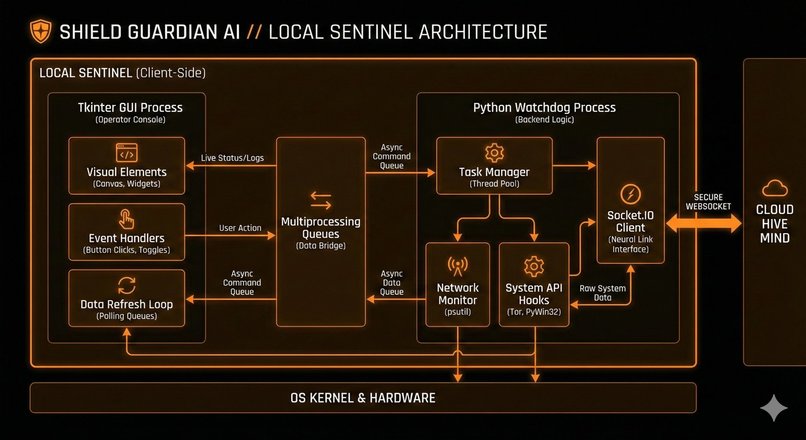
Shield sentinal technical and work flow of the project
-
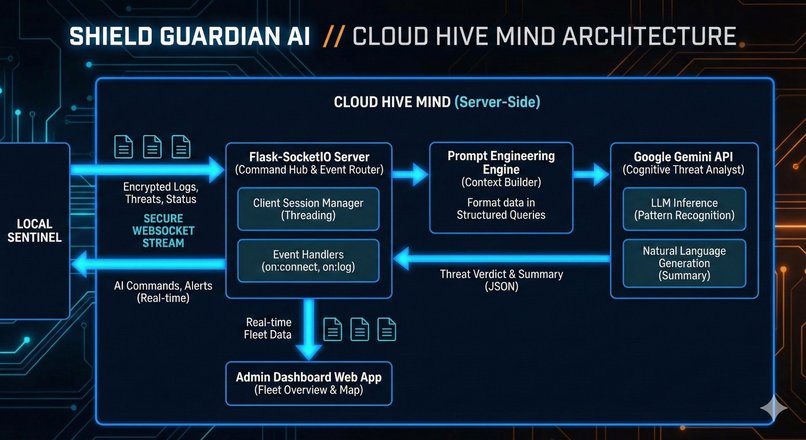
Shield technical workflow of the hive mind workflow
💡 Inspiration: The Philosophy of Active Defense
The modern internet has become a hostile environment. Cyber threats have evolved from simple static scripts into dynamic, persistent adversaries that adapt to defenses. At the same time, user privacy is eroding under the weight of mass surveillance and invasive OS telemetry. We realized that the traditional "install and forget" antivirus model is broken; it treats the user as a passive victim and the software as a black box.
Shield AI was born from a radical philosophy: Cyber Sovereignty.
We wanted to build a system that fundamentally shifts the power dynamic back to the user. We didn't just want to detect malware; we wanted to dismantle the mechanisms of tracking and surveillance. Our inspiration came from two distinct but converging needs:
The "Ghost Protocol" (Privacy by Design): We live in an age where "metadata is the message." Identifying who you are is often more valuable to an attacker than what you are doing. We were inspired to build Shield Sentinel not just as a shield, but as a cloak. We wanted to democratize state-level privacy tools—like Tor Onion Routing, MAC Address Spoofing, and Telemetry Blocking—and make them accessible via a single, tactical "Toggle Switch." The goal was to allow any user to vanish from the digital radar at will.
Swarm Intelligence (The Titan Hive): A lone defender is vulnerable; a network is resilient. We envisioned a C2 (Command & Control) Architecture where individual devices (Sentinels) act as sensory nodes for a central "Super Brain." By integrating Google Gemini 3, we moved beyond the limitations of rigid, rule-based detection. We wanted an AI that could "reason" about security—an intelligence that doesn't just flag a "Port Scan" but understands the intent behind it by analyzing the sequence of events across the entire fleet.
Shield AI is the realization of this vision: A Unified Defense Ecosystem where the Sentinel provides the tactical muscle, and the Titan Hive provides the strategic mind.
🛡️ What It Does: The Dual-Layer Architecture
The ecosystem functions on a distributed client-server model, ensuring that heavy cognitive processing (AI analysis) doesn't impact the performance of the local machine.
1. The Shield Sentinel (Autonomous Client)
The Sentinel is the "Body" of the system—a lightweight, high-performance Python agent deployed on the endpoint. It operates under the "Carbon Protocol", a custom communication standard we designed for secure, encrypted telemetry.
A. Global Network Monitor (The "All-Seeing Eye")
Unlike standard task managers that hide details, our Network Monitor hooks directly into the OS kernel using psutil. It provides a raw, unfiltered stream of every active connection:
- Process Mapping: It instantly correlates open ports to specific executables (e.g.,
chrome.exeon Port 443). - Traffic Analysis: It identifies the nature of the connection. As seen in our live tests, it can distinguish between standard traffic and Tor Relay Nodes (
192.168.TOR.60), giving the user confirmation that their traffic is successfully anonymized. - Kernel Controls: Users can toggle "Silent Mode" to suppress notifications or enable experimental "Kernel Hooks" for deeper inspection.
B. Active Defense Ops (The 6-Module Arsenal)
The Sentinel features six specialized defense modules, accessible via the tactical dashboard:
- Anonymity Circuit (Tor): This is not a VPN; it is a cryptographic router. When active, it forces outgoing traffic through a three-hop Tor Onion Circuit. Our tests confirmed that this successfully masks the user's origin, displaying a relay IP (e.g.,
104.22.XX.XX) instead of the true location. - Hardware ID Spoofer: To prevent persistent tracking bans, this module interacts with the network adapter's registry keys. It randomizes the Media Access Control (MAC) address on every boot, ensuring the device appears as a completely new machine to local networks.
- OS Telemetry Cloak: Windows 10/11 runs dozens of background services that report usage data. This module identifies and forcefully terminates these services. As shown in our dashboard, it is currently blocking 12 active tracking services, effectively "blinding" the OS from phoning home.
- Web Guard: A heuristic URL monitor that inspects browser navigation events in real-time, checking them against local blocklists of known phishing and malware distribution sites.
- Siren Monitor (Honeypots): This is our "Active Trap" mechanism. The Sentinel opens fake listening ports (e.g., Port 21, 23) on the local machine. If any device on the network attempts to connect to these decoys, the system instantly flags it as an internal intrusion attempt.
- Emergency Smart Scan: A manual override that triggers a deep file-system traversal. It uses heuristic analysis (checking for suspicious entropy and file signatures) rather than just hash matching, allowing it to catch zero-day variants.
2. The Titan Hive (C2 Server & Gemini 3 Brain)
The Hive is the "Brain"—a centralized Flask-based server that provides global overwatch for the entire fleet of Sentinels.
A. Gemini 3 Commander (The Analyst)
We integrated the Gemini 3 API to act as a Tier-1 Security Operations Center (SOC) Analyst.
- Structured Intelligence: We don't just send raw text. The Sentinel buffers logs into a JSON structure (The Intel Buffer) containing timestamps, event types, and metadata.
- Contextual Analysis: Gemini 3 analyzes this buffer to understand the narrative. It can differentiate between a user installing software (a series of benign file writes) and a ransomware attack (rapid, sequential file modifications).
- Threat Scoring: The AI assigns a dynamic Threat Score (0-100) and a status (NOMINAL / CRITICAL) to the fleet, which is displayed on the dashboard.
B. Privacy-First Dashboard (The "Ghost Protocol")
We faced a critical ethical challenge: How to monitor a fleet without creating a surveillance tool?
- IP Masking Middleware: We implemented a strict privacy layer in the server's API. When a Sentinel connects, the server resolves its Geo-Location (e.g., "Nairobi, Kenya") for the map but cryptographically hashes or masks the last two octets of the IP address (e.g.,
102.68.***.***). - Visual Anonymity: The admin sees where the threats are and how the network is performing, but the specific identity of the user remains protected. This allows for "Blind Overwatch."
C. Real-Time Swarm Tracking
The dashboard utilizes WebSockets (via flask-socketio) to maintain a persistent, bi-directional link with every agent.
- Live Status: We can see the exact status of 5+ agents simultaneously. The dashboard updates instantly—if a Sentinel goes offline or detects a threat, the UI reflects it in milliseconds without a page refresh.
- Module Telemetry: The Hive knows exactly which modules are active on which machine (e.g., "Agent 3 has Tor Active"), allowing for granular fleet management.
⚙️ How We Built It: The Tech Stack
We architected Shield AI as a high-performance, asynchronous ecosystem using Python 3.12.
1. The Sentinel (Client Engineering)
- Custom Tkinter (CTk): We rejected standard Windows widgets. We built a custom "Cyberpunk" design language using
Canvasdrawing for high-DPI scaling. This allowed us to create the pulsing "Shield" animations and the translucent "Midnight" glass effect panels. - Multiprocessing & Threading: A major hurdle was preventing the GUI from freezing during heavy network scans. We solved this by running the Network Monitor and Packet Sniffer in separate daemon threads, communicating with the UI via thread-safe queues.
psutil&scapy: These libraries form the backbone of our monitoring capability, allowing us to perform low-level socket inspection and packet manipulation without requiring a dedicated kernel driver.- The "Intel Buffer": We implemented a local queuing system. Instead of flooding the server with an API call for every single log, the Sentinel aggregates events and transmits them in compressed batches. This reduces bandwidth usage and ensures the C2 channel remains stealthy.
2. The Titan Hive (Server Engineering)
- Flask (Multi-Threaded): We re-engineered the backend from a simple development server to a robust, threaded application. This ensures that a "Keep-Alive" heartbeat from one agent doesn't block the threat analysis of another.
- SQLite V2 Schema: We redesigned the database schema to support our new capabilities. We added specific columns for
masked_ip,threat_score, andrecent_logs(stored as JSON text) to enable the "Ghost Protocol" and Gemini analysis features. - Leaflet.js Integration: For the global map, we integrated the open-source Leaflet library. We wrote custom JavaScript to parse the incoming WebSocket JSON stream and dynamically render pulsing "Beacon" markers on the map coordinates.
🚧 Challenges We Ran Into
1. The "Ghost Protocol" Conflict
We initially struggled with a conflict between Visibility and Privacy. The admin needed to see the agents to manage them, but storing user IPs violated our privacy manifesto.
- The Fix: We implemented the "Masking Middleware." This is a server-side interceptor that processes the incoming request before it reaches the database. It extracts the location data for the map but immediately redacts the identifying IP octets. This ensures that the raw IP is never stored in the persistent database, only the masked version. Also i used Antigravity in fixing
2. The WebSocket "Race Condition"
When testing with 5 agents, we encountered a race condition where the dashboard would crash if two agents sent heartbeats at the exact same millisecond.
- The Fix: We implemented a Mutex Lock on the database write operations and switched the Flask-SocketIO server to use
eventletfor better concurrency. This allowed the server to queue the incoming heartbeats and process them sequentially without dropping data.
3. AI Hallucination & Latency
Early versions of the Gemini integration were too "chatty," returning conversational text instead of raw data, and the API latency (1-2 seconds) caused the dashboard to lag.
- The Fix: We solved this with Prompt Engineering and Asynchronous Calls. We designed a strict "System Prompt" that forces Gemini to return only JSON data.For me it wa tough to fix and uses Google Gmini Pro for debugging Furthermore, we moved the AI analysis to a background worker job so that the dashboard UI remains responsive while the AI thinks.
🏆 Accomplishments We Are Proud Of
- The Ecosystem Launch: We didn't just write a script; we architected a platform. Seeing 5 separate agents populating the Titan Hive map in real-time, all reporting "ONLINE" with green status lights, was the ultimate validation of our distributed architecture.
- Gemini 3 Integration: Moving from simple regex detection to LLM-based Behavioral Analysis is a paradigm shift. The system now understands the context of a threat, not just its signature.
- Democratizing Privacy: Tools like Tor Routing and MAC Spoofing are usually command-line utilities reserved for experts. We are proud to have distilled these complex technologies into simple "Toggle Switches" that anyone can use to protect their digital identity.
- The "Network Monitor" Visualization: Building a tool that allows a user to see exactly what their computer is connecting to—and providing a "Tor Switch" to hide it—empowers the average user with state-level privacy capabilities.
🧠 What We Learned
- Privacy Must Be Architectural: You cannot "add" privacy later. Features like the Anonymity Circuit and IP Masking had to be baked into the core protocol from day one.
- LLMs Need Context: Gemini 3 is incredibly powerful, but only if you feed it the right data. We learned that sending a single log line is useless; sending a buffer of the last 10 actions allows the AI to "tell a story" and make accurate threat assessments.
- The Power of Asynchronous UI: Decoupling the Sentinel's GUI from its Network Logic using Python's
threadingandqueuemodules was critical. It taught us that a responsive user experience is just as important as the backend security logic.
🚀 What's Next for Shield AI
We are moving rapidly from a functional prototype to a globally distributed Decentralized Physical Infrastructure Network (DePIN). Our roadmap focuses on scalability, autonomy, and economic incentivization.
1. The Shield DePIN Protocol (Current Phase)
We are currently integrating the $SHIELD Utility Token (Solana) to transform the ecosystem into an incentivized security market.
- Proof-of-Protection: We are implementing a consensus mechanism where Sentinels earn tokens for verified uptime and validated threat intelligence.
- Access Gating: The token will serve as a cryptographic license key. Users must hold $SHIELD to unlock advanced Gemini 3 "Hunter Mode" features, creating a sustainable economy where security is a measurable asset.
2. The Titan Oracle (Cloud Intelligence Support)
We are fundamentally redefining the "Command & Control" (C2) concept. Instead of a central authority that controls your machine, we are deploying Titan Hive V2 as a "Support Oracle".
- The "Knowledge Shield" Architecture: The server operates on a strictly Federated Support Model. It does not issue commands to the Sentinel; instead, the Sentinel autonomously decides when to consult the server.
- Sentinel's Knowledge: Your local Sentinel handles all raw data processing on-device. It never sends your files or private logs to the cloud. It only sends anonymized "Problem Vectors" (e.g., "I see a suspicious pattern X").
- Hive's Knowledge: The Server aggregates these vectors from thousands of users to learn global threat trends, but it never learns who you are.
- Gemini Commander as a Consultant: When a Sentinel encounters a problem it cannot solve, it requests "backup" from the Gemini Commander. The AI analyzes the anonymized vector and returns a "Solution Package" (e.g., a custom firewall rule or a heuristic patch).
- User Benefit: This ensures you are protected by the collective knowledge of the entire network without ever exposing your personal data to it. The server exists solely to help, not to rule.
3. Autonomous "Hunter" Swarm
We are evolving from passive defense to active immunity.
- Goal: Enable peer-to-peer threat sharing. If Sentinel A detects a malicious IP in London, it instantly informs the Hive, which pushes a firewall rule to Sentinel B (Tokyo) and Sentinel C (New York), immunizing the entire global fleet in milliseconds.
4. Mobile Command App
Security never sleeps, and neither should the operator.
- Goal: Development is underway for a Flutter-based Mobile Dashboard. This will allow admins to receive "Critical Threat" push notifications and trigger countermeasures (like "Lockdown Mode") directly from their smartphones, anywhere in the world.
Built With
- flask
- flask-socketio
- gemini-3-api
- html
- javascript
- multiprocessing
- psutil
- python
- pywin32
- socket.io-client
- tkinter
- tor

Log in or sign up for Devpost to join the conversation.