-
-
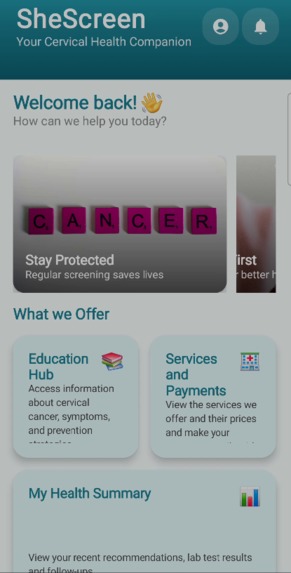
education hub
-
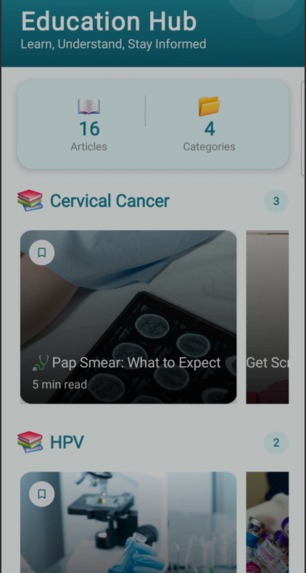
educational materials
-
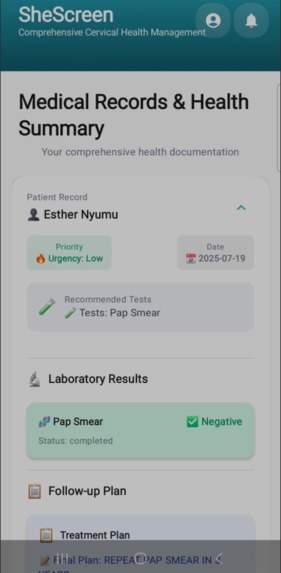
medical report
-
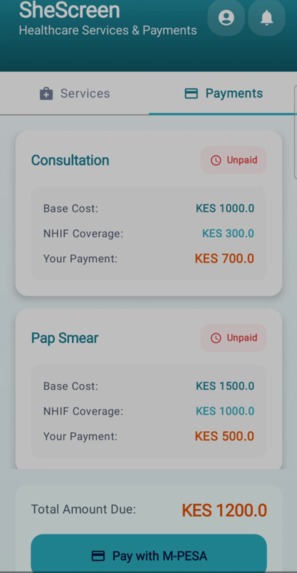
payment
Inspiration
We were inspired to create SheScreen by the reality that too many women lose their lives to cervical cancer simply because it's detected too late. Early detection is the key in saving lives when it comes to cancer. This motivated us to build a platform that empowers hospitals to: Identify high-risk patients early, Generate personalized screening recommendations, and ensure timely follow-up through a structured care plan.
What it does
The SheScreen dashboard does the following:
Risk Prediction
- Predicting a patient's risk of developing cervical cancer using provided risk factors.
Recommendations
- Based on the risk prediction, the system suggests personalized screening recommendations. Doctors can review, accept, or override these suggestions by providing their own input.
Lab Test Coordination
- The dashboard tracks all recommended lab tests. A doctor can then update test results, which automatically trigger follow up recommendations.
Follow-Up Planning
- Once lab test results are entered, another machine learning model proposes a follow-up plan. Doctors can choose the suggested plan or customize the follow up plan.
Billing & Cost Tracking
- All services are linked to costs. Bills are automatically generated with NHIF and out-of-pocket calculations.
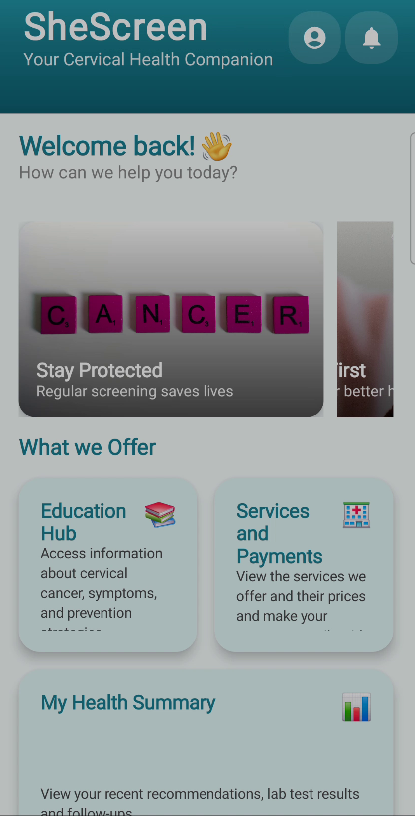
Mobile App
Chatbot Assistant
- An easy-to-use chatbot that answers questions users might have.
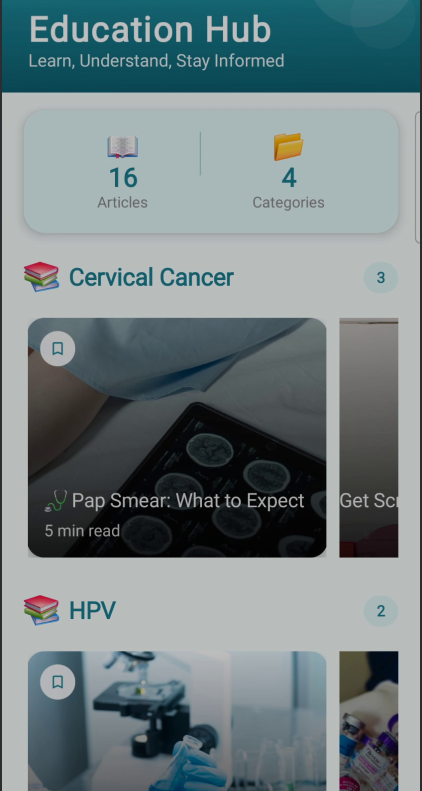
Education Hub
- Curated, easy-to-understand articles and videos to educate women about cervical cancer prevention, screening, and treatment options.
Access to Care Plans
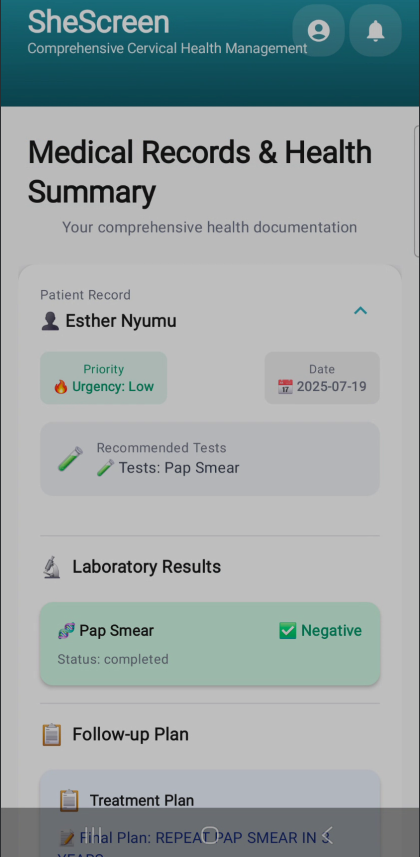
- Patients can view their: Screening recommendations, Lab test results and Follow-up plans from their doctor
Billing
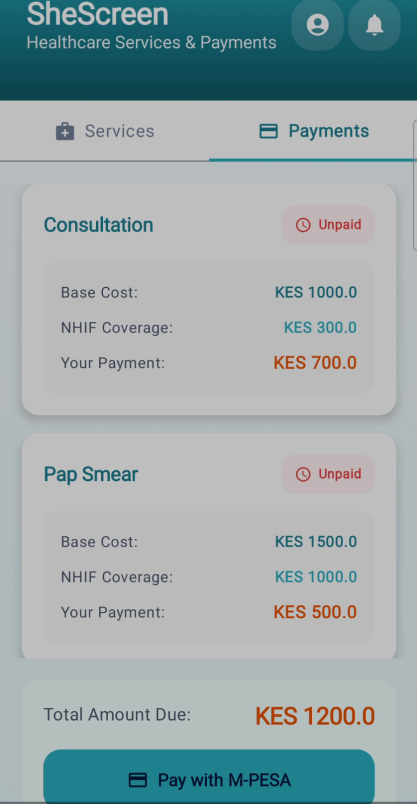
- View a breakdown of the service costs, including NHIF and out-of-pocket components and make payments for any outstanding medical bills directly from the app.
How we built it
Risk Model
We used the patient's medical information such as the age of the patient, sexual activity (number of partners and the first time), history of HPV, STD history and their lifestyle behaviour (if they smoke). This was an unsupervised problem. The task was to get different risk levels of the patients based on the above features. kMeans clustering had the best silhouette score of 0.3 on 2 clusters. From this clusters, the distance from the cluster center was calculated. The predicted cluster is then divided by the maximum distance to get the probability of the patient belonging in the high risk cluster. The model was then saved using joblib and an end-point for accessing it was built using FastAPI.
Recommended action/Follow-up model
From the dataset, the recommended action feature needed to play a role in our system. After the patient has done one of the tests, HPV DNA, Pap smear or VIA, the results of the tests are used together with the previous risk factors used in classifying the patient's risk probability to predict a follow-up action (the next step the patient should take). This was a supervised task, our target feature being the "recommended action". This feature contained more than 10 unique instances which would cause a "curse of dimensionality" problem. To approach it better we decided to consult a doctor on how the recommended actions could be grouped for accurate predictions. This was the guided groups:
Screening - REPEAT PAP SMEAR IN 3 YEARS, FOR PAP SMEAR, FOR HPV VACCINE AND SEXUAL EDUCATION
Follow up - FOR ANNUAL FOLLOW UP AND PAP SMEAR IN 3 YEARS, REPEAT PAP SMEAR IN 3 YEARS AND FOR HPV VACCINE
Diagnostic evaluation and Treatment - FOR COLPOSCOPY BIOPSY, CYTOLOGY; FOR COLPOSCOPY BIOPSY AND CYTOLOGY+/- TAH; FOR BIOPSY AND CYTOLOGY WITH TAH NOT RECOMMENDED, FOR LASER THERAPY; FOR COLPOSCOPY, CYTOLOGY THEN LASER THERAPY; FOR COLPOSCOPY BIOPSY, CYTOLOGY +/- TAH
Using this information, the task left was training that could prediction one of the three groups. We trained different machine learning models on the dataset and Random Forest Classifier had the best performance with an accuracy of 0.8 and F1 score of 0.75. With the unbalanced dataset we chose the harmonic mean of precision and recall (F1-Score) as our evaluation metric.
The model and the pipelines were saved using joblib and the recommendations API built using FastAPI.
Here is a simple flow of the two models SheScreen Model Algorithm
Challenges we ran into
One of our biggest challenges was designing a database where every part of patient care from risk assessment to follow-up could be accurately linked and tracked.
We needed to ensure:
- Risk predictions were tied to the right patient profile.
- AI-generated screening recommendations were tied to the right risk assessment.
- Recommendations triggered the right lab tests and were linked to the right follow-up plan.
- Billing records were connected to the exact service offered and to the responsible patient.
- Finally Resources could be traced in terms of consumption and back to services that consumed them.
Accomplishments that we're proud
- Creating two models: one for screening recommendations and another for follow-up planning.
- Developing a mobile application that empowers patients to track their care journey and interact with educational content.
- Accurately linking patient data across risk prediction, lab tests, recommendations, follow-ups and billing.
- Created a dashboard for doctors and admins to track patient care, manage services, monitor resources, and access financial information.
What we learned
Throughout the ups and downs of building SheScreen, we learned the following:
The importance of clinical input: Involving a doctor throughout our development process helped ground our decisions in real-world care. Their perspective ensured that our workflows were practical for the clinician.
Resilience: We went through multiple redesigns of the database schema and user flows each time learning to adapt, and improve. This taught us the value of staying flexible and listening to feedback.
Building with purpose: It became clear that solving a real healthcare problem means thinking beyond code and understanding patient journeys, resource constraints, and the end users’ day-to-day activities.
What's next for SheScreen
We envision a future where early detection of cervical cancer is possible in hospitals and where screening and management are seamless and patient centered. To bring that vision to life, our next steps for SheScreen include:
- Partnering with hospitals for clinical guidance ensuring we build alongside healthcare professionals and make sure the solution remains practical for them.
- Improving our AI models using real clinical data to enhance accuracy of the recommendations and follow-up care.
- Enabling Offline Access in the mobile application to ensure patients can access their follow up plans, recommendation, lab test results and education content without Internet connection.
Built With
- fastapi
- java
- javascript
- kotlin
- materialui
- mysql
- next
- numpy
- openai
- pandas
- python
- scikit-learn
- supabase


Log in or sign up for Devpost to join the conversation.