Inspiration
As everyday power users, we found ourselves constantly bouncing between different AI tools—using Claude for research, ChatGPT for coding, and specialized tools for generation. But every time we opened a new chat, we were forced to start from a blank slate. We were wasting hours copy-pasting the same background information, leading to severe "prompt fatigue" and wasted tokens.
But the inspiration went deeper than just saving time. As we increasingly outsource our thinking to AI, we are accidentally outsourcing our remembering. Today, every AI tool holds a fragmented, isolated version of who you are. We wanted to build a system that lets users reclaim their digital identity, giving them a transparent, sovereign memory layer that travels with them.
What it does
Sherry is a universal, user-controlled memory layer. It effectively unbundles "memory" from the AI models themselves.
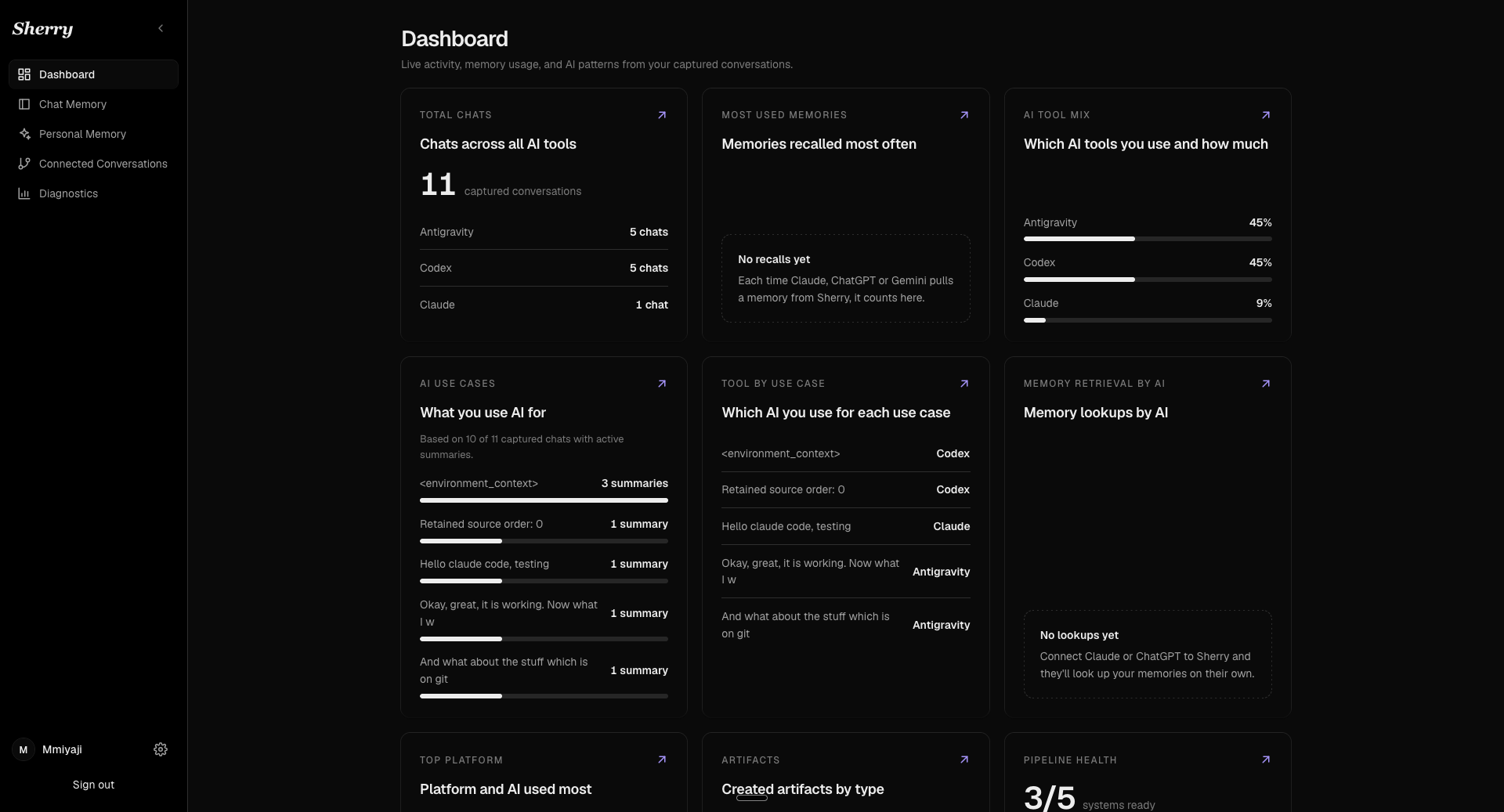
Instead of paying for multiple premium AI subscriptions just to get context features, Sherry acts as your personal context hub. Through a seamless browser extension, it securely stores your personal information, project context, and preferences. With a single click, Sherry injects your curated memory into any LLM you are using (ChatGPT, Claude, etc.), giving you a highly personalized response without the repetitive prompting. It also features a web dashboard where users have absolute transparency to view, edit, and manage exactly what the AI "knows" about them.
How we built it
We architected Sherry to be fast, frictionless, and intelligent:
- Jaclang: We used Jaclang as the core programming framework to build and orchestrate our agentic workflow, handling the intelligent extraction and retrieval logic.
- Supabase (pgvector): This serves as our secure database and vector store, handling user accounts and the mathematical embeddings of their memories.
- OpenAI / Claude APIs: We utilized these APIs as the "extraction engine" to intelligently pull relevant facts from user text and convert them into vector embeddings.
- Plasmo & Next.js: We built the frontend browser extension using Plasmo, React, and Tailwind CSS (with shadcn/ui components) to ensure the UI was beautiful and completely frictionless.
Challenges we ran into
One of our biggest technical hurdles was ensuring that the memory injection felt natural across entirely different AI platforms without breaking the conversational flow. Furthermore, extracting highly accurate, semantic "facts" from raw user input without bloating the vector database required careful tuning of our agentic workflow.
Logistically, as a hackathon project, we were constrained by time, API token limits, and the realities of building complex infrastructure on a tight deadline, which meant we had to rigorously scope our MVP.
Accomplishments that we're proud of
We are incredibly proud of shifting memory ownership away from multi-billion dollar AI models and placing it directly into the hands of the consumer. We successfully built a working prototype that completely bypasses the "blank slate" problem and eliminates the ~6.4 hours a week knowledge workers lose to repetitive prompting and "botsitting." Most importantly, we managed to package complex vector database retrieval into a simple, 1-click user experience.
What we learned
During our research and development, we learned that while the current market is heavily focused on building memory APIs for Enterprise B2B apps (like Mem0), the everyday consumer is being left behind.
We also learned that digital memory isn't just a technical feature; it's a deeply personal one. When you give a user a transparent dashboard showing exactly what an AI assumes about them—and give them the power to correct it, it completely changes their relationship and trust with generative AI.
What's next for Sherry
The MVP browser extension is just the beginning. Our vision for Sherry is to become a truly device-agnostic infrastructure for Personal AI:
- Profile Segmentation: Allowing users to seamlessly toggle between distinct identities (e.g., "Work Memory," "Creative Writing," "Personal Life").
- Passive Context Awareness: Enabling the system to passively learn and update your memory in the background through natural daily conversation, without requiring manual saves.
- Local Processing: Moving the embedding and extraction models to run locally on the user's device for absolute, offline privacy.

Log in or sign up for Devpost to join the conversation.