Inspiration
One misplaced wire can turn a simple breadboard circuit into a frustrating debugging session. Finding it often means tracing connections hole by hole.
We built Sherlock Ohms around a question: could a camera help inspect your wiring and catch mistakes before you spend another hour troubleshooting?
What it does
Sherlock Ohms is a camera-based breadboard inspection assistant. It detects visible wire and resistor endpoints, maps them to calibrated breadboard holes, and compares their connections against a reference circuit.
It checks electrical connectivity rather than visual similarity, so a different wire route can still pass if it creates the intended connections.
The browser workspace supports photo inspection, live camera checks, board calibration, reference circuits, and inspection history. Live checks require three consistent fresh frames before confirming a result.
How we built it
We combined computer vision with a circuit-checking engine:
- Endpoint detection: a fine-tuned YOLO11n-pose model locates wires, resistors, and their endpoints. A small refinement network improves endpoint positioning.
- Board calibration: OpenCV and ArUco markers establish the board’s position, allowing detections to be mapped to named holes.
- Circuit reasoning: the software models breadboard connections and compares the observed circuit with the reference.
- Local application: a Python and FastAPI backend runs inference and serves a browser interface. SQLite stores calibration, references, and inspection history.
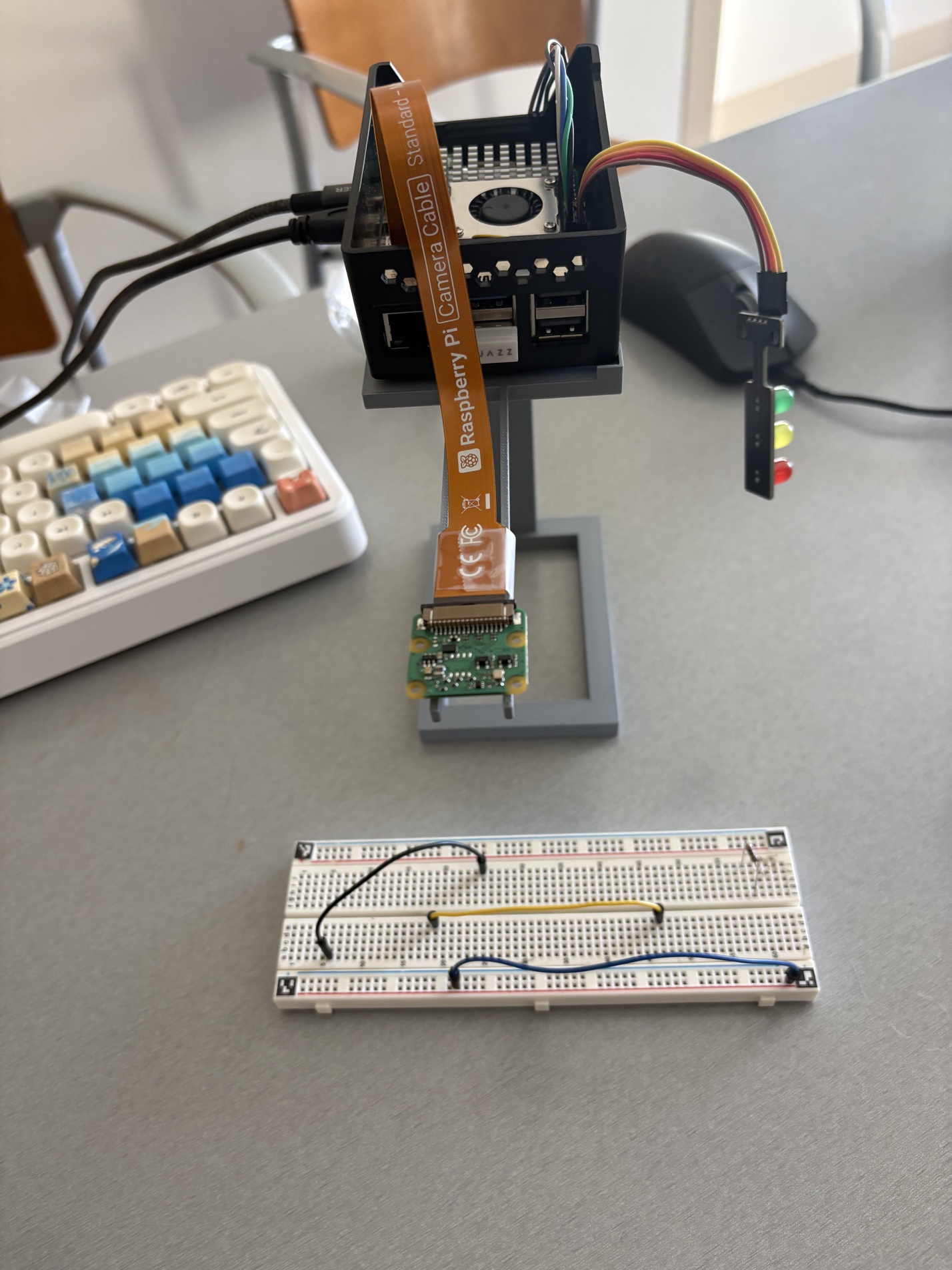
Our physical prototype includes a Raspberry Pi, an overhead camera, and a traffic-light indicator. The repository also includes Picamera2 capture and GPIO control support.
Challenges we ran into
The hardest problem was moving from recognizing a component to identifying its exact insertion hole. Adjacent holes are close together, and glare, camera angle, thin leads, and hidden endpoints can make that distinction difficult.
Another challenge was accepting valid alternative wiring. Comparing pictures alone would reject circuits that look different but connect the same points. We addressed this by comparing connectivity.
We also needed to handle uncertainty. A blurry image or stale camera frame should not become a confident success indication. Calibration checks and repeated-frame verification help keep the feedback grounded in usable observations.
Accomplishments we're proud of
We built a working local inspection workflow that connects trained vision models, breadboard geometry, circuit reasoning, and a browser interface.
We're particularly proud that Sherlock Ohms can reason about equivalent connections instead of requiring an exact visual copy of a reference.
What we learned
Recognizing an object is only the first step in understanding a physical circuit. Useful feedback depends on precise geometry, an accurate model of breadboard connectivity, and careful handling of uncertainty.
We also learned that camera placement, lighting, and calibration matter alongside model quality. Software tests validate the pipeline's behavior, but physical-board testing is essential to measure detection accuracy.
What's next for Sherlock Ohms
Our next priorities are validating accuracy on more physical circuit builds, completing the Raspberry Pi live workflow, and adding clearer correction guidance that highlights questionable connections.
Longer term, we want to support guided assembly and additional component types.
The current prototype focuses on visible wires and resistors. It does not measure electrical continuity or resistor values.
Built With
- css
- fastapi
- gpio
- html
- javascript
- networkx
- numpy
- opencv
- picamera2
- python
- pytorch
- raspberry-pi
- sqlite
- ultralytics
- yolo

Log in or sign up for Devpost to join the conversation.