-
-
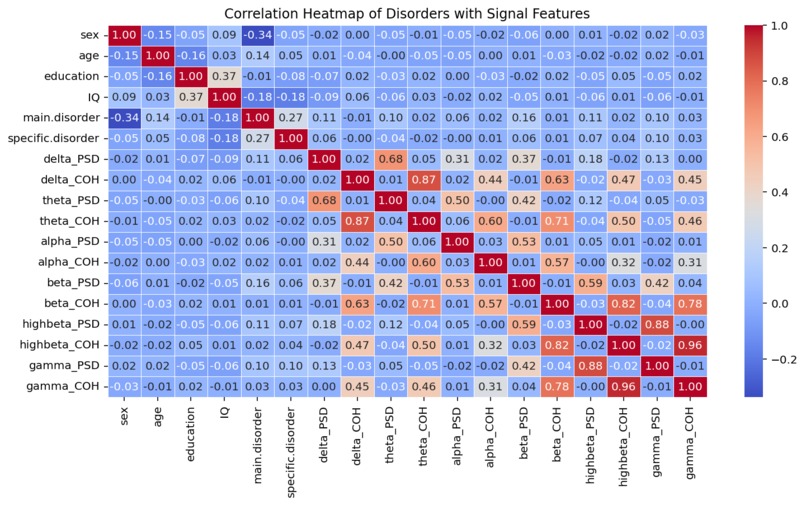
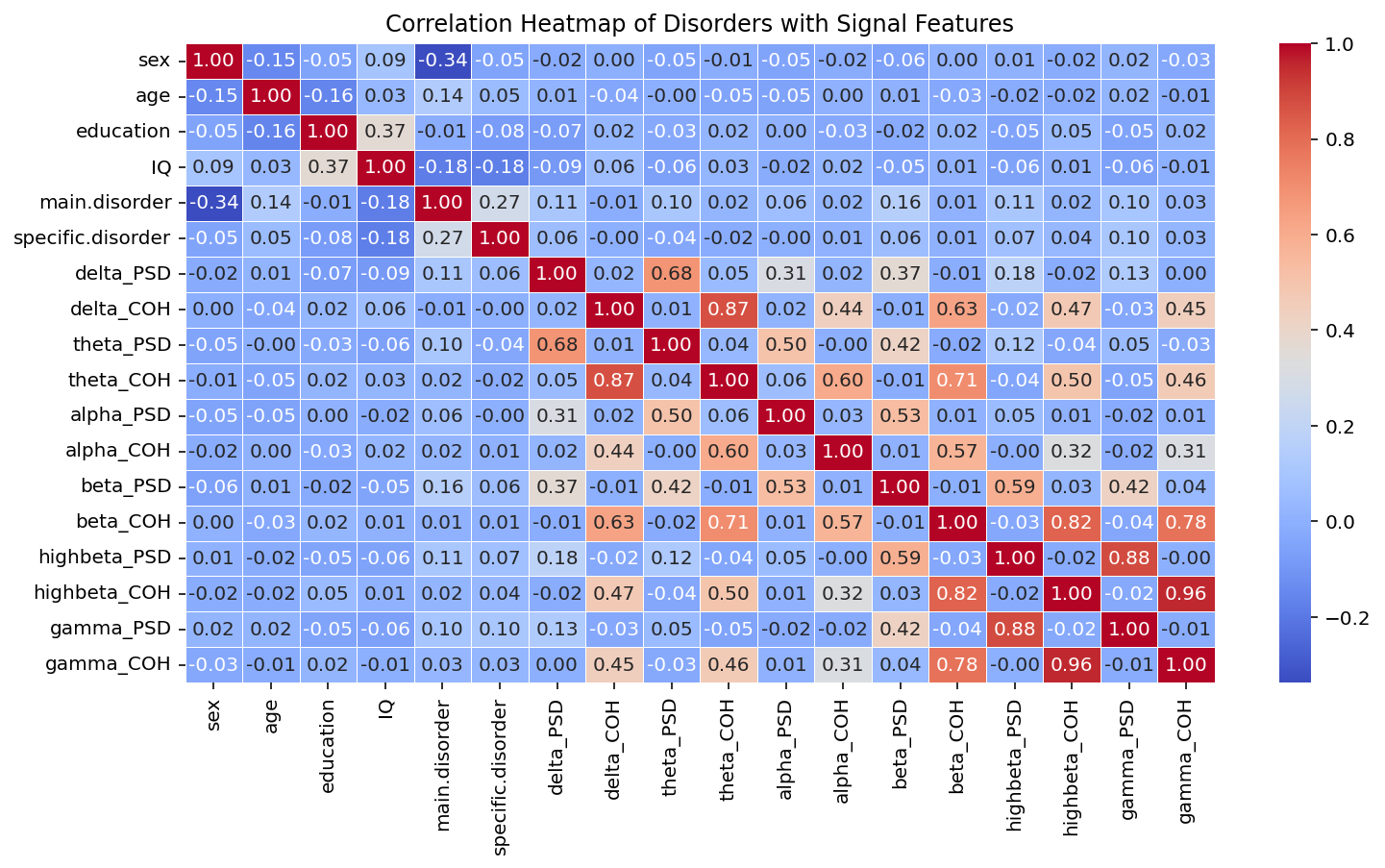
Correlation Heat map of Disorders with Signal Features.
What it does
Sherlock Neurons is an AI-powered tool that analyzes EEG data to detect subtle patterns indicative of psychiatric disorders, enabling earlier and more accurate diagnoses. It helps bridge the gap in objective mental health assessment, paving the way for personalized treatment plans.
How we built it
Data Preprocessing:
- Imputed Null Values:Used KNNImputer to fill in missing data.
- Dropped Irrelevant Features: Removed columns like EEG date and empty columns.
- Encoded Categorical Variables: Applied RobustScaler to encode variables like sex, main disorder, and specific disorder.
- Handled Outliers: Used the Inter Quartile Range (IQR) method to detect and manage outliers.
- Balanced Dataset: Employed SMOTE to create a balanced training dataset.
- Feature Engineering: Reduced data dimensionality and extracted valuable insights.
Machine Learning Models:
- Predictive Modeling: Implemented Random Forest and Elastic Net models.
- Hyper parameter Optimization: Used Grid Search and Randomized Search CV for tuning.
- Metrics Used: Evaluated models using MSE, R-squared, and Accuracy Score.
Results: Predicted Output file can be accessed here: https://github.com/KavimayilPK/Rice-Datathon-2025/tree/main/Results
Challenges we ran into
- High Dimensionality: Managed the complexity of EEG data and significant inter-band correlations.
- Class Imbalance: Addressed the challenge of distinguishing subtle neurological signals associated with complex psychiatric conditions.
Accomplishments that we're proud of
- Model Development: Successfully developed a model with promising accuracy in identifying several psychiatric disorders using EEG data within 36 hours.
- AI Potential: Highlighted the potential of AI to revolutionize mental health diagnostics.
What we learned
- Data Preprocessing Techniques: Gained insights into various data preprocessing methods.
- SMOTE Effectiveness: Learned the importance of SMOTE in balancing datasets and improving accuracy.
What's next for Sherlock Neurons
- Model Fine-Tuning: Continue refining the model to achieve better accuracy.
- Web-Based Dashboard: Develop a web-based dashboard for interactive insights and user engagement.

Log in or sign up for Devpost to join the conversation.