Inspiration
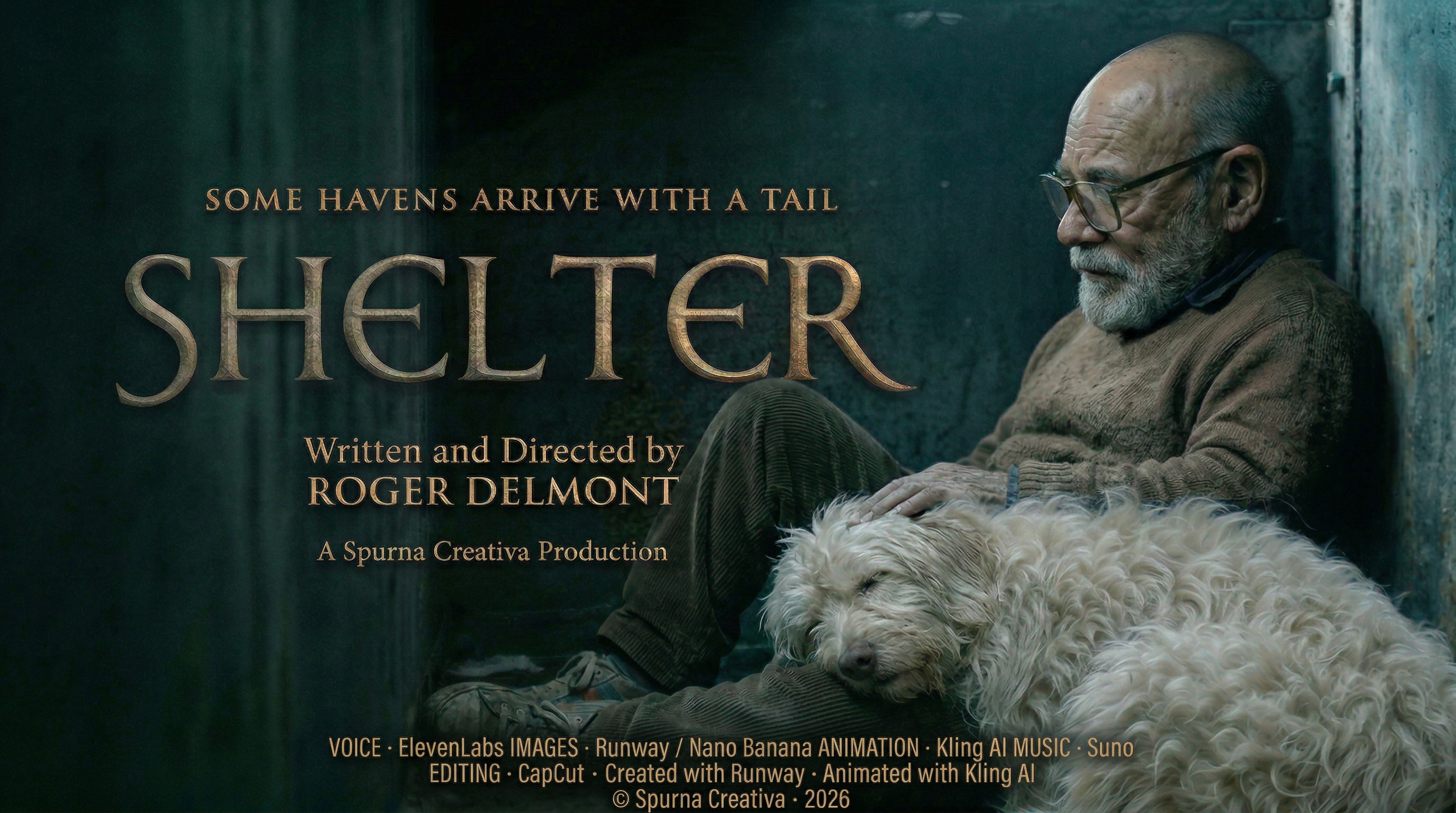
Shelter came from a simple moment of observation. I was walking through Barcelona one morning and saw an old man sitting with a stray dog. They weren't interacting much, but there was something profound in their stillness together, a kind of mutual recognition. Two beings with nothing, yet somehow complete in that moment. That image stayed with me. I wanted to explore what happens when loneliness finds companionship, not in grand gestures, but in quiet presence.
Building the Story
The narrative is deliberately spare. Bertus and Black meet by chance in the margins of the city, and slowly, over ten minutes, they become home for each other. There's no redemption arc or rescue narrative, just the simple truth that connection heals. I spent weeks thinking about how to convey emotion through absence and presence, through what you don't see as much as what you do.
How I Made It
Shelter is entirely created with artificial intelligence, which was both the vision and the challenge. I used Runway's Nano Banana for environments and character design, Kling AI 3.0 Pro for animation, ElevenLabs for voice acting, Suno for the original score, and CapCut for final editing. The workflow required precise creative direction at every stage. AI doesn't interpret nuance automatically, so I had to architect every frame, every transition, every emotional beat through detailed prompts and multiple iterations.
THE CHALLENGES
The biggest challenge was character coherence. Bertus and Black needed to be consistent beings across the entire narrative, with recognizable emotional arcs. In traditional film, an actor brings continuity to a character through their presence and instinct. With AI, that consistency has to be engineered through language and meticulous direction. I had to establish a detailed character profile for each of them before a single frame was generated. Bertus had to move and exist in a particular way, with a specific posture and energy that communicated his exhaustion and quiet dignity. Black needed to express vulnerability and gradual trust through body language alone. Every animation prompt had to reference these established traits so the character wouldn't drift or feel fragmented across shots. The real difficulty was transmitting empathy. Emotion doesn't work in AI the way it does with human actors. You can't rely on a glance or the slight tremor in someone's voice. You have to construct empathy through action, composition, and accumulated small moments. Each scene required multiple iterations because the first pass often felt hollow or overwrought. The challenge was finding the restraint, the space where less becomes more. When Bertus sits with Black in the rain, that moment carries weight only if everything before it has established who these characters are, what they need, and why their meeting matters. It's a different kind of acting direction, but it's direction nonetheless.
What I Learned This project taught me that AI isn't a shortcut, it's a different language for cinema. It demands a kind of directorial precision that's almost mathematical, yet the results can be deeply human. The tool doesn't diminish the story, it just requires you to understand exactly what story you're telling before you begin. Shelter is my argument that emotion doesn't require traditional production. It requires clarity of vision.
Built With
- capcut
- elevenlabs
- kling
- runway
- suno


Log in or sign up for Devpost to join the conversation.