-
-
Math
Inspiration
Both of us are females in STEM. We know how difficult it is for minority groups to thrive in STEM. As a result, we built a website, hoping to increase diversity and inclusion in STEM.
What it does
For companies: Our website can show the diversity score within a company based on employee information. Based on this score, the company will receive a unique color, representing the company’s diversity degree. The brighter the color is, the more diverse a company is. RGB color red represents gender, green represents race, and blue represents family education background. As time goes by, the diversity status of a company might change, in this case, its color will also change. Also, using the idea of colors, one can identify different types of company very quickly. For example, a company diverse in gender will have different color than a company diverse in race. People can choose a company to work in by their preference more easily based on the color. Besides, companies can see its gender distribution, race distribution, and family education background distribution. This helps them see which aspects they can improve the most.
For company’s employees: Our website can show how many points one can earn by referring someone to the company. The points one can earn are dynamically allocated, influenced by the company’s current diversity distribution. To be specific, if one refers someone who belongs to the true minority group in the company, one can earn much more points, because it can increase diversity to a greater degree. These points might be changed if the company’s distribution status changes.
How we built it
The distribution of three categories: gender, race, education, will be converted into three numbers that represent the RGB values. Then, we can get the unique color for the company.
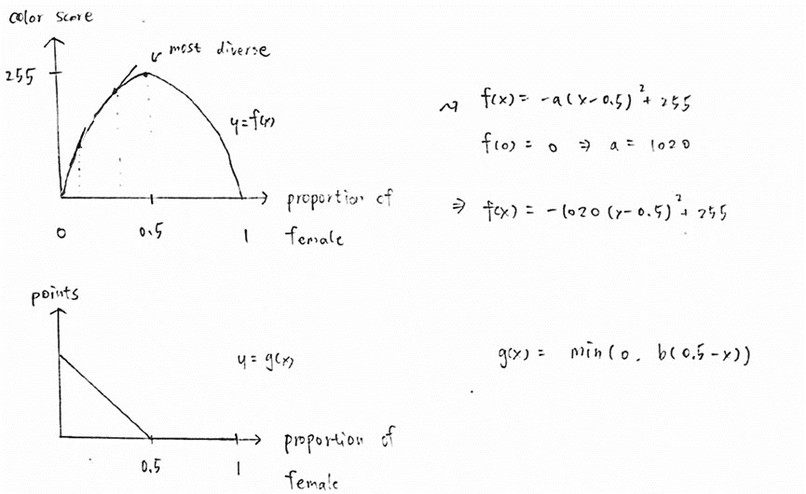
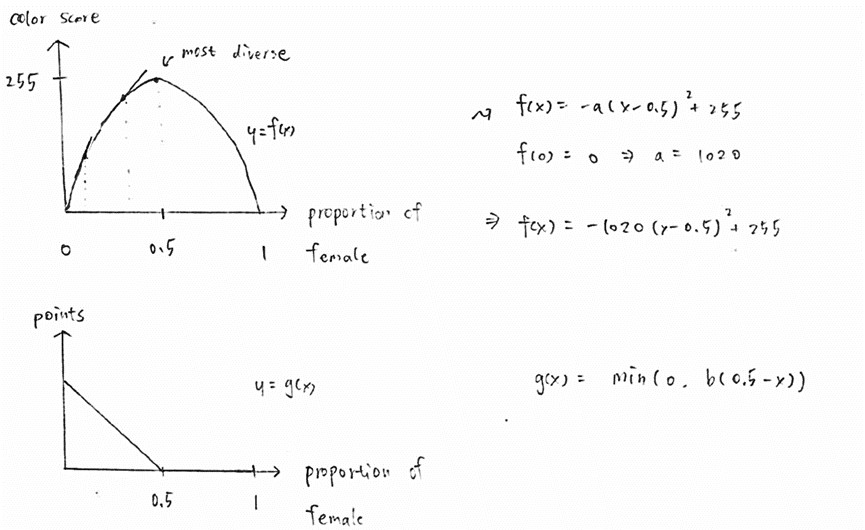
Formula description: We need to construct a basic model to determine the relation between the proportion of female employees, the color code for red, and the points to earn if someone recommends a female employee. We observe that as the proportion of female employees in the company increases, the need for female employees will be less urgent. So, the points to earn will decrease. We also hope the points can reflect the company’s improvement in its color code for red. Basically, our model is like the utility model used in economics. The color code will always increase as the proportion of female employees increases. The marginal color code will diminish. The derivatives of the color code formula will be the points to get. We consider the easiest case -- a downward hyperbola. Using some calculation, we can find a good way to match the proportion 0~0.5 to all the color codes 0~255. The result will be symmetric for the proportion 0.5~1. Therefore, the points to get will be a straight line with negative slope for the proportion 0~0.5. Notice that the recommender will earn zero points when the proportion is already larger than 0.5.
Challenges we ran into
How to construct a formula? This is one of the most difficult problems we encountered. How to construct and present the color based on the formula was another difficult problem.
Accomplishments that we're proud of
Dream teammates and dream teamwork. We cooperated well throughout the process and learned together to build a website in the limited time given! We were able to come up with some special ideas presenting our thoughts. We like the idea of representing a company with its diversity status and calculating different referral points for different minority groups. We were able to design such complex calculating formulas within a short period of time.
What we learned
We learned how to build a project together in a limited time. We had to set our goal clearly, arrange some subgoals in each step, and split them into parts so that we can work simultaneously without affecting each other. We also faced some technical problems in the process. Luckily, with the help of each other and online resources, we finally accomplished it. We also learned how to use a variety of tools during this event, such as GitHub, Django, html, css.
What's next for Diversity & Inclusion
Perhaps adding more categories in our project. For now, we have gender, race, and family education background covered. We might add lower income families, disabled people, LGBT, and more.


Log in or sign up for Devpost to join the conversation.