Inspiration
Retail teams lose revenue every day from invisible shelf issues: out-of-stocks, misplaced products, pricing mismatches, and delayed replenishment. We were inspired by how much of this is still detected manually, too late, and without clear ownership. ShelfSense AI was built to give stores a real-time “operational nervous system” that detects friction early and turns it into actionable intelligence.
What it does
ShelfSense AI autonomously detects retail shelf friction from camera/video inputs, identifies likely root causes, and recommends next best actions. It helps teams:
- Detect shelf anomalies (stockouts, facings issues, planogram drift)
- Prioritize incidents by business impact
- Explain probable root causes (replenishment lag, execution gaps, demand spikes)
- Trigger workflow-ready alerts for faster resolution
- Track improvements over time with feedback loops for self-optimization
How we built it
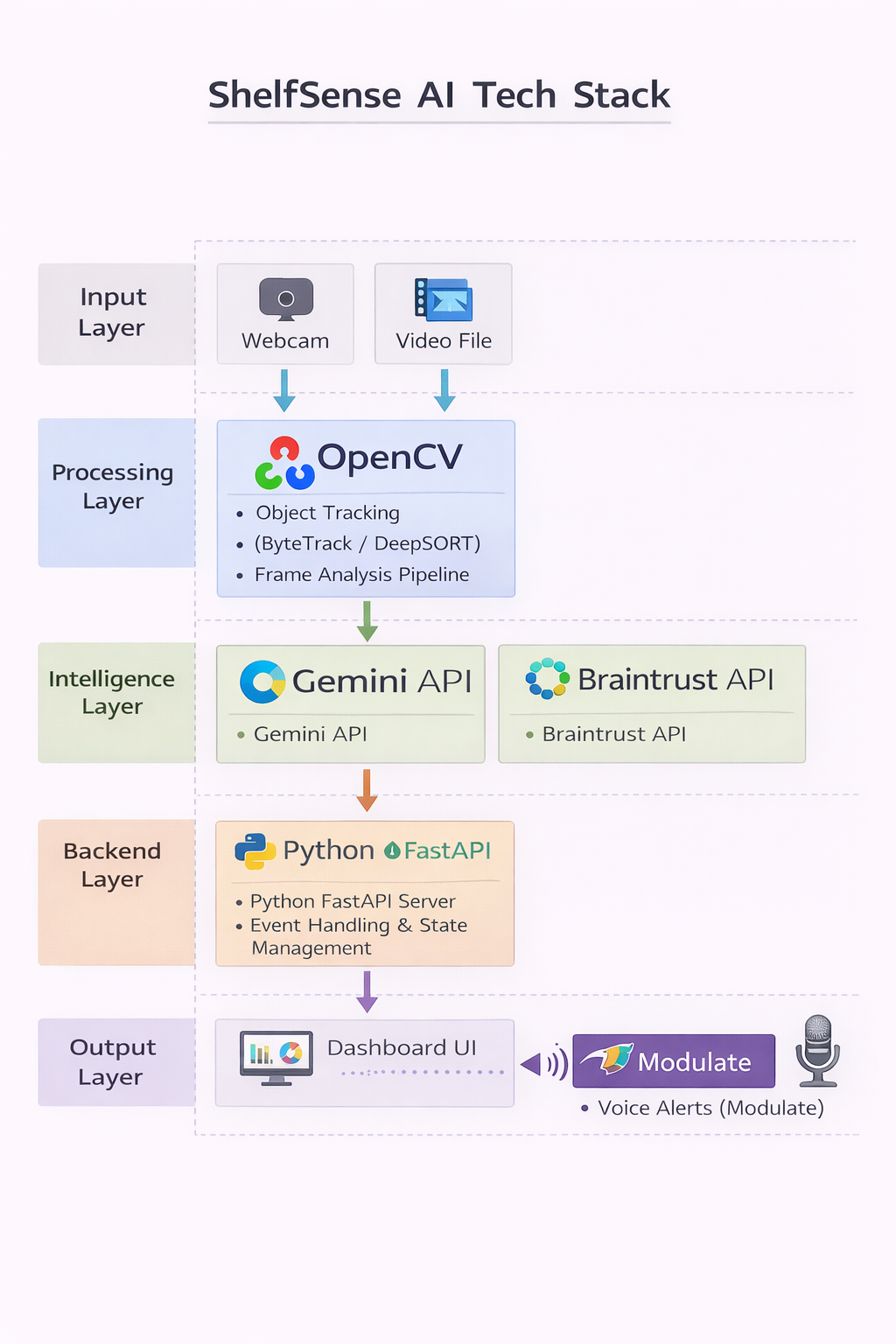
We built ShelfSense AI as a multimodal pipeline:
- Computer vision models analyze shelf imagery/video for inventory and placement signals
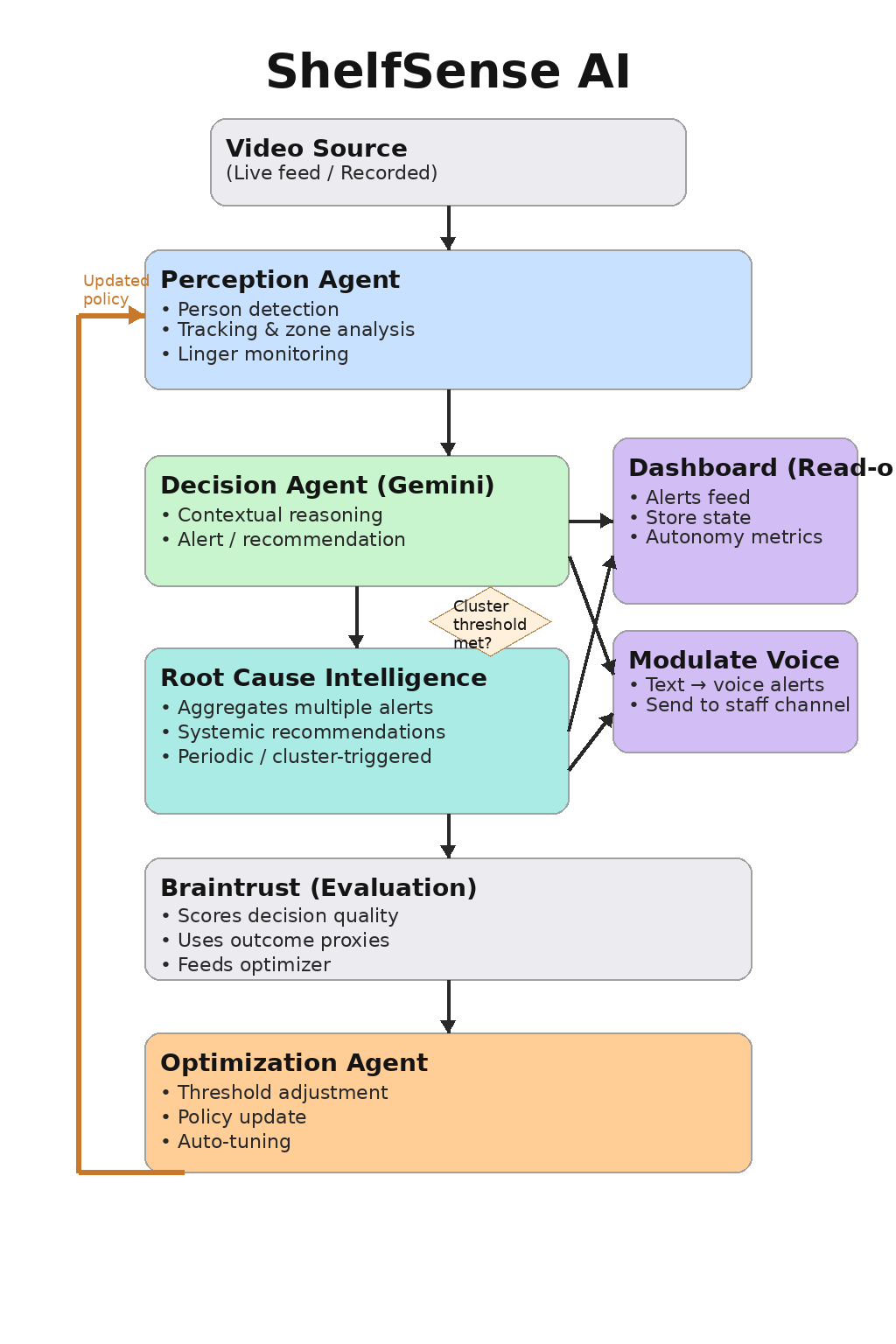
- A reasoning layer converts detections into incident narratives and root-cause hypotheses
- An orchestration/API layer serves alerts, summaries, and recommendations
- A dashboard surfaces incidents, confidence, severity, and trend metrics
- Evaluation and iteration loops improved precision and reduced noisy alerts
Challenges we ran into
- Handling varied shelf conditions (lighting, angle, occlusion, motion blur)
- Balancing detection sensitivity vs. false positives
- Mapping low-level visual signals into explainable root-cause insights
- Keeping the system responsive while processing continuous media inputs
- Designing outputs that are actionable for store operators, not just technically accurate
Accomplishments that we're proud of
- End-to-end prototype from detection to decision support
- Root-cause intelligence, not just anomaly flagging
- Practical operator-facing experience with clear prioritization
- Robust handling of real-world shelf noise in demo scenarios
- Strong foundation for autonomous, closed-loop retail optimization
What we learned
- Accuracy alone is not enough; explainability and workflow fit drive adoption
- Retail friction is multi-causal, so context fusion matters
- Fast human trust is built with clear confidence, rationale, and impact
- Feedback loops are essential to improve model behavior in changing stores
- Productizing AI means solving UX, integration, and operations together
What's next for ShelfSense AI
Autonomous retail friction detection, root-cause intelligence, and self-optimization:
- Expand from pilot scenarios to multi-store, multi-category deployments
- Add proactive forecasting for “likely-to-fail” shelf zones
- Integrate with store tasking systems for closed-loop execution
- Improve self-learning from resolution outcomes and operator feedback
- Deliver measurable KPIs: reduced stockouts, faster recovery, higher on-shelf availability

Log in or sign up for Devpost to join the conversation.