
ShelfScan — never miss an empty shelf again
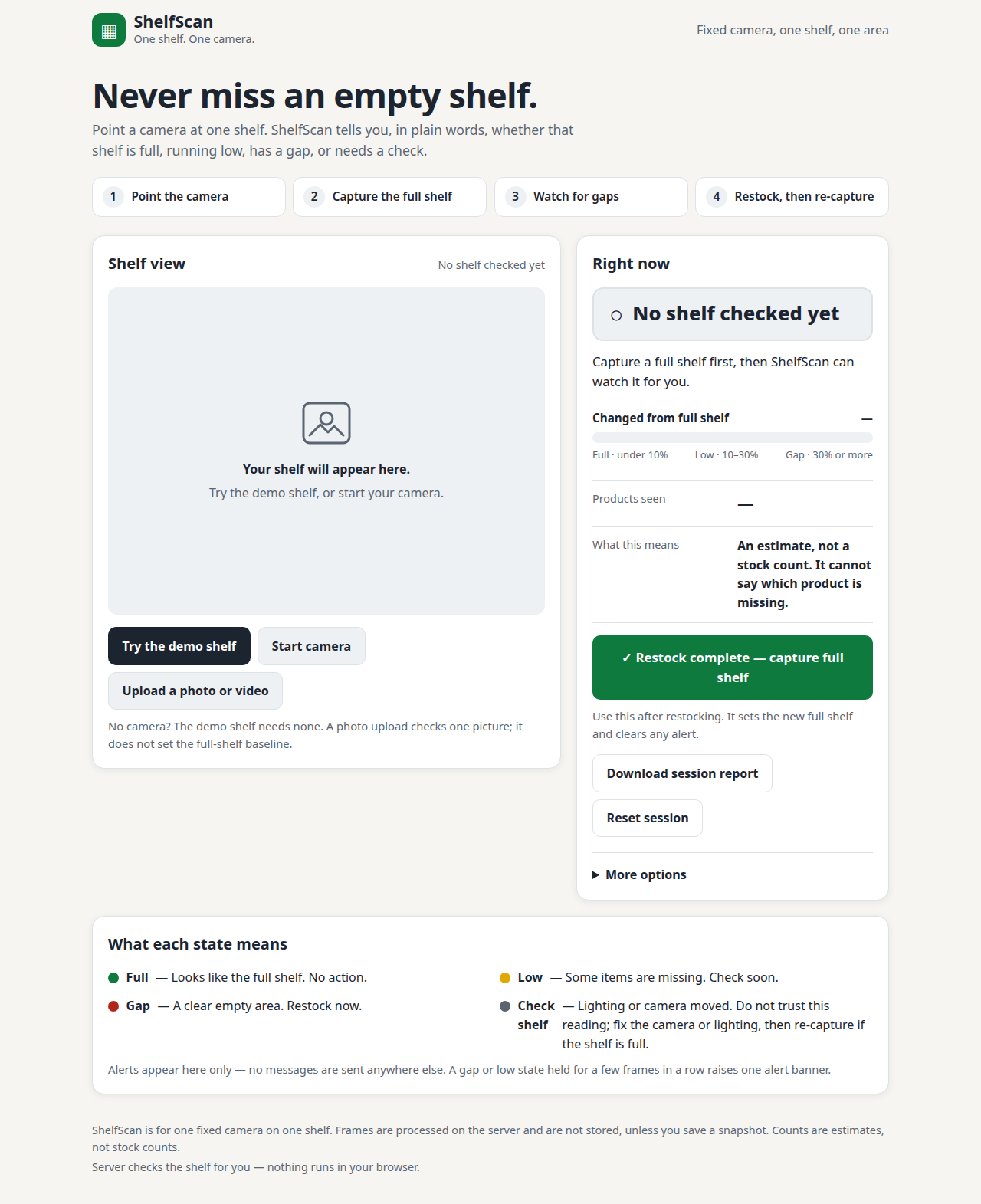
One shop, one shelf, one camera. ShelfScan watches a single shop shelf and tells the shopkeeper, in plain words, whether that shelf is Full, Low, has a Gap, or needs a Check — so an empty facing is found by staff, not by a customer.
The inversion: most shelf tools lead with counting. ShelfScan leads with change — how much this shelf differs from its own full baseline — and treats counting as a rough second signal. That is the whole design bet.
Try it in 30 seconds (JSON check, no camera needed)
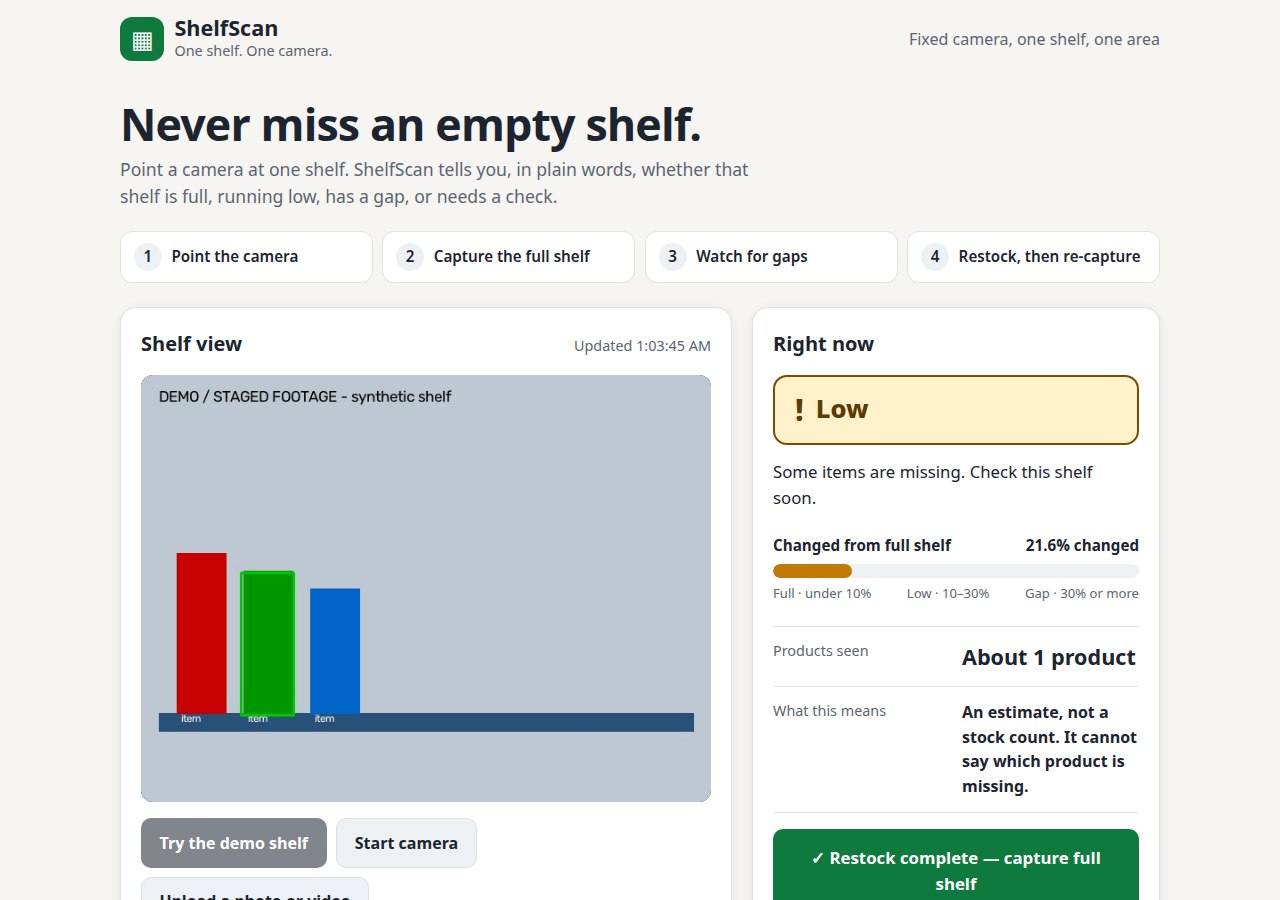
A. Open the live full app on AWS EC2: http://16.171.250.54:8000 B. Open http://16.171.250.54:8000/health — it returns OpenCV 5.0.0. C. Open http://16.171.250.54:8000/api/demo — it returns the synthetic demo shelf state (Low, changed 0.216, re-verified 27 Oct 2026 05:27 GMT).
Try the full flow (no camera needed)
Try the full flow on EC2, no camera needed: Reset session first, then use "Try the demo shelf", or "Set full shelf from a photo", then upload a later photo to see Full / Low / Gap / Check. Do NOT click Start camera on HTTP. A single photo upload will not raise the 5-frame alert, which needs 5 consecutive frames. Live camera needs HTTPS or localhost — this EC2 page is HTTP, so the dashboard explains that and offers the photo path instead. Repo run is only needed for a live webcam.
Evidence at a glance — and what to trust it for
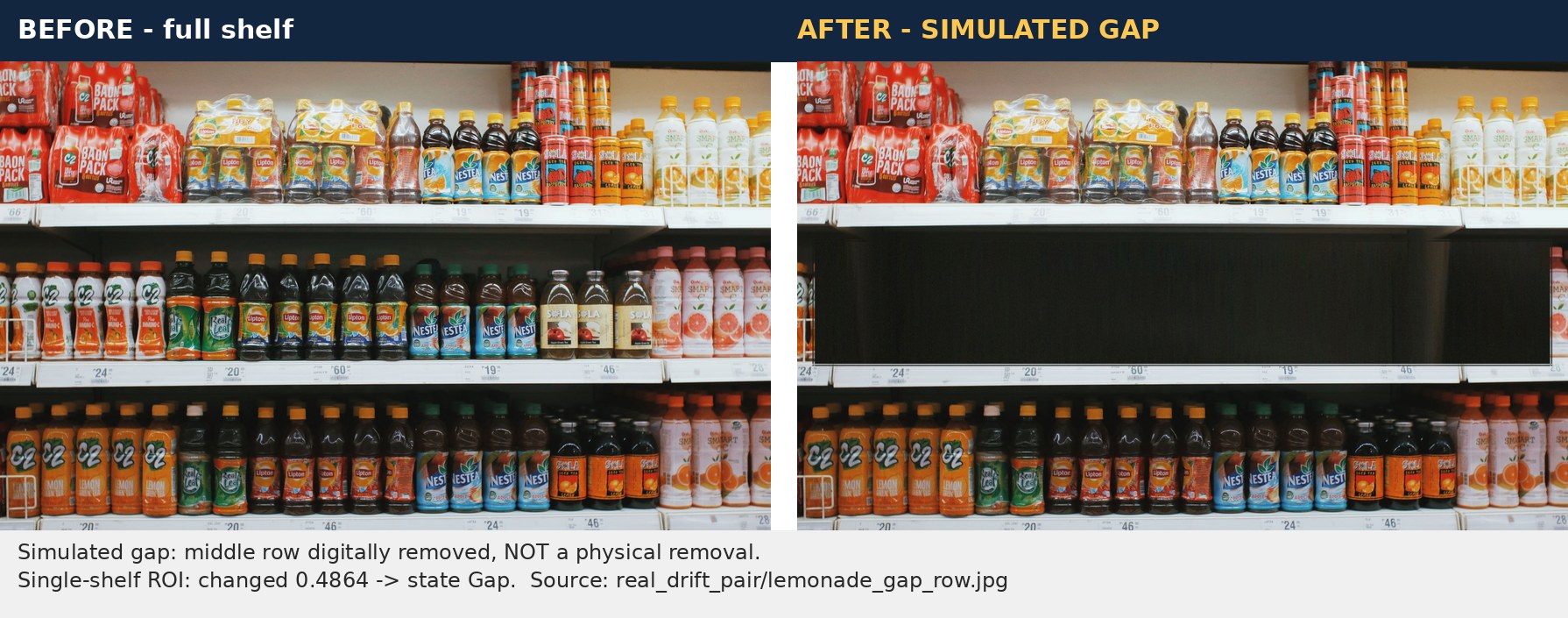
- Drift Gap 0.4864 on a simulated whole-row removal only, single-shelf ROI (whole-image ROI on the same removal is only Low 0.2021).
- Counting MAE 7.0, n=5, exact 0/5, bleach 5/24, predicted 146 vs hand 175. The same 5 photos were also used to select conf 0.10 among 8 configs; an independent held-out shelf test is still pending. Hand-count uncertainty is about ±5 on lemonade, ±4 on soda, ±3 on bleach.
- False Gaps 50 → 5 on 24 videos / 322 frames, with phase + shift guards. No shop pilot. Impact claims in this submission describe intended use, not measured shop results.
- Trust it only to flag a whole-row gap on one fixed-camera shelf. Do NOT use its count for stock or ordering.
The problem
In a small independent shop, shelf checks are manual and get skipped. An empty facing is often discovered by a customer, not by staff. ShelfScan is built for one owner-manager, one shop, one shelf, and one fixed camera — not for a chain, not for many cameras, and not for brand or barcode recognition.
How it works — one journey, start to finish
- Point a fixed camera at one shelf and capture a "full" baseline — or, on this HTTP demo page, use "Set full shelf from a photo" (see "Try the full flow" above).
- ShelfScan compares each new frame with that baseline and shows
one of four states:
- Full — the shelf looks like the full baseline, no action.
- Low — some items are missing, check soon.
- Gap — a clear empty area, restock now.
- Check shelf — lighting or camera moved, do not trust the state; fix the camera or lighting, then re-capture the baseline.
- A Gap or Low state held for 5 consecutive frames raises an in-dashboard alert (banner, session history, CSV export). There is no SMS, email, push, or sound alert in v1.
- Restock the shelf fully, capture a new baseline, and the state returns to Full. That re-baseline is the restock confirmation.
What changes for the shopkeeper: morning, capture the full shelf once. During the day, glance at one word — Full, Low, Gap, Check — instead of walking the aisle to look. Only a Gap or Low held for 5 frames raises an alert. Restock, re-capture the baseline, done.
What is new here
The innovation is the inversion, not a new model. Most shelf tools lead with counting products. ShelfScan leads with baseline and occupancy drift — how much the shelf has changed from its full baseline — because a generic product counter cannot reliably name packaged goods (see "Evidence, honestly" below). Counting is kept secondary, single-class "product" only, no brand/SKU, never a stock count.
Three decisions, each testable: (1) baseline drift is the primary Gap signal, counting is secondary; (2) one class, "product," no brand or SKU — trained on vending images, tested on real shelf photos (MAE 7.0, n=5, estimate only); (3) conservative guards — lighting and camera-move both fall back to Check, and alerts need 5 consecutive frames.
Two camera guards stop the commonest false alarms. A brightness guard sends large lighting changes to Check shelf instead of Gap, and a camera-move guard (phase correlation plus camera-shift measurement) sends moving-camera footage to Check shelf instead of Gap. A shelf that is genuinely emptied while the camera also moves will conservatively report Check shelf, not Gap.
When ShelfScan is unsure, it says Check shelf — not Gap — so staff are not sent to restock a shelf that is actually full. A false restock trip is the cost this design is built to avoid.
How it is built (brief)
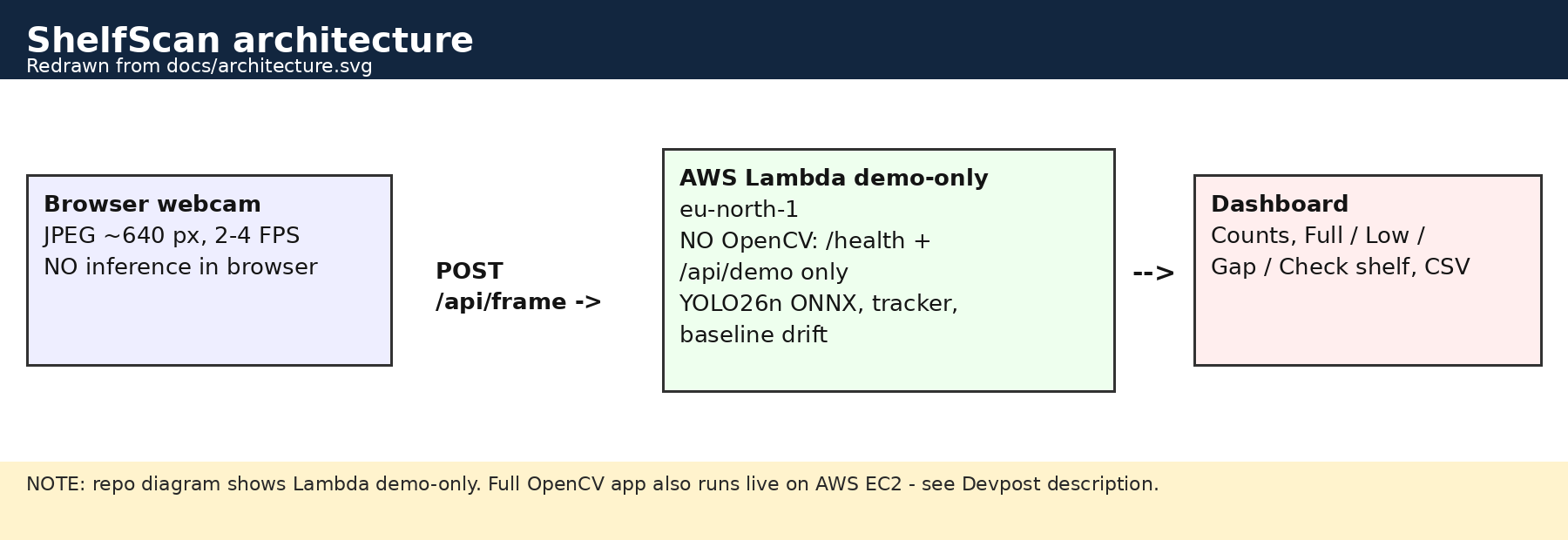
- OpenCV 5.0.0, Python, FastAPI, vanilla HTML/CSS/JS dashboard. Server-side inference only; nothing runs in the browser.
- Pipeline: webcam frame → letterbox → YOLO26n ONNX (DNN output [1, 300, 6]) → IoU/centroid tracker → baseline drift as the primary shelf-state signal. Counting uses a separate single-class "product" model; see the technical report §12 for its details.
- AWS: full app on EC2 (t3.micro, eu-north-1, Docker image built from the repository Dockerfile, 399 MB, build passed on EC2). A Lambda demo-only endpoint is kept as a secondary link only.
- Tests: 39 passed locally. Pinned dependencies, SHA256-verified model download, reproducible run instructions in the README.
Evidence, honestly
Shelf-state (drift) — this is what the product claims:
- Real photo, simulated gap (a real shelf photo with a whole row digitally removed, labelled as simulated, not a physical removal): single-shelf ROI, whole-row removal → Gap, changed 0.4864. A small central block alone was missed (Full, 0.0851). Gap is therefore observable, but only for a substantial removal inside one shelf area.
- Fixed-camera constructed video (real stills, Full then Gap): Full → Gap at the same 0.4864 change. This is the only Full-to-Gap video proof; it is constructed from stills, not a shop camera recording.
- 24 online shelf videos, 322 sampled frames: with no guard, 214 of 298 post-baseline frames would have been Gap. With the phase guard alone, 50 frames were still false Gaps on slow pans. With phase plus shift guards, false Gaps fell to 5 frames (1 momentary alignment, 4 person-occlusion frames). Moving footage is therefore reported as Check shelf, not Gap. No shop pilot and no fixed shop-camera footage exist yet.
Counting — an estimate, not an exact stock count:
- Single-class YOLO26n, trained on HoloSelecta (20 vending images, 807 boxes, one class 'product'), run in OpenCV 5 DNN, single-tile, conf 0.10, latency 102–176 ms.
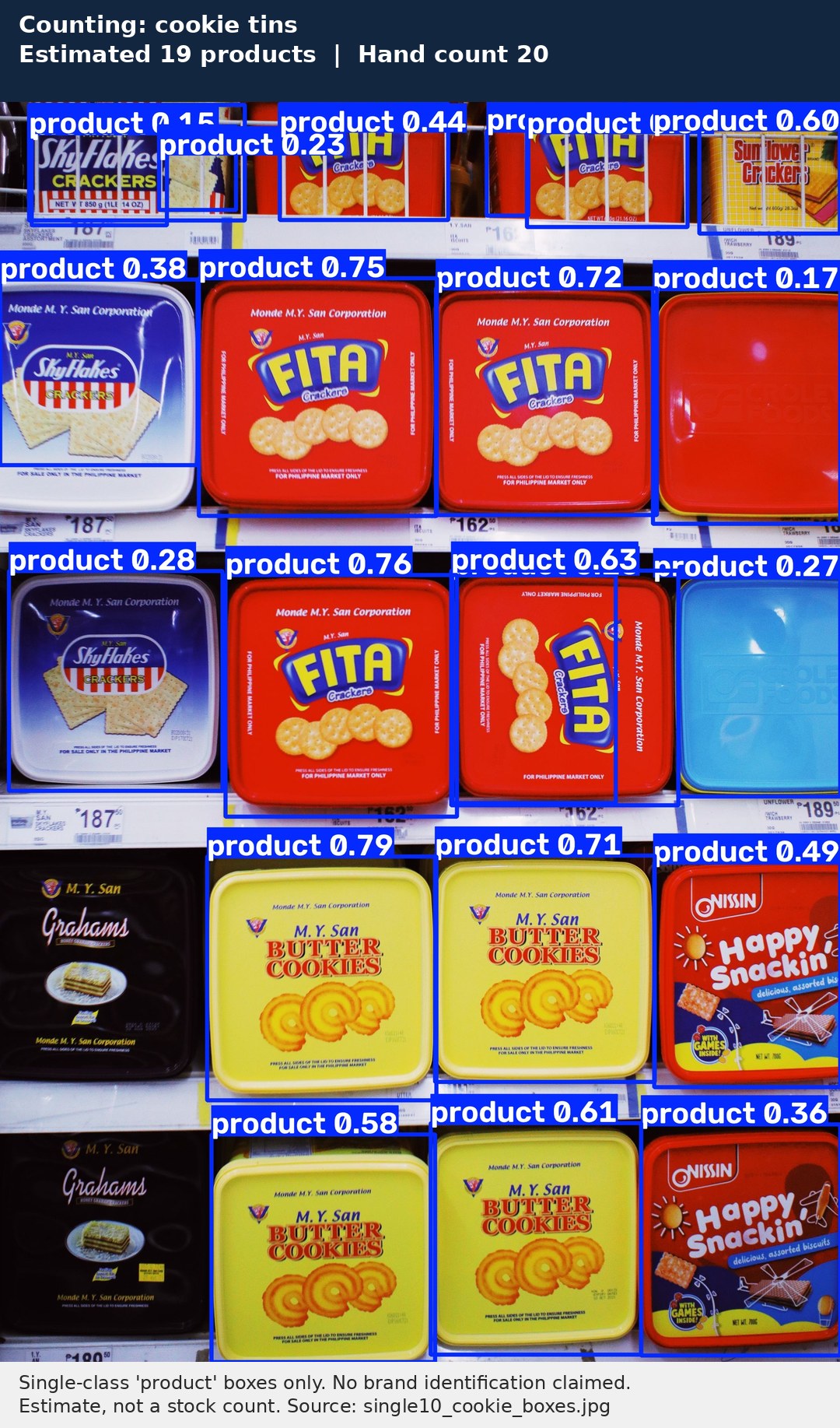
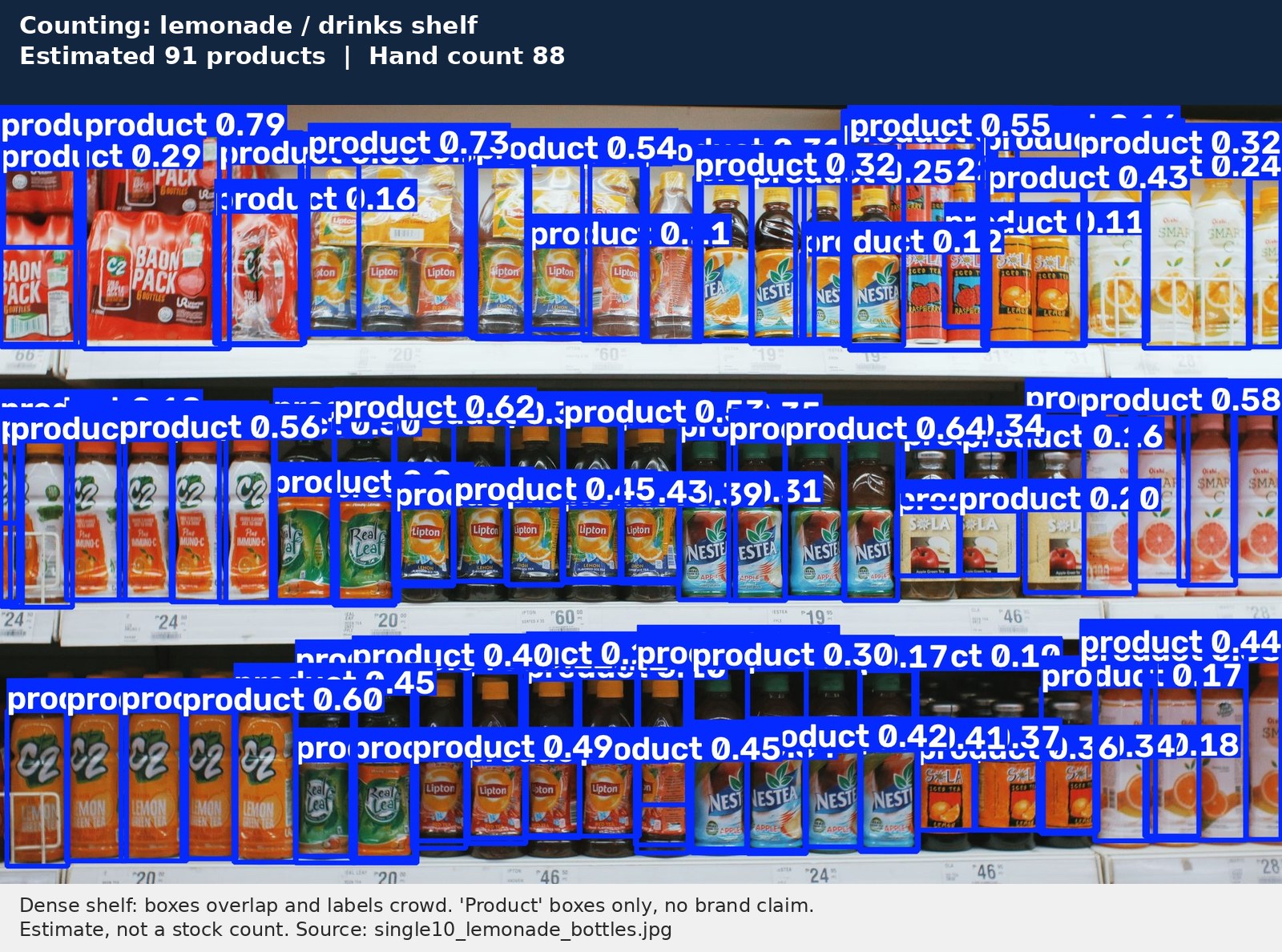
- Held-out real shelf stills, 5 countable photos, hand total 175, predicted 146, MAE 7.0, exact 0/5. Per photo: cookie 19/20, lemonade 91/88, wooden 14/16, soda 17/27, bleach 5/24 (white-on-white, worst case). A 6th photo was not reliably countable and was excluded, not counted.
- Generic COCO counting on the same 5 photos was MAE 18.4, with wrong labels (whole shelf as 'refrigerator', cookie tins as 'cell phone'). Classical alternatives did not beat it reliably (contour MAE 36.4, MSER MAE 29.6).
- No brand, SKU, labelling accuracy, exact stock count, or time-saved figure is claimed. Drift remains the primary gap signal; counting estimates how much is there.
Challenges and what we learned
- Generic COCO labels fail on packaged goods: a whole shelf reads as "refrigerator", cookie tins as "cell phone", cans and bottles as "refrigerator" or "cup", and white bleach bottles score 0–2 at every threshold. The response was to change the headline from counting to shelf-state, not to hide the failure.
- Moving cameras break naive drift: slow pans kept phase correlation high enough to pass the first guard, so a second shift guard was added and validated on 24 videos.
- App Runner in eu-west-2 was unavailable for new customers and Lambda in eu-west-2 was region-blocked for this new account, so the full app was deployed on EC2 in eu-north-1 instead. The Lambda link is kept only as a demo-only secondary link.
Limitations and responsible use
- Fixed camera, one shelf, one area only. Multi-shelf, SKU, barcode, and POS work are out of scope.
- No shop pilot, no real physical removal pair, no person-occlusion handling yet. Occlusion can still flash Gap on a near-fixed camera.
- No login or rate limiting on the demo; session state is shared, so two judges or tabs can overwrite each other's baseline. Point the camera at the shelf only, not at staff, customers, or till areas. No facial recognition, no audio. Live frames are processed in memory and are not stored by default; only an explicit snapshot saves an image.
- EC2 ports 8000 and 22 are open to all addresses for demo only and will be restricted after judging. Free-tier cover through judging is not confirmed from billing data.
- No COOL and no Agentic Vision award is claimed.
What's next
- Expand the boxed shelf training set (500–1000 boxed shelf images, with a held-out shelf test set) before claiming counting beyond the current MAE 7.0 estimate.
- Add person-occlusion handling so a person reaching for a product does not flash Gap.
- Run a real shop pilot with a fixed camera, a real before/after removal pair, and owner feedback on whether alerts are trusted and acted on — measuring three things not yet measured: facings caught before a customer reports them, manual shelf checks avoided, and false alerts per week. Until then, impact above is intended use, not measured outcome.
Secondary demo-only link — a different staged shelf
This is a different staged shelf from the EC2 demo shelf, not a second view of it: Gap 0.625, 3 vs 8, JSON only, no OpenCV, no webcam. Do not compare it with the EC2 demo (Low, changed 0.216). https://rhy7elxmanwrtyuqyfw2xg53ji0bnecg.lambda-url.eu-north-1.on.aws/
Video
Current video (v4, counting + shelf state, 2:00, no burned-in subtitles, natural voice, captions via YouTube): https://www.youtube.com/watch?v=62QhywyJCFQ Video shows counting as an estimate alongside drift; counting is not a stock count.
Code, architecture, and report
- Code: https://github.com/OlsOls4/opencv-hackathon-2026
- Technical report: docs/TECHNICAL_REPORT.md in the repository
- Architecture diagram: docs/architecture.svg in the repository
- Submission file: shelfscan-submission-v5.zip (Additional info)
Built with
OpenCV 5, Python, FastAPI, YOLO, AWS EC2, AWS Lambda, Docker, HTML, CSS, JavaScript
Built With
- 5
- amazon-web-services
- css
- docker
- ec2
- fastapi
- html
- javascript
- lambda
- opencv
- python
- yolo

Log in or sign up for Devpost to join the conversation.