-
-
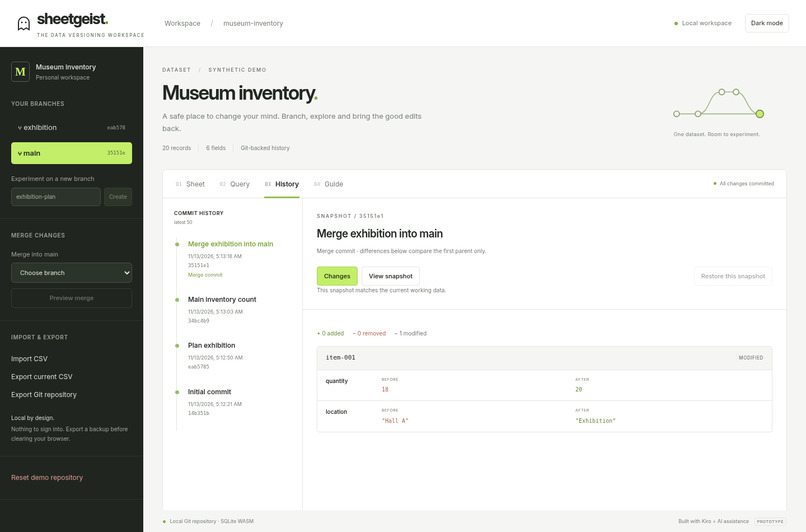
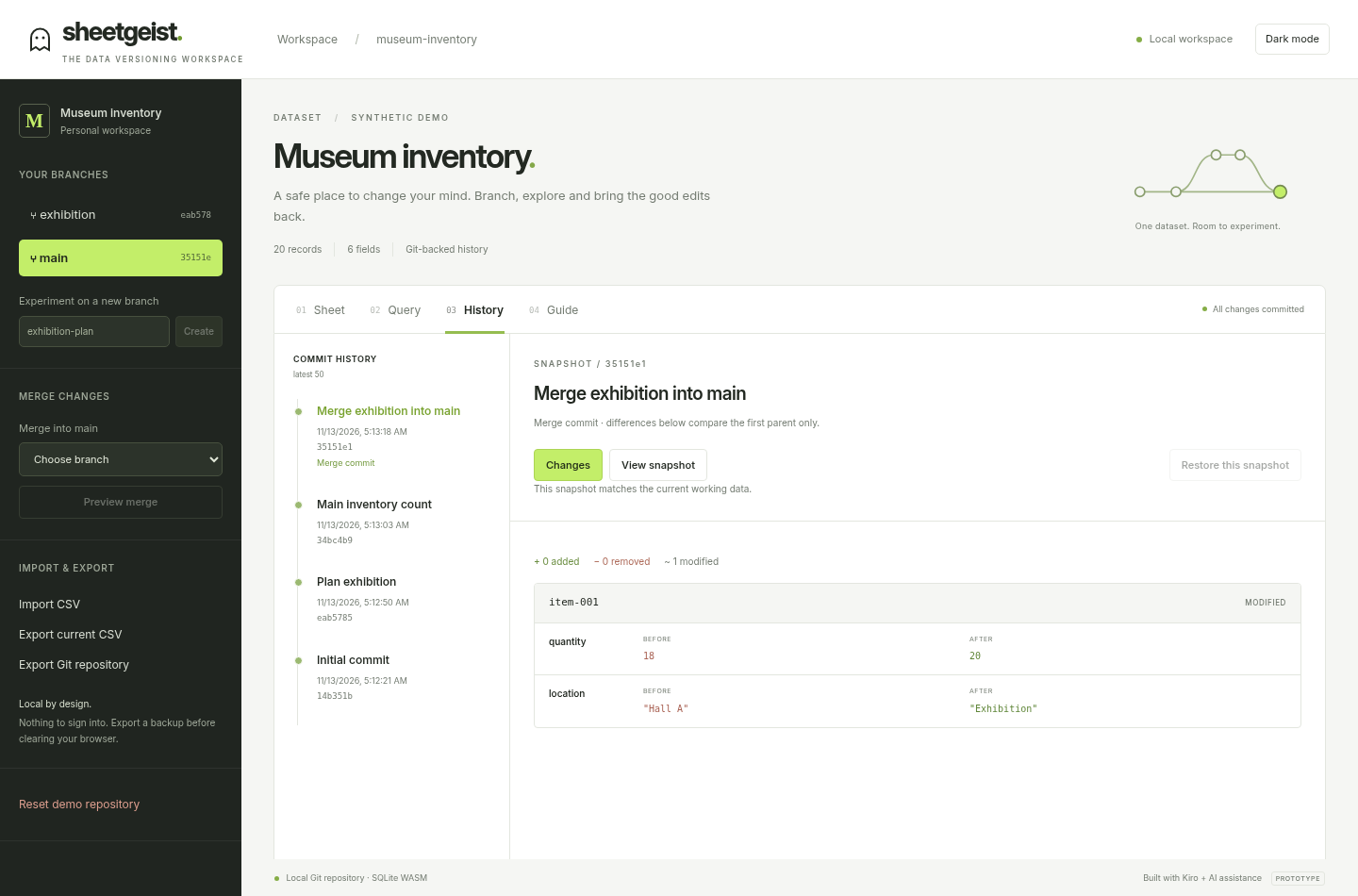
Typed commit differences show exact field changes against the first parent; merge history retains both parents.
-
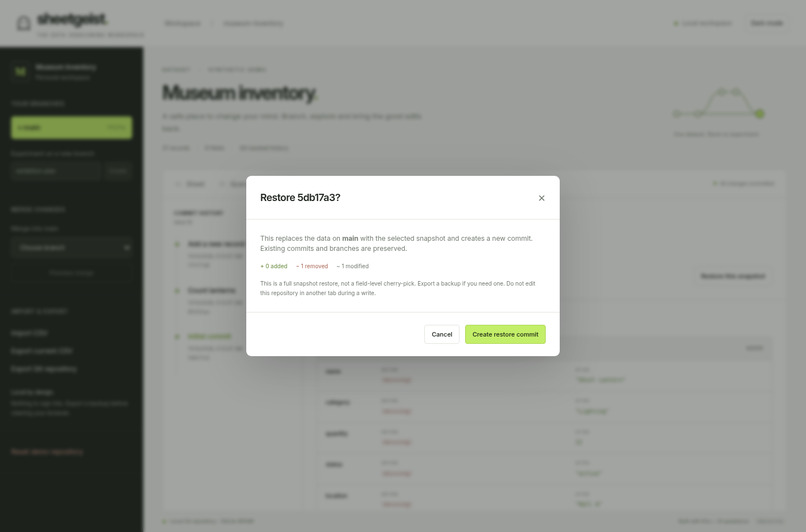
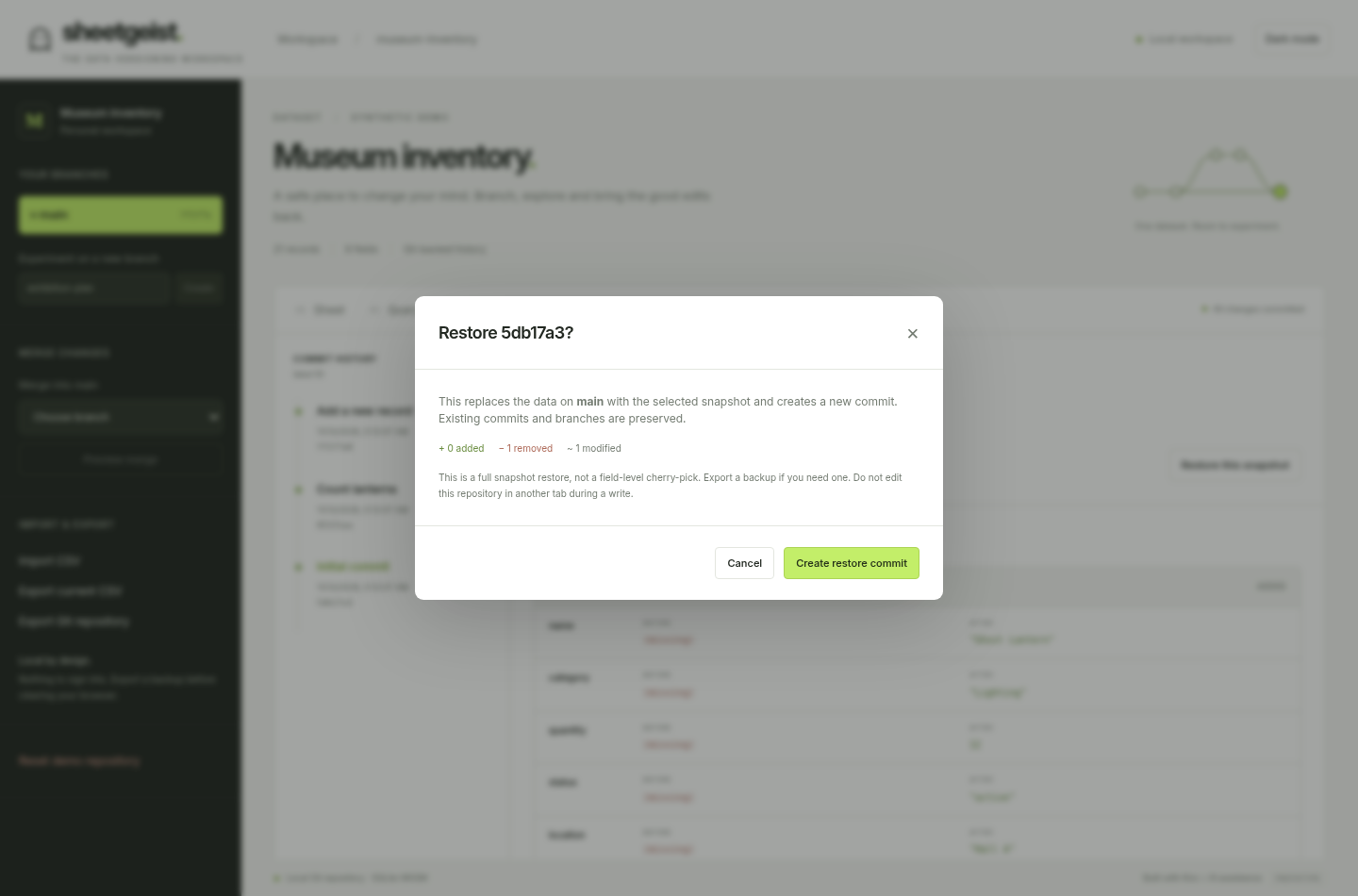
Restore previews full-snapshot impact and creates a new commit. Earlier history stays intact; this is never a hard reset.
-
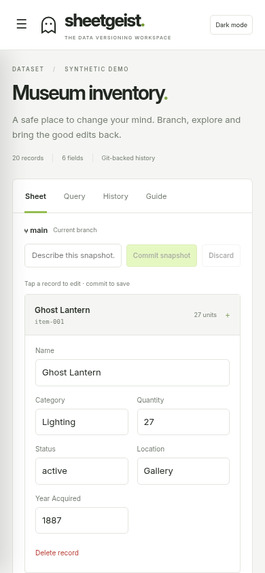
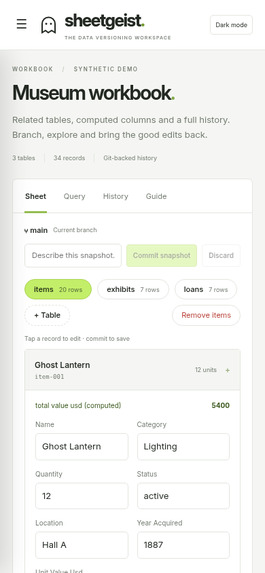
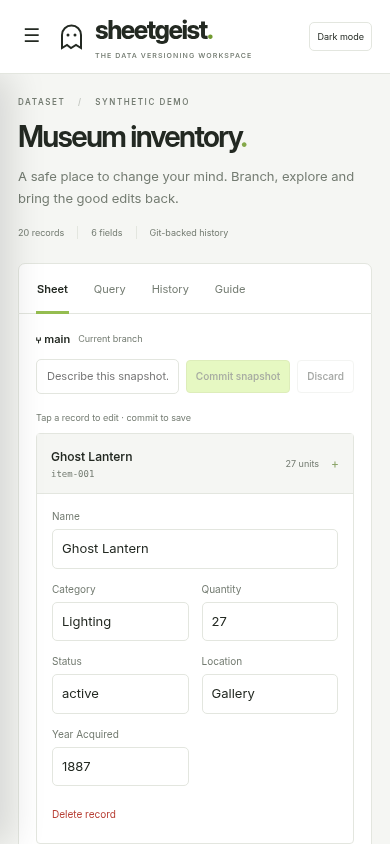
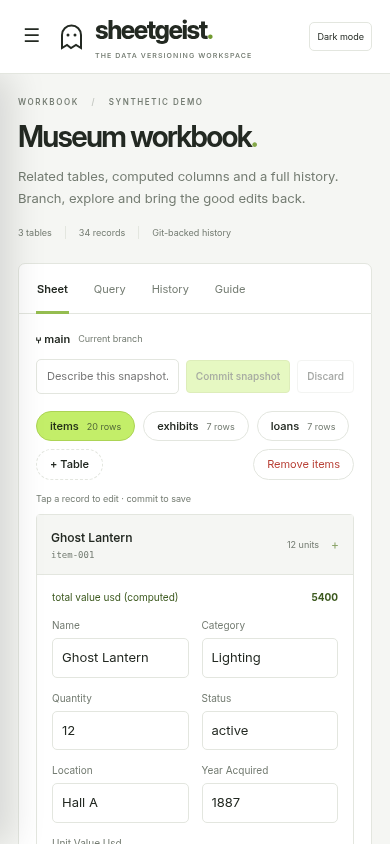
Phone record editing stacks fields instead of clipping a wide spreadsheet. Branches and commits use the same local repository.
-
-
-
-
-
Inspiration: the spreadsheet that remembers
A copied spreadsheet is an experiment without a reliable way home. "final", "final-v2" and "actually-final" hide which changes belong together. Sheetgeist asks: what if a small data table had Git's history, branches and merge semantics, without requiring a terminal?
For Kiroween's Frankenstein category, it stitches together three tools with different instincts: an editable spreadsheet, a real Git repository, and a relational SQLite query engine. The ghost is the table's past: it stays visible, even when an earlier version returns.
What it does
- Edit a synthetic museum inventory or import your own CSV.
- Commit a canonical JSON snapshot into a real browser-local Git repository.
- Create branches, experiment independently, and switch back to unchanged data.
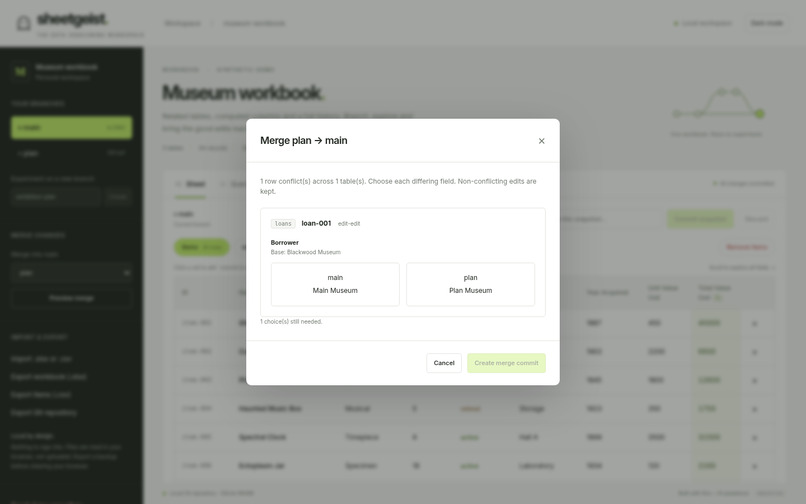
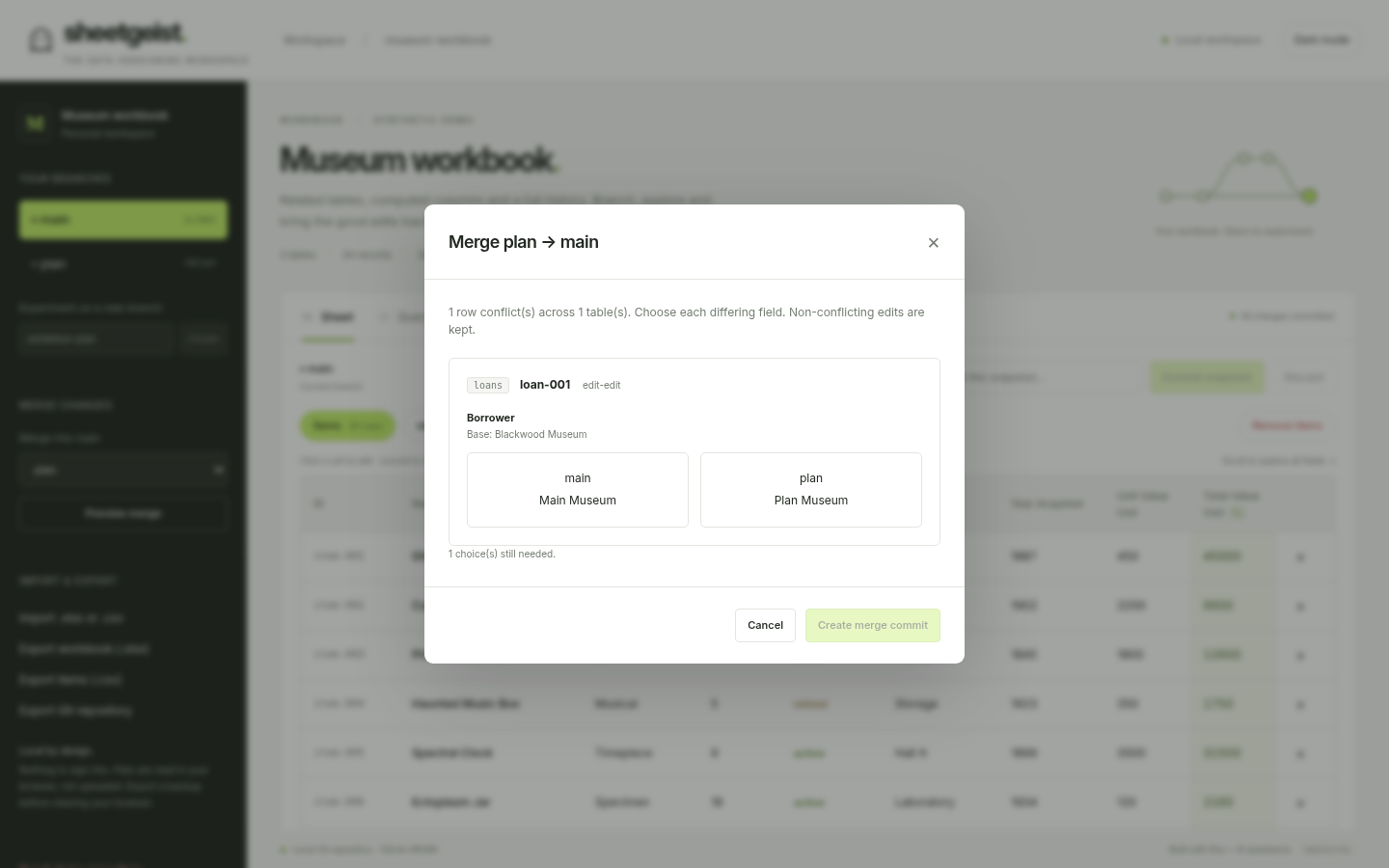
- Preview three-way merges against the common ancestor. Choose a side for conflicting fields without losing independent edits, then create a two-parent merge commit.
- Inspect typed, field-level commit differences. Text "1", number 1, missing values and null are distinct. Merge comparisons explicitly use the first parent.
- Restore an earlier full snapshot as a new commit, with an impact preview. No hard reset and no erased commit chain. Dirty or no-op restores are blocked.
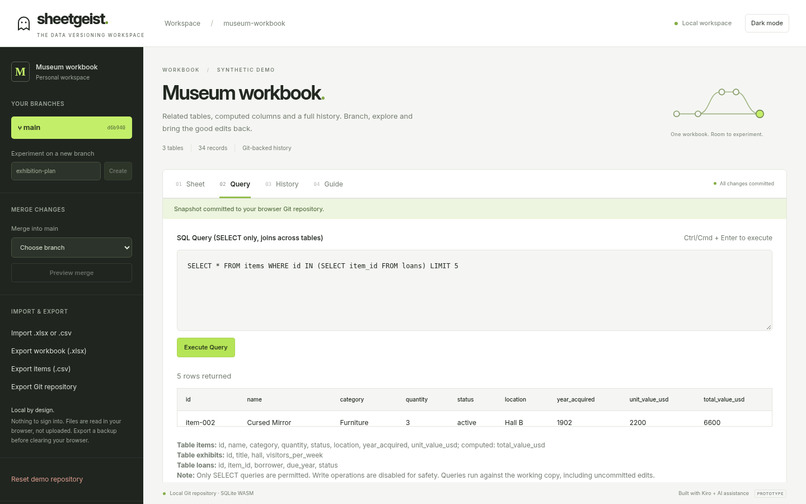
- Run a single read-only SELECT through SQLite, including grouping and aggregates.
- Export CSV or a ZIP containing a Git repository and its history.
Workbook upgrade (13 November 2026):
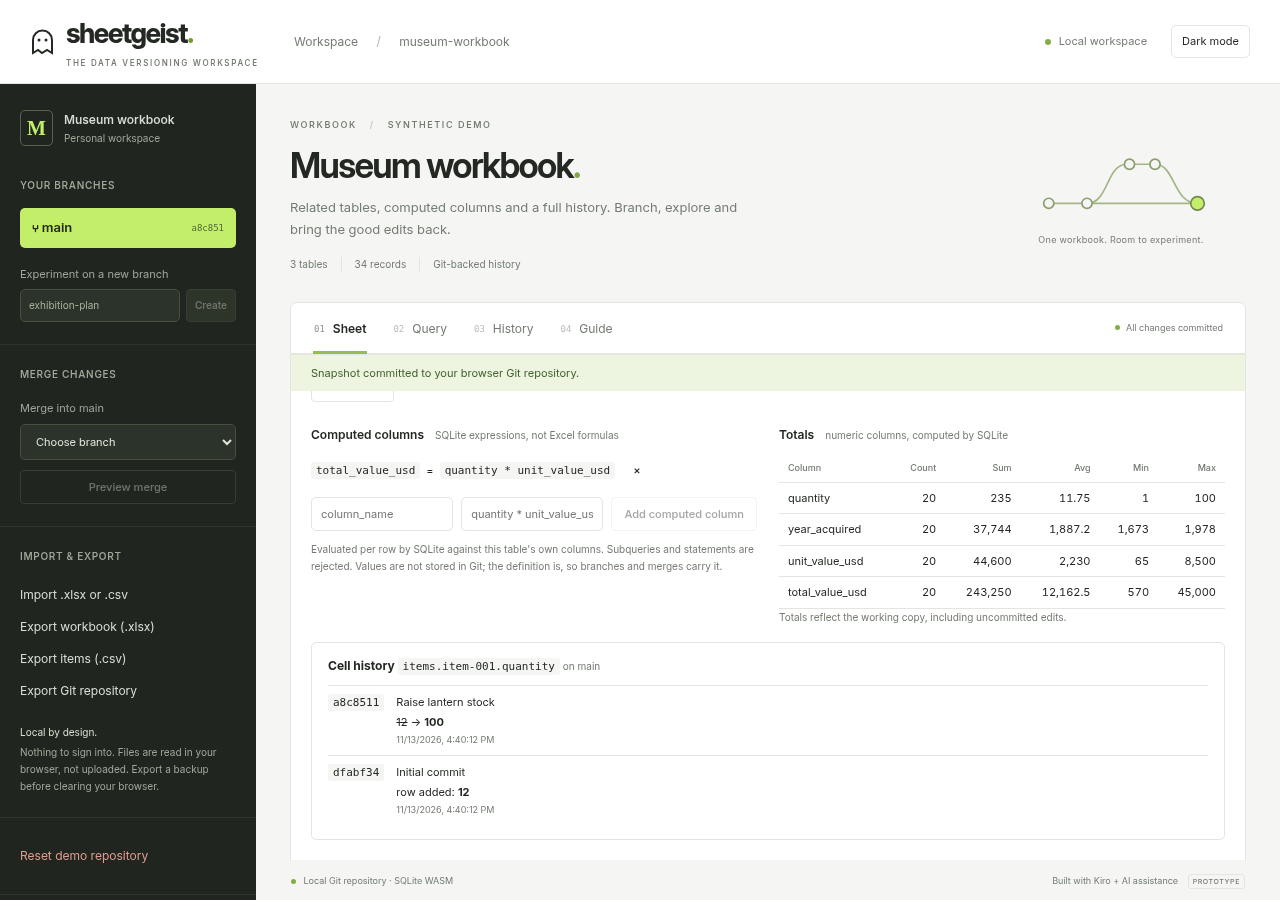
- A workbook of several related tables (demo: items, exhibits, loans), stored in Git as
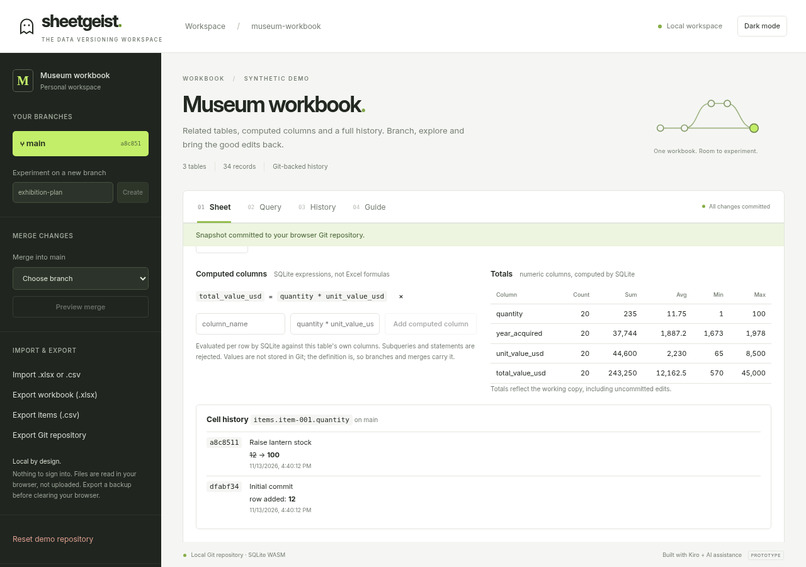
workbook.jsonplus one JSON file per table. Older single-table repos still open, as a table named "sheet", with history intact. - Computed columns: SQLite expressions such as
quantity * unit_value_usd, with a totals panel. These are not Excel formulas and there is no formula engine. - Per-cell history: every commit that changed one cell, with before and after.
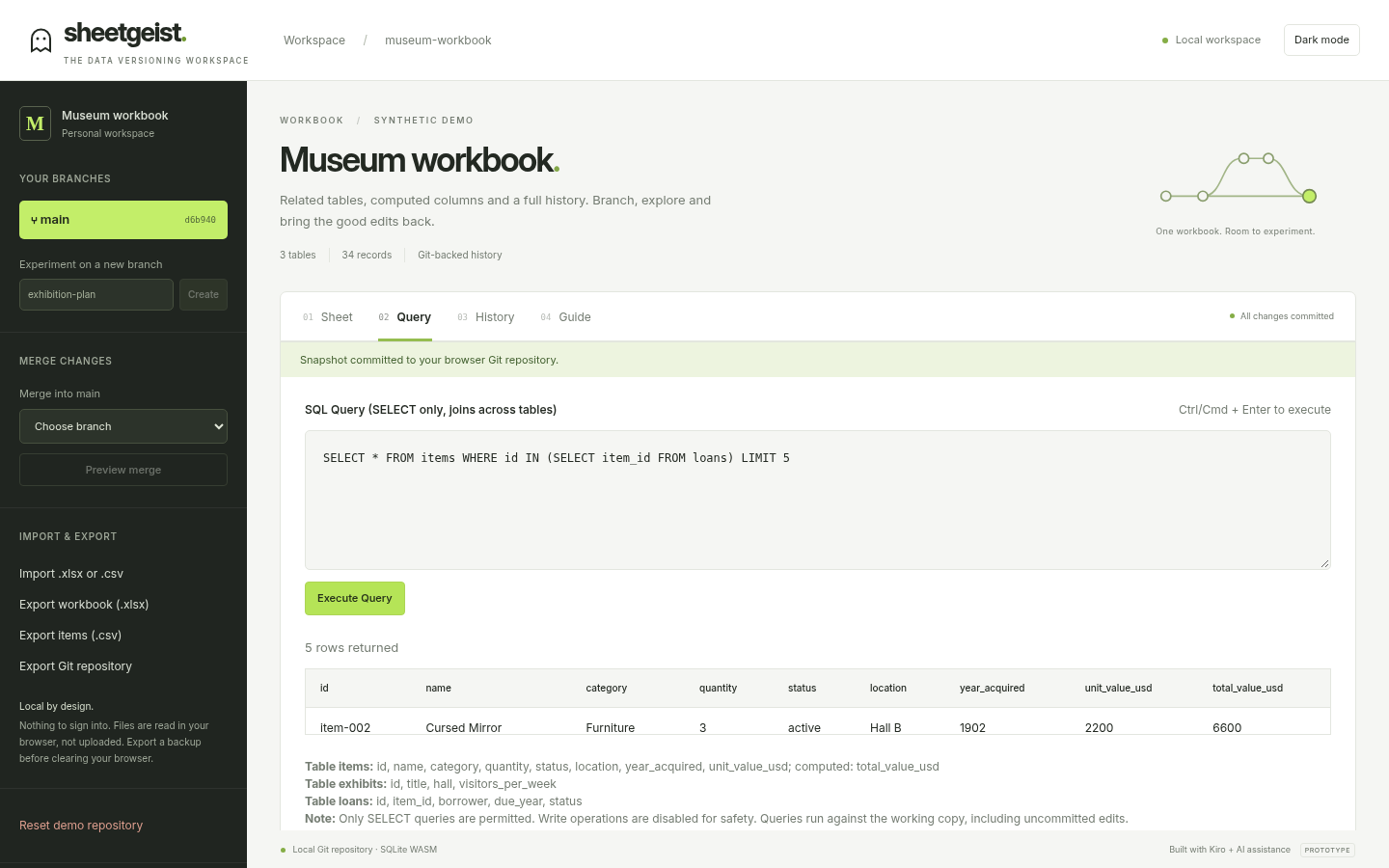
- SQL across all tables, including joins. Still one read-only SELECT.
- Per-table merge: conflicts name the table, row and field; independent edits are kept.
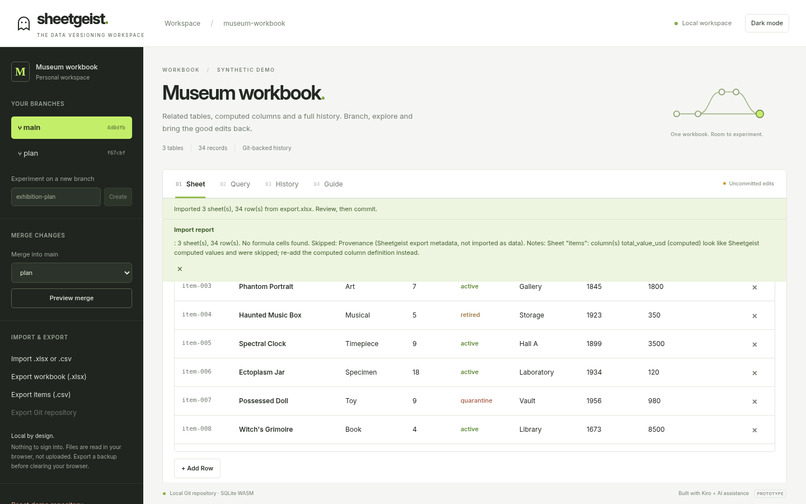
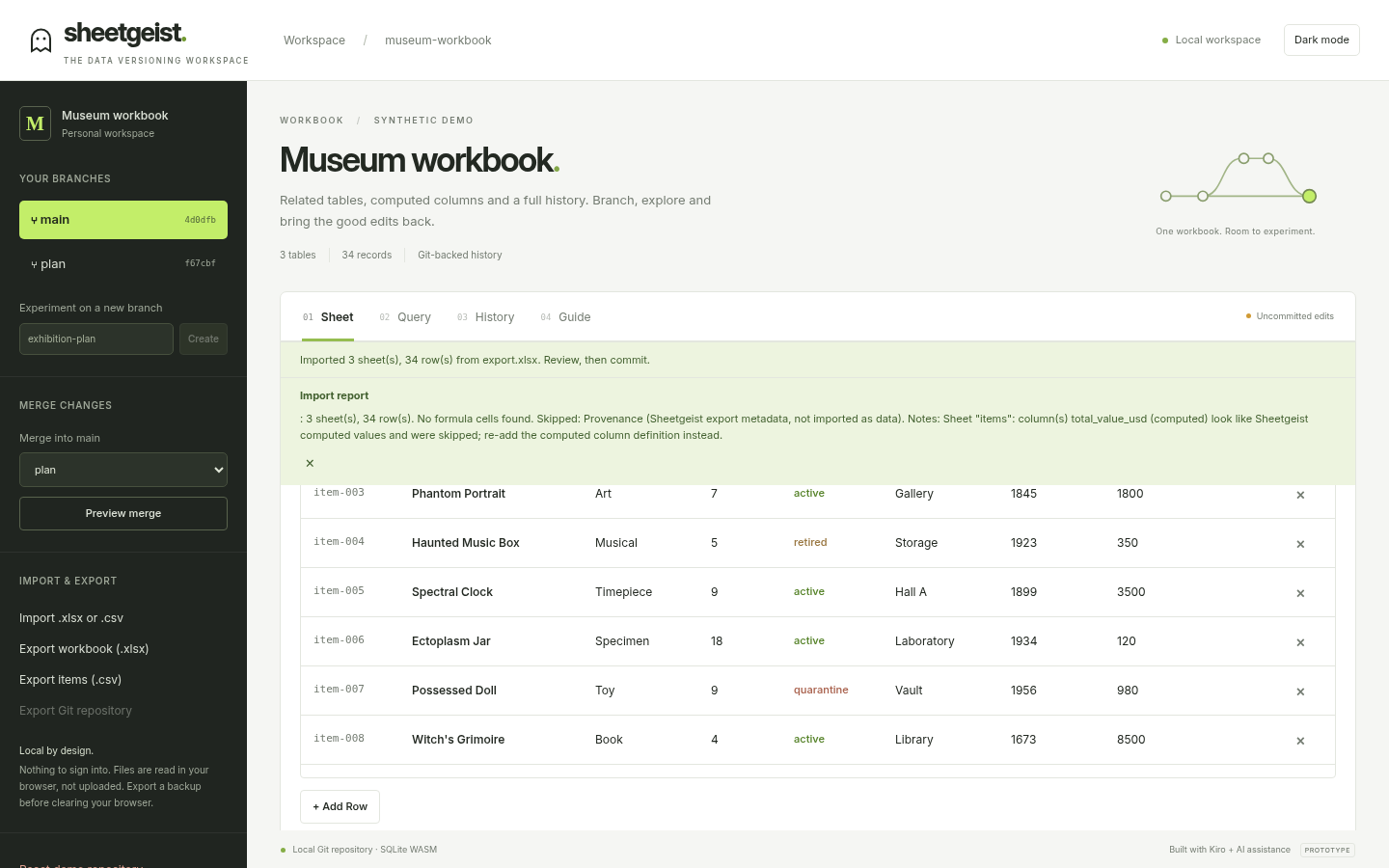
- .xlsx import and export using SheetJS 0.20.3 (Apache-2.0, vendored from cdn.sheetjs.com). Formulas are never evaluated: only values saved in the file are imported, formula cells with no saved value are counted and imported empty, and the import report lists everything skipped (Provenance sheet, "(computed)" columns, renamed sheets). Formatting, charts and macros are not imported.
No account, API key or server is needed to try it. The demo inventory is fictional. On phones, expandable record editors replace a cramped desktop grid.
How it was built, and where Kiro helped
Kiro CLI generated the initial requirements, design, task plan and product steering. Its implementation run created the TypeScript model, pure three-way merge engine and 14 initial merge tests, Git/LightningFS layer, SQLite layer, CSV boundary, ZIP export, fixture and UI components.
A service throttle stopped that run before the application entry was complete. Later AI-assisted work wired the application, reviewed and fixed bugs, redesigned the interface, and added typed diffs and restore-as-new-commit. Those later additions are not attributed to the earlier Kiro run.
Workbook upgrade and Kiro. On 13 November 2026 Kiro CLI (Free plan; 6.43 to 17.4 of 50 monthly credits used, no upgrade, trial or card) wrote the upgrade spec in .kiro/specs/workbook-upgrade/, a steering addition, first versions of the workbook, SQL, merge and xlsx modules, and several test files. The service throttled it twice, and it was not retried. The rest was done outside Kiro with AI assistance: Git storage for workbooks and legacy migration, the interface, import hardening and the browser tests. Tests found a real bug in Kiro's SQL layer (columns were declared TEXT, so numeric ordering and comparisons were wrong); it was fixed with a regression test. KIRO_USAGE.md has the exact split. The root .kiro directory preserves the actual spec and steering files; KIRO_USAGE.md separates Kiro's work from later integration and verification. No hooks, custom agents, MCP integrations or property-based tests are claimed.
Stack: React, TypeScript and Vite; SheetJS 0.20.3 for .xlsx; isomorphic-git over LightningFS/IndexedDB; sql.js with a bundled local WASM asset; PapaParse; JSZip. MIT licensed. The app has no runtime AI dependency. The narrated demo uses AI-generated voice with burned-in captions.
Challenges and lessons
The hard part was preserving meaning, not drawing a spreadsheet. Review caught a merge-resolution bug that discarded a non-conflicting edit from the other branch. Another change replaced CSV commit storage with canonical JSON, because CSV cannot faithfully preserve types and multiline values. Browser compatibility and delayed persistence also needed real-browser checks.
The lesson: a convincing history panel is not proof of version control. Exported repositories were checked using ordinary git fsck and parent-chain inspection. SQL was checked against merged values, not a simulated query parser.
What is verified
The current public release passes 105 unit/regression tests (34 from the first release plus 71 for the workbook upgrade), a 25-check Playwright suite on desktop and 390 px mobile run against the live site, and a check that a repository saved by the previous build opens in the new one. Browser checks against the deployed app cover branch isolation, conflicting and independent edits, actual two-parent merges, SELECT results and write rejection, reload persistence, typed differences, restore preview/cancel/new-commit semantics, ZIP export, and phone editing. Public CI and test commands are in the repository.
Honest limits and what's next
This is an open-source prototype, not a shared online spreadsheet or a production database. Clearing browser storage can erase local work; download backups. Schema-changing merges are rejected. SQL runs on the main thread, so expensive queries can freeze the UI. Restore checks the current branch and head, but is not a cross-tab transaction or crash-atomic operation. CSV import/export has documented typing limits. .xlsx import reads values only (2 MB, 10 sheets, 5,000 rows, 50 columns), and no security claim is made about parsing untrusted spreadsheet files. Computed columns are SQLite expressions, not a spreadsheet formula engine. The original demo video is https://youtu.be/pqz4zhF7YZo; the updated workbook demo is https://youtu.be/UNb8KUeE4-E. The diff UI caps displayed changed rows at 200.
Next steps are a SQL Web Worker with cancellation, stronger cross-tab coordination and crash recovery, and a richer schema-aware merge workflow. Remote collaboration and automatic cloud backups are not implemented.
Built With
- isomorphic-git
- kiro
- react
- sql.js
- sqlite
- typescript
- vite
