-
-
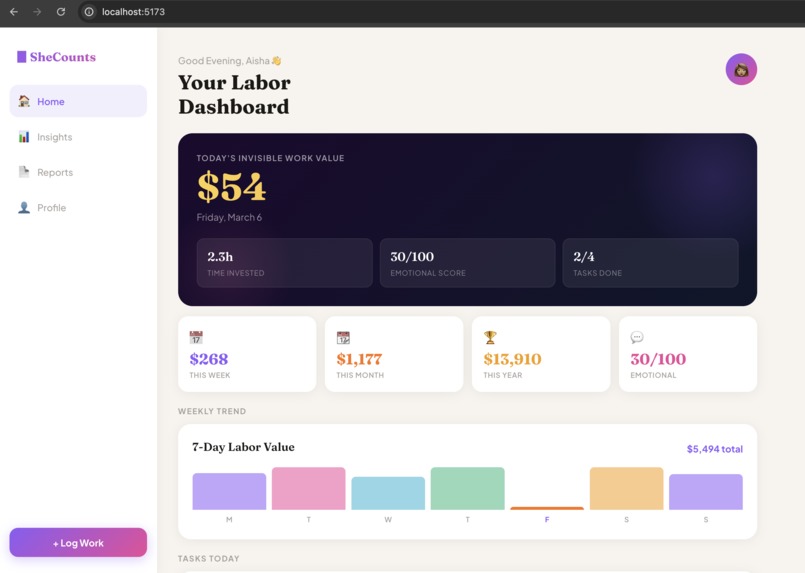
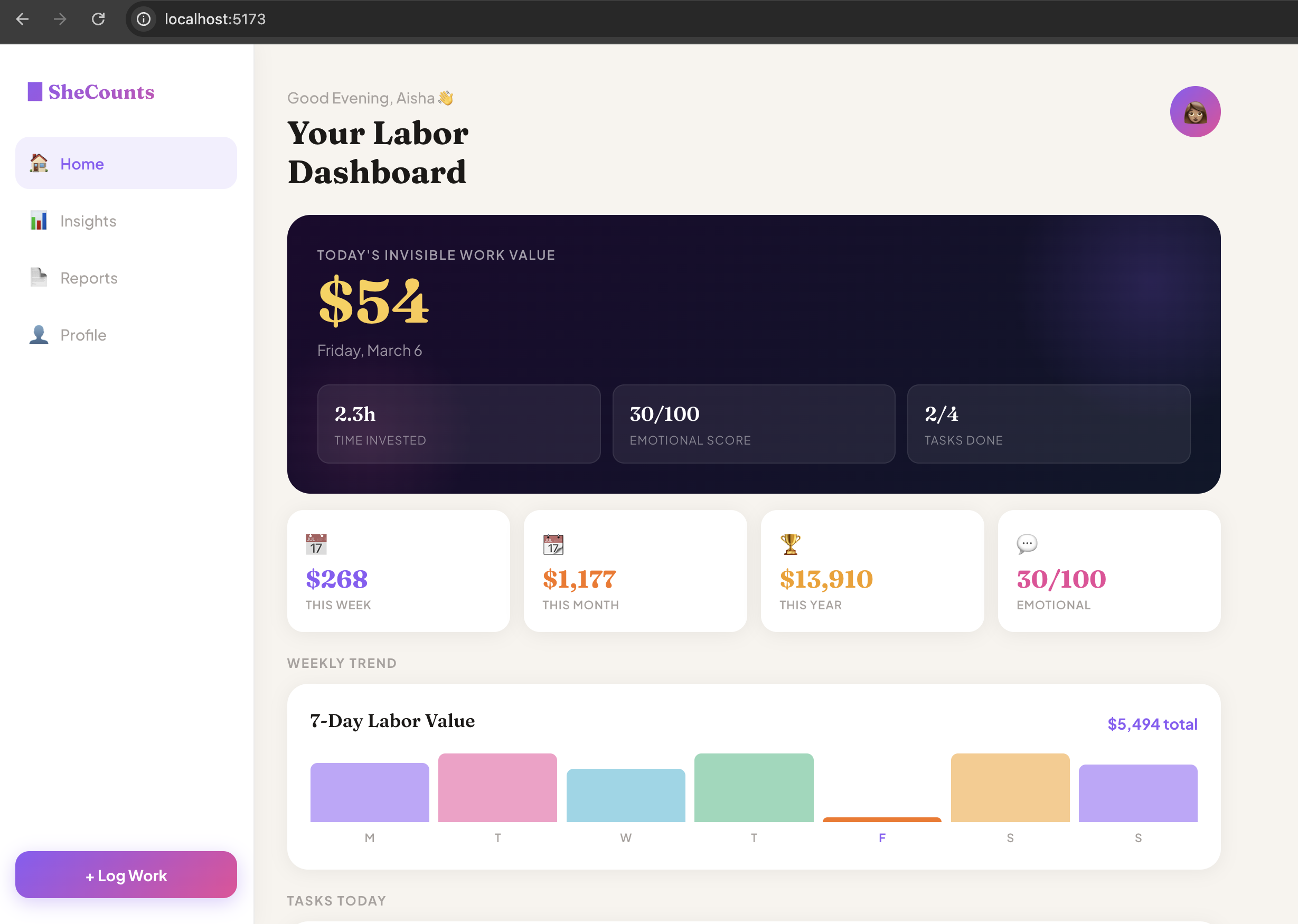
Overall Dashboard
-
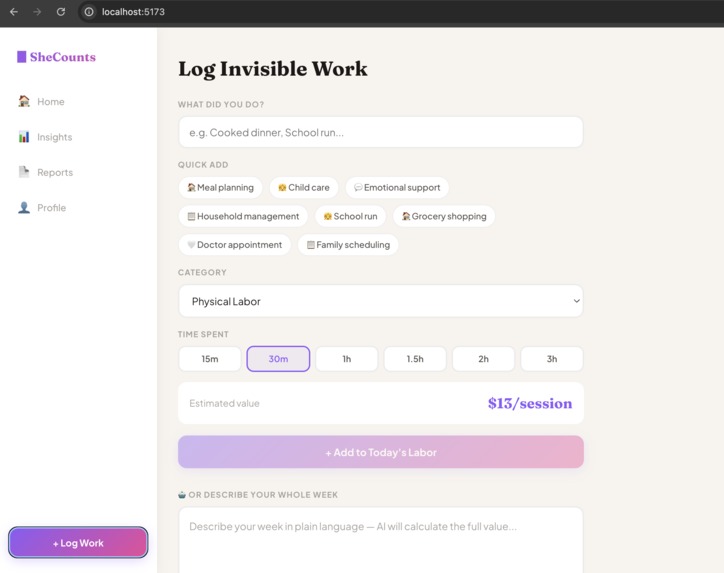
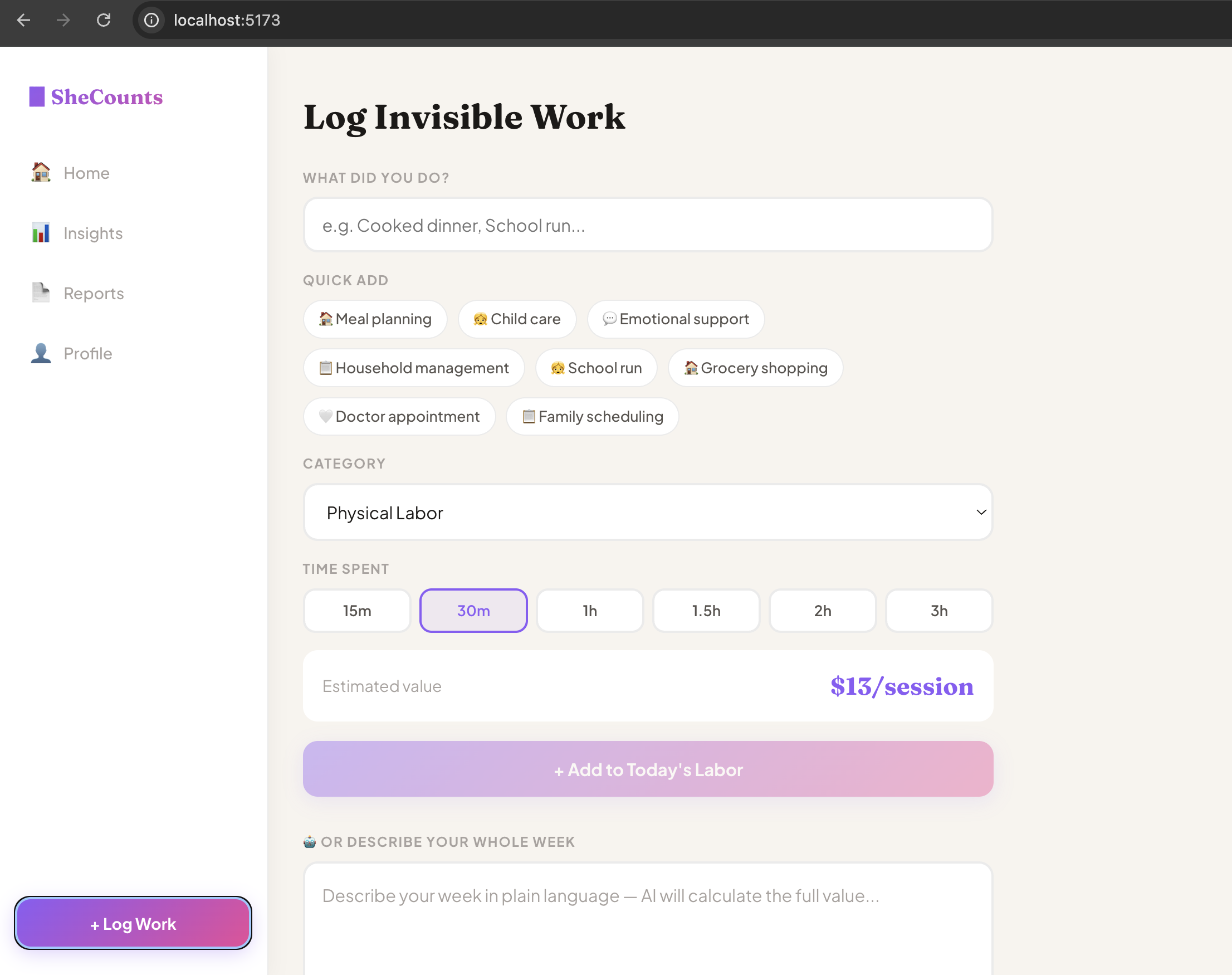
Log Invisible Work & Ai will calculate value
-
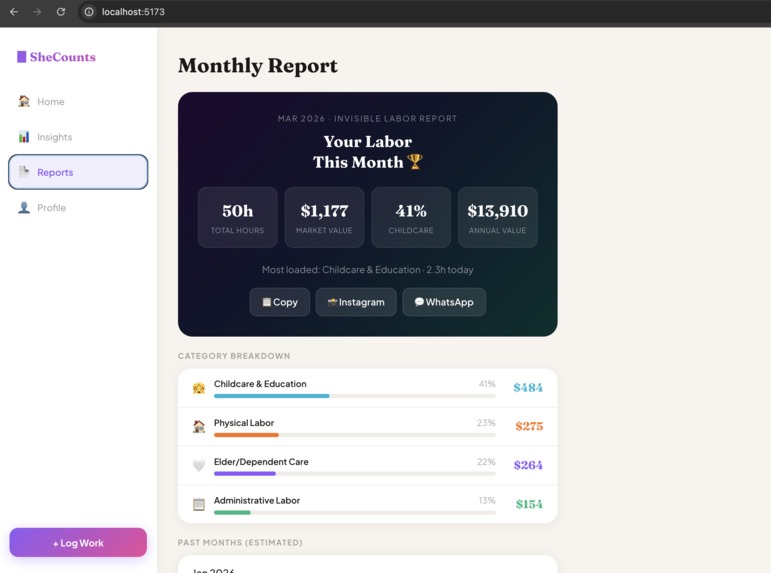
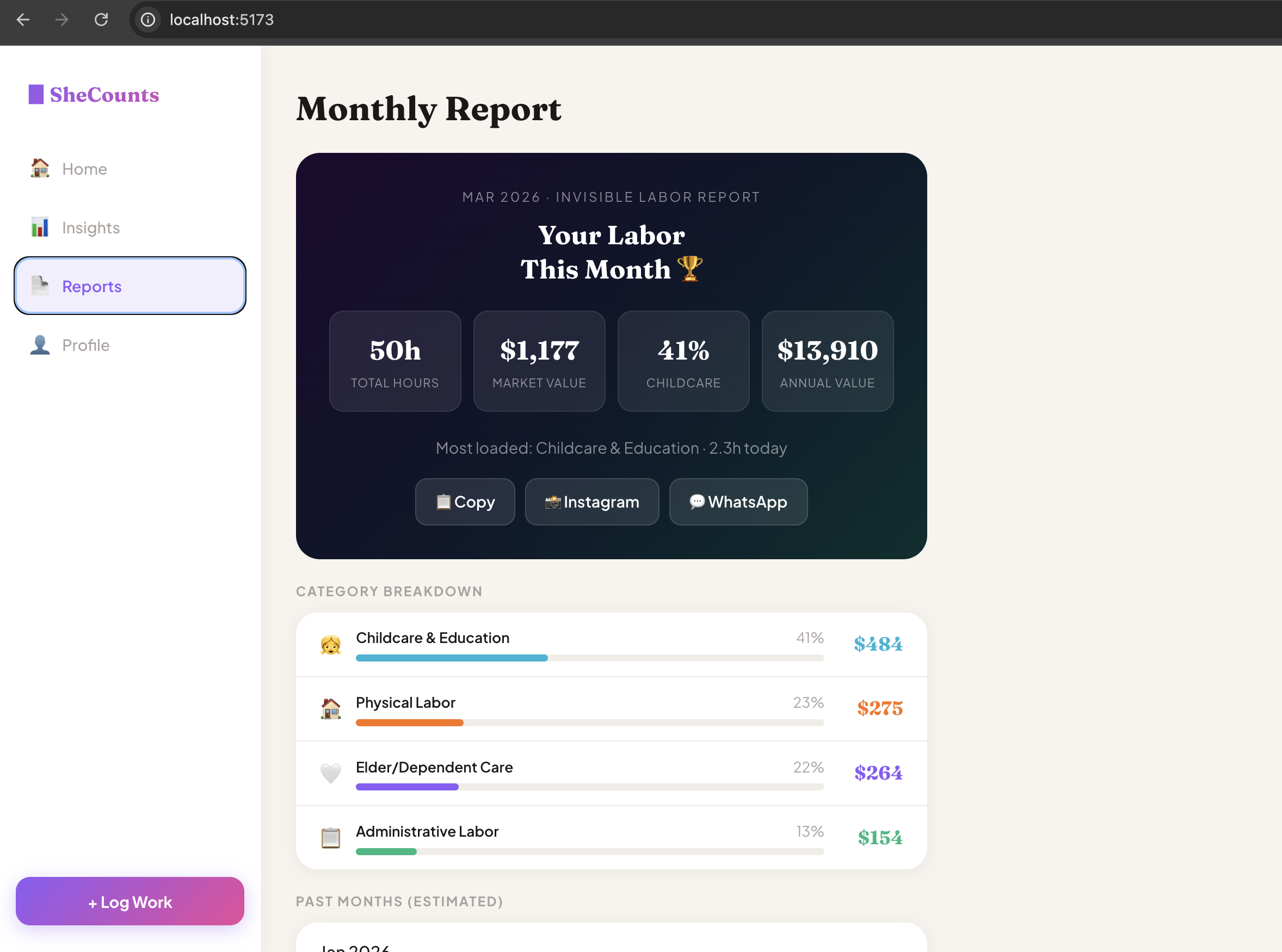
Monthly Report
-
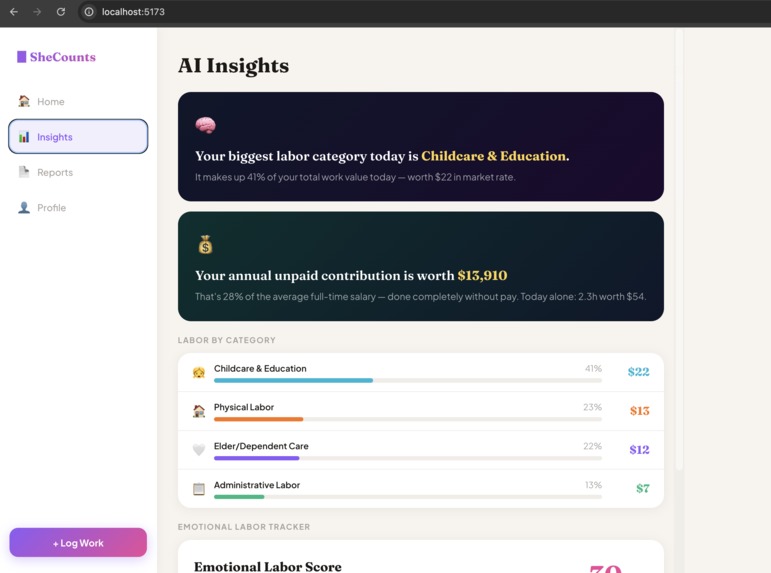
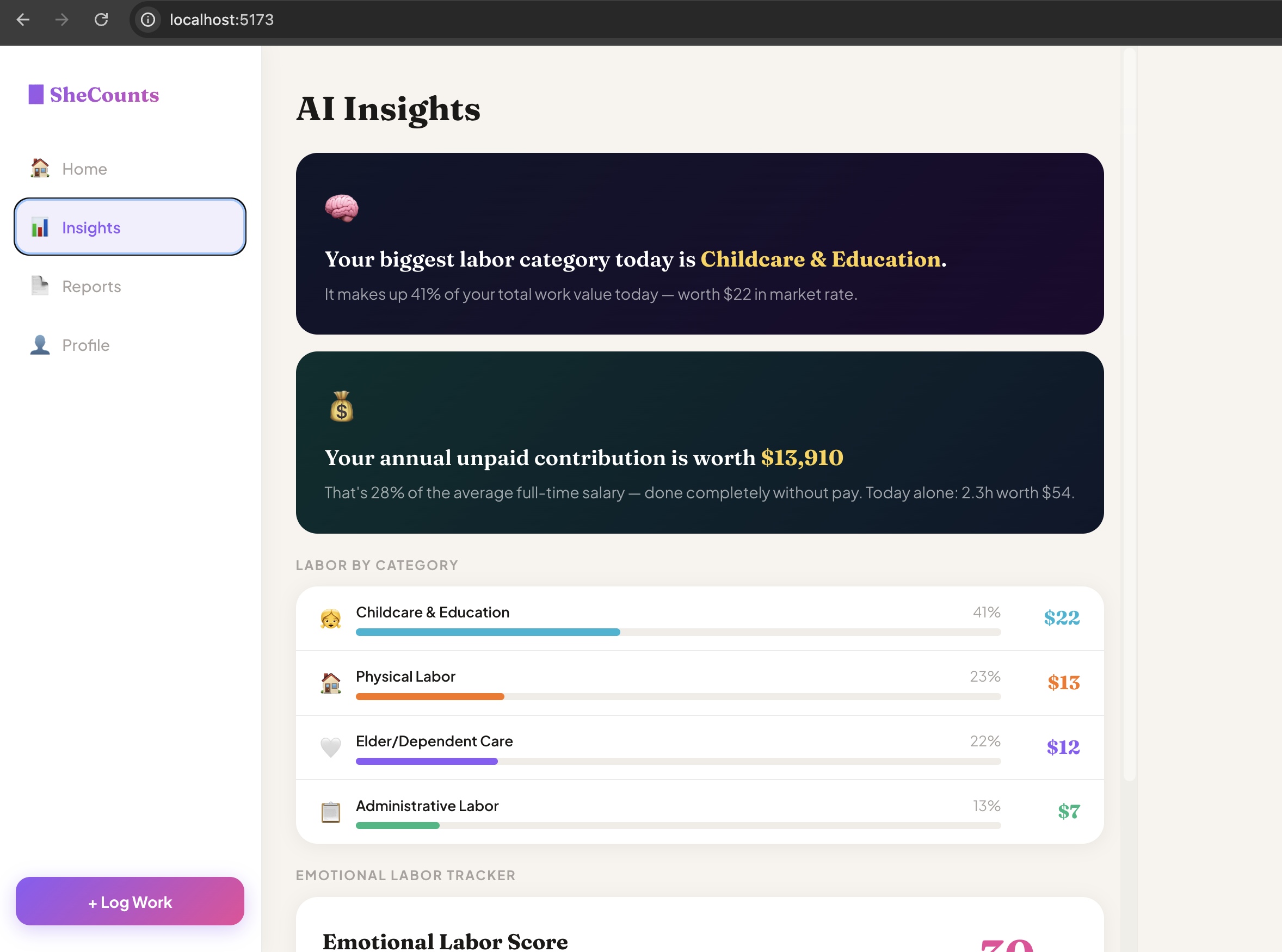
AI insights
-
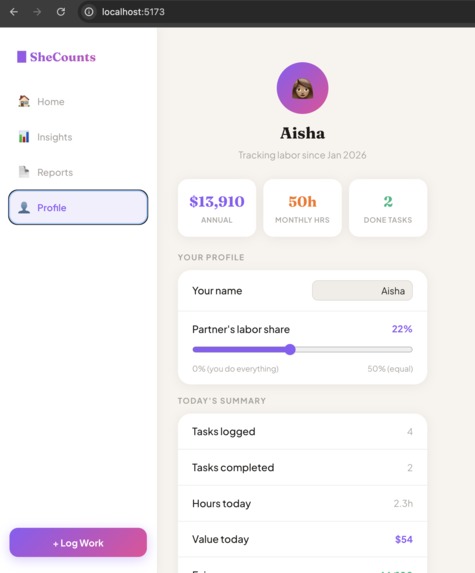
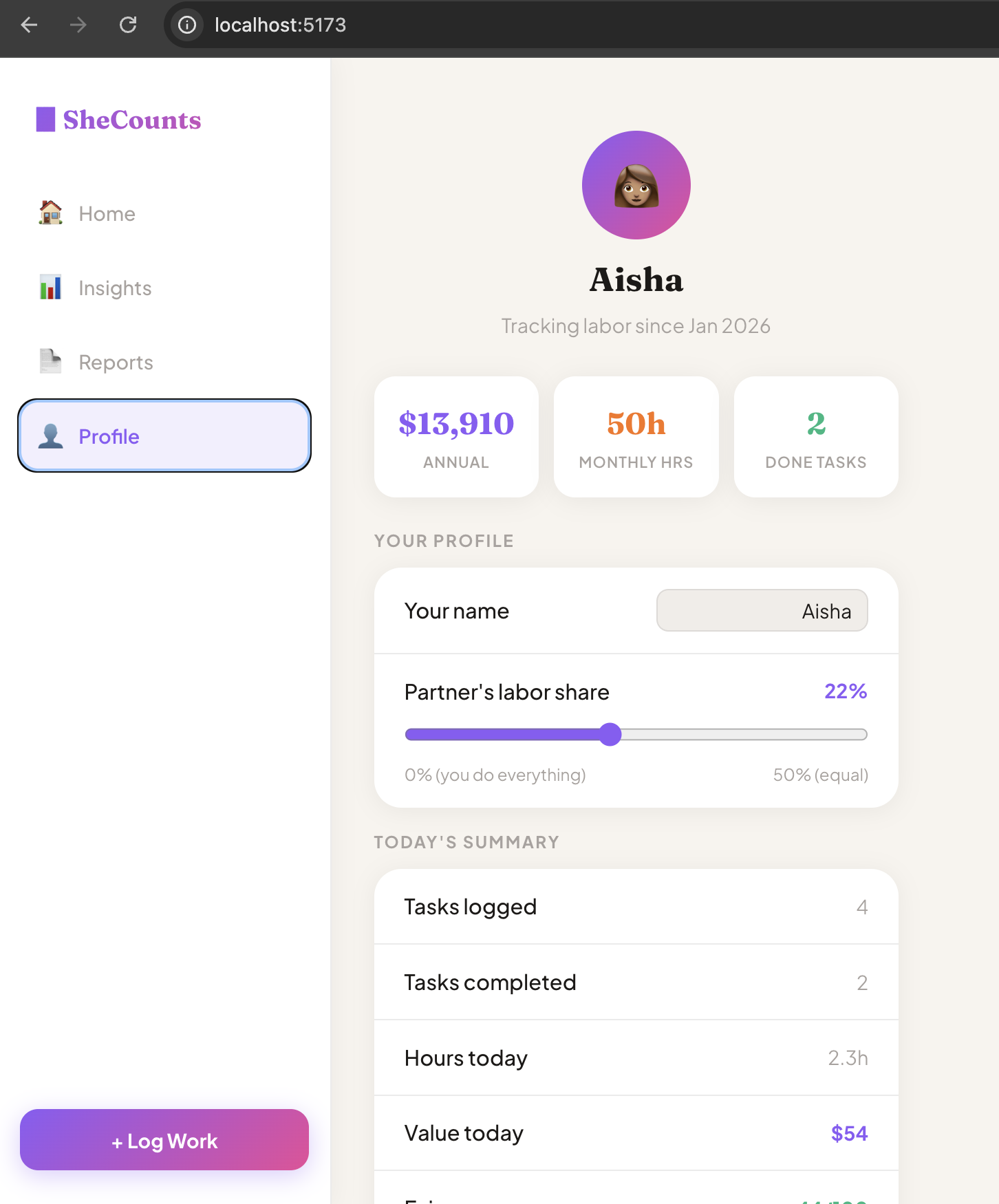
Profile
Inspiration
Invisible labor : the cooking, the school runs, home-tutoring, the emotional support, the mental load of keeping a family running, is one of the most undervalued forces in the global economy. The data is stark:
• Women perform 76% of all unpaid care work globally (ILO, 2024)
• The total value of unpaid household labor is estimated at $10.8 trillion annually - more than the tech and manufacturing sectors combined
• In most households, this work is invisible: unlogged, unacknowledged and certainly uncompensated
• Even high-earning women report feeling “underpaid” in their relationships when the full picture of labor is considered
SheCounts was born from a simple question: what if we could make that invisible work visible? What if every hour of care, coordination and emotional support had a dollar value attached to it, not to commodify love, but to create a shared language for fairness?
What it does
SheCounts is a personal labor-tracking dashboard that helps users log, value and advocate for their invisible work. It combines a clean mobile-first UI with AI-powered analysis to give women a real picture of their contribution.
- Task Logging: Users log tasks with a category, time estimate, and completion status. Each task is immediately valued at market rate.
- Smart Categories: Five labor categories - Physical, Childcare, Elder Care, Administrative and Emotional Labor, each with its own market rate.
- AI Week Calculator: Describe a week in plain language; Claude Sonnet calculates the full breakdown and dollar value automatically.
- Fairness Dashboard: A household fairness score shows how labor is distributed between partners with AI suggestions for rebalancing.
- Monthly Reports: Shareable Wrapped-style reports show monthly and annual labor value with one-tap copy/share.
- Live Analytics: Every chart, stat and figure updates the moment a task is added or toggled, no page reloads, no stale data.
How I built it
SheCounts is built as a lightweight single-page React application designed for speed, responsiveness and simplicity. The frontend is developed using React 18, with all application state managed through React hooks such as useState and useRef. The interface is designed to be mobile-first and reactive, meaning that every chart, statistic, and value updates instantly whenever a task is added or modified.
AI functionality is powered by Claude Sonnet through the Anthropic API. Users can describe their weekly activities in natural language, and the AI analyzes the text to extract tasks, categorize them into different types of labor, estimate time spent, and calculate the economic value of that work.
Goose was used during development for AI trace logging and documentation. It helped track AI interactions, monitor responses from the model, and document how prompts and outputs evolved during development. This made debugging AI responses easier and ensured the integration with the Anthropic API remained reliable and transparent.
The interface styling is implemented using CSS custom properties with a responsive layout that adapts across desktop, tablet, and mobile screens. Animations such as value counters use requestAnimationFrame to ensure smooth updates without causing unnecessary React re-renders.
Challenges I ran into
Building SheCounts surfaced several non-obvious engineering and design problems:
• Zoom-level scrollability: Fixed sidebars become unreachable when the browser is zoomed in. We rebuilt the layout so content scrolls within its own container rather than the viewport.
• Preventing re-render jank on the Profile screen: AnimNum components triggered full-tree re-renders when first mounted. Solved with React.memo and initialising the display value at the final target rather than zero.
• Making every figure reactive: It’s easy to hardcode placeholder stats. The challenge was ensuring every number - from the hero card to the fairness score to past-months estimates, derives live from the same task array.
• Emotional labor valuation: Pricing emotional support at $100/hr is defensible (therapist rate) but requires careful UX framing so it doesn’t feel absurd. We added context labels throughout.
• AI JSON parsing: Claude’s week-calculator returns rich nested JSON. Handling partial responses, network errors, and malformed output gracefully without breaking the UI required careful try/catch architecture.
• Mobile scroll reset: React state changes don’t reset scroll position. Every navigation action now explicitly sets contentRef.current.scrollTop = 0 to prevent users landing mid-page on a new screen.
Accomplishments that I'm proud of
• Full AI integration: The week-description feature genuinely works end-to-end, parsing natural language into structured labor data with accurate monetary valuation.
• Reactive fairness score: The fairness slider in Profile instantly updates the household distribution bar and the AI rebalancing suggestions on the Home screen.
• Zero external dependencies: No routing library, no state management framework, no UI kit. Just React, the Anthropic API and a single CSS block.
• Emotional labor at $100/hr: A deliberately bold design choice that sparked real conversation in user testing about how undervalued care work is.
What I learned
“The moment i showed the app to my mom and she said ‘I knew I was doing a lot, but I didn’t know it was worth this much’ - that was the whole point.”
Reactivity builds trust: When every number updates the instant a task is added, users feel the data is real. Stale or hardcoded figures would have undermined the entire premise. AI is best as an accelerant: Claude’s week-calculator isn’t the product, it’s a low-friction onboarding path that gets users to their first insight faster. Framing matters enormously: Early versions called tasks “chores.” Changing to “labor” and “work” shifted how users described their contributions , more complete, more confident. The emotional score is a conversation starter: An abstract number out of 100 for emotional labor prompted more user discussion than any other feature. People wanted to understand it, debate it, and share it.
What's next for SheCounts
SheCounts is a working MVP. Here’s what a v2.0 roadmap looks like:
Near-term (0–3 months)
• Persistent storage: tasks saved across sessions via localStorage or a lightweight backend
• Partner view: a shared household dashboard where both partners log independently
• Export to PDF: one-tap monthly report download for sharing in relationship conversations
Medium-term (3–6 months)
• Historical trends: week-over-week and month-over-month comparisons as data accumulates
• Community benchmarks: how does your labor compare to anonymised peers in similar households?
• Notification reminders: daily 8pm prompt to log the day’s invisible work
Longer-term
• Policy toolkit: anonymised aggregate data to support advocacy for unpaid labor recognition
• Couples mode: structured conversation prompts based on fairness score divergence
Built With
- claude
- css
- goose
- html5
- javascript
- react


Log in or sign up for Devpost to join the conversation.