-
-
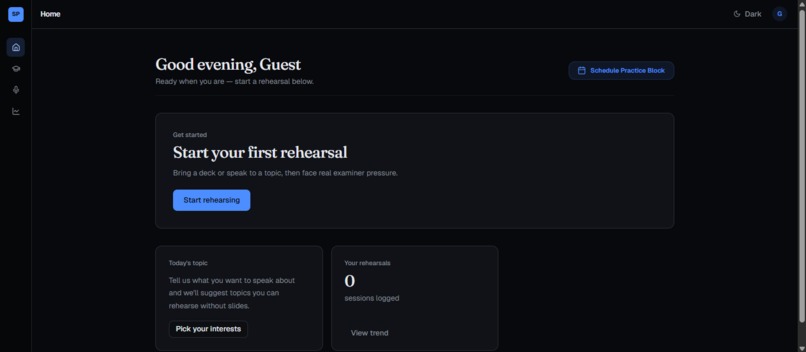
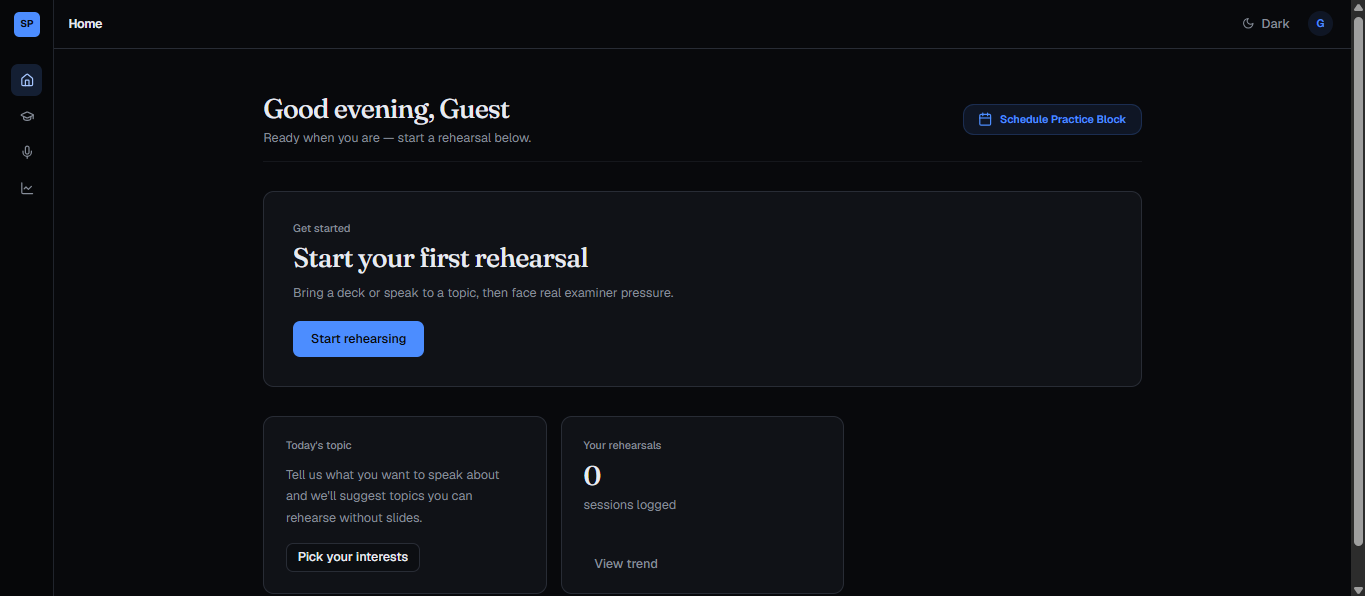
home page
Inspiration
"In the era of AI coding agents, building products is fast—but defending them under live pressure is the ultimate bottleneck. SharkPit solves this." At a recent hackathon, I spent all my time building and only realized 10 minutes before going on stage that I hadn't prepared a pitch. Panicking, I asked ChatGPT to generate a script and tried to memorize it verbatim. When my turn came, I froze. The computer-generated script felt unnatural, my mind went blank, and the moment a judge threw an unexpected question at me, I completely bombed.
That failure led to a pivotal realization: while AI coding tools have made building faster than ever, the true differentiator today is real-time communication, pitching, and live defense. A mirror gives zero feedback, and memorized scripts shatter the second an investor, recruiter, or judge asks a curveball question. True mastery requires active, verbal defense under pressure.
That is why I built SharkPit—an interactive AI sparring partner designed to transform how people test, refine, and articulate their knowledge before stepping into high-stakes rooms.
What it does
SharkPit is an educational AI platform designed to shift learning and presentation prep from passive reading to pressurized active retrieval.
Instead of passive speech practice, SharkPit turns any presentation deck (PPTX, PPT, PDF), job resume/CV, or text topic into a live examination room where an AI panel actively listens to your presentation and interrupts mid-slide with grounded curveball questions.
How we built it
- Custom Text & Delivery Analysis Engine (Proprietary Heuristics):
reading-analysis.ts: Built custom string n-gram overlap algorithms to compute real-time slide reliance metrics, flagging verbatim slide reading versus original explanation.delivery-analysis.ts: Built a time-series camera telemetry engine that aggregates webcam samples (eye-contact, posture, presence) stamped on the session clock.
- AI Core & Reasoning Engine: Groq API running Llama 3.3 70B (
llama-3.3-70b-versatile) for ultra-fast, sub-second examiner interruption decisions and 7-dimension evaluation reports (with fallback to Gemini / OpenAI). - Speech Transcription: Groq Whisper ML model (
whisper-large-v3-turbo) via/api/transcribefor low-latency, highly accurate audio-to-text processing. - Frontend & UI: Next.js 16 (App Router, Turbopack), TypeScript, Tailwind CSS, Lucide React, glassmorphism UI tokens, and custom dark mode themes.
- Database & Persistence: SQLite with Prisma ORM, persisting transcript segments, examiner events, delivery samples, and custom configuration prompts.
- Testing & Engineering Rigor: Built with test-driven discipline—103 Vitest test suites (439 unit tests passing 100%).
Challenges we ran into
- Sub-Second Interruption Decision Loop: Making the AI examiner decide when to interrupt during live speech without lagging or breaking flow. Leveraging Groq's high-speed inference on Llama 3.3 70B, we engineered a session-clock timeline stamp system that evaluates speech-to-slide context in sub-second cycles.
- Differentiating Verbatim Reading from Deep Understanding: Ensuring the AI doesn't just evaluate keyword matches. We combined custom string n-gram overlap algorithms with time-series camera posture telemetry so the system rewards genuine conceptual explanation.
Accomplishments that we're proud of
- Deep Custom Engineering Beyond Wrappers: Developed specialized heuristic analysis engines (
reading-analysis.ts&delivery-analysis.ts) alongside LLM inference to provide rigorous, objective feedback. - Democratizing High-Stakes Coaching: Created a free educational tool that makes executive pitch coaching, interview prep, and thesis defense sparring accessible to anyone worldwide.
- Production Performance: Zero React hydration errors, crisp dark mode design system, clean Next.js 16 compilation, and a 100% pass rate across 439 unit tests.
What we learned
We learned that AI/ML can revolutionize education by shifting learning from passive consumption to active verbal articulation. When users are forced to articulate concepts out loud in response to unpredictable AI questions, they internalize their material far deeper than if they read slides 50 times.
What's next for SharkPit
- Native Desktop App with Live Screen Sharing: Building a native desktop application with real-time screen capture so presenters can share live software demos, interactive web applications, and codebases directly to the AI panel without uploading static files.
- Multi-User Panel Sparring: Supporting multi-speaker team presentations with co-founders and multiple AI judges.
- Low-Latency Streaming Voice: Integrating full-duplex WebSocket audio streaming for instantaneous spoken examiner dialogue.
Built With
- groq
- llama-3.3-70b
- next.js
- node.js
- prisma
- react
- shadcn-ui
- sqlite
- tailwindcss
- turbopack
- typescript
- vitest
- whisper-api
- zod

Log in or sign up for Devpost to join the conversation.