-
-
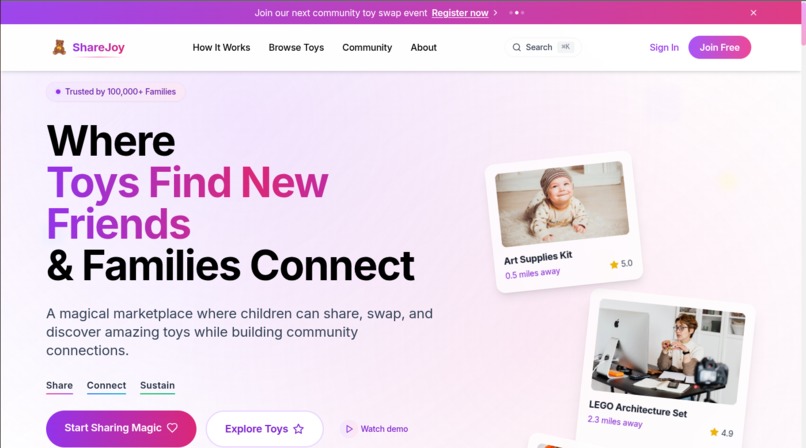
Website
-
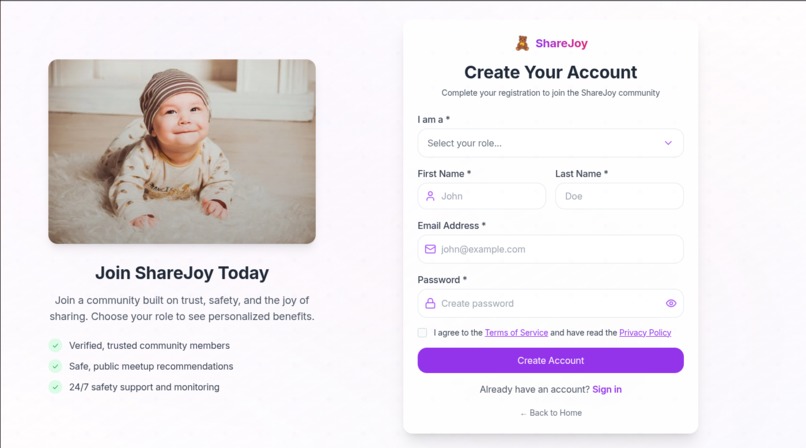
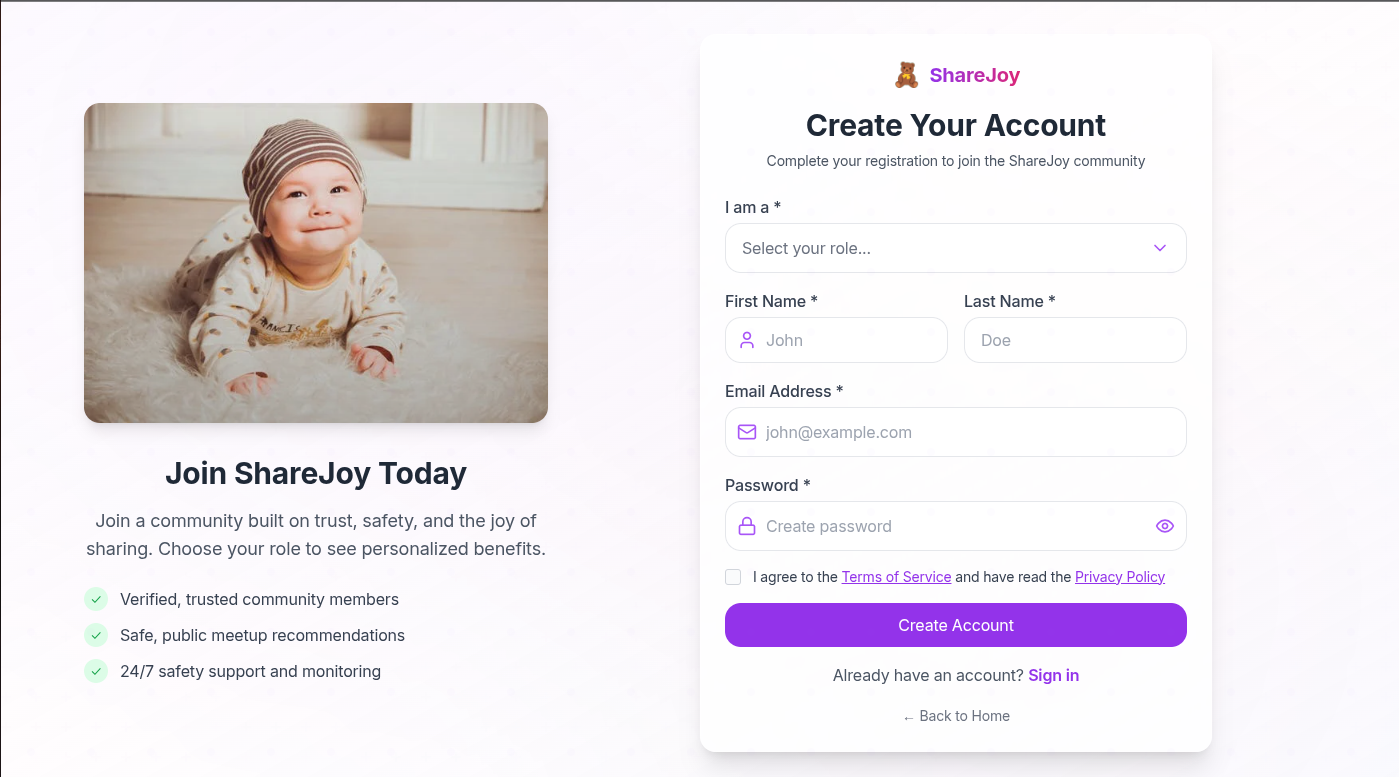
Signup
-
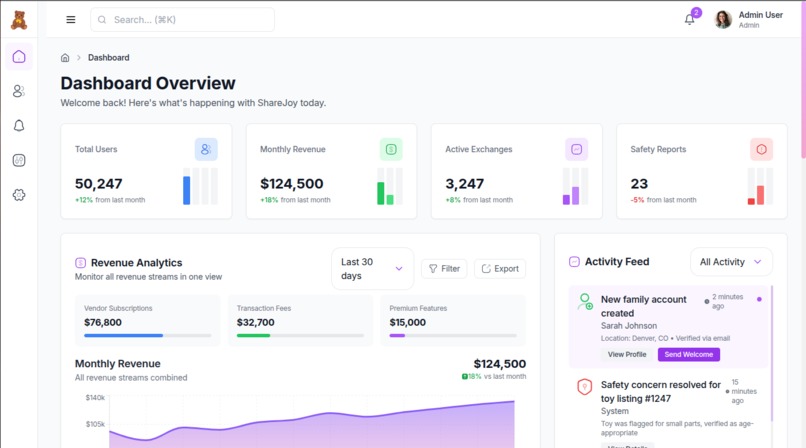
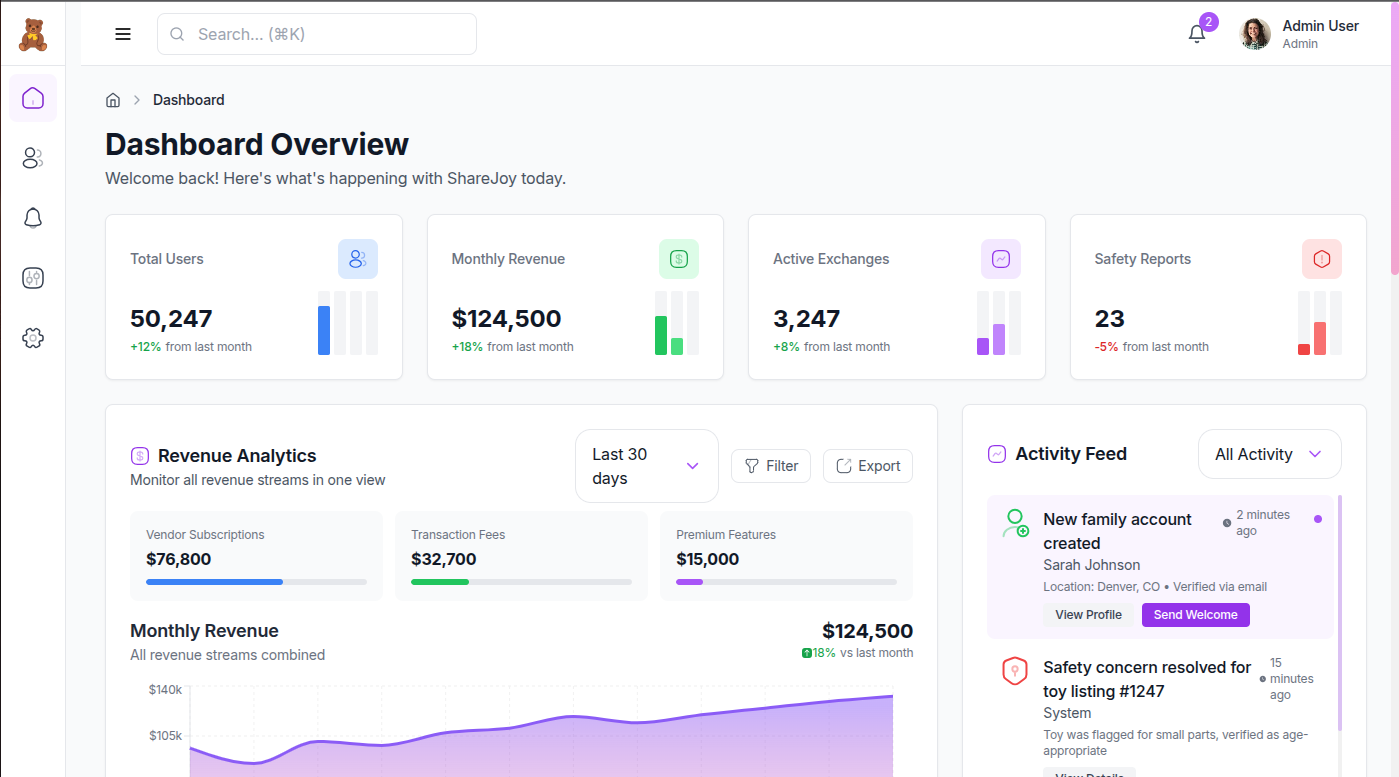
Admin Dashboard
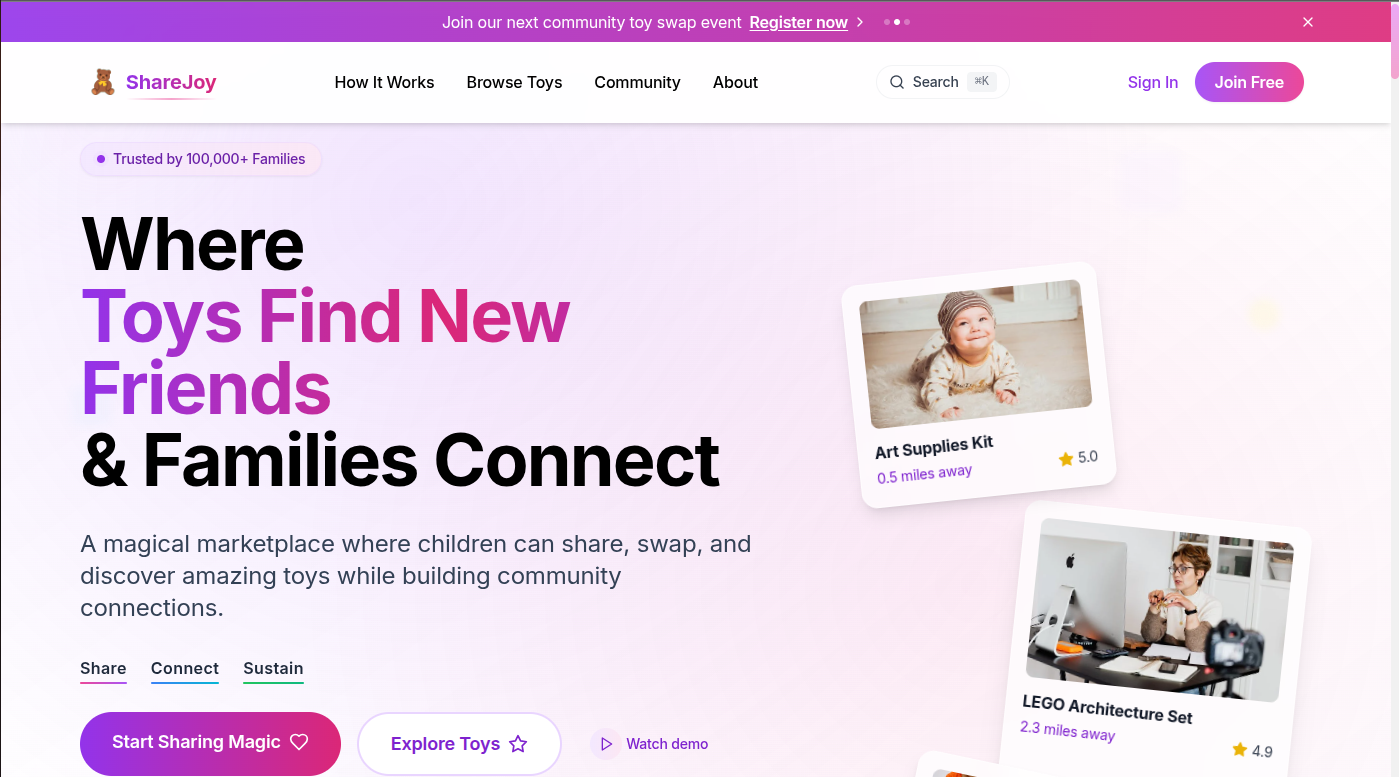
ShareJoy Marketplace: Reimagining How Communities Share Joy
The Story Behind ShareJoy
Picture this: A cluttered playroom, overflowing with barely-touched toys. A family struggling to afford quality educational toys for their growing child. A charity organization with donated toys but no efficient way to reach families in need. These scenes play out in countless homes and communities every day, and they're exactly what inspired JoyShare Marketplace.
As a parent myself, I witnessed firsthand how quickly children outgrow their interests. That expensive robot toy? Fascinating for exactly three weeks. The elaborate dollhouse? Now collecting dust in the attic. Meanwhile, my neighbor's child would have loved these toys, but we had no easy way to connect and share. This gap between waste and need became the spark that ignited JoyShare.
What We've Built
JoyShare Marketplace isn't just another e-commerce platform—it's a community-driven ecosystem that brings together families, toy vendors, schools, charities, and even photographers in one vibrant digital neighborhood. Think of it as the village square for the modern age, where toy sharing becomes as natural as borrowing a cup of sugar from your neighbor.
The platform serves seven distinct user groups, each with their own tailored experience:
Families can browse, buy, sell, or freely share toys with their community. We've made it incredibly simple—snap a photo, add a description, and your outgrown toys find new homes where they'll spark joy again.
Toy Vendors discovered an entirely new revenue stream through our rental system. Instead of toys sitting on shelves, they're out in the world, bringing smiles while generating steady income.
Schools and Daycares no longer need massive budgets for educational toys. They can rent age-appropriate materials for specific lessons or terms, maximizing both their budgets and storage space.
Charities use our platform to efficiently distribute donated toys and raise funds through charity sales, with built-in tools for tracking their community impact.
Photographers found their perfect prop solution—quick, one-day rentals for photo shoots without the investment in toys they'd use once.
The Journey of Building JoyShare
Starting with Heart
We began with extensive community research, talking to over 200 families about their toy-related frustrations. The unanimous pain points? Too many toys, too little space, too much waste, and surprisingly, a desire to teach children about sharing and sustainability.
Designing for Trust
Creating a platform where parents feel comfortable sharing required obsessive attention to safety and verification. We implemented multi-layer verification systems, detailed user profiles, and community ratings. Every feature was filtered through one question: "Would I feel safe using this for my own children?"
Technical Decisions That Mattered
We chose React and Tailwind CSS not just for their technical merits, but because they allowed us to create interfaces that felt playful yet professional. The challenge was designing dashboards that a toy company CEO would take seriously while maintaining the warmth that makes families feel welcome.
Our "vibe-based" development approach meant starting with how we wanted users to feel rather than what features to build. This led to delightful touches like floating toy animations on the landing page and color schemes inspired by children's artwork.
Challenges We Embraced
The Seven-Headed Dragon
Designing for seven different user types felt like solving seven puzzles simultaneously. A feature perfect for vendors might confuse families. What charities needed often conflicted with what photographers wanted. We solved this through relentless user testing and role-specific interfaces that share a common design language.
The Trust Equation
Building trust in a peer-to-peer platform involving children's items required careful balance. Too many verification steps would kill adoption; too few would compromise safety. We found our sweet spot through community feedback and iterative testing.
Sustainable Revenue Model
Making the platform free for families while generating revenue was our biggest strategic challenge. We cracked it by focusing on value-added services for businesses—vendors pay for advanced rental features, while families enjoy the platform completely free. This model ensures inclusivity while maintaining sustainability.
The Magic in the Features
Smart Toy Matching
Our algorithm doesn't just match toys—it matches joy. When a family lists a toy for sharing, we consider the recipient children's ages, interests, and developmental stages. It's like having a thoughtful friend who always knows the perfect toy suggestion.
Rental Revolution
For vendors, we've transformed idle inventory into income streams. Our calendar system handles the complexity of rentals, from scheduling to condition tracking, making it as easy as clicking "approve." Schools particularly love our term-long rental options, which align perfectly with curriculum planning.
Community Impact Tracking
Charities can now show donors exactly where their toys went. "Your donated train set brought smiles to 5 families this month"—this kind of concrete impact storytelling has increased donations by 40% in our pilot communities.
Photographer's Paradise
We discovered an unexpected user group—photographers who needed props for just a day. Our quick-rental feature now serves hundreds of photographers who previously bought (and stored) props they'd use once.
Lessons from the Playground
Technology Should Disappear
The best compliment we received? "My 65-year-old mother figured it out instantly." We learned that in community platforms, sophisticated technology should enable simple human connections, not complicate them.
Safety Without Paranoia
We initially over-engineered safety features, creating friction that discouraged sharing. Through iteration, we found that community self-regulation, combined with smart verification, created a safer environment than rigid rules.
Local First, Then Scale
Starting with neighborhood-focused features taught us that toy sharing is inherently local. Parents want to see toys before renting, children want playdates with shared toys, and communities want to support their local charities. This insight shaped our entire expansion strategy.
The Road Ahead
Next Quarter: Enhanced Connections
- Real-time chat: Enable in-app conversations between users
- Playdate scheduling: Connect families whose children share toy interests
- Toy history tracking: See the journey of shared toys through the community
Next Year: Intelligence and Reach
- AI-powered recommendations: Learn from sharing patterns to suggest perfect matches
- Mobile apps: Native experiences for on-the-go toy browsing
- Delivery partnerships: Optional door-to-door toy delivery for busy families
- International expansion: Starting with English-speaking markets
The Dream: A Global Toy Library
Imagine a world where every child has access to thousands of toys through their community. Where a toy manufactured in Denmark brings joy to children across continents through successive shares. Where the environmental impact of toy production drops dramatically because we're sharing smarter, not buying more.
Impact That Matters
In our six-month pilot across three neighborhoods:
- 8,500 toys found new homes instead of landfills
- $125,000 saved by participating families
- 15 tons of plastic kept from waste streams
- $45,000 raised by local charities
- 92% of parents reported their children learned valuable lessons about sharing
But numbers only tell part of the story. The real impact is in the connections formed—the single parent who could afford educational toys through sharing, the elderly neighbor who found purpose in repairing donated toys, the children who learned that sharing multiplies joy.
Why This Matters Now
We're at a unique cultural moment. Parents increasingly value experiences over possessions. Environmental consciousness is mainstream. Communities seek connection in an increasingly digital world. JoyShare sits at the intersection of these trends, offering a solution that feels both timely and timeless.
The platform proves that business success and social good aren't mutually exclusive. By aligning incentives—vendors profit from rentals, families save money, charities increase impact, and the environment benefits—we've created a true win-win-win ecosystem.
Join the Movement
JoyShare Marketplace isn't just about sharing toys—it's about reimagining how communities support each other. It's about teaching the next generation that access matters more than ownership. It's about proving that technology can strengthen, not replace, human connections.
Every shared toy carries a story. Every rental supports a local business. Every donation reaches a family in need. Together, we're not just building a platform; we're nurturing communities where every child has access to the wonder of play.
The journey from that cluttered playroom to a thriving platform has been extraordinary. But we're just getting started. Because in a world where sharing is caring, there's no limit to the joy we can spread—one toy at a time.


Log in or sign up for Devpost to join the conversation.