🌟 Inspiration
The inspiration for Shard came from observing two key problems in the modern computing landscape:
Wasted Computing Power: Millions of high-performance Macs sit idle for hours each day, their powerful Apple Silicon chips underutilized while consuming electricity.
Centralized AI Infrastructure: Running AI inference and compute-intensive tasks typically requires expensive cloud infrastructure or centralized services, creating bottlenecks and single points of failure.
I asked myself: What if I could create a decentralized marketplace where anyone could contribute their idle computing power and earn cryptocurrency, while others could access distributed compute resources at a fraction of traditional cloud costs?
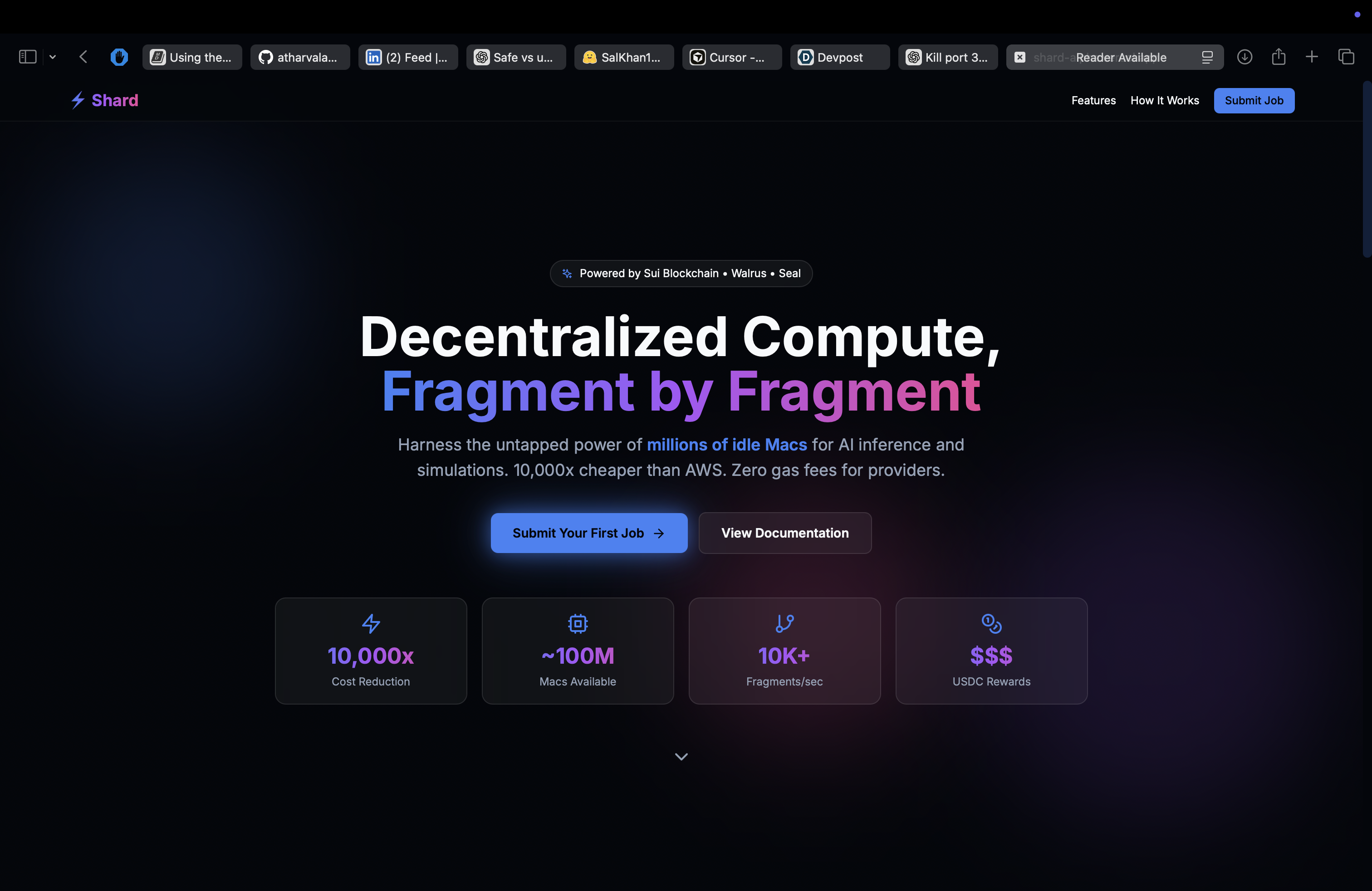
The name "Shard" reflects the core innovation—breaking large computational jobs into tiny micro-task fragments that can be processed independently across a distributed network, similar to how blockchain shards distribute data and computation.
🛠️ What It Does
Shard is a decentralized compute network built on the Sui blockchain that transforms idle Mac computers into a distributed supercomputer. Here's how it works:
For Job Submitters (via Web Interface)
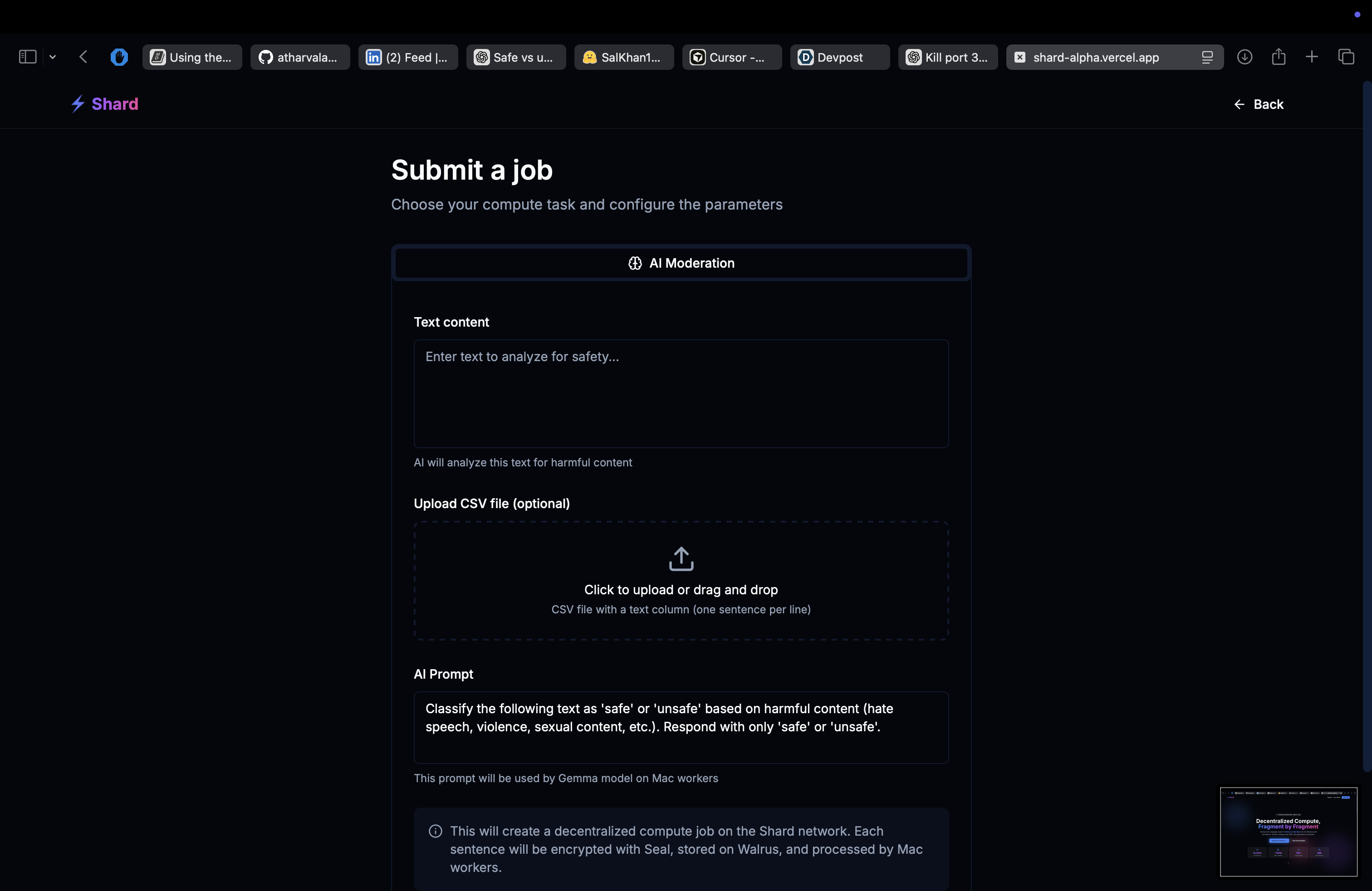
- Submit Computational Tasks: Upload a CSV file with 100 sentences for AI content moderation or provide parameters for Monte Carlo simulations
- Automatic Fragmentation: The system breaks your job into tiny independent fragments (1 sentence per fragment)
- Privacy-First Encryption: Each fragment is encrypted using Sui Seal threshold encryption
- Decentralized Storage: Encrypted data is stored on Sui Walrus (decentralized blob storage)
- On-Chain Job Posting: The job and all fragments are published to the Sui blockchain with USDC bounties (0.01 USDC per fragment)
- Real-Time Progress: Watch as workers around the world claim and process your fragments
- Automatic Result Aggregation: Get your completed results delivered in the original order
For Computing Providers (via macOS App)
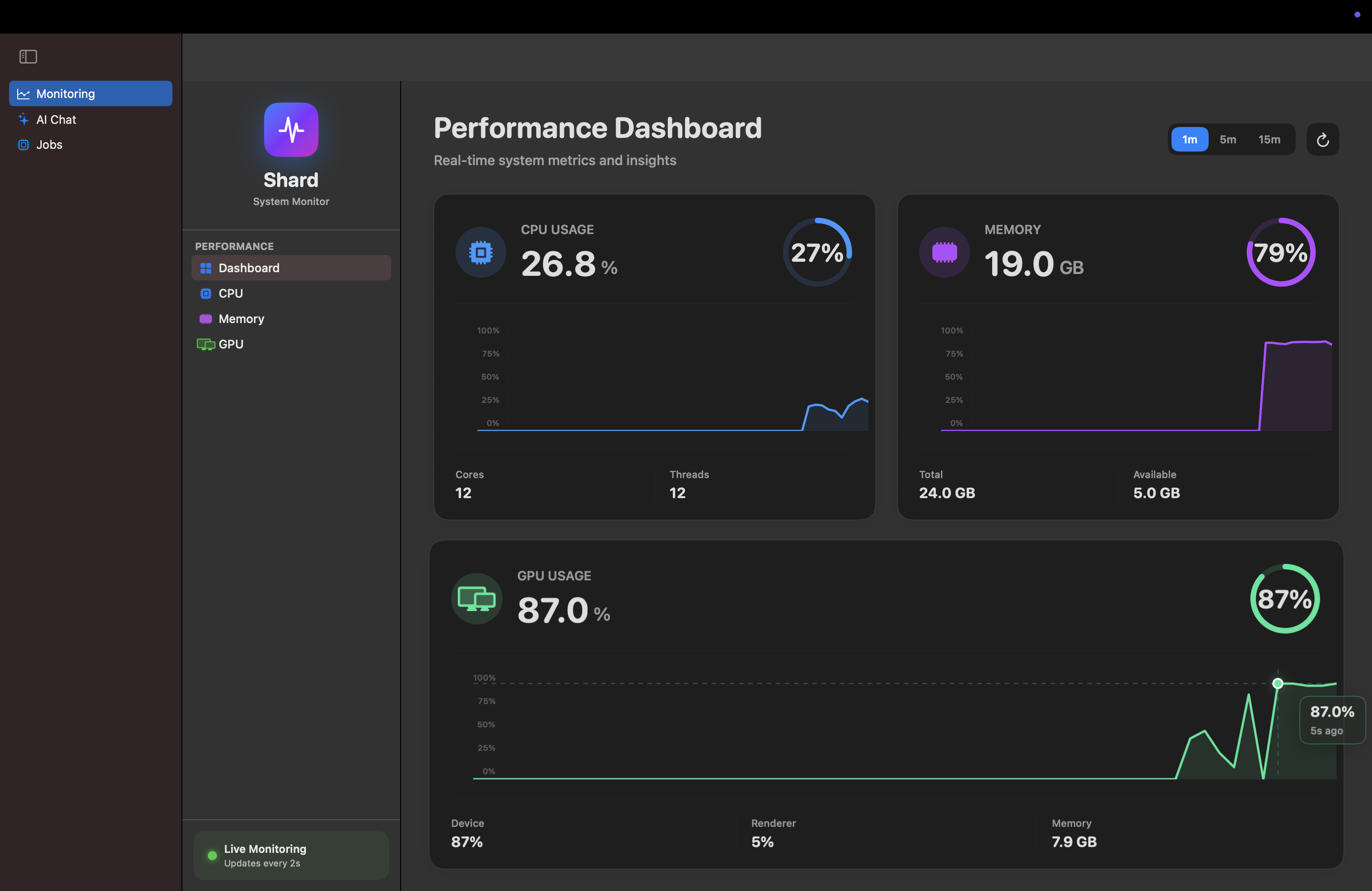
- Beautiful System Monitor: Track CPU, GPU, and memory usage in a Robinhood-like interface
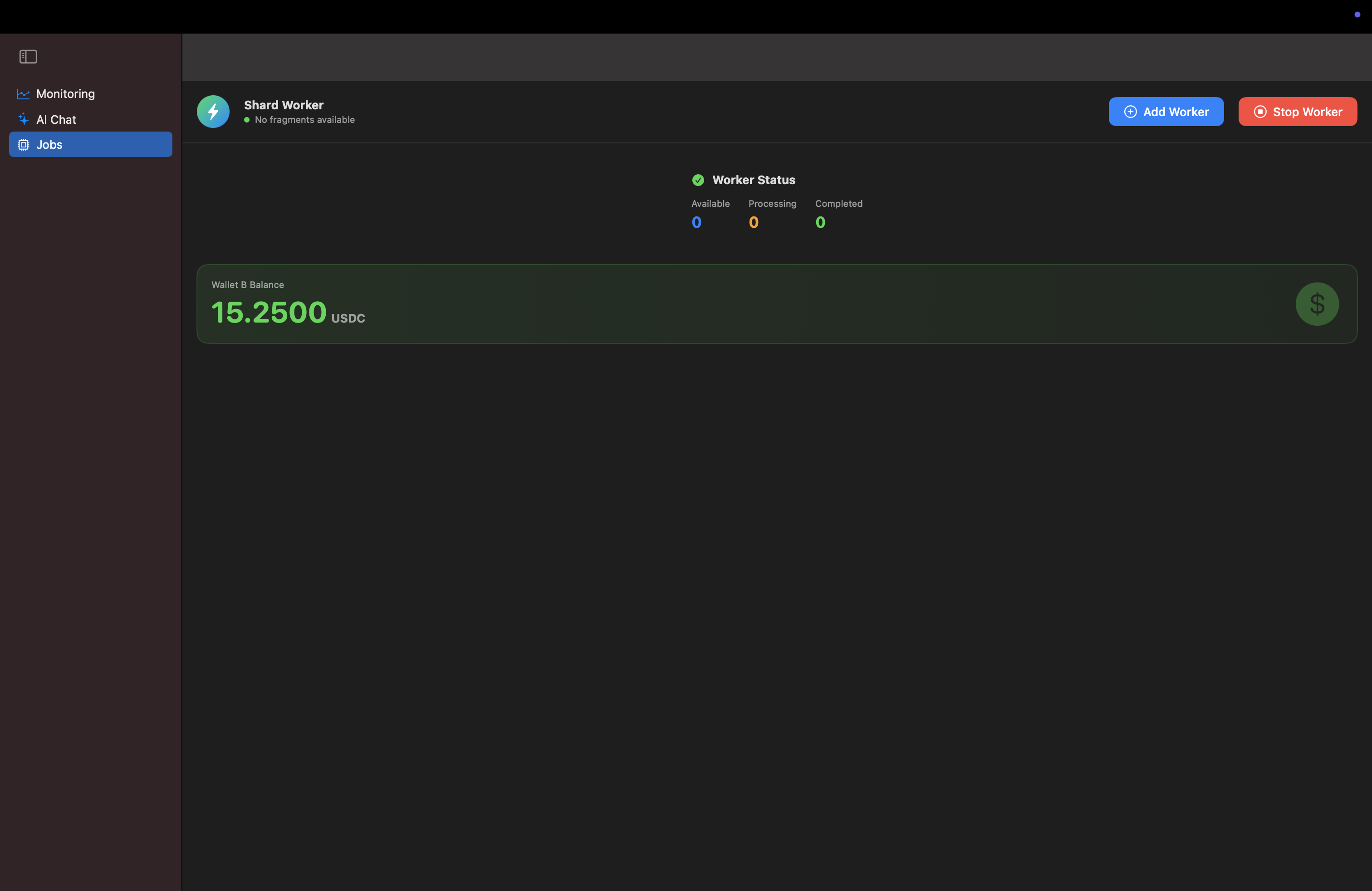
- One-Click Worker: Click "Start Worker" to begin earning USDC
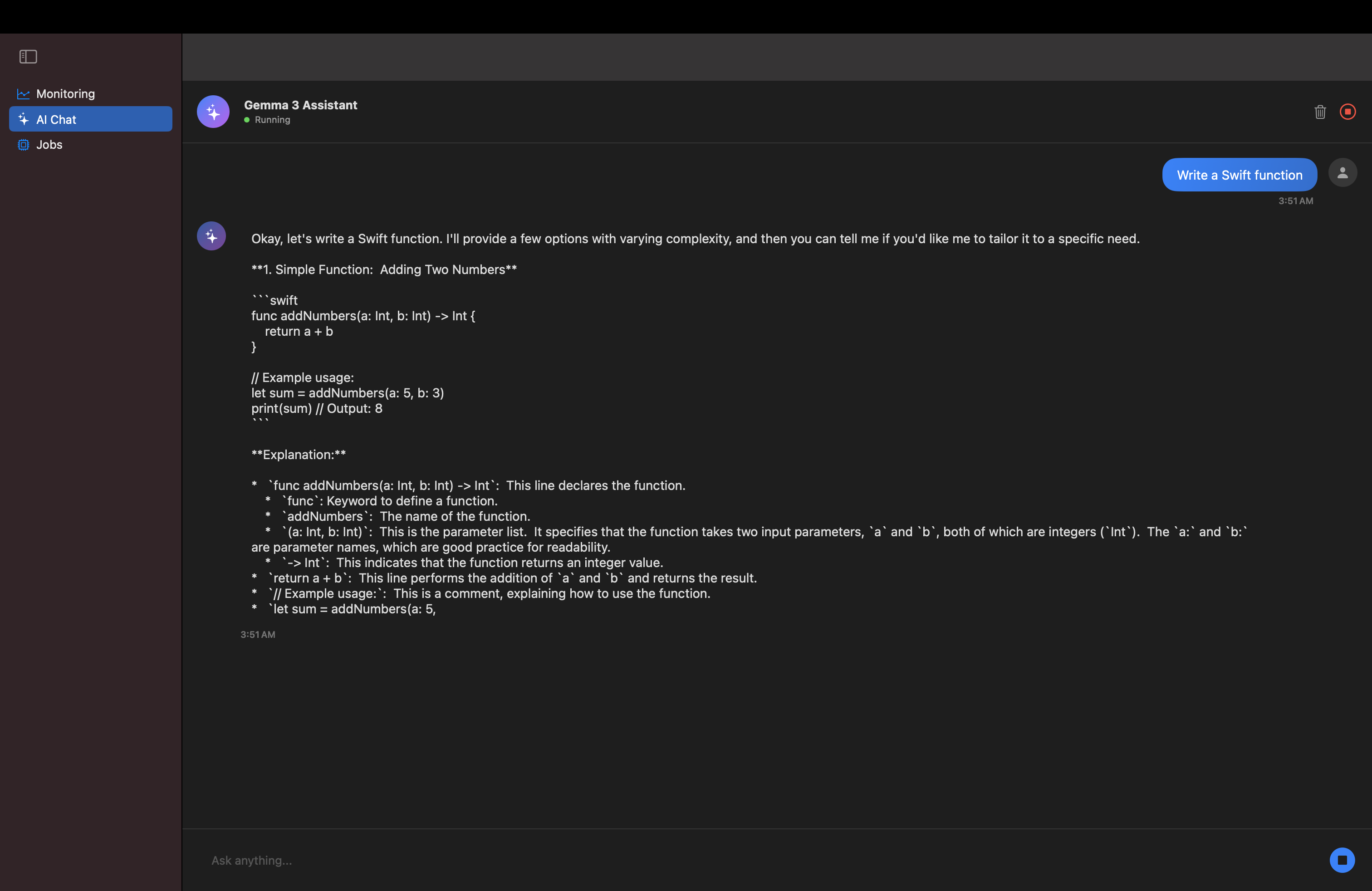
- AI-Powered Chat: Built-in Gemma 3-4B chatbot for local AI assistance
- Auto-Discovery: The app polls the blockchain for available work
- Secure Processing: Downloads encrypted fragments, decrypts locally using Seal
- Local AI Inference: Runs Gemma AI model to classify content (safe/unsafe)
- Upload Results: Encrypts and uploads results to Walrus, submits completion on-chain
- Instant Payment: Receives 0.01 USDC per completed fragment (sponsored transaction—zero gas fees)
- Multi-Worker Support: Spawn multiple worker windows to process tasks in parallel
Key Features
- Zero Gas Fees for Workers: All transactions are sponsored by job creators
- Privacy-Preserving: Workers never see raw sensitive data—only encrypted fragments
- Fault-Tolerant: Uncompleted fragments are automatically re-queued
- Native Performance: Leverages Apple Silicon's Metal acceleration for AI inference
- Real-Time Transparency: Both submitters and workers see live progress updates
🏗️ How I Built It
I built Shard solo over 15 hours during the hackathon, integrating cutting-edge blockchain technologies with native macOS development.
Tech Stack
Frontend (Next.js 14 + React + TypeScript)
- UI Framework: shadcn/ui components with Tailwind CSS for a minimalist, dark-mode-first design
- Animations: Framer Motion for smooth transitions and progress indicators
- Real-Time Updates: Polling-based live fragment status tracking
- Features: Job submission portal, AI inference configuration, Monte Carlo simulation setup
Backend (Node.js + Express + TypeScript)
- API Server: RESTful endpoints for job management, fragment lifecycle, and wallet queries
- Sui Integration:
@mysten/suiSDK for blockchain interactions and USDC transfers - Walrus Client: Custom implementation for uploading/downloading encrypted blobs
- Seal Encryption:
@mysten/sealSDK for threshold encryption with session keys - Job Orchestration: Automatic fragmentation, encryption, and on-chain publishing
macOS App (SwiftUI + Combine)
- System Monitoring: Real-time CPU/GPU/Memory tracking using IOKit and Mach APIs
- AI Integration: Embedded
llama.cppserver running Gemma 3-4B-it-q4_0.gguf model - Metal Acceleration: Native Apple Silicon GPU support for AI inference
- Worker Engine: Multi-threaded fragment discovery, claiming, processing, and completion
- Multi-Window Architecture: Spawn independent worker windows for parallel processing
- Live Dashboard: Beautiful glassmorphic UI with animated charts (inspired by Apple's design language)
Blockchain (Sui + Move)
- Sui Network: Testnet deployment for job and fragment state management
- Smart Contracts: Move modules for access control policies (Seal)
- Walrus Storage: Decentralized blob storage with erasure coding
- Seal Encryption: Threshold encryption with programmable access control
- Sponsored Transactions: Job creators pay all gas fees for workers
Development Highlights
1. Micro-Task Fragment Protocol
I designed a novel fragmentation system where each sentence becomes an independent TaskFragment with:
- Unique fragment ID and job ID
- Encrypted data blob stored on Walrus
- USDC bounty (0.01 per fragment)
- Status lifecycle:
pending→claimed→completed
2. Sui Seal Integration
I implemented end-to-end encryption using Seal's threshold encryption:
- Generated session keys with TTL for time-limited access
- Created Move access policy contracts (
seal_approve) - Encrypted fragments using AES256GCM
- Workers decrypt using session keys without exposing raw data
3. llama.cpp Embedding
I bundled the Gemma AI model and llama-server binary directly into the macOS app:
- Built static
llama-serverto avoid dynamic library issues - Spawned server as subprocess with Metal GPU acceleration
- Implemented streaming HTTP client for real-time inference
- Created beautiful chat UI with gradient avatars and suggestion chips
4. Multi-Worker Architecture
I built a sophisticated worker management system:
@Environment(\.openWindow)for spawning new worker windows- Shared
WorkerServiceinstances with independent worker IDs - Competitive claiming (first worker to claim gets the fragment)
- Real-time USDC balance tracking across all workers
5. Production Deployment
- Frontend: Deployed to Vercel (
https://shard-alpha.vercel.app) - Backend: Deployed to Vercel with Cloudflare Tunnel for local testing
- CORS: Dynamic subdomain support for
*.trycloudflare.com - Config Management: Centralized API URLs for easy environment switching
🎓 What I Learned
Blockchain & Cryptography
- Sui Blockchain: I dove deep into the Sui ecosystem, learning about Move smart contracts, sponsored transactions, and how to structure on-chain state for a compute marketplace.
- Sui Walrus: I implemented decentralized storage for both job inputs and results, learning how erasure coding provides redundancy without centralized servers.
- Sui Seal: I mastered threshold encryption and programmable access control, enabling workers to decrypt job data without ever exposing it to centralized parties.
- BCS Encoding: I learned about Sui's Binary Canonical Serialization for efficient data encoding.
Native macOS Development
- I built a production-grade SwiftUI application with real-time system monitoring (CPU, GPU, Memory).
- I integrated llama.cpp and Gemma 3-4B for local AI inference using Apple Silicon's Metal acceleration.
- I learned advanced Swift concepts: Combine framework,
@Publishedproperties,URLSessionstreaming, and multi-window architecture. - I mastered IOKit for low-level hardware metrics and Mach APIs for system-level monitoring.
Distributed Systems Design
- I implemented a micro-task fragment protocol where jobs are broken into independent units that can be processed in parallel.
- I designed fault-tolerant execution with fragment re-queuing if workers go offline.
- I built a polling-based worker discovery system that scales to multiple simultaneous workers.
- I learned about eventual consistency and how to handle race conditions in distributed claiming.
Full-Stack Integration
- I connected React/Next.js frontend → Express.js backend → Sui blockchain → macOS worker app in a seamless end-to-end flow.
- I implemented real-time progress tracking with polling-based live fragment status updates.
- I managed CORS, API design, environment configuration, and production deployment.
- I debugged complex multi-component issues (e.g., USDC transfers, fragment completion, UI state synchronization).
Performance Optimization
- I optimized SwiftUI rendering by removing continuous animations and using
.drawingGroup()for Metal acceleration. - I reduced CPU usage from 50% to <5% by simplifying chart rendering and using efficient update intervals.
- I implemented smart batching for blockchain queries to minimize network overhead.
🚀 What's Next for Shard
Short-Term (Next 3 Months)
- Mainnet Launch: Deploy to Sui mainnet with real USDC incentives
- More Task Types: Support image processing, video transcoding, and scientific simulations
- Advanced Reputation System: Track worker reliability and completion rates with on-chain NFTs
- Mobile Support: Build iOS/Android worker apps to expand the provider network
- Job Verification: Implement cryptographic proofs of correct computation
Long-Term Vision
- Cross-Chain Support: Integrate with Ethereum, Solana, and other L1s for broader adoption
- Specialized Hardware: Support GPU-intensive tasks (3D rendering, AI training) with CUDA/ROCm
- Enterprise Partnerships: Offer B2B solutions for companies needing distributed compute
- DAO Governance: Community-driven protocol upgrades and fee structures
- Carbon Credits: Reward providers for using renewable energy sources
Technical Improvements
- WebSocket Real-Time Updates: Replace polling with push notifications for instant updates
- Smart Contract Upgrades: On-chain fragment verification and slashing for malicious workers
- Result Validation: Implement consensus mechanisms (multiple workers verify the same fragment)
- Benchmarking System: Automatically test worker capabilities and assign appropriate tasks
- Dynamic Pricing: Market-driven bounty pricing based on task complexity and demand
🎯 Conclusion
Shard demonstrates that it's possible to build a fully functional decentralized compute network in a single weekend. By leveraging Sui's innovative blockchain architecture, Walrus's decentralized storage, and Seal's privacy-preserving encryption, I created a platform that turns idle Macs into a global supercomputer—while ensuring privacy, fault tolerance, and instant micropayments.
This is just the beginning. The future of computing is decentralized, and Shard is proof that we can build it today.


Log in or sign up for Devpost to join the conversation.