-
-
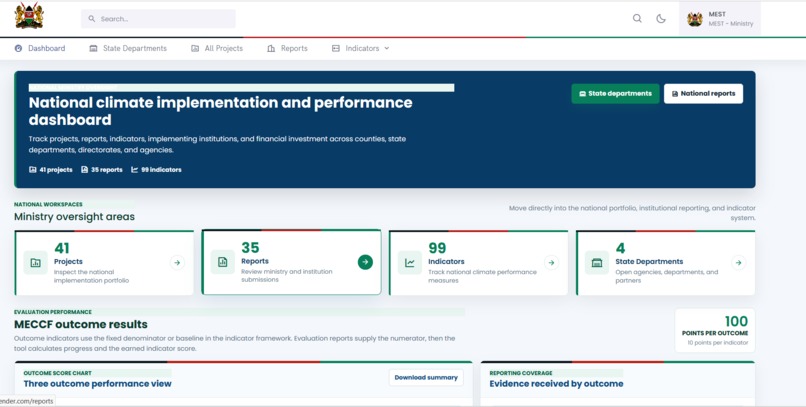
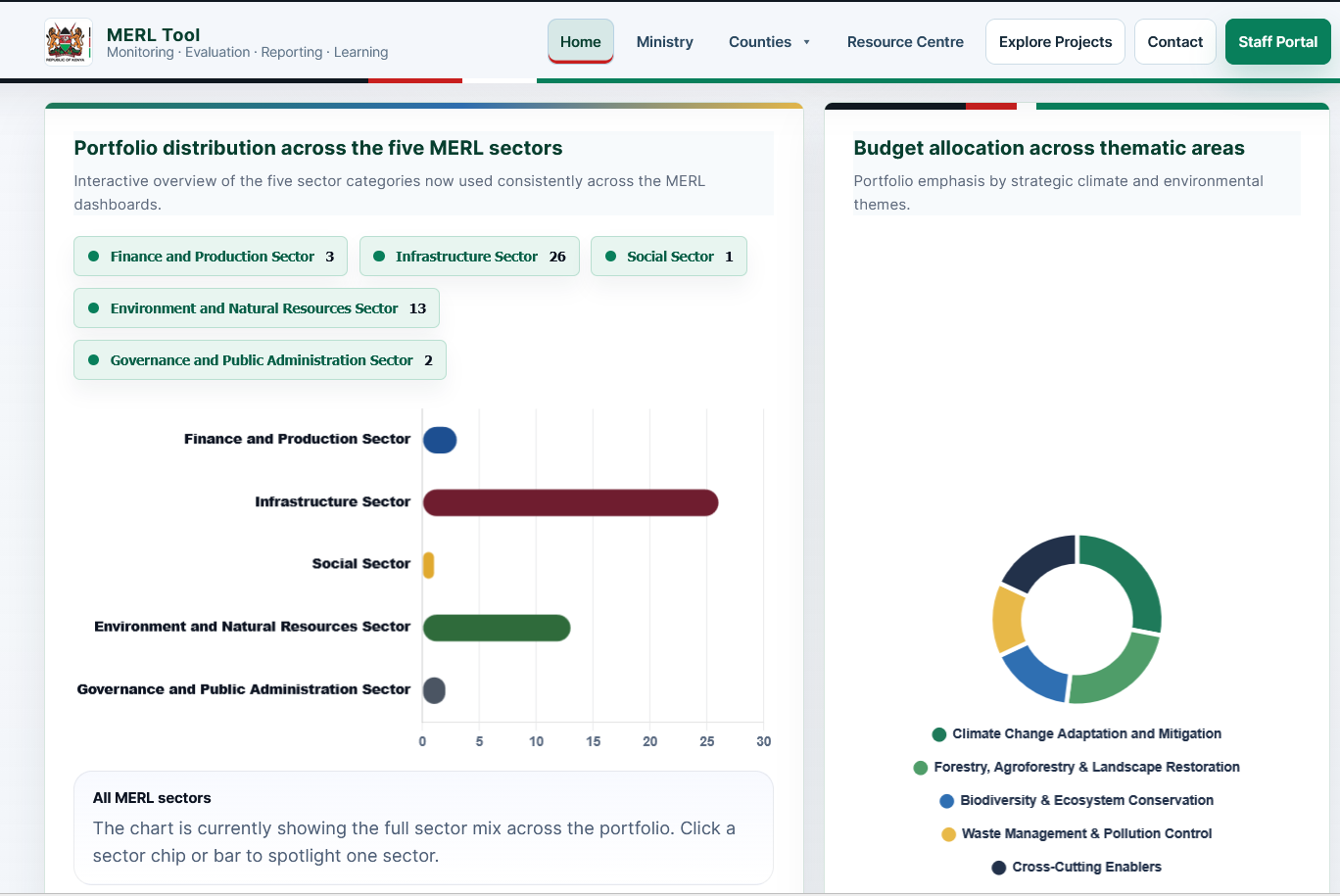
The front public page
-
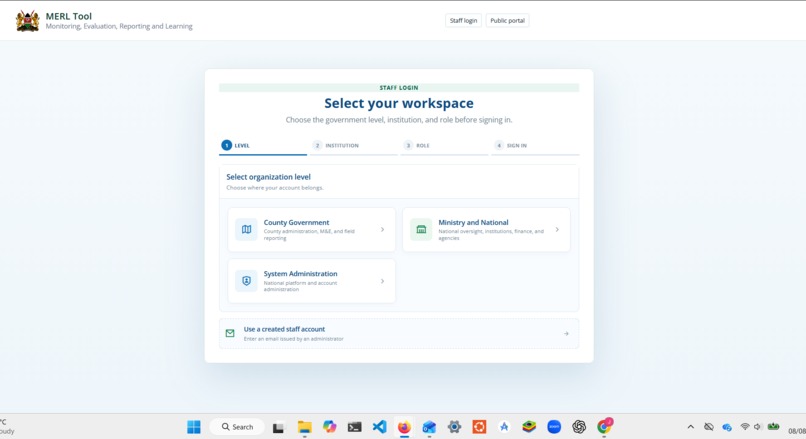
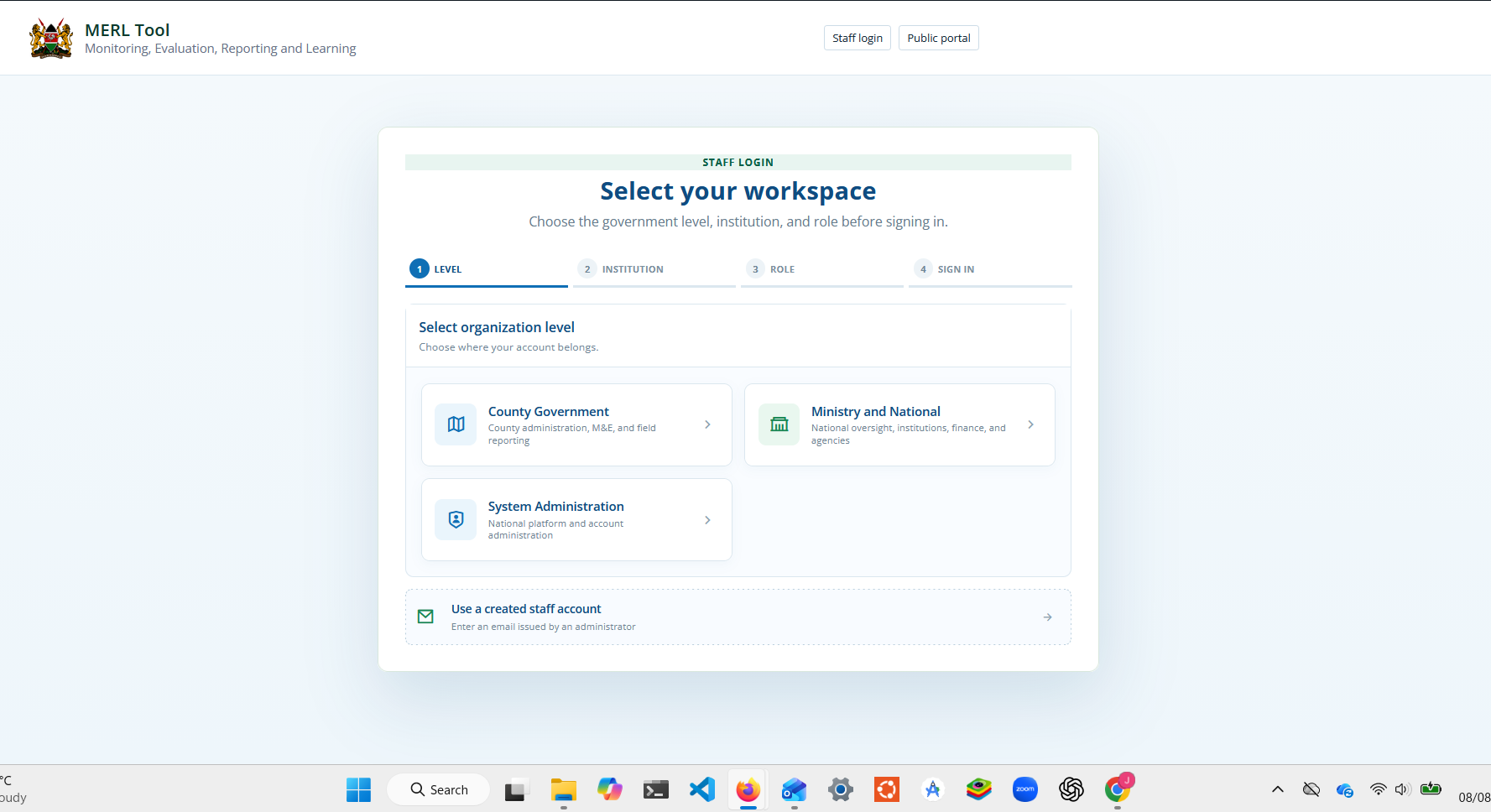
Login Interface
-
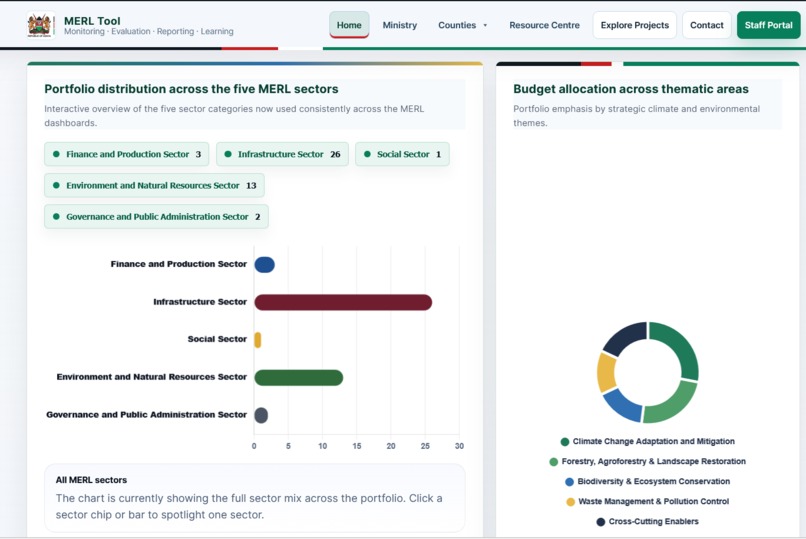
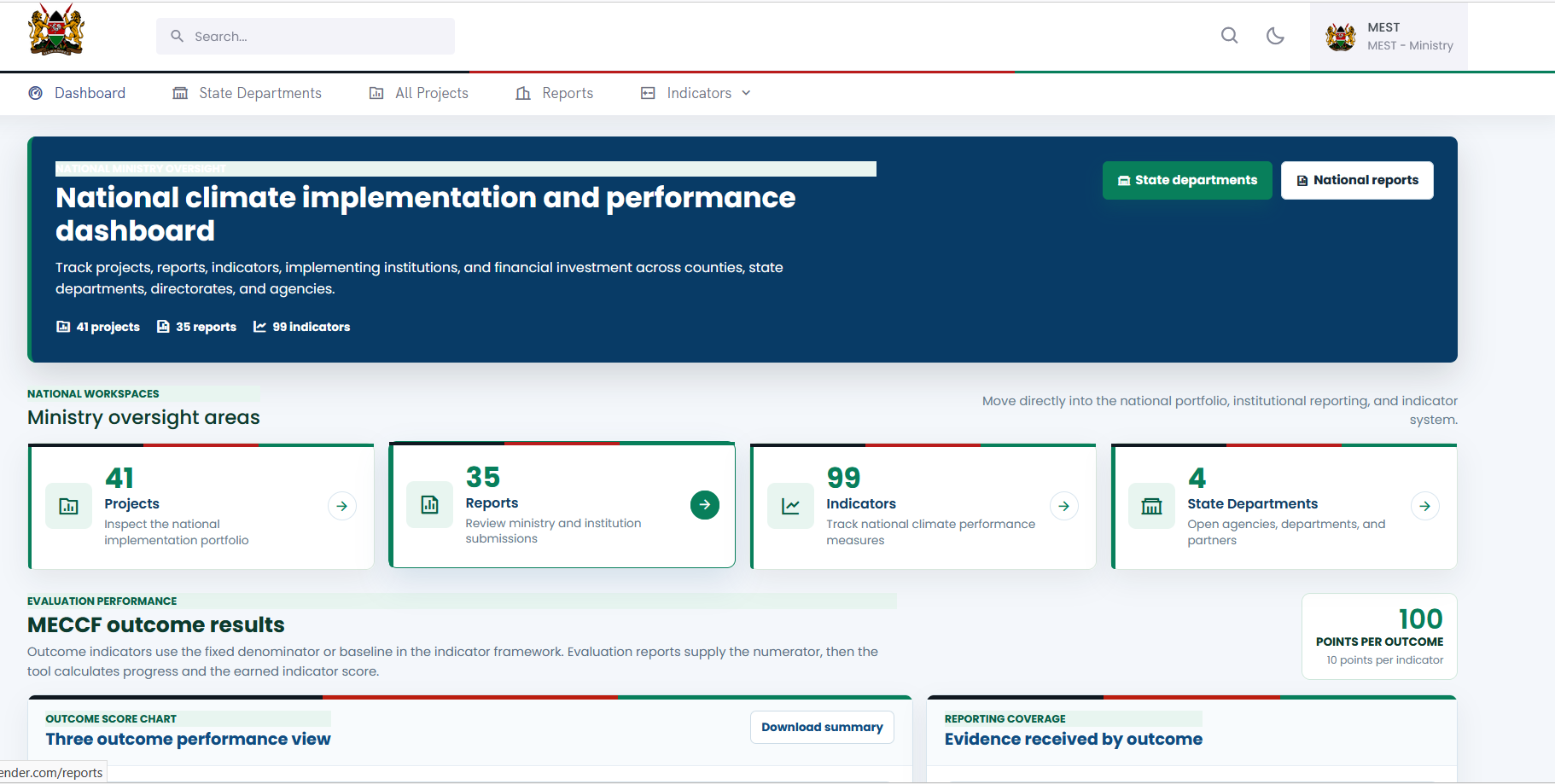
Inspiration
Climate programmes generate large amounts of monitoring, evaluation, reporting, and learning data, but turning that information into timely insights remains difficult for many public institutions. National and county government officers often work with fragmented datasets, lengthy reports, indicator frameworks, project updates, and multiple reporting requirements. These processes can be time-consuming, repetitive, and heavily dependent on stable internet access and cloud-based systems.
MERL AI was inspired by this challenge.
The project builds on an existing Monitoring, Evaluation, Reporting and Learning (MERL) platform developed to support national and county governments in tracking climate-related programmes, projects, indicators, progress, and results. As the platform moved closer to testing and piloting, I saw an opportunity to make it more intelligent while still respecting the realities of the hardware and connectivity available to many public institutions.
Instead of depending on cloud-hosted AI services, MERL AI explores how a lightweight language model can run locally on an ordinary laptop and help government officers interact with monitoring data, generate summaries, retrieve relevant information, and support reporting workflows.
The goal is to make AI-assisted climate governance more accessible, affordable, private, and resilient to connectivity constraints.
What it does
MERL AI builds on the existing MERL platform, which provides structured workflows for monitoring, evaluation, reporting, and learning.
The current platform supports functions such as:
creation and management of climate-related projects; tracking of implementation progress; monitoring of indicators and results; project reporting; evaluation workflows; storage and retrieval of monitoring information; support for national and county-level reporting processes.
The AI component is being developed as an intelligence layer that can interact with this information through natural language.
The envisioned MERL AI assistant can support tasks such as:
summarizing project progress; identifying projects with missing or incomplete reports; retrieving information on specific indicators; generating draft monitoring narratives; summarizing evaluation findings; highlighting implementation bottlenecks; comparing project performance; answering questions based on locally stored MERL data.
A user could, for example, ask:
“Which projects are behind schedule?”
or:
“Summarize the main implementation challenges reported this quarter.”
or:
“Which projects are reporting against adaptation indicators?”
The objective is to allow these tasks to be performed locally on low-resource hardware without relying on external AI APIs.
How we built it
The project started with the development of the core MERL platform as a full-stack web application.
The system was designed around structured project and indicator data, with workflows for creating projects, submitting reports, tracking progress, and supporting evaluation and learning.
For the hackathon, the next engineering layer is focused on bringing language-model capabilities closer to the data while minimizing dependence on cloud infrastructure.
The architecture is being designed around four main components:
The existing MERL application layer, which manages projects, indicators, reports, and evaluations. A lightweight local language model, optimized to operate on the ADTC Standard Laptop. A local retrieval layer, which allows the model to retrieve relevant project, indicator, and reporting information before generating a response. A conversational AI interface, allowing users to ask questions about their monitoring and reporting data in natural language.
The design prioritizes CPU-based inference, low memory usage, and compatibility with an 8 GB RAM laptop with integrated graphics.
Rather than sending sensitive project or government information to external cloud APIs, the intention is for the AI inference process to remain local wherever possible.
Challenges we ran into
The largest technical challenge is balancing accuracy, speed, and memory efficiency.
A model that is too large may produce stronger responses but exceed the available memory budget or generate responses too slowly for practical use. A smaller model can run efficiently but may require stronger retrieval, prompt engineering, and domain grounding to maintain useful response quality.
Another challenge is converting structured MERL information into context that a language model can interpret efficiently. Monitoring systems contain projects, indicators, reporting periods, targets, results, evaluation findings, and other structured records. Feeding too much information into the model increases memory usage and latency.
The retrieval system therefore needs to identify only the most relevant information for each query.
Data reliability is also critical. In monitoring and evaluation, a confident but incorrect answer can be more harmful than no answer at all. For this reason, MERL AI is being designed so that responses are grounded in available monitoring records rather than relying entirely on the model’s pretrained knowledge.
A further challenge is maintaining acceptable performance on commodity hardware. The target machine has only 8 GB RAM and integrated graphics, meaning model size, quantization, context length, cache management, and retrieval architecture all have to be carefully optimized.
Accomplishments that we're proud of
For many public institutions, cloud-based AI introduces three major constraints: connectivity, cost, and data governance.
Reliable internet connectivity cannot always be assumed, particularly across decentralized government offices. Continuous API usage also creates recurring operational costs. More importantly, monitoring and evaluation systems may contain sensitive government, programme, budget, or implementation information that institutions may not want transmitted to external AI providers.
An on-device architecture addresses these challenges by keeping inference close to the user.
This changes the role of the laptop from being only an interface to a remote AI service into becoming the actual AI computing environment.
What we learned
Working on MERL AI has reinforced that useful AI systems do not always require the largest available models.
For a specialized application such as monitoring and reporting, the combination of a smaller model and high-quality local context can often be more valuable than using a much larger general-purpose model.
I have also learned that AI performance must be evaluated as a complete system rather than only as a model.
The effectiveness of MERL AI depends on:
model size; quantization; inference speed; retrieval quality; context management; memory consumption; application design; data structure; user experience.
This project has also highlighted the importance of designing AI around the environments where it will actually be used. For African public institutions, efficiency, offline capability, low operational cost, and data privacy are fundamental system requirements rather than optional features.
What's next for MERL AI
The next phase is focused on integrating and optimizing the local AI layer within the existing MERL platform.
Planned work includes:
benchmarking lightweight language models on commodity hardware; quantizing the selected model for efficient CPU inference; implementing local retrieval over MERL project and reporting data; connecting the AI assistant to structured project information; testing natural-language queries against monitoring and reporting workflows; profiling memory consumption and token-generation speed; testing the system against the ADTC Standard Laptop requirements; refining the user interface; conducting user testing and piloting with intended government users.
The longer-term vision is for MERL AI to become a practical digital assistant for public-sector monitoring, evaluation, reporting, and learning.
Rather than requiring governments to send their data to powerful cloud AI systems, MERL AI explores the opposite approach:
Built With
- ai
- analytics
- api
- climate
- data
- gguf
- github
- javascript
- llama
- llm
- machine-learning
- node.js
- postgresql
- python
- quantization
- rag
- react
- render

Log in or sign up for Devpost to join the conversation.