-
-
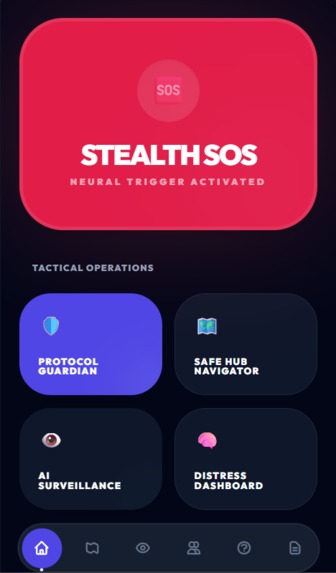
Home screen
-
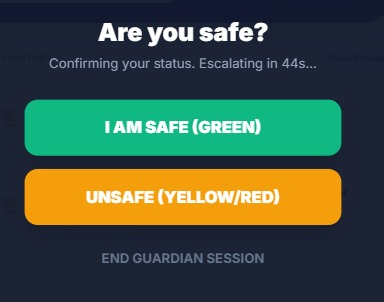
Safety Check in
-

logo

Inspiration
In India, safety tools often fail at the exact moment they’re needed most: when it’s socially risky to open an SOS screen, when there’s panic, when speaking openly isn’t possible, or when reporting later becomes messy because there’s no clear timeline or proof.
We were inspired by stories where the hardest part wasn’t only getting help—it was doing it discreetly, and later being able to explain what happened clearly to friends/family/authorities without reliving everything from scratch. That gap—discreet activation + meaningful evidence + guided support—is what ShaktiSaathi is built to solve.
What it does
ShaktiSaathi is a women safety + empowerment copilot designed for real Indian scenarios (late travel, crowded places, language switching, and hesitation to “look like you’re in trouble”).
It provides:
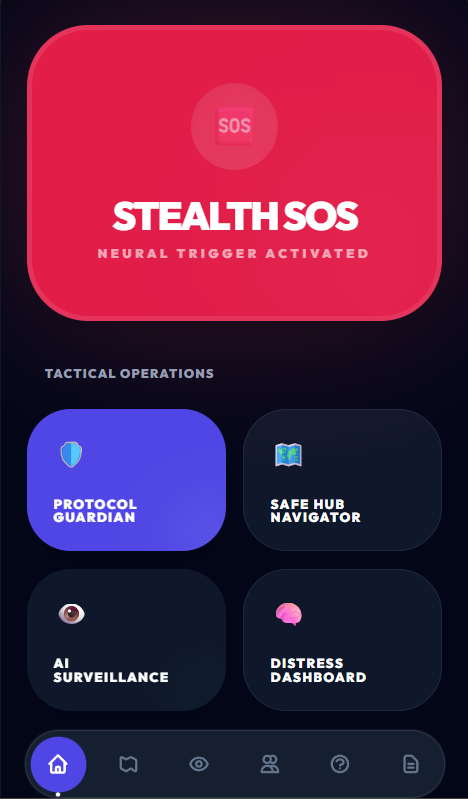
Stealth SOS: Trigger help from a disguised screen (like a calculator/notes UI) or via a safe phrase—so you can get help without drawing attention.
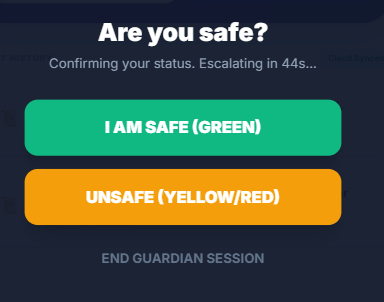
Circle of Trust + Smart Escalation: Alerts trusted contacts in a step-by-step escalation ladder, sharing live location and clear instructions (“call now”, “track live”, etc.).
EvidenceKit (key differentiator): When SOS is triggered, the app creates a timestamped incident timeline (location trail + quick voice notes). Gemini 3 turns this into:
- a formal incident summary (structured and report-friendly)
- a simple summary (for family/friends)
- a next-steps checklist (what to do immediately)
Multilingual UX (English/Hindi/Hinglish-ready): Users can communicate naturally; the app responds in the language that feels safest and fastest.
How we built it
We designed ShaktiSaathi as a reliability-first system: simple flows, low friction, and Gemini 3 doing the heavy reasoning.
Architecture overview (high level):
- Frontend: Mobile-friendly UI with a stealth screen mode + quick actions
- Backend: API layer to manage sessions, trusted contacts, escalation rules, and report generation
- Gemini 3 core modules: 1) Distress + context reasoning: Convert minimal user input into an action plan 2) EvidenceKit summarization: Convert raw timeline + notes into structured reports 3) Responder-specific messaging: Different tone/content for friend vs family vs support contact 4) Language adaptation: Hinglish/Hindi/English switching without losing meaning
We kept outputs structured using JSON schemas so the app stays predictable even when the content is AI-generated.
Challenges we ran into
- Designing for stealth without confusion: A safety app must be discreet and usable under stress. We iterated on triggers and made the “escape path” obvious to the user but invisible to others.
- Avoiding AI unpredictability: Safety workflows can’t depend on “creative” text. We constrained Gemini outputs with structured formats, strict templates, and short instruction blocks.
- Making reports useful, not verbose: EvidenceKit needed to be concise, chronological, and readable—something a trusted contact can act on quickly and that can later support formal reporting.
- Balancing privacy with usefulness: We designed EvidenceKit to be opt-in, minimizing data collection and keeping user control central.
Accomplishments that we're proud of
- Built a stealth-first safety flow that doesn’t scream “SOS app” in public.
- Created EvidenceKit, which upgrades safety from “alert-only” to alert + proof + clarity.
- Implemented smart escalation and responder-specific messaging, so contacts don’t freeze—they know exactly what to do.
- Designed an India-first UX that supports Hinglish and multilingual communication naturally.
What we learned
- In safety products, reliability and clarity beat complexity. Under stress, users need fewer choices, not more.
- AI is most powerful when it’s constrained—structured outputs, deterministic flows, and clear roles (summarize, classify, format, guide).
- “Safety” isn’t only an emergency feature; it’s also about reducing friction to ask for help and enabling recovery with dignity.
What's next for ShaktiSaathi
- Risk-aware travel companion: Safety check-ins + safer route suggestions using time/place signals and public POIs.
- Offline-first fail-safes: Store critical actions locally, retry delivery, and ensure escalation works even with unstable networks.
- Verified support network: Integrations with NGOs, legal aid, and workplace support resources (with region-based discovery).
- More discreet triggers: Wearable/gesture triggers and configurable “safe phrases.”
- Empowerment expansion: Workplace safety toolkit (message risk detection + professional response templates) and career support modules.
Built With
- ai-studio
- firebase-auth
- firebase-cloud-functions
- firebase-cloud-messaging-(fcm)
- firestore
- github
- google-gemini-3-api


Log in or sign up for Devpost to join the conversation.