-
-
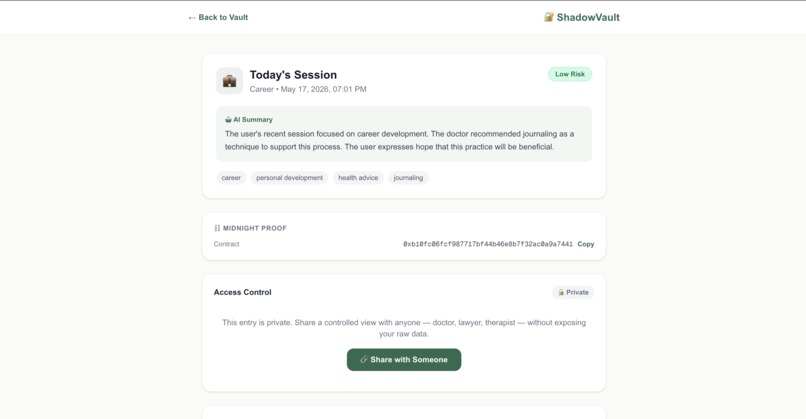
Vault Entry
-
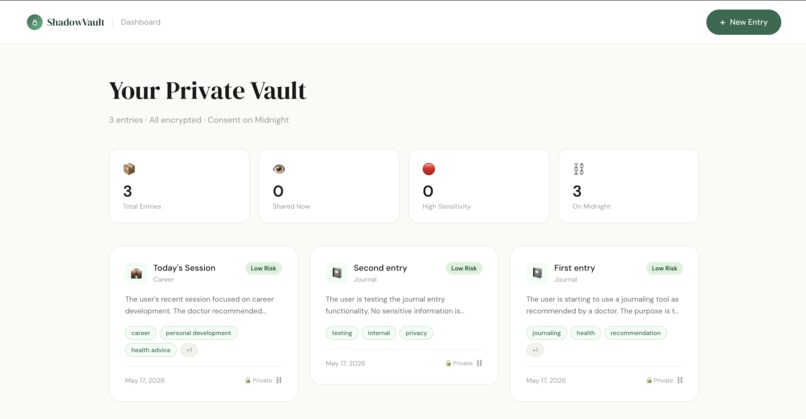
Dashboard
-
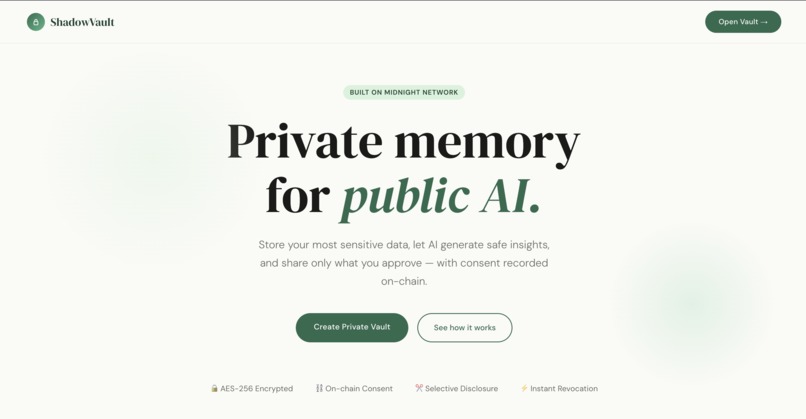
Landing Page
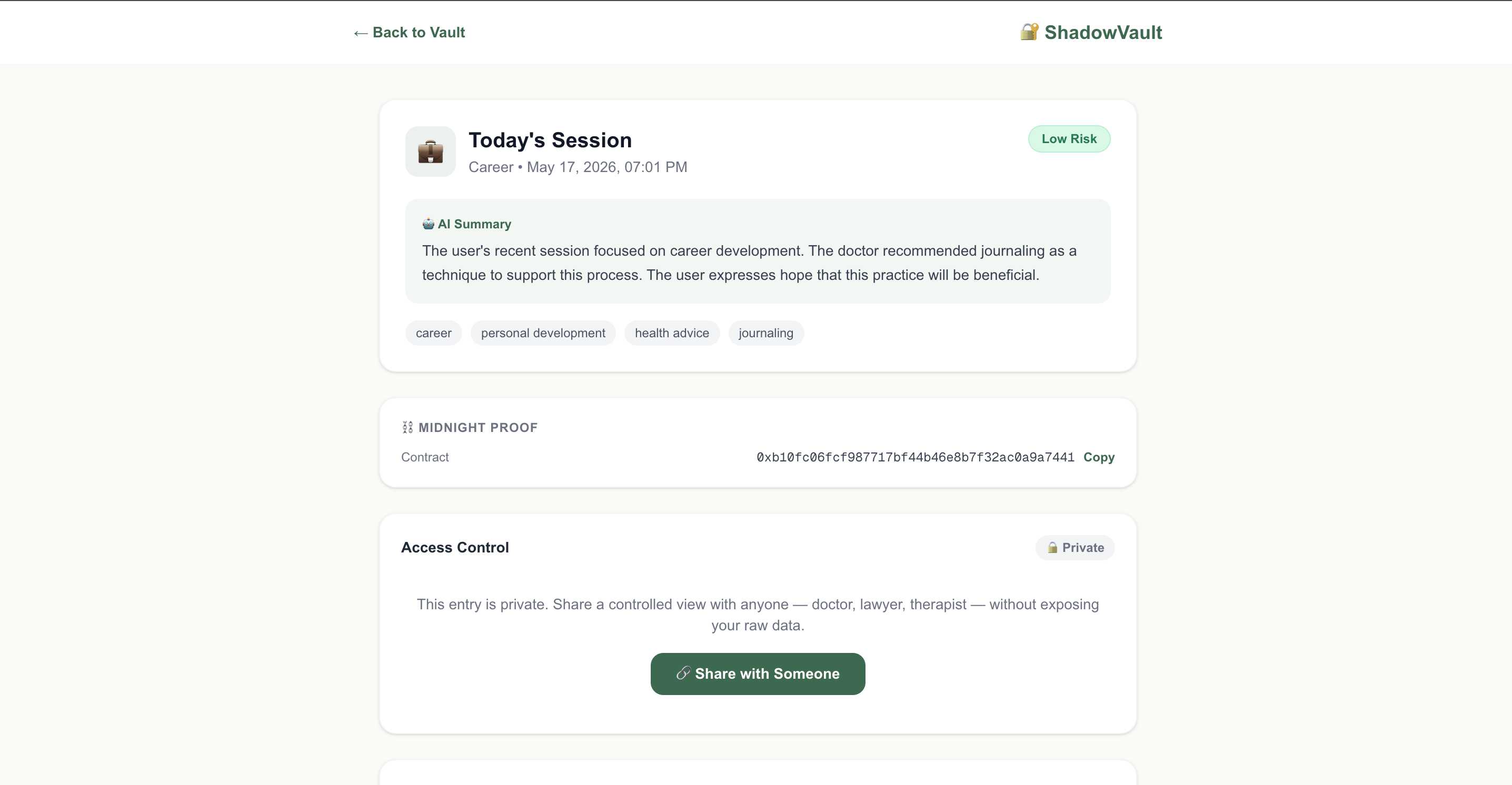
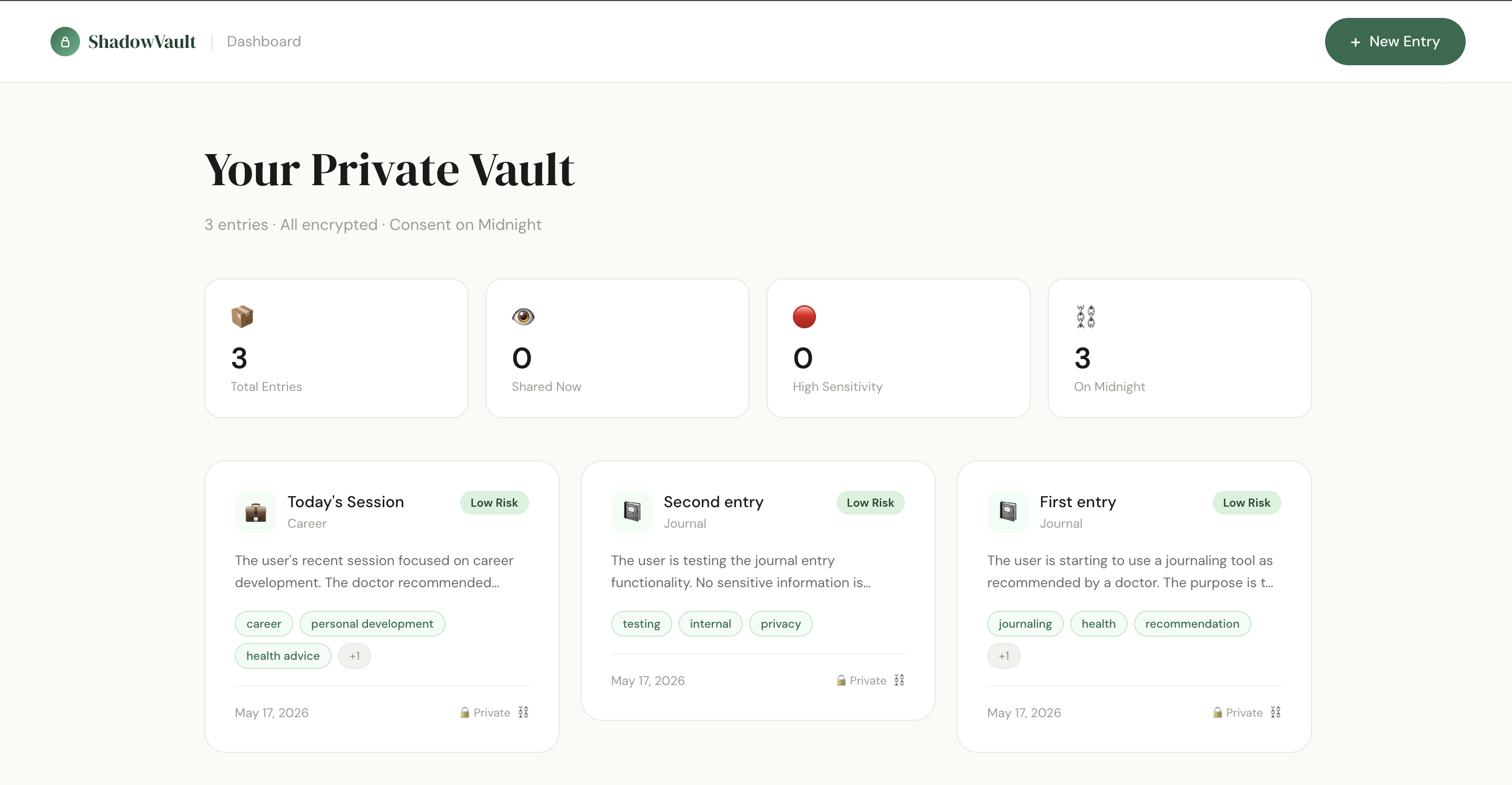
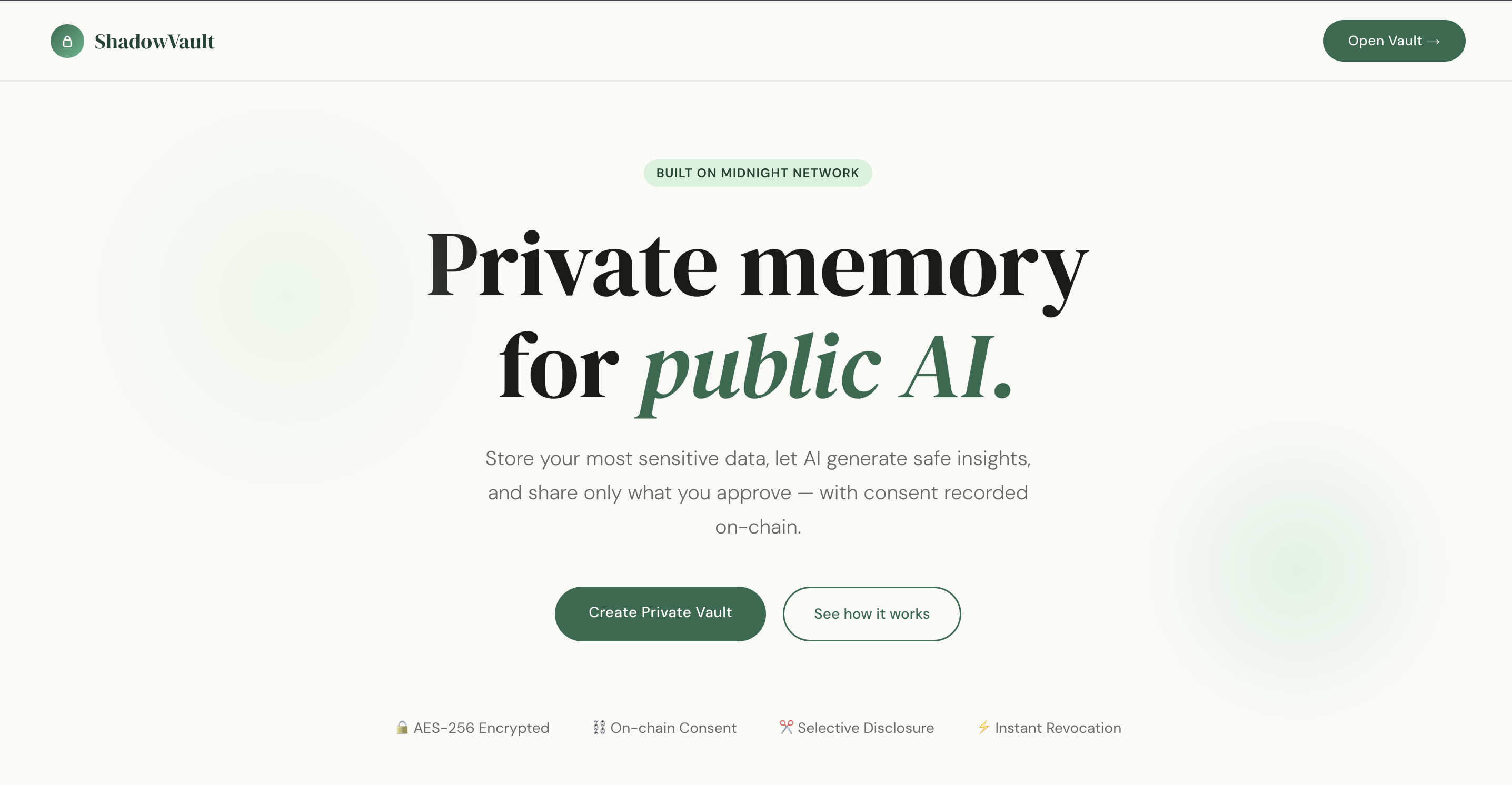
ShadowVault — Devpost Submission
Inspiration
Every time you share a medical record, therapy note, or personal document, you lose control of it. There's no way to say "show them the summary but not the raw content" — and no way to take it back once it's shared. ShadowVault fixes that using Midnight's zero-knowledge architecture.
What It Does
ShadowVault is a privacy-preserving consent management system for sensitive personal records.
You write a journal entry — therapy notes, medical history, career reflections. ShadowVault encrypts it with AES-256-GCM, runs it through Gemini for an AI-generated summary and risk assessment, and anchors a SHA-256 content hash to a Midnight smart contract.
When you want to share something, you choose exactly which fields the viewer can see: the AI summary only, the risk level, the topics — or everything. You generate a viewer link. The viewer sees only what you permitted — nothing else. And you can revoke that access at any moment. The link goes dark instantly.
Every action — creation, grant, view, revocation — is recorded on a tamper-proof audit trail with Midnight transaction IDs and block heights.
How We Built It
Smart contract — A custom Compact contract (shadowvault.compact) with four ZK circuits: createRecord, grantAccess, revokeAccess, and updateAccess. Access permissions are encoded as a field bitmask (summary=1 | riskLevel=2 | topics=4 | rawContent=8), making them compact, verifiable, and cryptographically enforced on-chain.
Frontend & API — Next.js 16 with React and Tailwind. API routes handle encryption, AI summarisation via Gemini, and database persistence with Prisma/SQLite.
Midnight integration — The contract was compiled with Compact 0.5.1 targeting language version 0.23, generating ZK keys and circuit files. We integrated the Midnight JS SDK and the 1AM wallet connector for browser-side transaction signing.
Challenges
Midnight preprod experienced significant network congestion and faucet outages during the hackathon weekend, preventing live on-chain transaction submission. We designed and compiled the real contract, wired the full SDK integration with the 1AM wallet, and the demo runs the same consent lifecycle flow — the on-chain submission is the only piece blocked by infrastructure rather than code.
Accomplishments
- Designed a novel field-level consent model using ZK bitmasks
- Compiled a working 4-circuit Compact smart contract with real ZK keys
- Built a complete grant → view → revoke → locked flow with a tamper-proof audit trail
- Integrated Gemini AI for automatic risk assessment and topic extraction
- Built a clean, production-quality UI with real-time status updates during entry creation
What We Learned
The Midnight SDK is powerful but the toolchain is very early-stage — the gap between "contract compiled" and "transaction on-chain" involves a lot of moving parts (proof server, indexer, wallet sync, DUST fees) that are still maturing. Designing around that with a clean abstraction layer (the midnight.ts interface) meant the app stayed functional throughout.
What's Next
- Complete the live on-chain integration once the network stabilises
- Add time-limited access with on-chain expiry enforcement
- Support multiple viewers with independent access policies per entry
- Add a Cardano wallet integration for NIGHT token holders
Built With
- next.js
- typescript

Log in or sign up for Devpost to join the conversation.