-
-
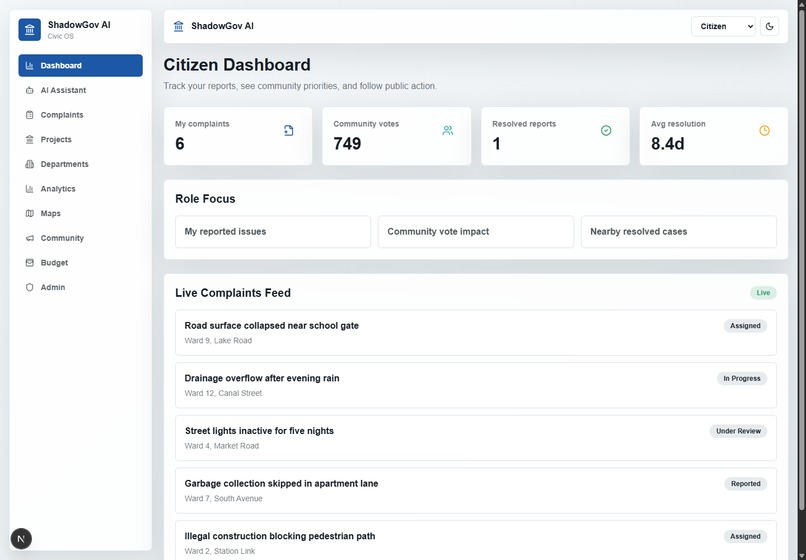
Dashboard
-
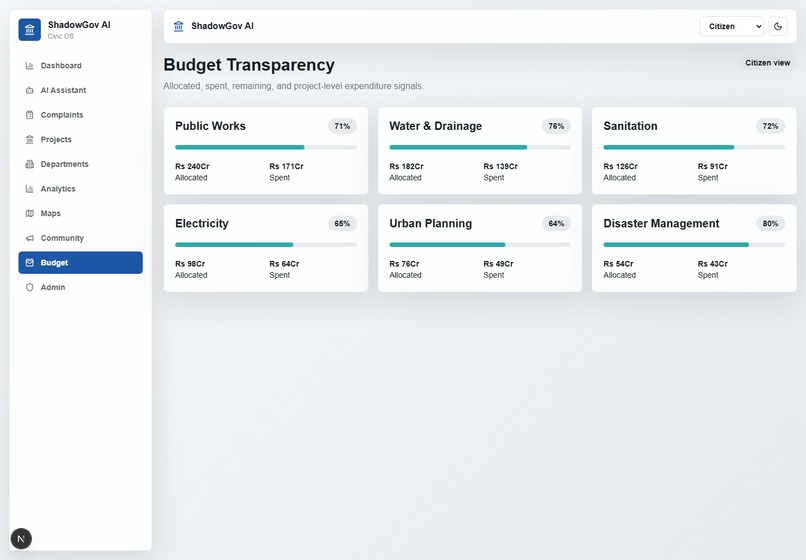
Budget
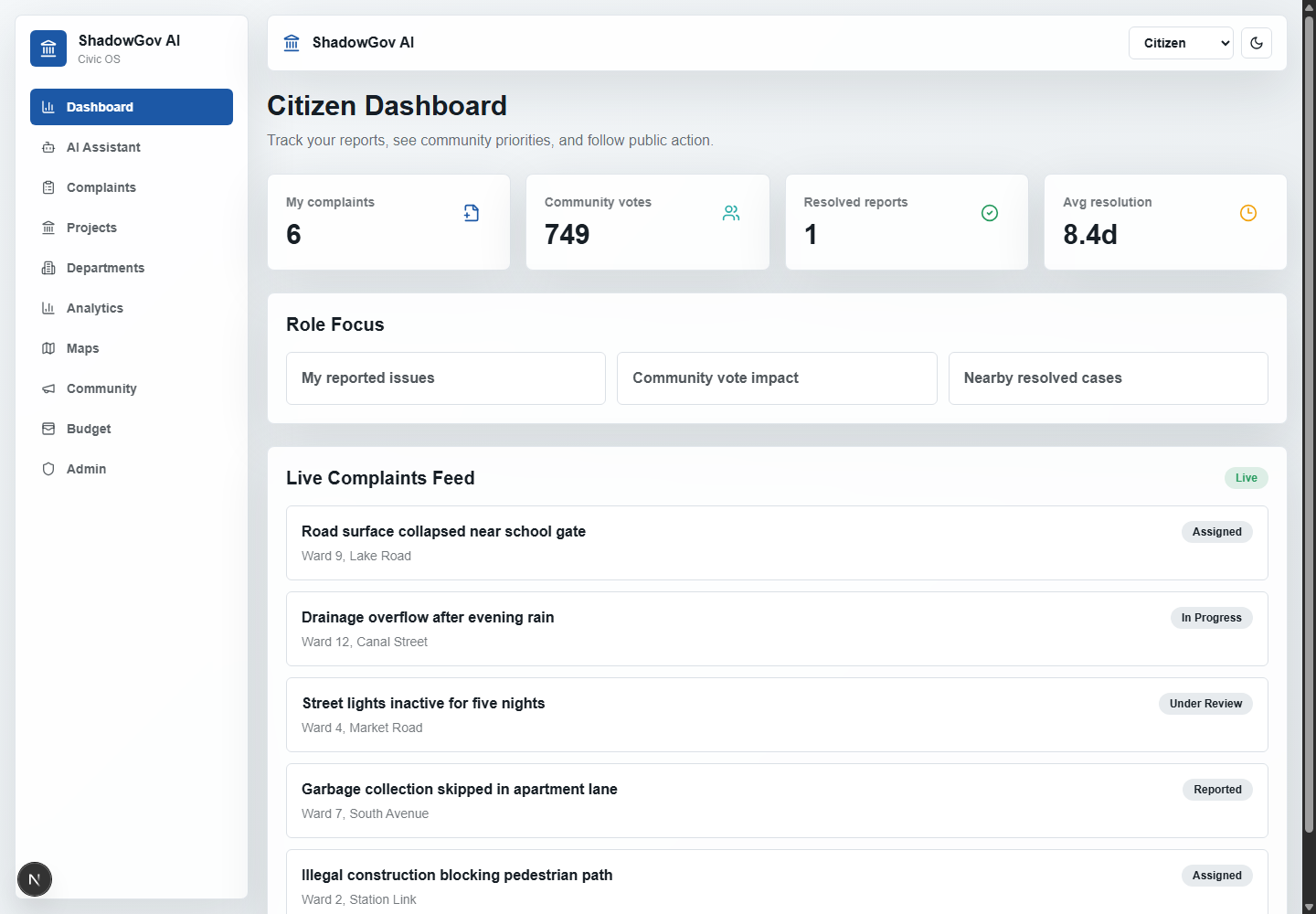
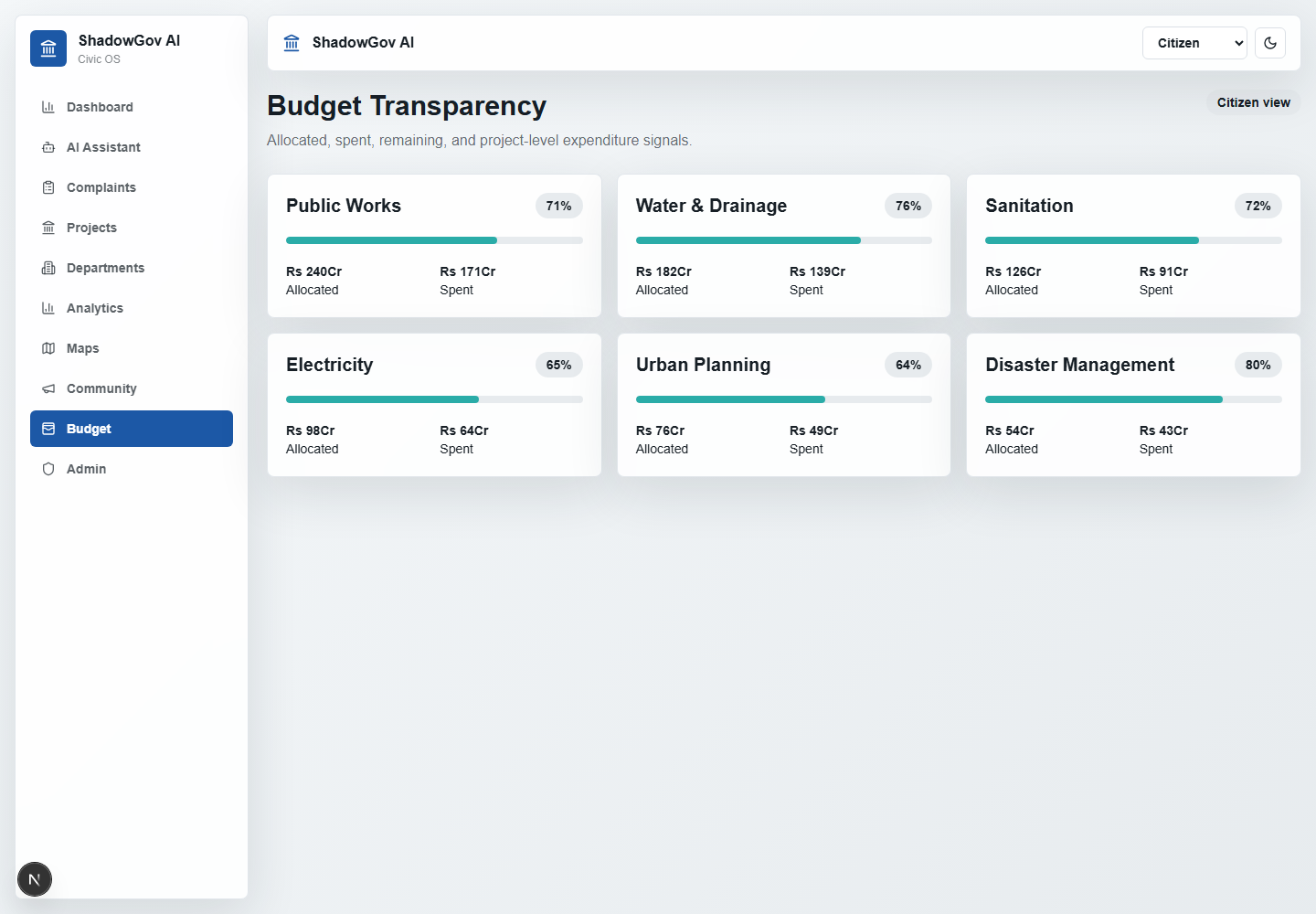
ShadowGov AI — Know What Your Government Is Doing
Inspiration
Every day, citizens report issues like damaged roads, garbage accumulation, water leakage, traffic congestion, and incomplete public projects. However, most people never know what happens after submitting a complaint.
Questions like:
- Why is this road still broken?
- Which department is responsible?
- Where is the allocated budget being spent?
- Why are public projects delayed?
often remain unanswered.
We were inspired by the growing need for transparency, accountability, and accessibility in public governance. Many government systems already collect large amounts of civic data, but that information is often fragmented, difficult to understand, and inaccessible to ordinary citizens.
Our goal was to create a platform that transforms complex public data into meaningful civic intelligence using Artificial Intelligence.
Instead of simply reporting issues, we wanted citizens to understand how their city functions and where action is needed.
ShadowGov AI was built around a simple idea:
Public information should be understandable, accessible, and actionable.
Civic technology initiatives around the world have shown how technology can improve transparency, citizen participation, and public accountability. ShadowGov AI expands on this vision by introducing AI-powered analysis, prediction, and civic insights.
What It Does
ShadowGov AI is an AI-powered civic intelligence platform that helps citizens monitor public complaints, government projects, budgets, departments, and city operations from a single dashboard.
The platform enables users to:
- Report civic issues
- Track complaint progress
- Explore citywide complaint maps
- Monitor government projects
- Analyze department performance
- View budget transparency data
- Receive AI-generated civic insights
- Ask natural language questions through an AI assistant
Examples include:
- "Why is this road not repaired yet?"
- "Which department has the highest unresolved complaints?"
- "What projects are delayed in my area?"
- "How is the municipal budget being utilized?"
How We Built It
We designed ShadowGov AI as a full-stack civic-tech platform.
Frontend
- Next.js 15
- TypeScript
- Tailwind CSS
- Zustand
- React Query
- Recharts
The frontend provides:
- Civic dashboards
- Complaint management
- Smart maps
- Budget monitoring
- Project tracking
- Analytics visualizations
Backend
- FastAPI
- SQLAlchemy
- PostgreSQL-ready architecture
- Redis-ready structure
- Celery-ready task processing
The backend handles:
- Complaint processing
- Project monitoring
- Department analytics
- AI service integration
- Data aggregation
AI Layer
The AI system was designed to:
- Analyze complaints
- Categorize civic issues
- Detect urgency levels
- Generate summaries
- Recommend responsible departments
- Produce civic insights
We structured the architecture so future versions can support multi-agent workflows using LangGraph and Retrieval-Augmented Generation (RAG).
System Architecture
Citizens
     ↓
Next.js Frontend
     ↓
FastAPI Backend
     ↓
Database Layer
     ↓
AI Intelligence Engine
     ↓
Insights, Predictions, Reports
Key Features
Smart Complaint Tracking
Citizens can create complaints and monitor their status through multiple resolution stages.
Civic Intelligence Dashboard
Provides citywide visibility into:
- Complaints
- Projects
- Budgets
- Departments
- Performance metrics
Interactive Civic Maps
Visualizes:
- Complaint locations
- Project zones
- Risk areas
- Department activity
AI Civic Assistant
Citizens can ask governance-related questions using natural language.
Budget Transparency
Tracks:
- Allocated budgets
- Department spending
- Project expenditures
Project Monitoring
Provides visibility into:
- Delayed projects
- Risk scores
- Completion progress
Challenges We Faced
1. Transforming Raw Civic Data Into Useful Insights
Displaying data is easy.
Making it understandable is difficult.
We had to think carefully about how citizens would interpret complaints, project information, and departmental performance without being overwhelmed.
2. Designing AI For Public Transparency
AI systems can generate information quickly, but transparency requires trust.
One of our biggest challenges was designing outputs that are understandable, explainable, and useful rather than simply generating summaries.
Research in civic AI highlights that meaningful transparency must help people understand decisions and take action rather than just exposing raw information.
3. Balancing Technical Complexity With User Experience
We wanted advanced features such as:
- AI analysis
- Predictive insights
- Civic intelligence
while still keeping the platform simple enough for everyday citizens.
4. Building A Scalable Architecture
Even though this is currently an MVP, we designed the system to support future expansion into:
- Multi-city deployments
- Government integrations
- Open-data pipelines
- AI agent workflows
- Real-time civic monitoring
What We Learned
This project taught us that civic technology is not only a technical challenge but also a human-centered design challenge.
We learned:
- How to design systems for public accountability
- How AI can simplify complex governance information
- How civic data can be transformed into actionable insights
- How to build scalable full-stack architectures
- How to balance analytics, usability, and transparency
Most importantly, we learned that technology becomes significantly more impactful when it helps people understand and improve the communities they live in.
Future Roadmap
Future versions of ShadowGov AI will include:
- Multi-agent AI workflows
- Predictive complaint resolution
- Budget anomaly detection
- Computer vision for infrastructure monitoring
- Satellite-based road damage detection
- WhatsApp complaint integration
- Voice-based reporting
- Multilingual support
- Open government data integrations
We also plan to introduce a predictive civic intelligence engine capable of estimating project delays, complaint escalation risks, and department performance trends.
For example:
[ P(\text{Delay}) = \frac{\text{Overdue Complaints}}{\text{Total Complaints}} ]
This would allow cities to proactively identify operational bottlenecks before they become major public issues.
Conclusion
ShadowGov AI is our attempt to bridge the gap between citizens and government through Artificial Intelligence.
Rather than simply collecting complaints, the platform helps people understand public systems, track accountability, and make civic information accessible to everyone.
We believe transparency should not require expertise.
It should be available to every citizen.
ShadowGov AI — Know What Your Government Is Doing.
Built With
- css
- fastapi
- framer
- gpt-4o
- langchain
- langgraph
- lucide
- moderator
- next.js
- officer
- openai
- pgvector
- postgresql
- pydantic
- python
- query
- react
- recharts
- redis
- sqlalchemy
- tailwind
- typescript
- zustand

Log in or sign up for Devpost to join the conversation.