Inspiration
Night-shift operators are often alone with a wall of sensor numbers and very little time to make an expensive decision. A single misread can mean the difference between a quick fix and a facility shut in until repairs are complete, with thousands of dollars lost in between.
The information needed to prevent that is already in the data. Failing pumps, leaks and worn equipment all leave clear signs in the sensor readings, often hours before they become a crisis.
We built ShadowGauge to work like a quiet partner watching from the shadows: it reads every gauge, notices when something is off, and hands the operator a clear answer instead of more data.
What it does
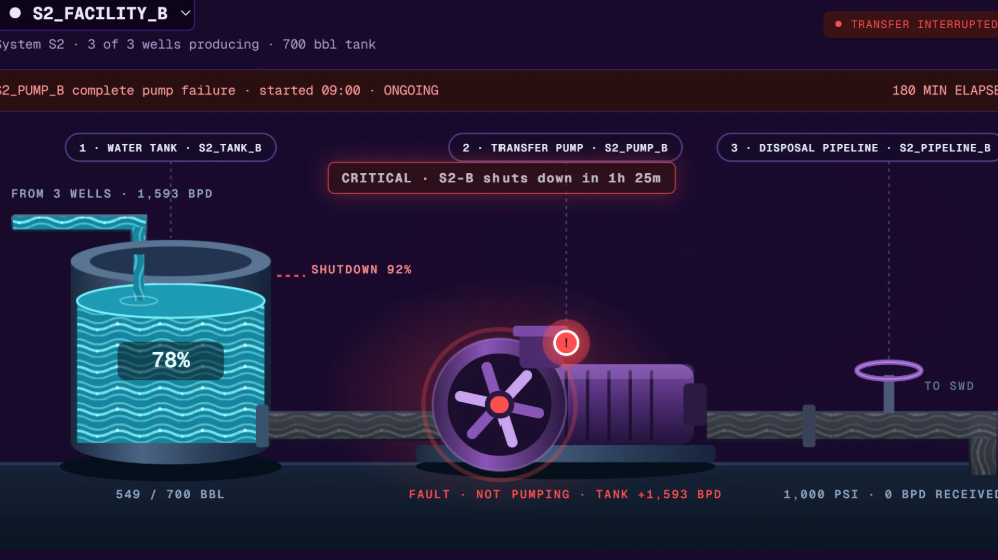
ShadowGauge is an operations-monitoring dashboard for oilfield water-handling systems. It shows each facility as a simple live diagram of the water path: producing wells → tank → pump → pipeline → saltwater disposal well (SWD), with the latest readings next to each part. Well production, tank level, pump state and flow, and pipeline flow and pressure are all visible at a glance. When something goes wrong, the problem appears directly on the part that has it.
It detects three kinds of problems from the telemetry and system data, not from a fixed status light alone:
Pump failure: the pump reports a fault. The pump is marked red, and if the tank could reach its shutdown level before the pump is repaired, a countdown shows how long the operator has, along with the revenue at risk. Pump wear: while running, the pump’s average flow is lower than expected compared with its rated capacity and its healthy operation in the dataset. The pump is marked yellow and flagged for inspection. Pipeline leak: water is missing between the pump and the disposal site, and pipeline pressure is below the healthy-running reference. Both signals must agree before we raise an alert. The pipeline is marked red and flagged for inspection.
Every active alert lists the evidence behind it, so operators can see why the system flagged it and trust the call. Multiple issues at the same facility are all listed.
For a failed pump, ShadowGauge estimates whether and when the tank will hit shutdown, then compares every response (sending water trucks, shutting in wells early, a combination, or doing nothing) and recommends the lowest-cost plan that avoids a shutdown, as a short list of steps. It accounts for repair timing and for the fact that trucks are shared across facilities in the same system. A side-by-side comparison shows what happens with the plan versus without it, along with the money saved.
A network map shows how facilities connect to their shared disposal sites, so operators can locate the facilities that need attention. Dataset snapshots let anyone switch between recorded situations and see the latest state of each. Every name, price, limit and truck count is read from the data files, so a new network loads without any code changes.
Operators enter through a vault-door intro and a sign-in page before reaching the console.
How we built it
The frontend is built with Next.js and React [and Tailwind CSS]. The facility diagram is a custom SVG that updates from live readings, with animated water flow and a pump impeller that slows as the equipment degrades.
The backend is Python and FastAPI [with pandas holding the telemetry in memory]. Detection is rule-based. Failures come from the pump’s fault status. For the slower-developing wear and leak conditions, we evaluate one-hour averages and calibrate the thresholds from healthy-running readings in each dataset, so the same logic works on networks we haven’t seen. The definitions and operating rules are documented in SPEC.md, and the dashboard data is assembled in dashboard.py.
For planning, ShadowGauge simulates each possible response minute by minute and keeps the cheapest one that holds the tank below its shutdown limit. Because the number of options is small, checking all of them guarantees the optimal result. We validated detection and plan costs with a scoring script against the practice answer keys, which the app itself never reads.
Challenges we ran into
The hardest detection problem was separating normal behavior from real failures. Pumps switch on and off constantly as tank levels rise and fall, and that pattern can look like a problem if it is not handled carefully. For wear and leaks, a single noisy reading can look alarming, so we used hourly averages and required a leak’s pressure drop and missing flow to agree before alerting.
Planning became much harder when multiple pumps failed in the same system at once. Every truck assignment affects every other facility’s options, so the plans had to be solved together instead of one at a time.
We also had to make sure nothing was hardcoded, since the app needed to work on a network it had never seen. On the design side, we went through several layouts before settling on one page that moves naturally from the facility, to the problem, to the plan.
Accomplishments that we're proud of
- Our plans match the answer key's choices on all three practice snapshots.
- An operator can read the page and know what to do within seconds.
- The plan comparison makes the value of each recommendation clear and easy to trust.
What we learned
We learned how produced water moves through an oilfield and how much revenue can depend on a single piece of equipment. On the technical side, we found that a complete search is often the right choice when the number of options is limited, because it is simple to verify and always finds the best answer. We also learned that thresholds calibrated from each dataset’s own healthy readings generalize far better than fixed numbers. Most importantly, we learned that a good operator tool keeps the complexity behind the scenes and puts only the answer in front of the user.
What's next for ShadowGauge
- Place the network map on real coordinates, with truck yards and live routes
- Predict pump failure from wear trends, so crews arrive before the pump stops
- Live sensor feeds, plus one-tap dispatch of the recommended plan by text
- An animated replay of the tank with and without the plan
- Confidence scores and earlier warnings for slow-developing leaks and pump wear
- A short plain-English shift handoff for the next operator
- A mobile layout for operators in the field

