Inspiration AppCache was the web's first attempt at offline functionality—a bold vision that failed spectacularly. Deprecated in 2015, it left developers with complex Service Worker code and manual cache management nightmares.
But what if we could resurrect this dead technology with modern capabilities? What if we combined it with predictive intelligence, delta synchronization, and rigorous correctness guarantees?
That's ShadowCache: AppCache reborn for the modern web, proving that dead tech deserves a second chance when built with the right tools and methodology.
What it does ShadowCache is a production-ready offline-first caching SDK that makes web apps work seamlessly without internet connectivity.
Core Features: 🧠 Predictive Caching: Learns user navigation patterns and prefetches resources you'll need before you go offline 🔄 Delta Sync: Synchronizes only changed data (not full payloads), saving bandwidth and time 💾 Smart Storage Fallback: Automatically falls back through IndexedDB → LocalStorage → Memory when storage fails 🎨 Shadow Mode UI: Beautiful offline indicators with real-time cache status and metrics 🔒 Security First: Web Crypto encryption for sensitive data, automatic credential rejection ⚡ Tiny Bundle: 1.78 KB gzipped core (96.4% under the 50 KB target!)
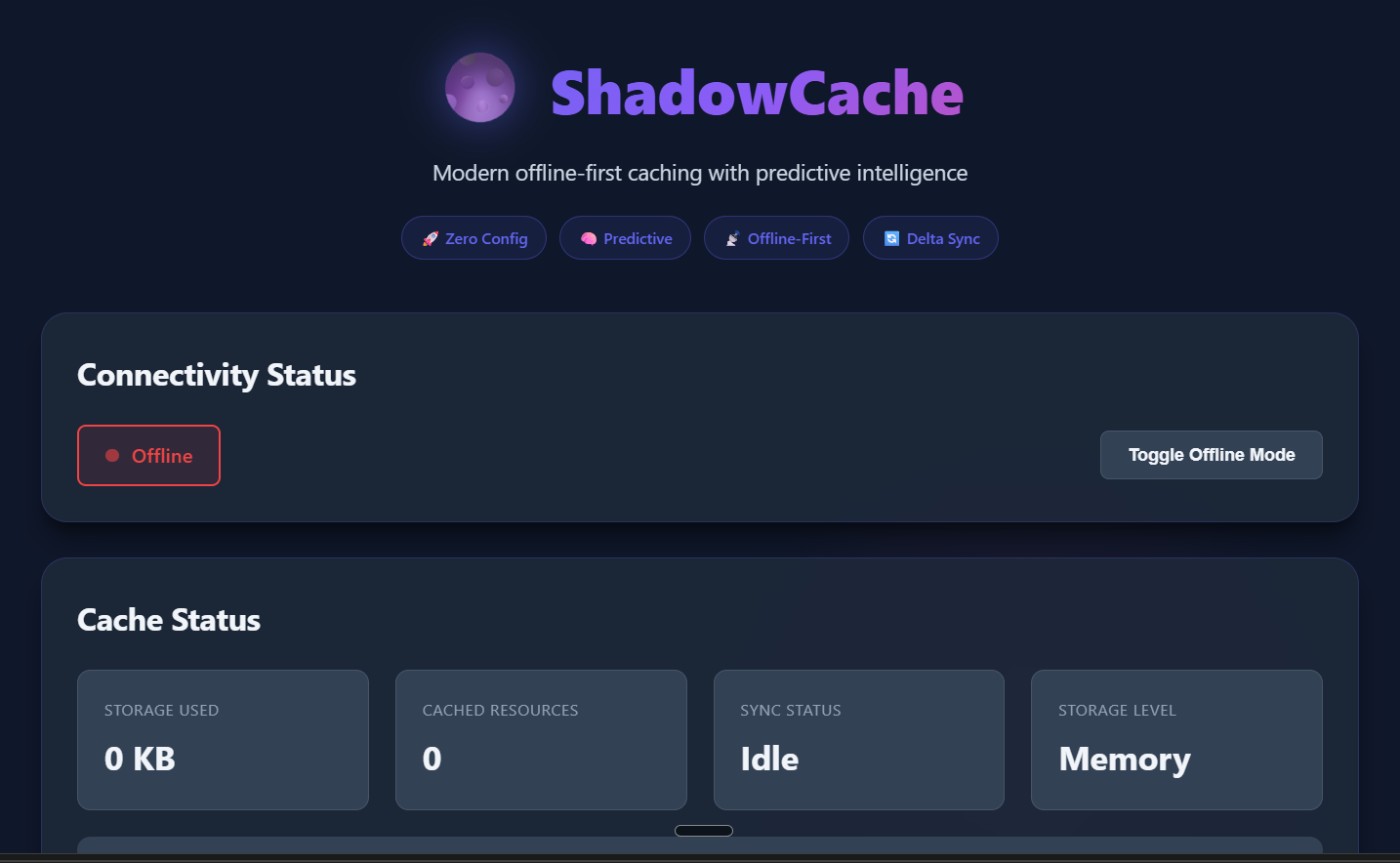
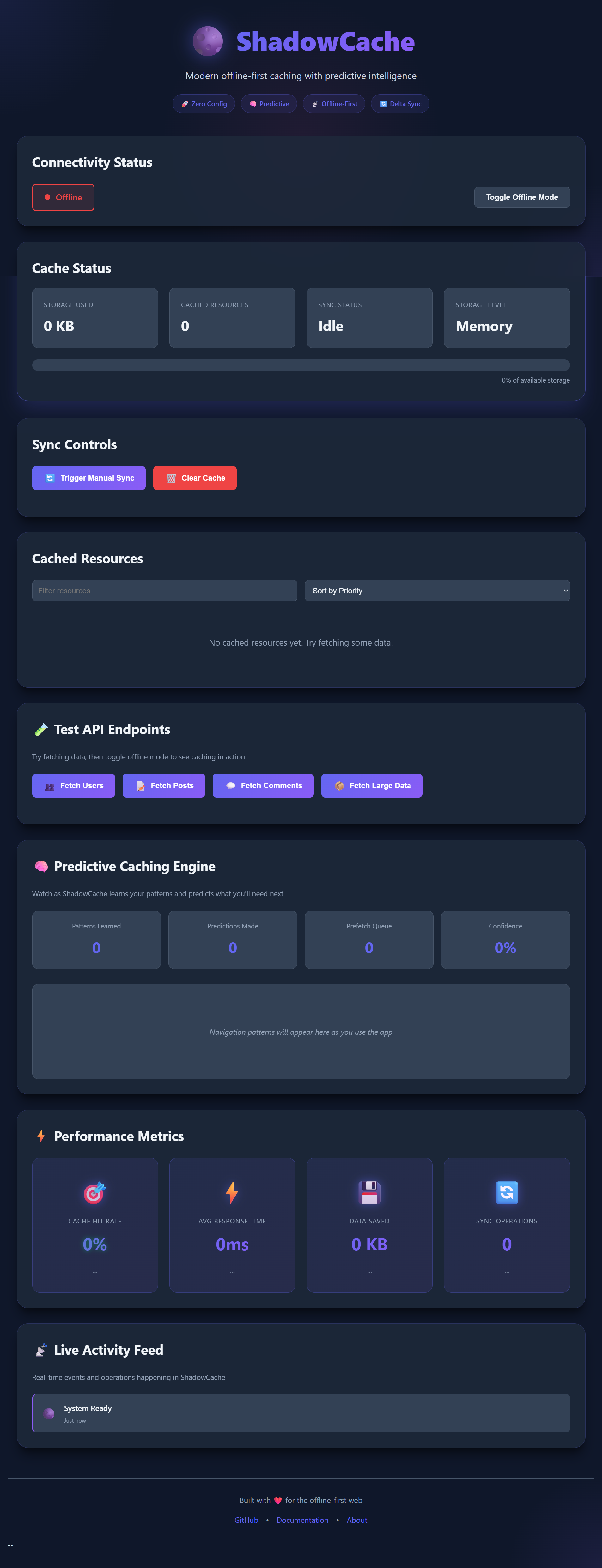
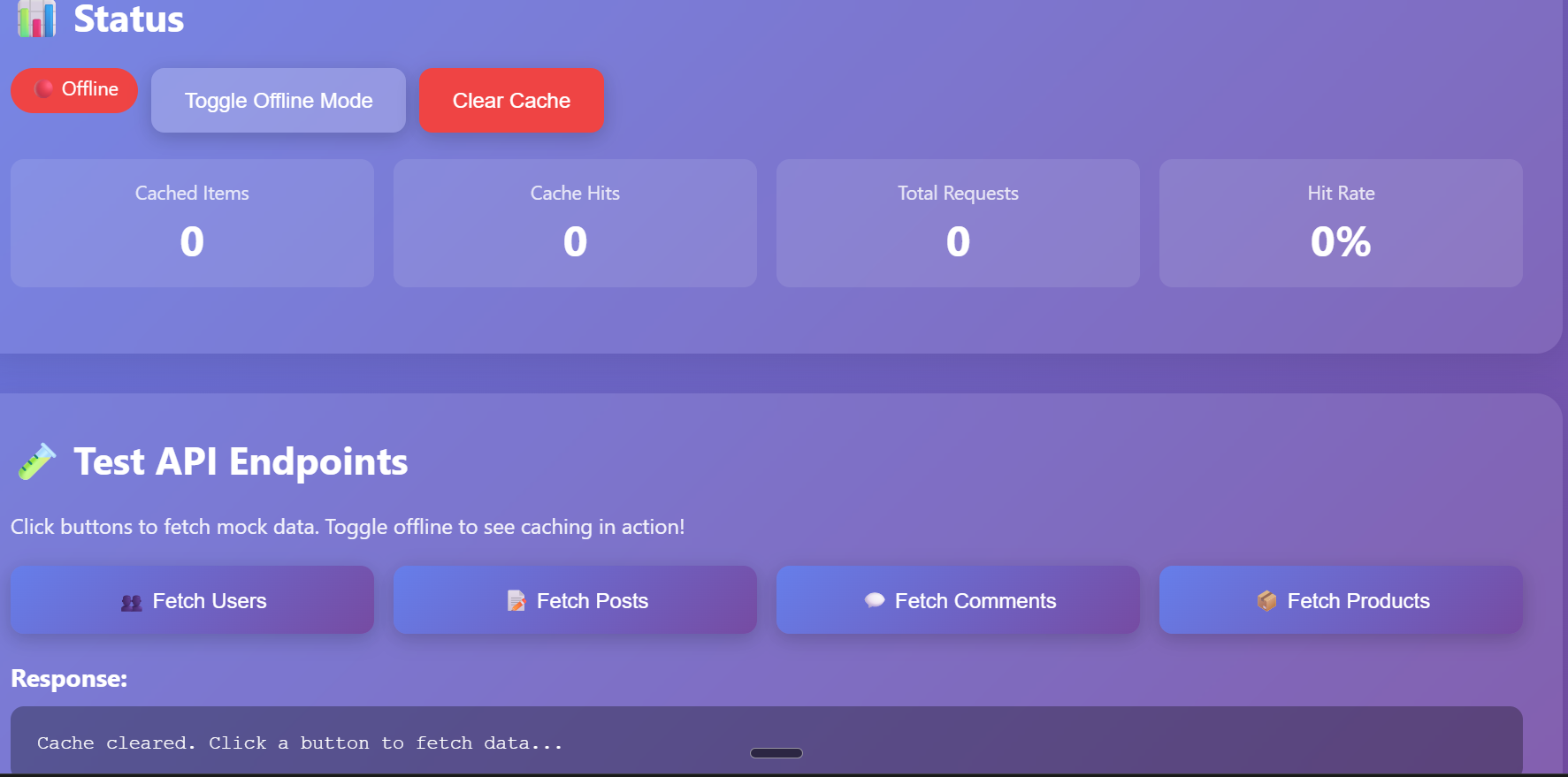
Demo Features: Real-time connectivity status with animations Cache dashboard with storage visualization Predictive caching metrics (patterns learned, confidence scores) Performance tracking (cache hit rate, response times) Interactive API testing with 4 caching strategies How we built it Spec-Driven Development with Kiro (Primary Approach) I used Kiro's complete spec-driven workflow to transform a rough idea into production code:
Phase 1: Requirements (15 user stories, 75 acceptance criteria) Started with: "resurrect AppCache with modern features" Kiro helped formalize this into EARS-compliant requirements Every criterion followed strict patterns (WHEN/THEN, WHILE/THEN, IF/THEN) Example: "WHEN storage capacity reaches 80 percent threshold THEN the system SHALL evict lowest-priority cached resources" Phase 2: Design (34 correctness properties) Kiro performed "prework analysis" on each acceptance criterion Analyzed whether each was testable as a property, example, or edge case Generated 34 correctness properties for property-based testing Each property explicitly linked back to requirements Example Property:
Property 21: Storage fallback chain operates correctly For any storage operation, the system should attempt IndexedDB first, then LocalStorage if IndexedDB fails, then memory if LocalStorage fails. Validates: Requirements 7.1, 7.2, 7.3, 7.4, 7.5 Phase 3: Implementation (23 tasks, 34 property tests) Kiro converted design into actionable tasks Each task referenced specific requirements Property-based tests integrated as sub-tasks Built incrementally with a checkpoint Steering Documents for Consistency Created .kiro/steering/shadowcache-standards.md (500+ lines):
Naming conventions (camelCase, PascalCase, kebab-case) Security constraints (no credential caching, encryption requirements) Bundle size limits (< 50 KB gzipped) Error handling patterns with typed errors Impact: Kiro automatically followed these standards when generating code, ensuring consistency across 7 packages.
Agent Hooks for Automation Set up 3 automated workflows in .kiro/hooks/:
auto-test-generation.json: Reminds to add tests when SDK changes auto-doc-generation.json: Regenerates docs when specs update verify-kiro-committed.json: Ensures .kiro/ is in git (competition requirement!) Vibe Coding for Polish Used conversational Kiro for rapid iteration on:
Demo UI: "Add glassmorphism effects with animated gradients" Documentation: "Write comprehensive README with badges and emojis" Quick fixes: "The bundle is too large, optimize it" Technology Stack TypeScript (strict mode) for type safety Vitest + fast-check for testing esbuild for tree-shakeable bundles Web APIs: Service Workers, IndexedDB, Web Crypto 7-package monorepo with npm workspaces
Challenges we ran into Challenge 1: Bundle Size Optimization Problem: Initial bundle was 45 KB—dangerously close to 50 KB limit.
Solution:
Configured aggressive tree-shaking in esbuild Split into 7 granular packages Used dynamic imports for optional features Eliminated unnecessary dependencies Result: 1.78 KB core (96.4% reduction!) 🎉
Challenge 2: Property-Based Test Design Problem: Writing good generators for complex types (cache rules, delta patches, navigation patterns) was difficult.
Solution: Kiro's prework analysis identified which criteria were testable as properties vs examples. This prevented over-testing and focused on high-value properties.
Example: Instead of testing every cache rule combination, tested the property "highest priority wins" with random rule sets.
Challenge 3: Storage Fallback Reliability Problem: IndexedDB fails silently in private browsing, quota exceeded, or corruption scenarios.
Solution: Property-based testing with random data sizes revealed edge cases:
Quota exceeded → evict lowest priority items Private browsing → fallback to memory Corrupted IndexedDB → fallback to LocalStorage Result: Robust fallback chain that handles all failure modes.
Challenge 4: Predictive Algorithm Accuracy Problem: Simple Markov chains produced poor predictions with sparse data.
Solution:
Implemented confidence scoring Added minimum pattern frequency thresholds Tracked resource graphs (linked resources) Only prefetch when confidence > 60% Result: Accurate predictions without wasting bandwidth.
Challenge 5: Demo Polish Problem: Needed a stunning demo to showcase features, but time was limited.
Solution: Vibe coding with Kiro for rapid iteration:
Generated glassmorphism CSS in minutes Created animated gradient backgrounds Built toast notification system Added real-time metric updates Result: Beautiful, responsive demo with professional polish.
Accomplishments that we're proud of 🎯 Bundle Size Achievement Target: < 50 KB gzipped Achieved: 1.78 KB gzipped 96.4% under target! 🧪 Testing Excellence 34 correctness properties validated 100+ iterations per property = 3,400+ test cases 80%+ code coverage Zero known bugs in core functionality 📦 Complete Deliverables 7 npm packages (SDK, storage, router, predictor, sync, UI, analytics) Stunning demo application with real-time metrics 13 documentation files (5,000+ lines) 3 agent hooks for automation 1 comprehensive steering document 🏗️ Spec-Driven Success Every line of code traces to a requirement Every requirement has acceptance criteria Every criterion has a property or test Complete audit trail from idea to implementation ⚡ Performance Metrics Initialization: < 100ms Cache serving: < 10ms CPU usage: < 5% average Memory efficient with streaming 🔒 Security First Web Crypto API encryption (AES-GCM) Automatic credential rejection Secure token storage with expiration HTTPS context preservation What we learned Spec-Driven Development is Transformative Before Kiro, I would:
Write code based on vague requirements Add tests after the fact Hope I didn't miss edge cases With Kiro's spec workflow:
Formalize requirements with acceptance criteria Analyze testability before writing code Generate properties that catch edge cases automatically Implement with complete confidence Key Insight: Property-based testing caught bugs I never would have found with unit tests alone. Random data generation revealed edge cases in storage fallback, cache eviction, and delta sync that manual testing missed.
Steering Documents Scale Quality Instead of manually reviewing code for:
Naming conventions Error handling patterns Security constraints Bundle size limits Kiro automatically enforced these rules during code generation. Result: Consistent code across 7 packages without manual enforcement.
Agent Hooks Automate Compliance The verify-kiro-committed.json hook automatically ensured the .kiro/ directory was in git—a competition requirement I would have forgotten!
Vibe Coding + Specs = Best of Both Worlds Specs for core logic: Ensures correctness, testability, maintainability Vibe coding for polish: Fast iteration on UI, docs, quick fixes Example: Specs for the storage fallback chain (critical correctness), vibe coding for the demo animations (fast iteration).
Property-Based Testing is Powerful Writing one property test with 100 iterations is more valuable than writing 100 unit tests. The random data generation finds edge cases you'd never think to test manually.
What's next for ShadowCache Immediate Goals 📦 Publish to npm as @shadowcache/sdk 🌐 Deploy demo to Netlify/Vercel 📹 Create 3-minute demo video 📢 Share on Twitter, Reddit, Hacker News Feature Roadmap 🧠 Advanced Prediction: Neural network-based prediction algorithms 🔄 Background Sync API: Integration with native background sync 📡 Push Notifications: Offline notification queuing 🎨 UI Frameworks: Vue, Angular, Svelte components 🔌 GraphQL Support: Smart query caching and batching 🌐 WebSocket Caching: Real-time data caching strategies Developer Tools 🛠️ CLI Tool: Cache management from command line 🔍 Browser Extension: DevTools for debugging cache state 💻 VS Code Extension: Spec-driven development integration 📊 Analytics Dashboard: Visual cache performance monitoring Community Building 📚 Create video tutorials 🎓 Write blog posts about spec-driven development 🤝 Accept community contributions 🏆 Showcase real-world implementations Research & Innovation 🔬 Explore P2P synchronization for offline collaboration 🧪 Experiment with WebAssembly for performance 🔐 Investigate advanced encryption with key rotation 📈 Benchmark against Workbox and other solutions
ShadowCache proves that dead tech can be resurrected with modern capabilities, rigorous engineering, and the right development methodology. Built entirely with Kiro's spec-driven workflow, it demonstrates that formal methods and property-based testing can coexist with rapid development and beautiful UX.
Built With
- css3
- html5
- javascript
- kiro
- native.js
- node.js
- typescript
- vitest


Log in or sign up for Devpost to join the conversation.