-
-
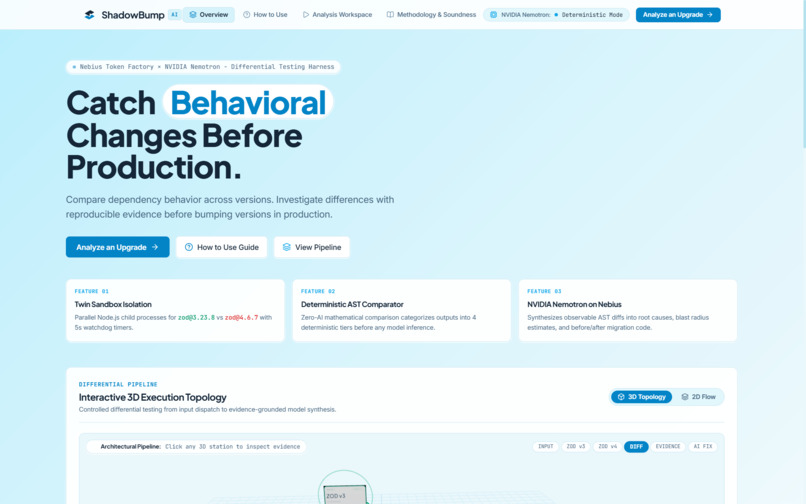
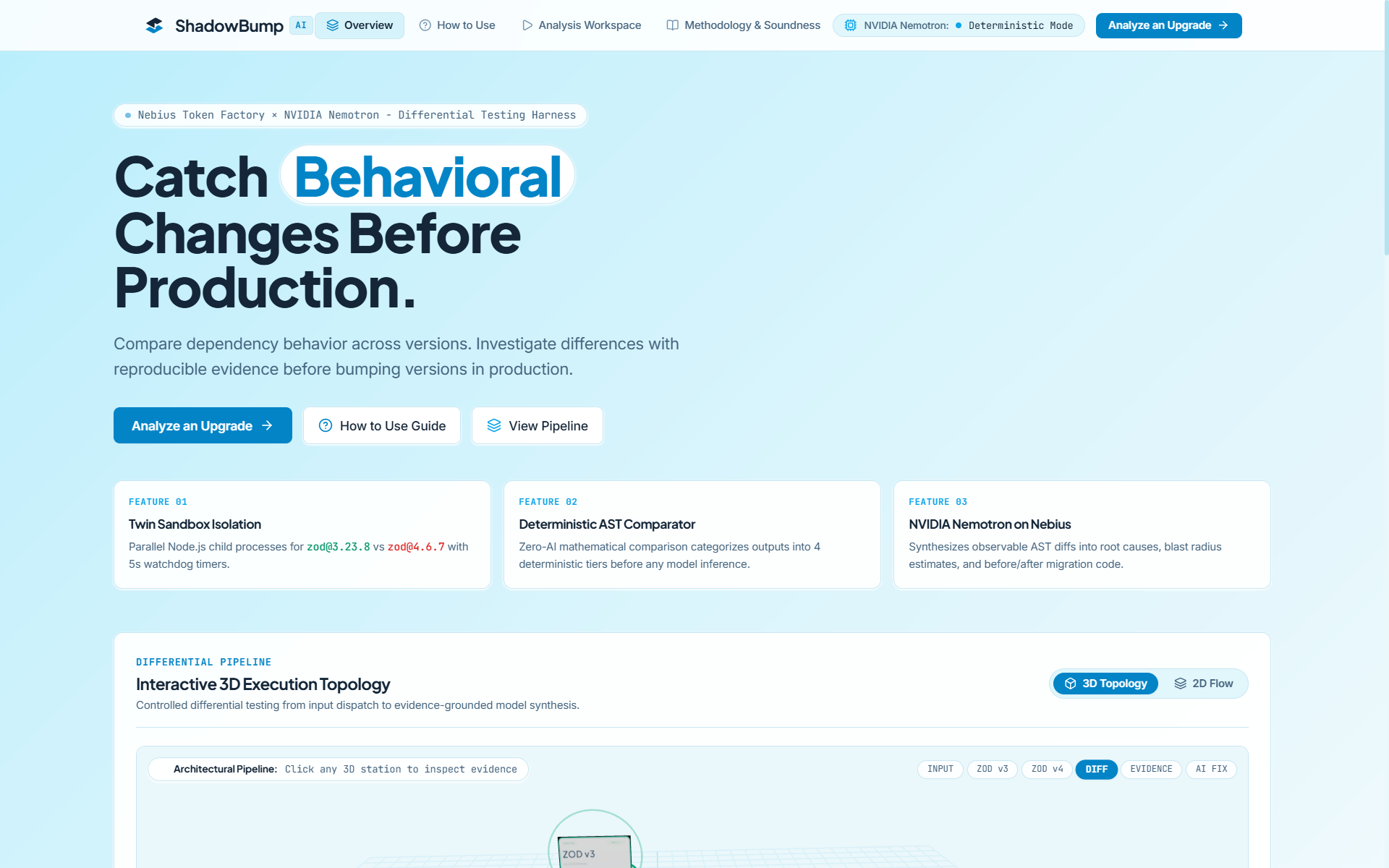
Project Overview: ShadowBump AI: Catch behavioral changes in dependency upgrades before they reach production.
-
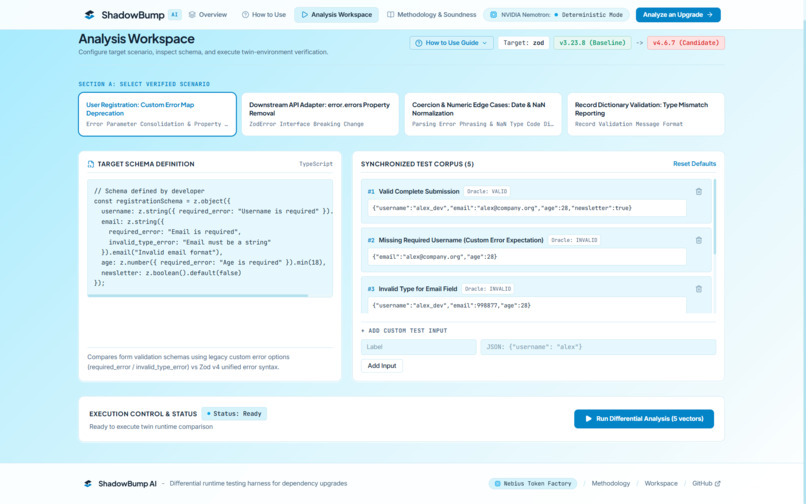
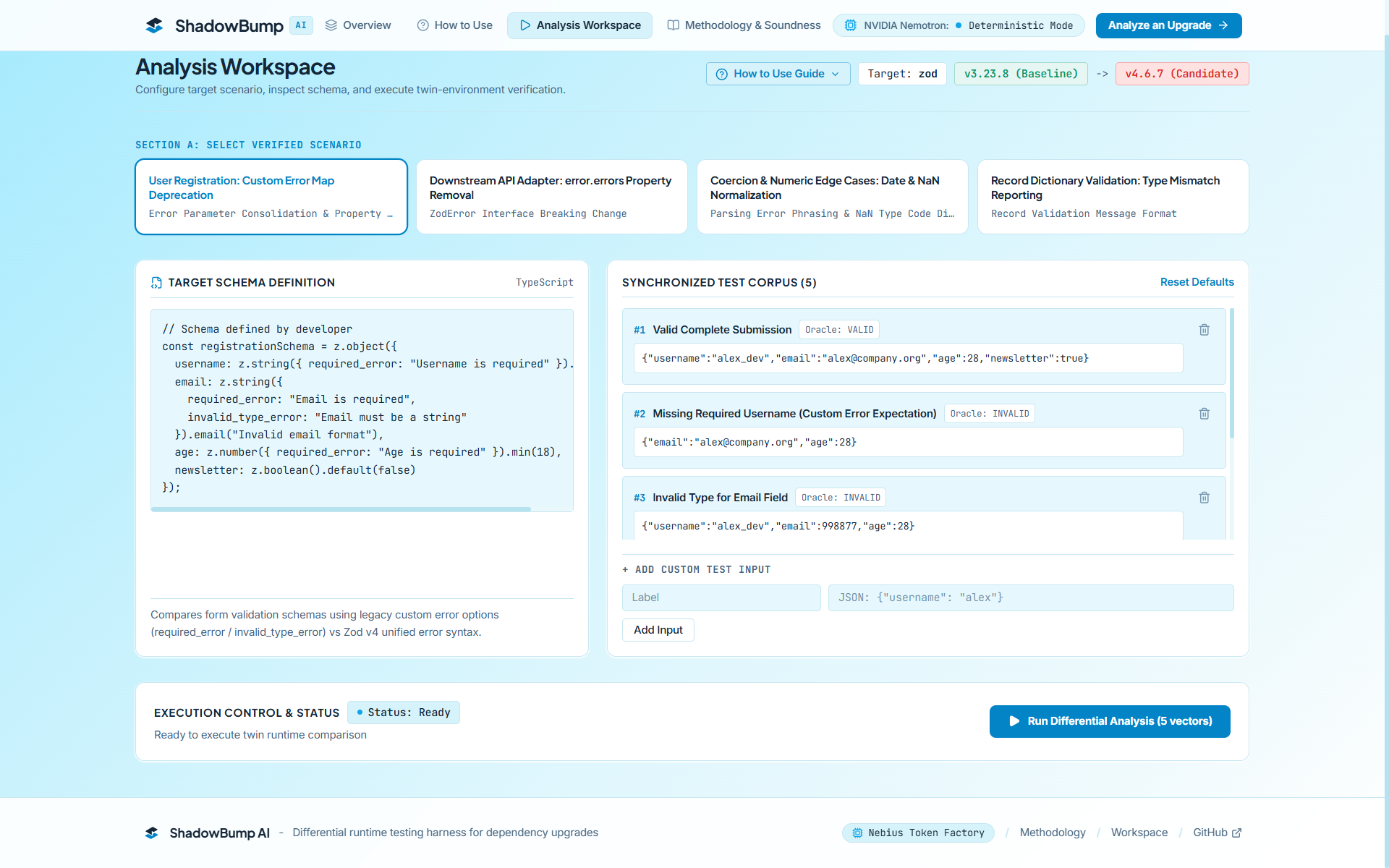
Analysis Workspace: Configure dependency versions, select test scenarios, and run differential analysis in one workspace.
-
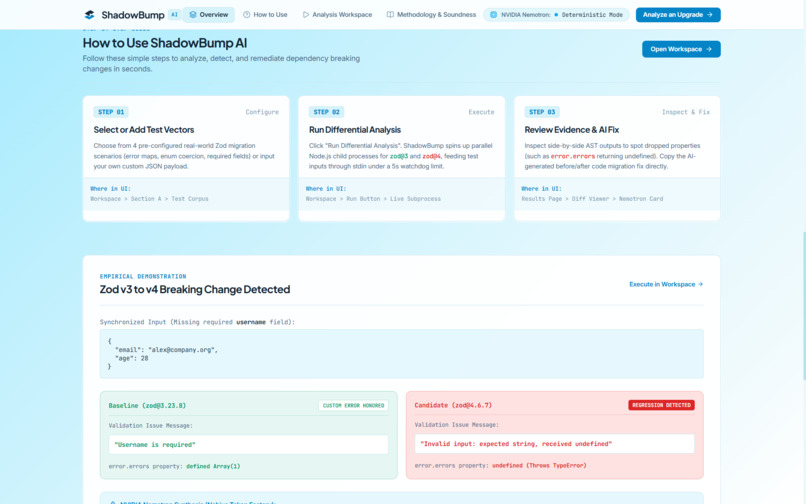
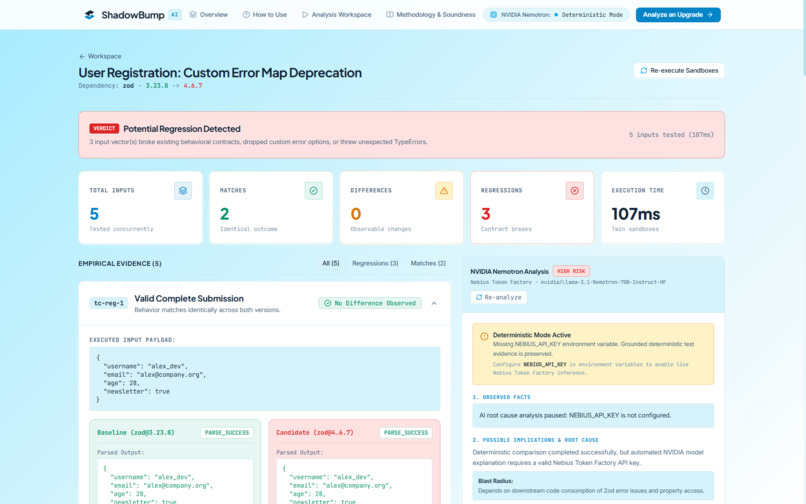
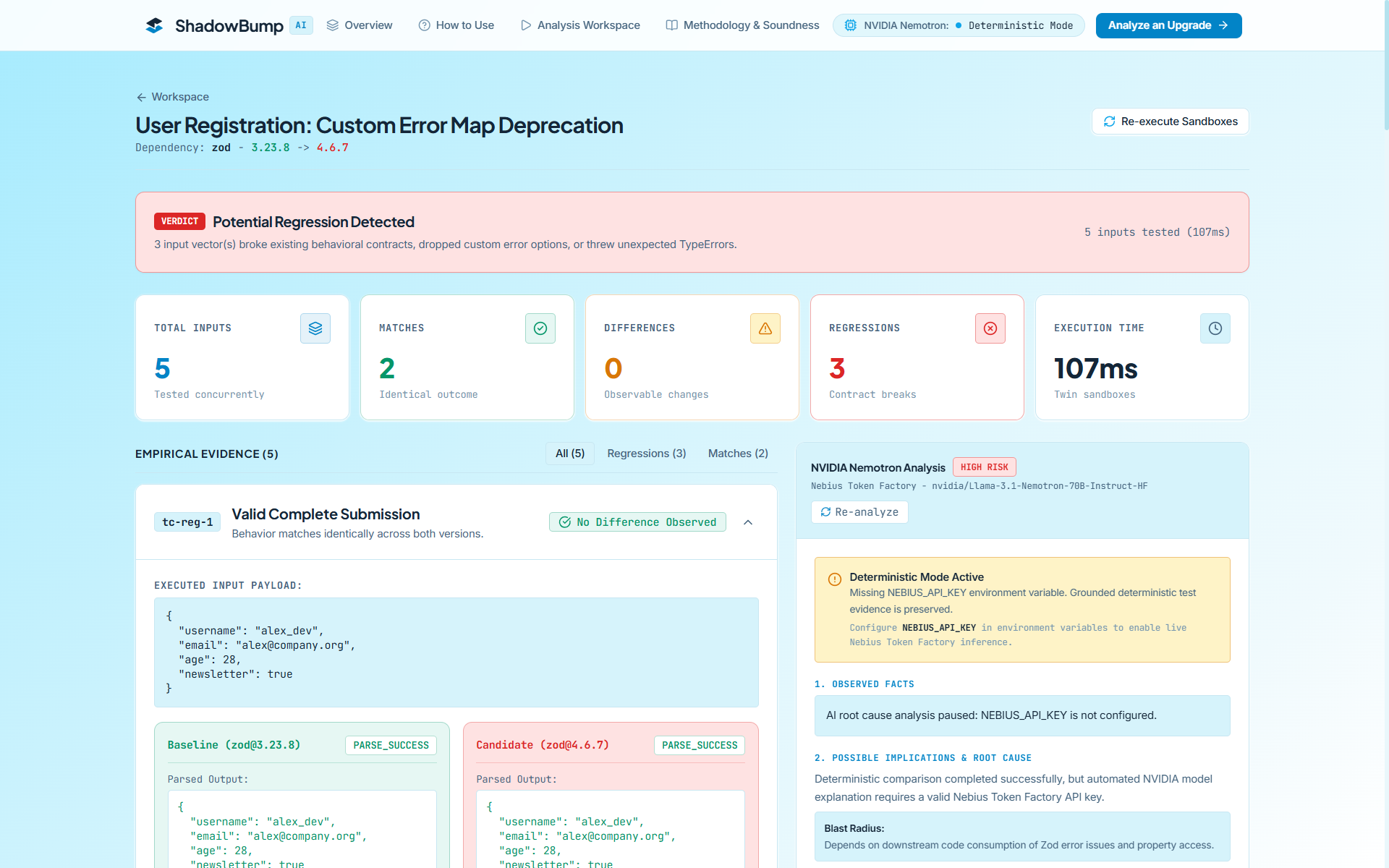
Analysis Results: Compare execution outcomes, identify potential regressions, and inspect reproducible evidence.
-
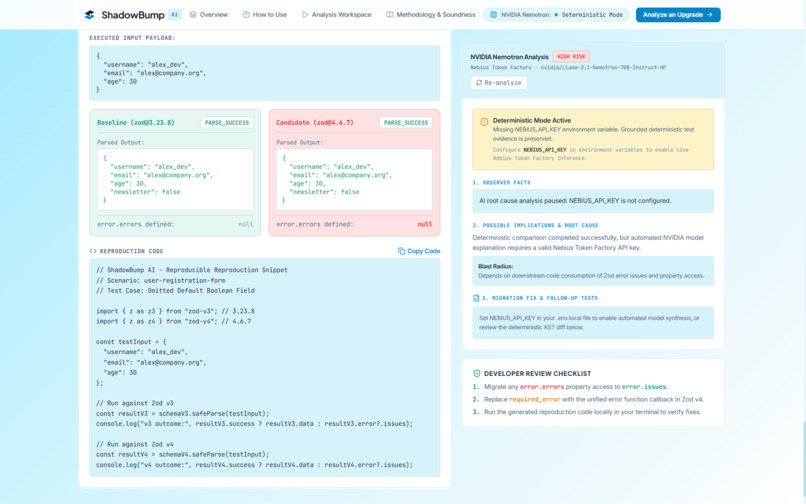
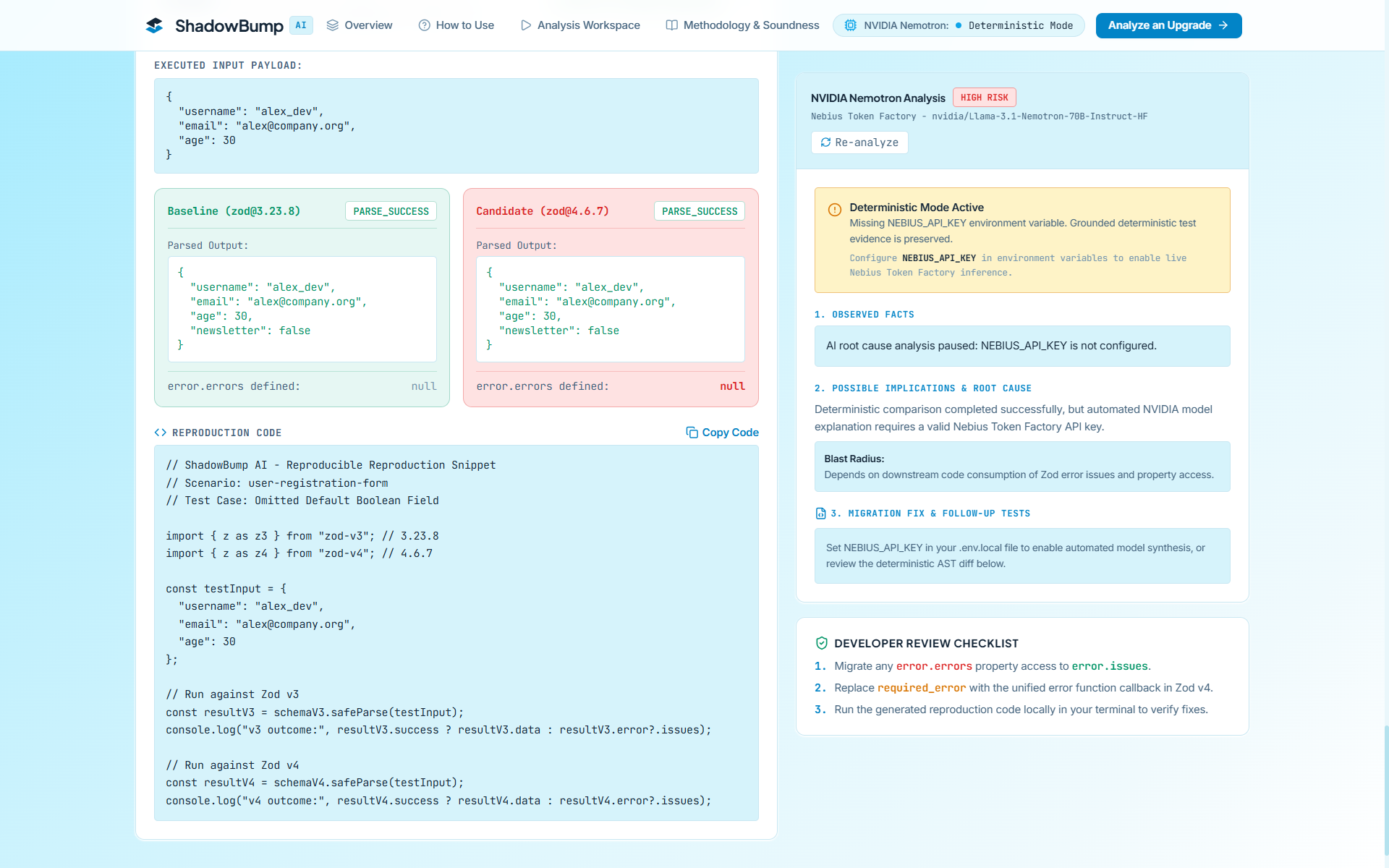
AI Analysis: Investigate compatibility risks with evidence-grounded AI explanations and suggested follow-up tests.
-
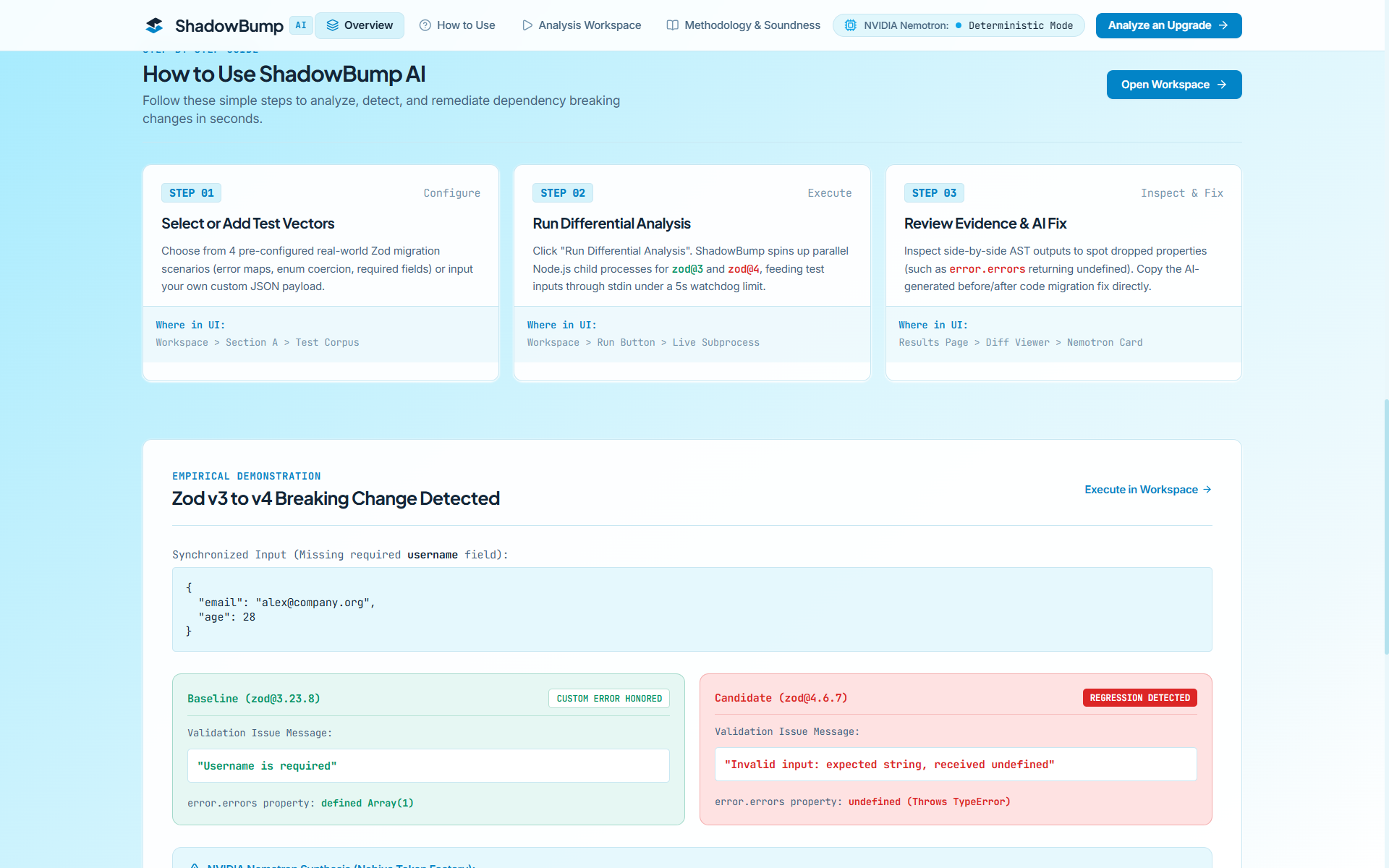
How to Use: Configure inputs, execute differential tests, and investigate behavioral changes in three steps.
-
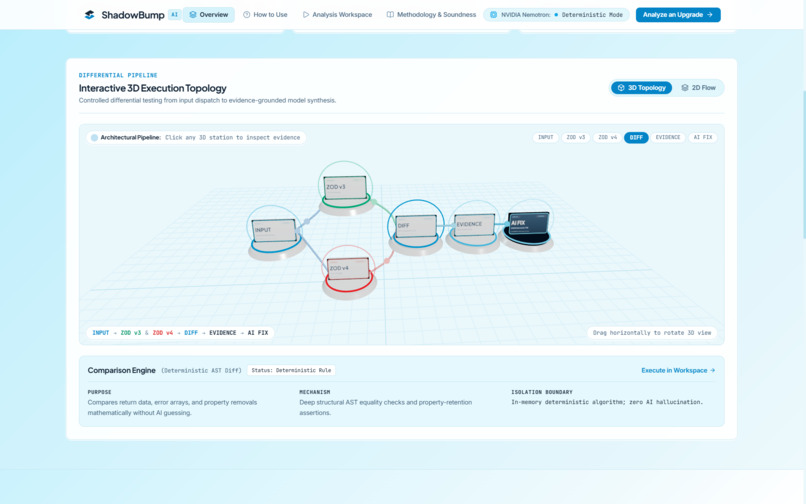
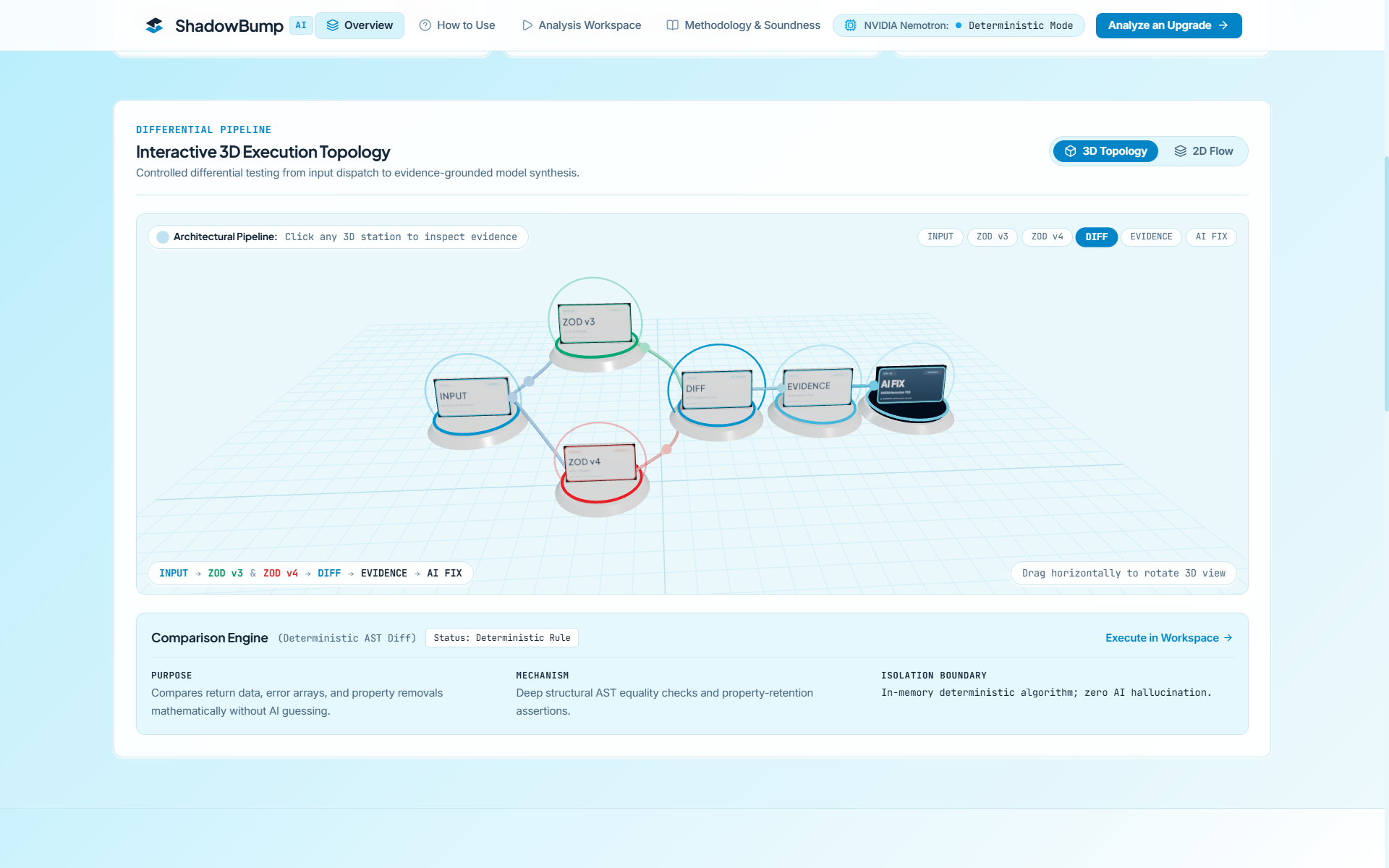
Execution Pipeline: Follow the workflow from test input through version comparison to evidence and AI-assisted analysis.
-
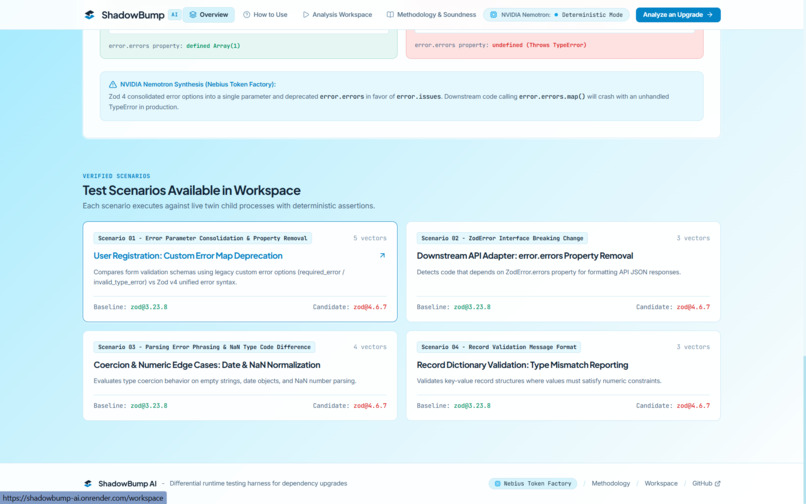
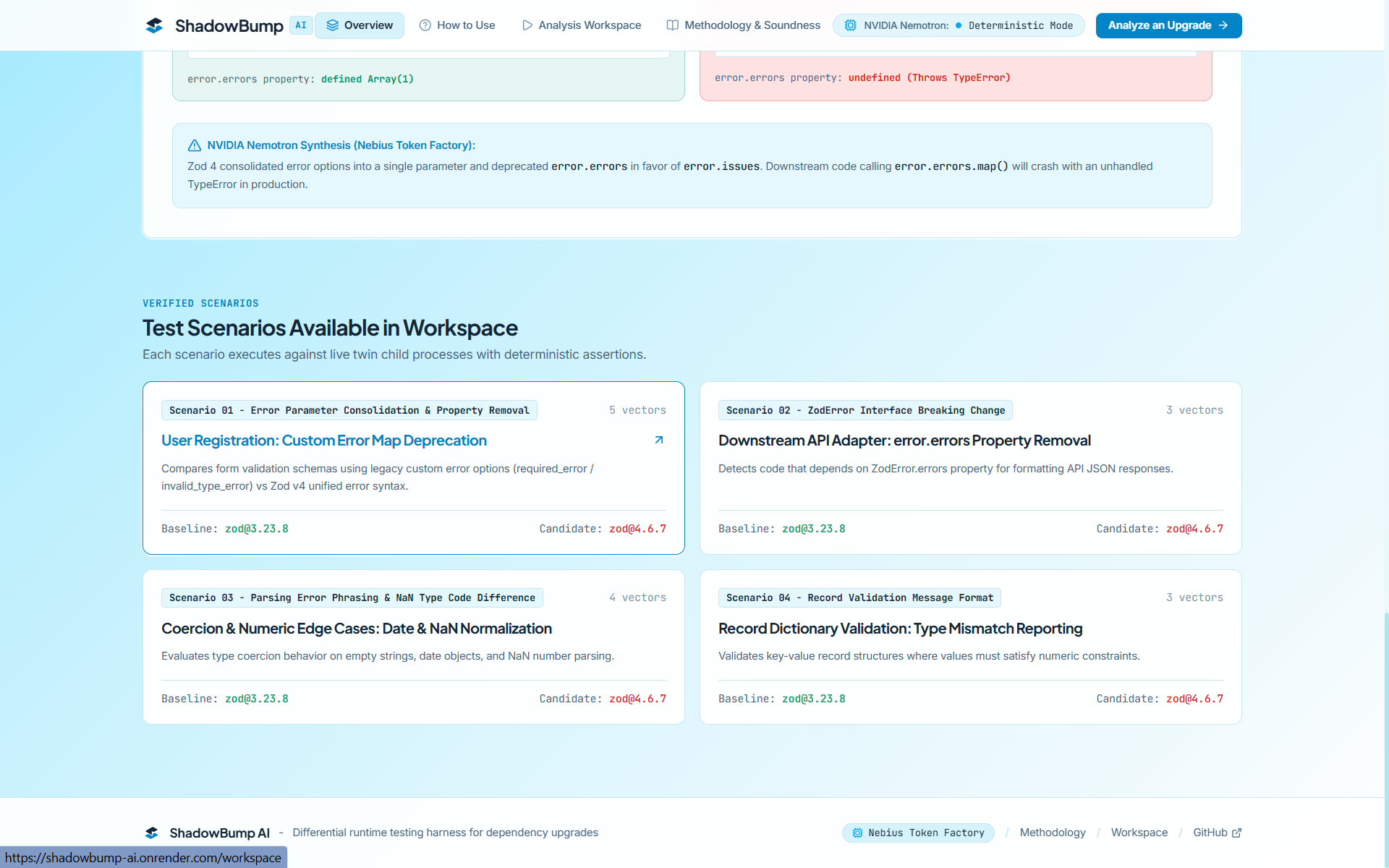
Test Scenarios: Explore Zod migration scenarios covering validation, error handling, type coercion, and compatibility.
Inspiration
Dependency upgrades are a normal part of software development, but a successful installation or passing build does not necessarily mean an application will behave the same way after an upgrade.
A library can change its validation behavior, output structure, or error handling in ways that affect downstream code. These differences can be difficult to identify before they reach production.
We built ShadowBump AI to explore a practical question: what if developers could compare the actual behavior of two dependency versions before deciding whether an upgrade is safe?
What It Does
ShadowBump AI is an AI-assisted differential testing tool designed to identify behavioral differences between dependency versions.
It runs the same test inputs against a baseline version and a candidate version, compares the observed results, and presents differences for investigation.
The platform aims to make those differences easier to understand through evidence-based AI explanations powered by an NVIDIA model accessed through Nebius Token Factory.
A behavioral difference is not automatically a bug. ShadowBump AI focuses on surfacing observable evidence so developers can investigate potential compatibility issues rather than relying on assumptions.
How We Built It
The project combines a dependency-version comparison workflow, runtime execution, result comparison, and AI-assisted analysis.
The demonstration focuses on a Zod v3-to-v4 upgrade scenario, using validation behavior to illustrate how two versions can produce different results from the same input.
The intended workflow is straightforward:
- Configure the baseline and candidate dependency versions.
- Execute the same test input against both versions.
- Compare the observed outputs and errors.
- Inspect the behavioral differences and supporting evidence.
- Use AI-generated explanations to understand potential implications and decide what to investigate next.
We designed the experience around a simple principle: the comparison engine provides the evidence; AI helps explain it.
Challenges
One of the central challenges is distinguishing a meaningful compatibility concern from an ordinary behavioral difference. A changed error message, for example, may matter to downstream code, but it does not automatically establish that an upgrade is broken.
Another challenge is making AI explanations useful without allowing them to replace or misrepresent actual execution results. Reliable comparisons also require careful handling of execution failures, timeouts, and differences between dependency versions.
These challenges shaped our focus on transparent results, reproducible test cases, and clear separation between observed behavior and AI-generated interpretation.
What We Learned
Building ShadowBump AI strengthened our understanding of differential testing, dependency compatibility, runtime behavior, and the importance of evidence-driven debugging.
It also reinforced an important lesson about AI in developer tools: AI is most useful when it works from concrete evidence, communicates uncertainty, and supports engineering judgment instead of pretending to replace it.
What's Next
Our next priorities are expanding supported test scenarios, improving the clarity of comparison reports, strengthening execution isolation, and validating the approach across additional dependency upgrades.
ShadowBump AI - Catch Behavioral Changes Before Production.
Built With
- artificial
- developer
- differential
- factory
- intelligence
- nebius
- nemotron
- node.js
- nvidia
- testing
- token
- typescript
- zod
