-
-
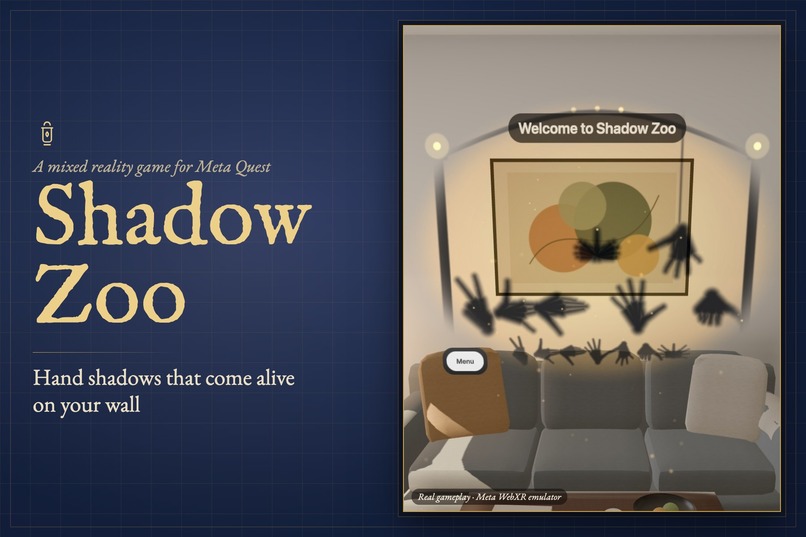
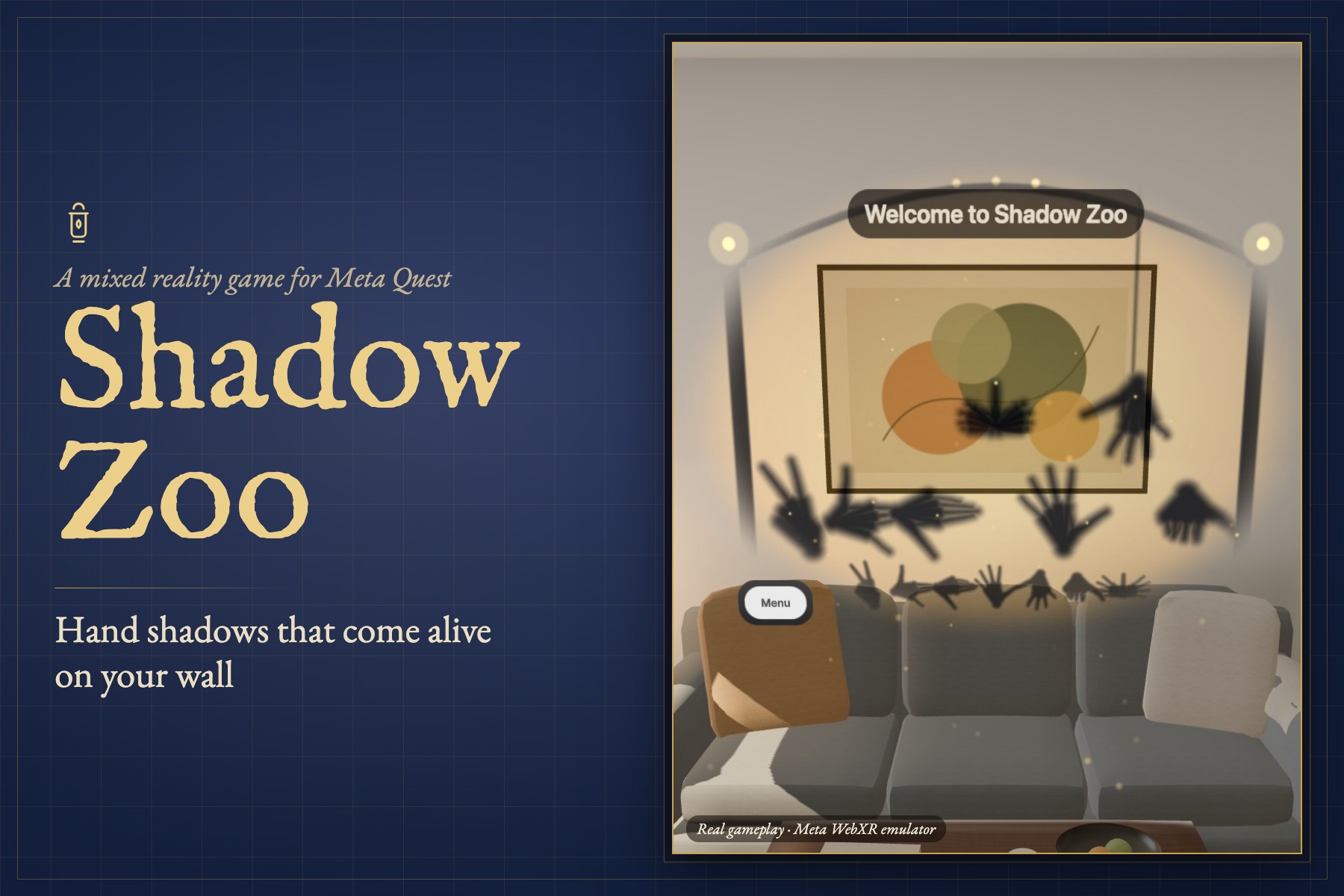
Shadow Zoo: hand shadows that come alive on your real wall. A mixed reality game for Meta Quest.
-
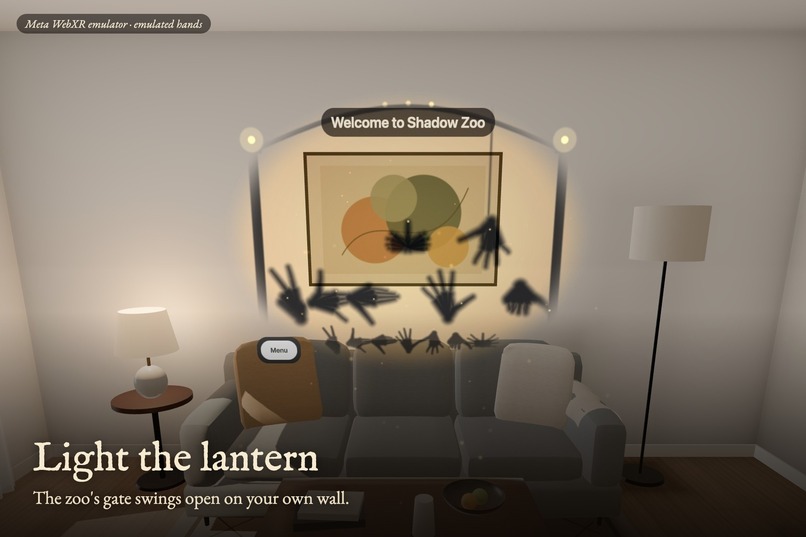
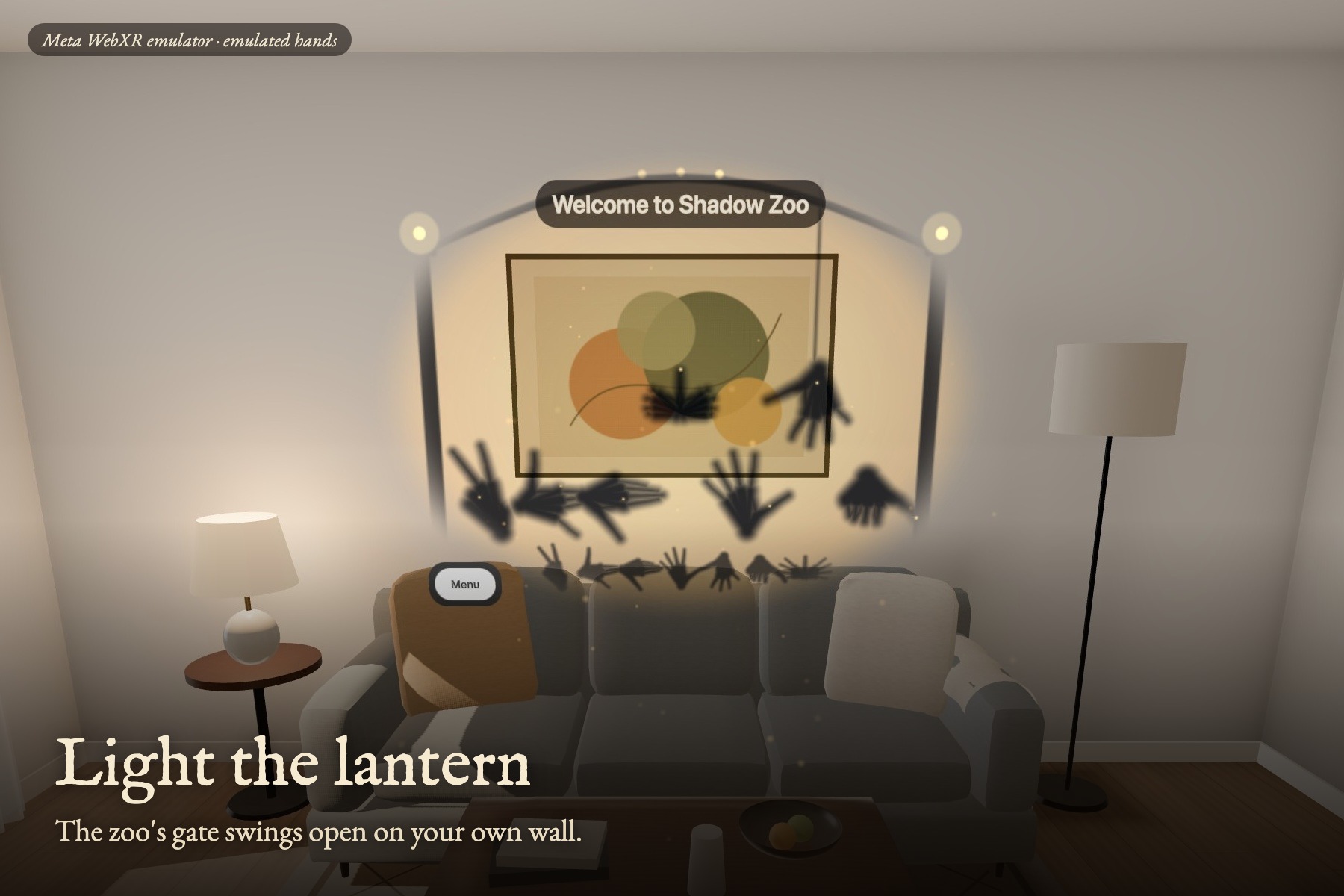
Light the lantern: the zoo's gate swings open on your own wall.
-
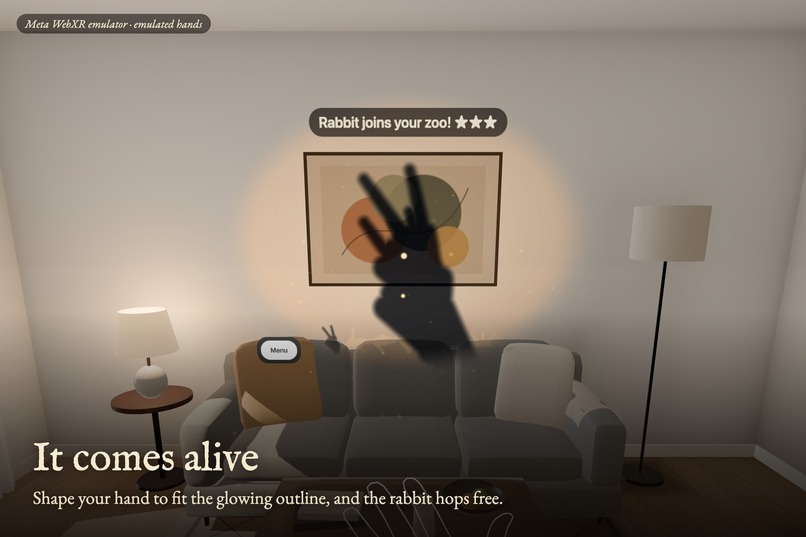
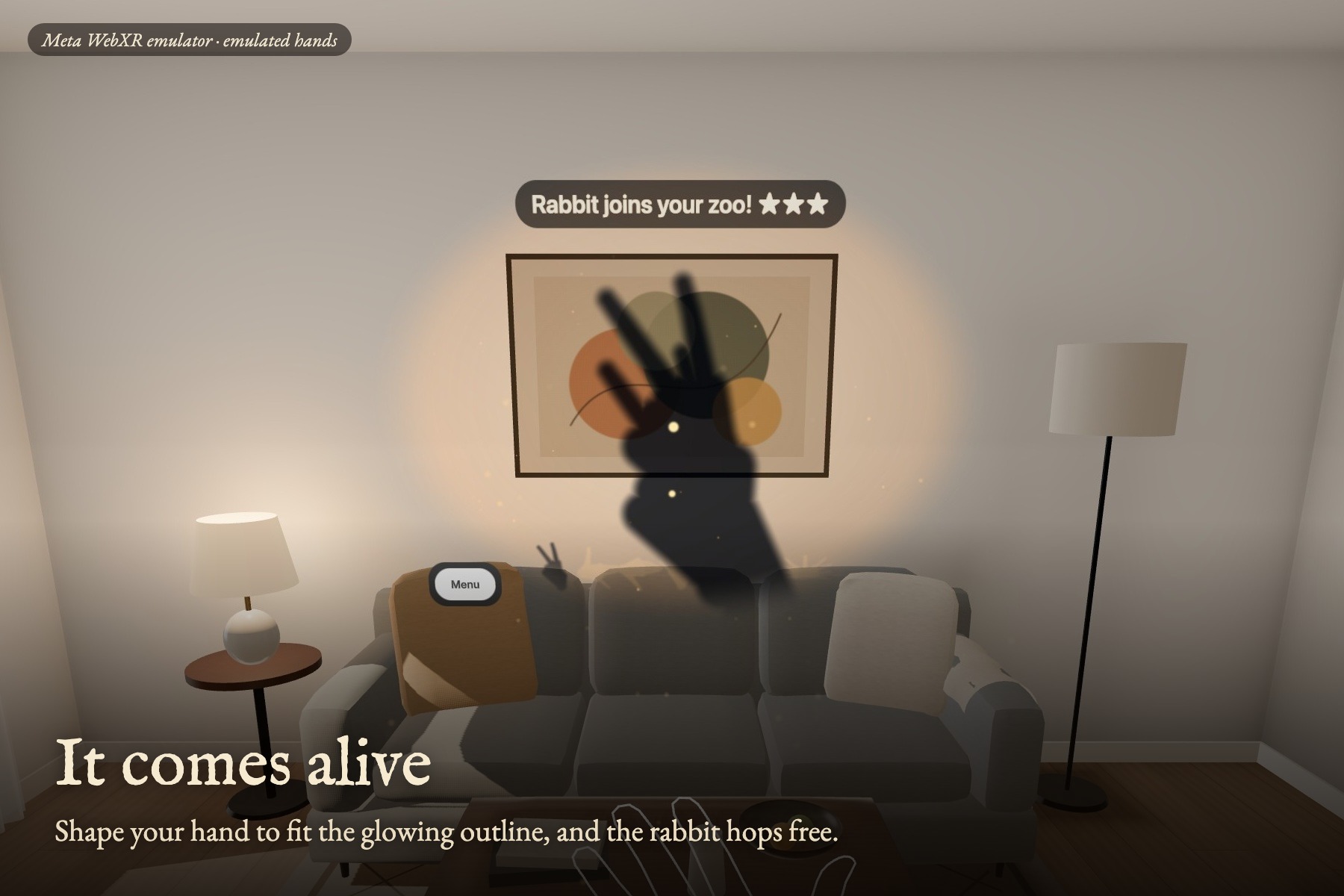
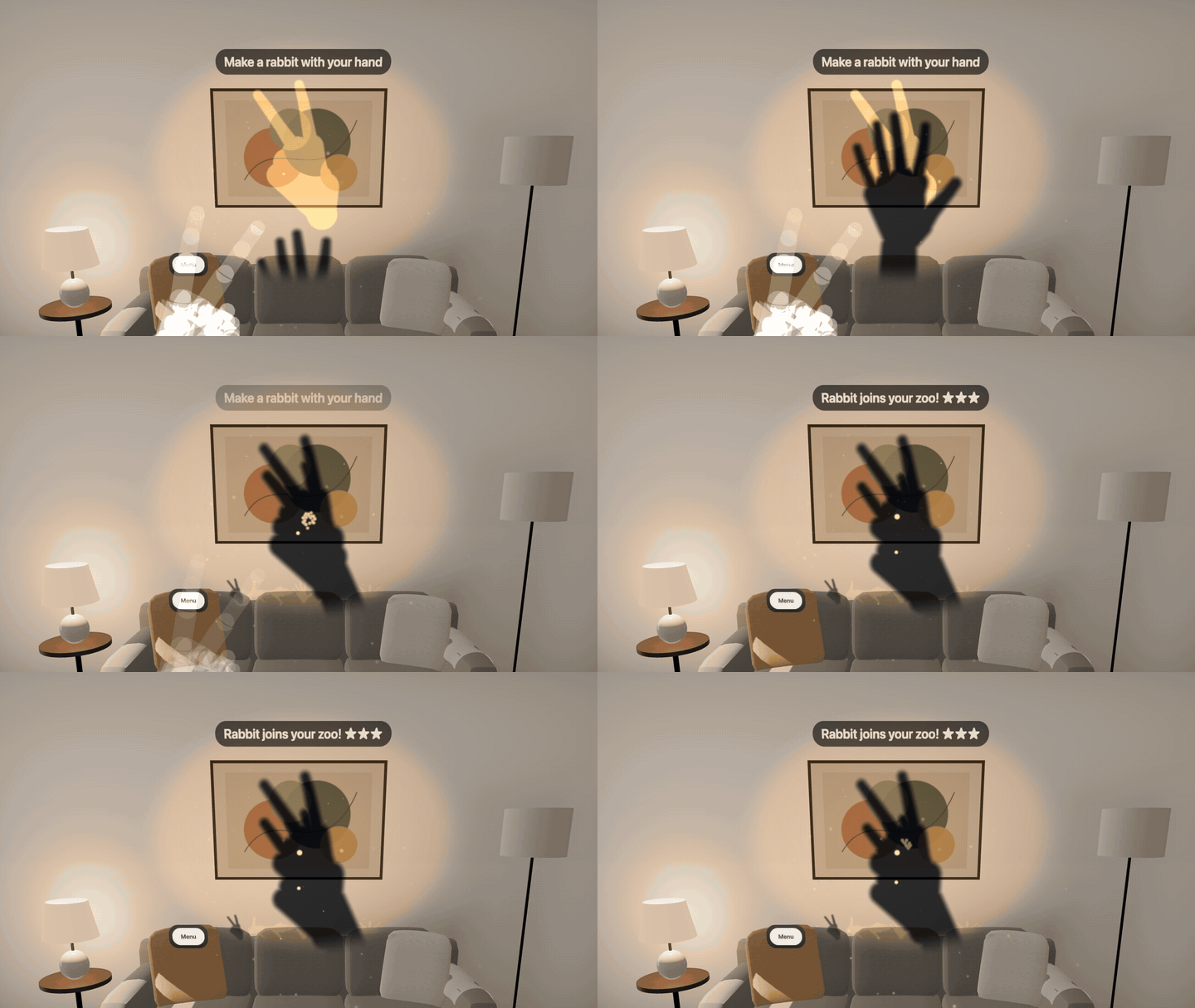
It comes alive: shape your hand to fit the glowing outline, and the rabbit hops free.
-
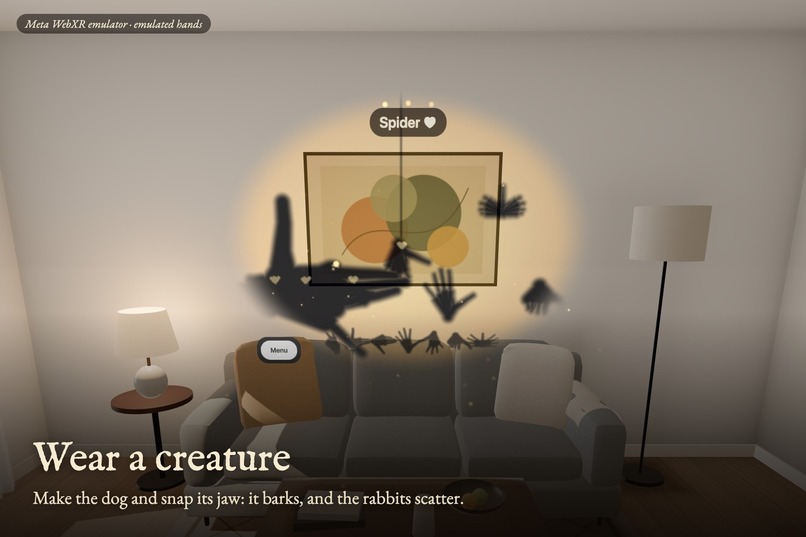
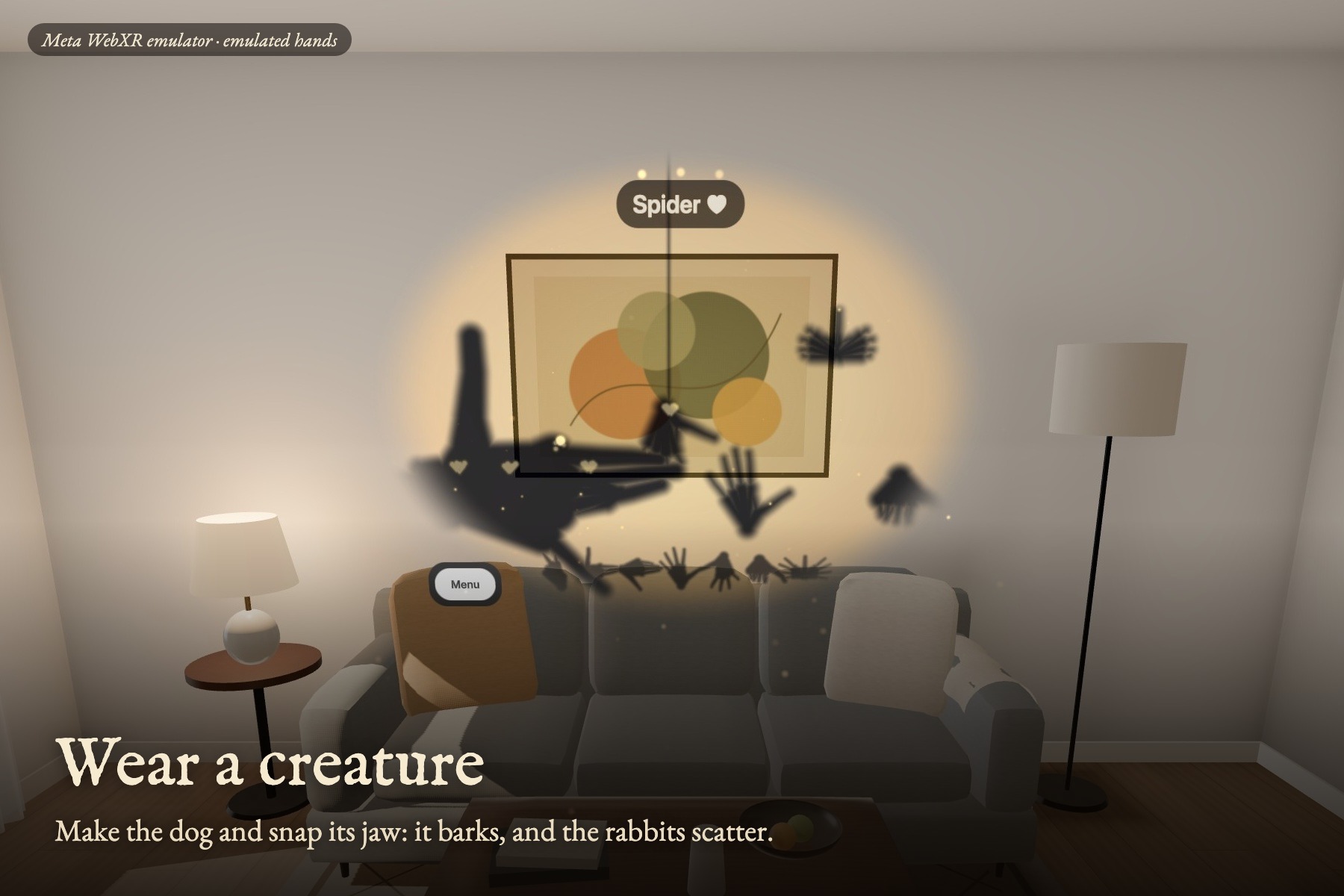
Wear a creature: make the dog and snap its jaw. It barks, and the rabbits scatter.
-
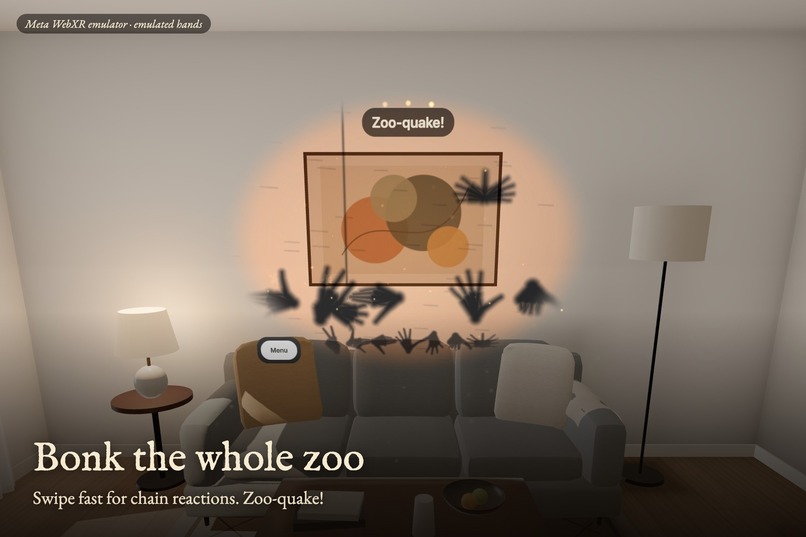
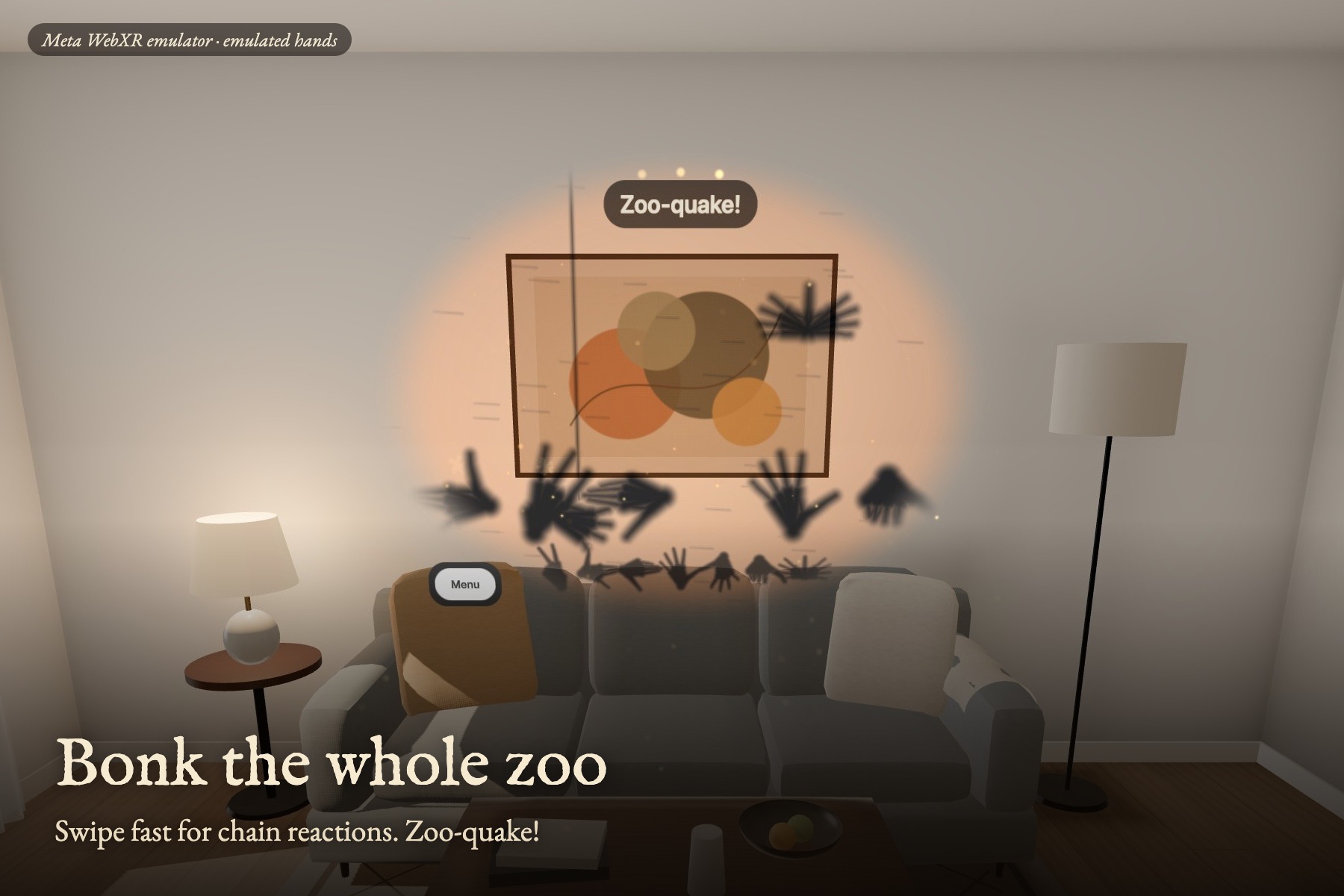
Bonk the whole zoo: swipe fast for chain reactions. Zoo-quake!
-
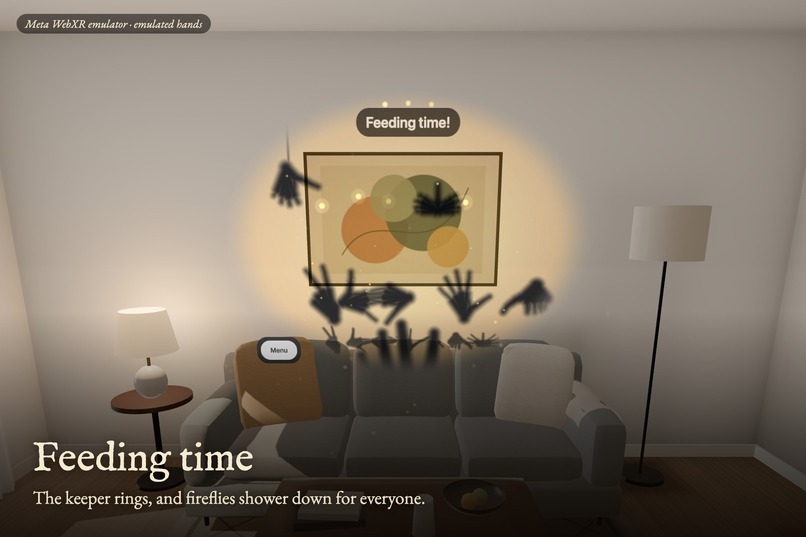
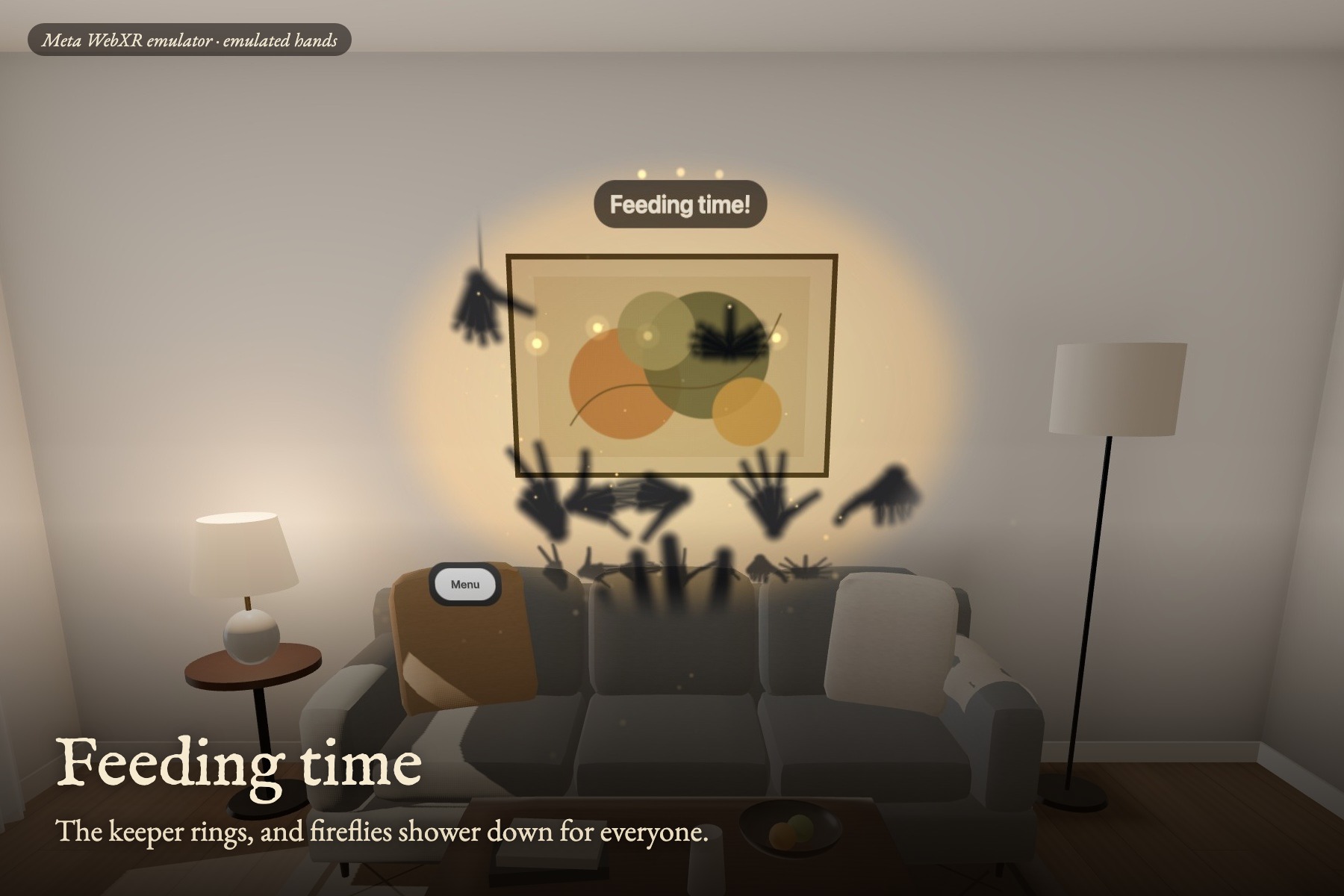
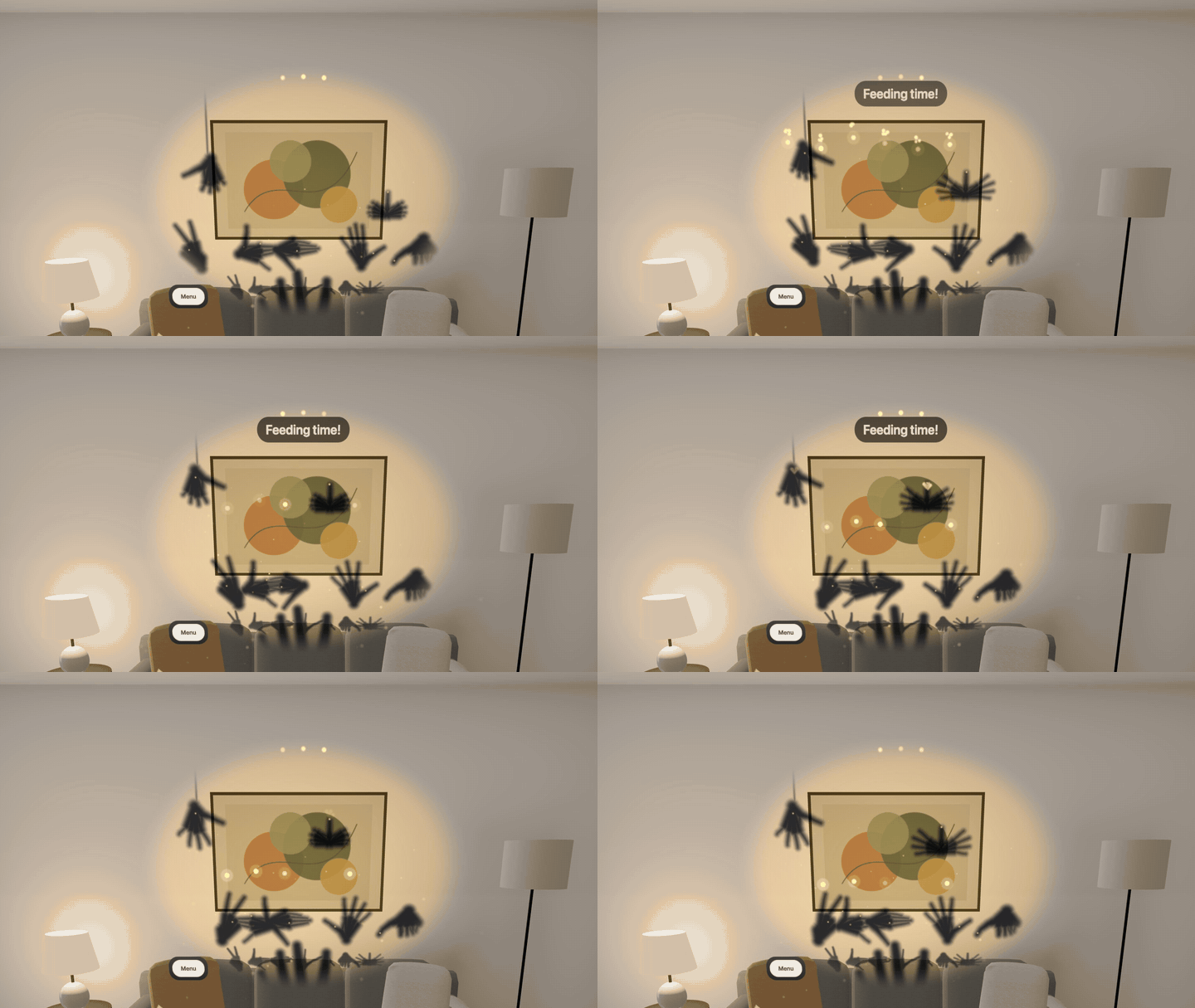
Feeding time: the keeper rings, and fireflies shower down for everyone.
-
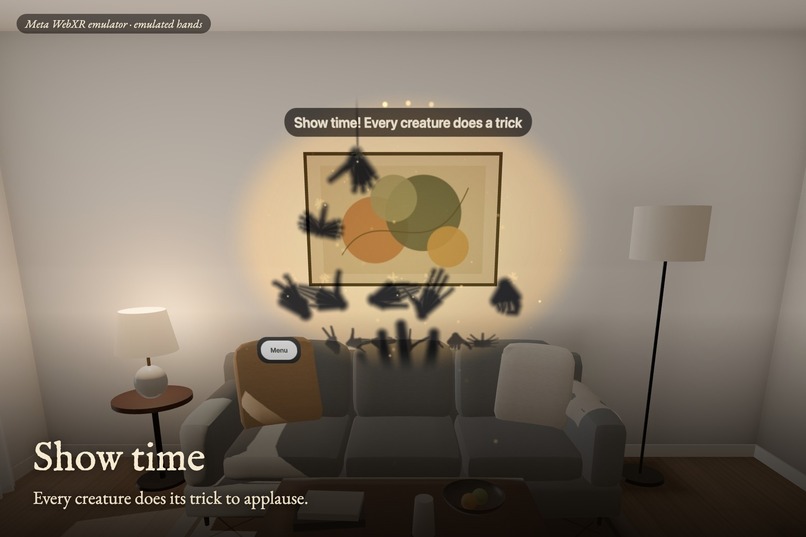
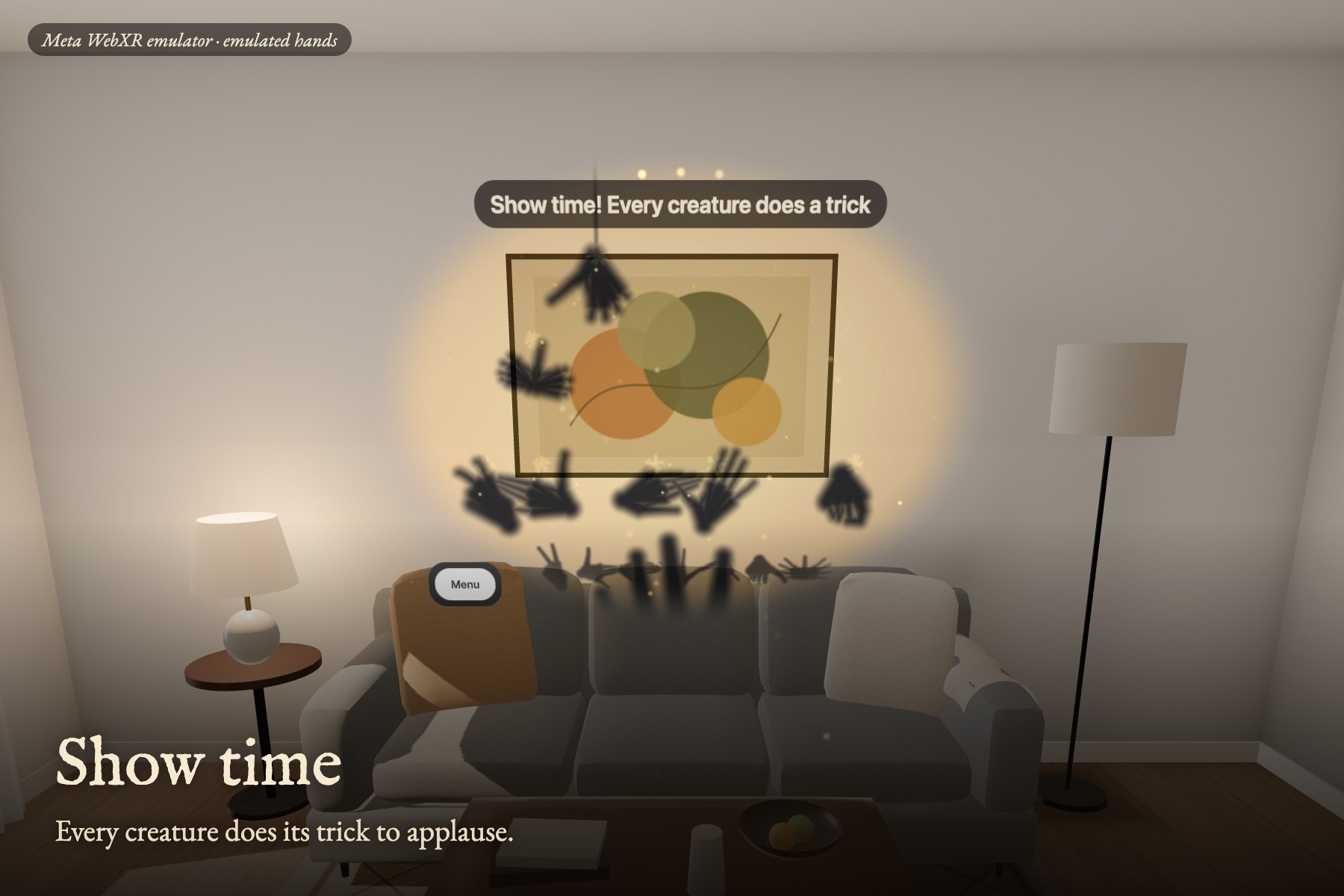
Show time: every creature does its trick to applause.
-
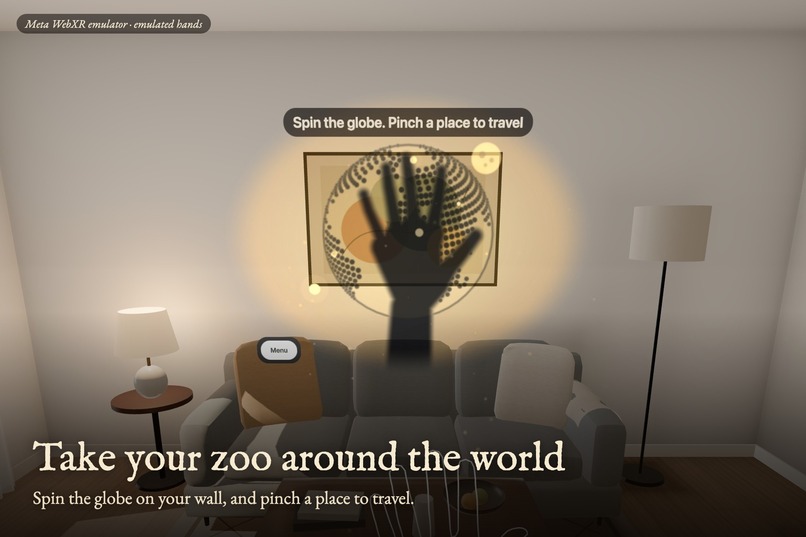
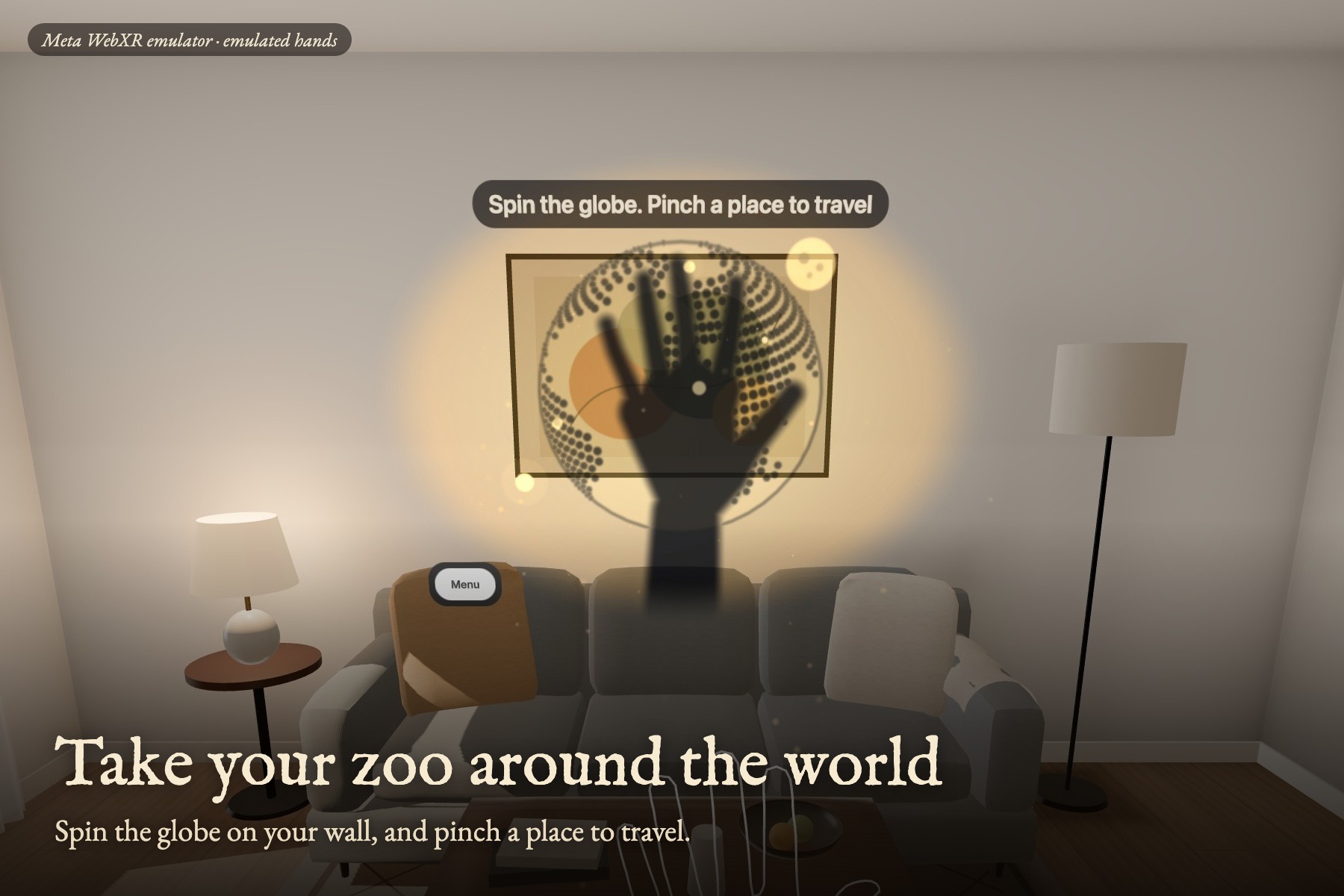
Take your zoo around the world: spin the globe on your wall, and pinch a place to travel.
-
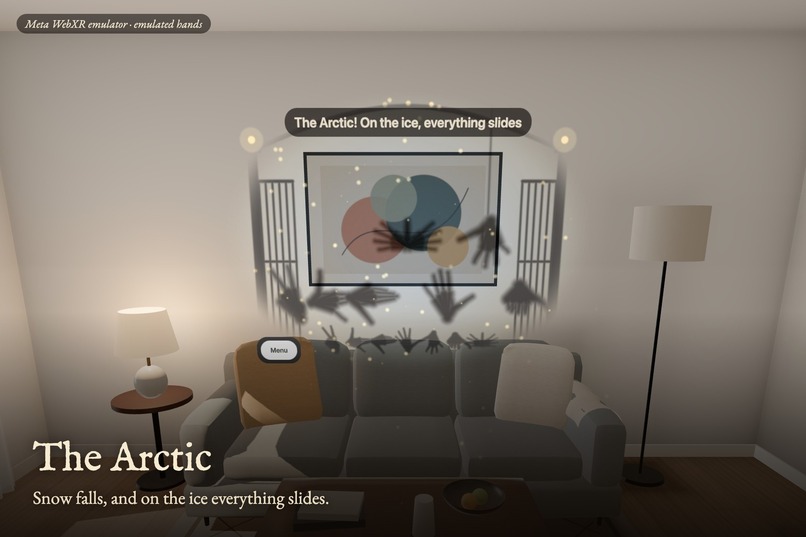
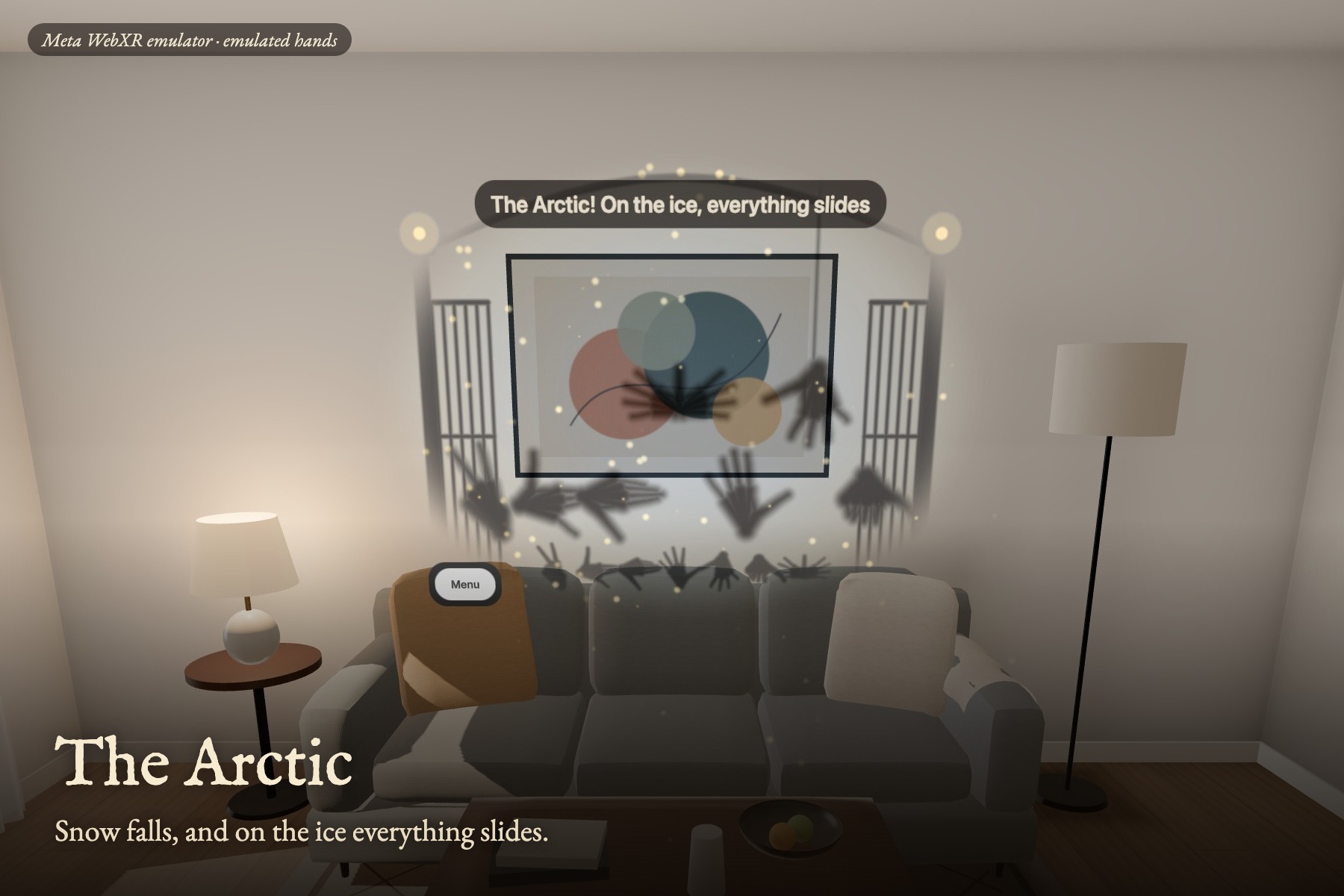
The Arctic: snow falls, and on the ice everything slides.
-
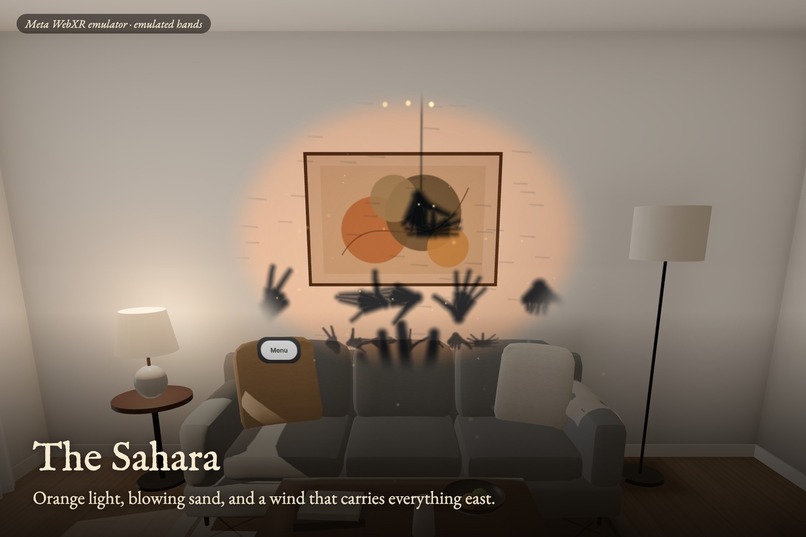
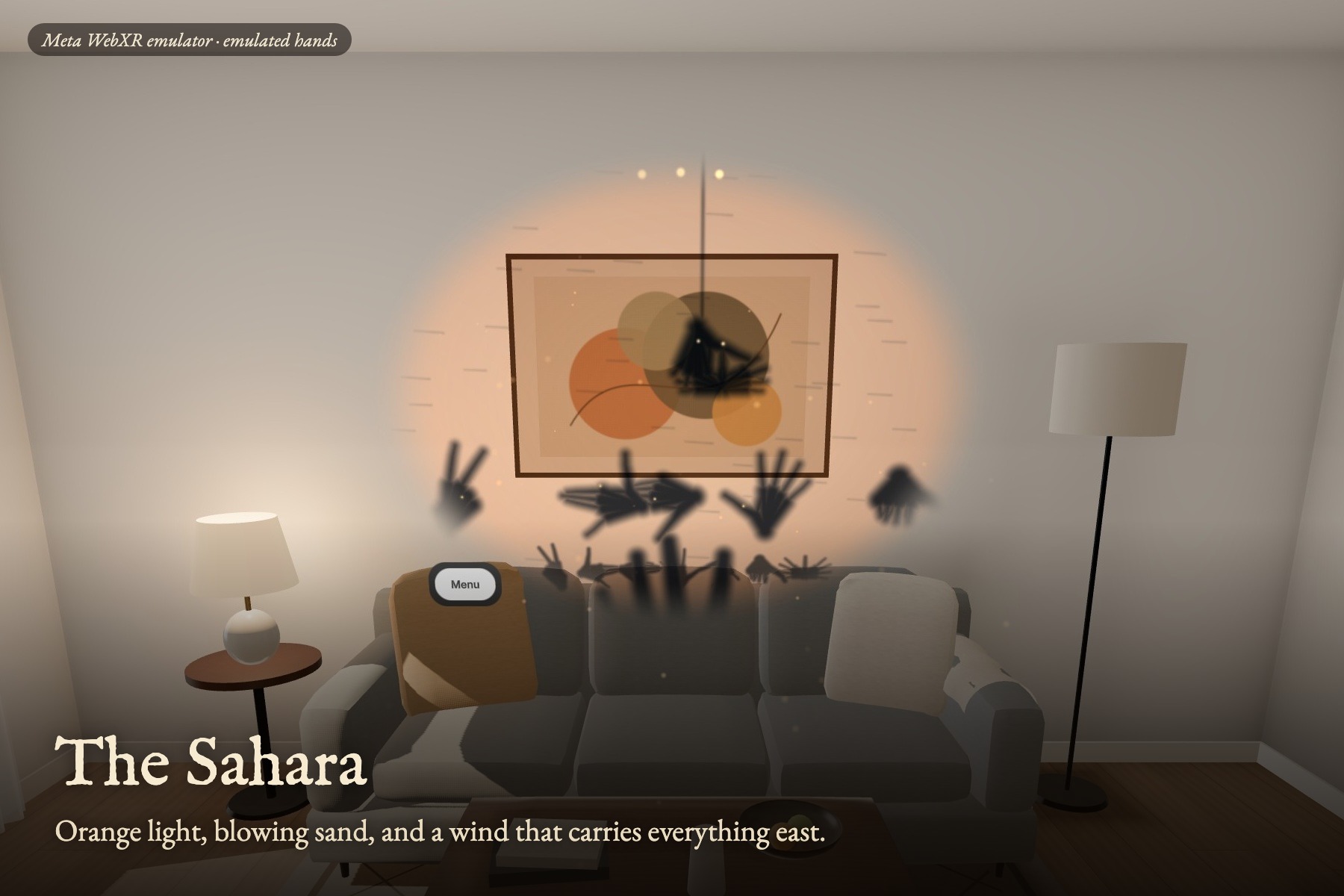
The Sahara: orange light, blowing sand, and a wind that carries everything east.
-
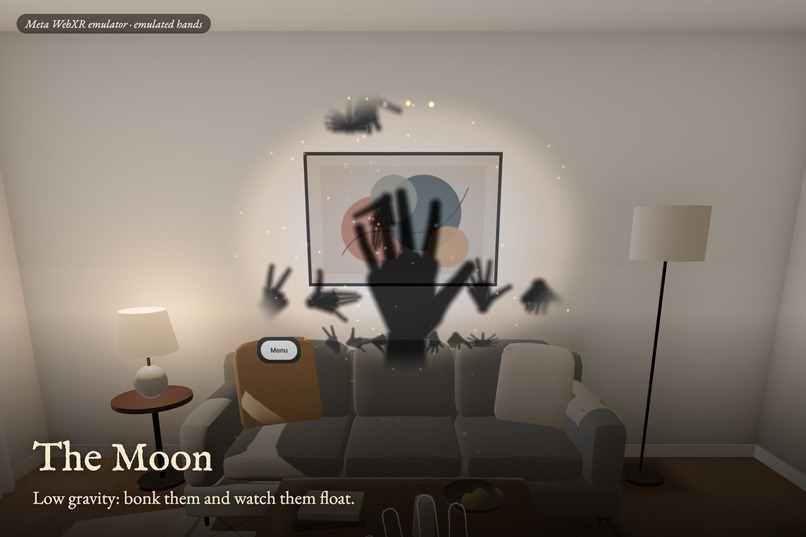
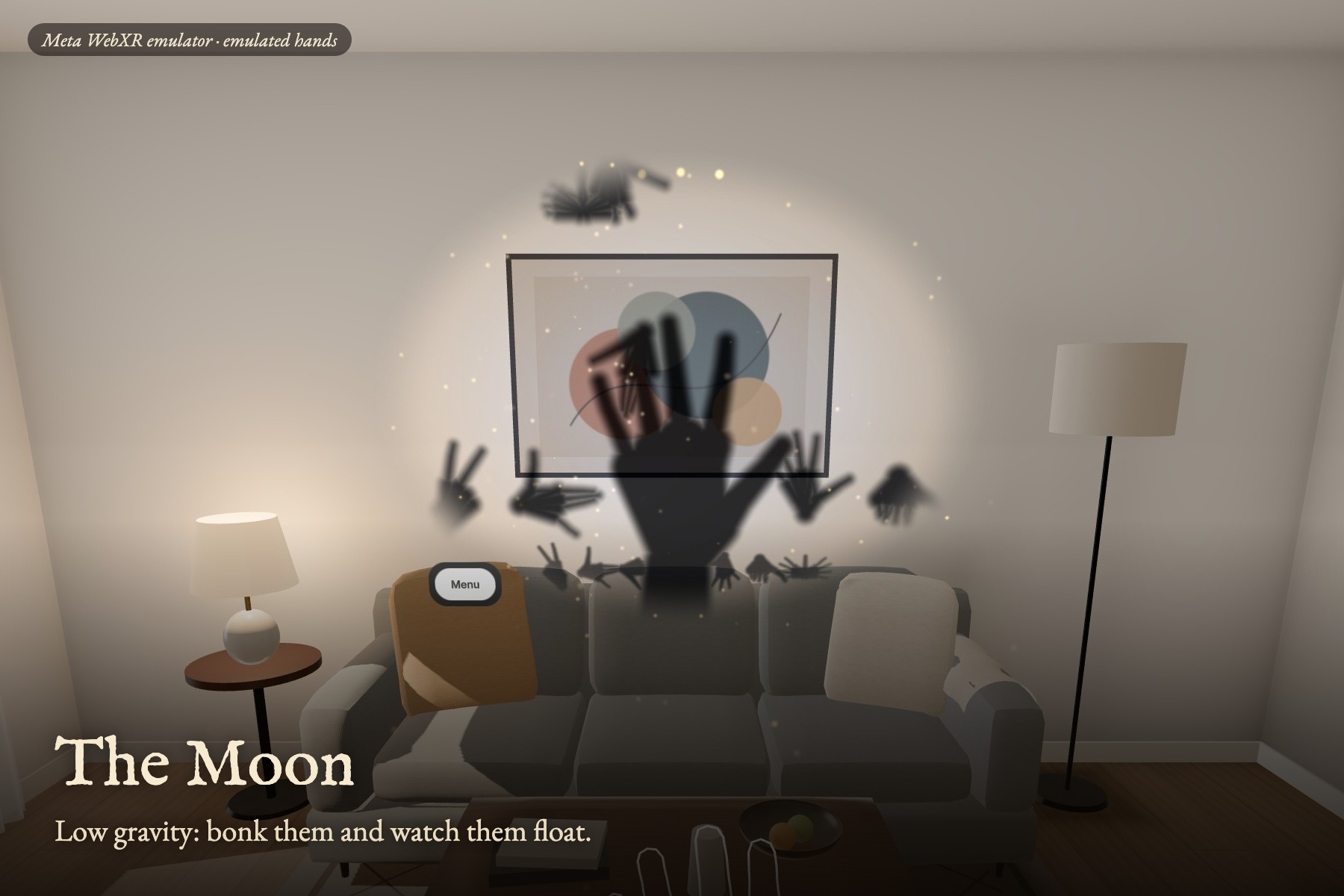
The Moon: low gravity. Bonk them and watch them float.
-
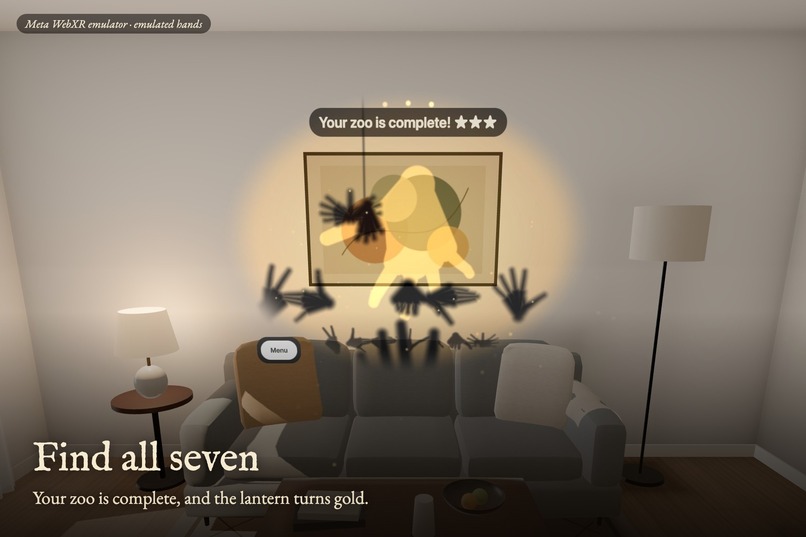
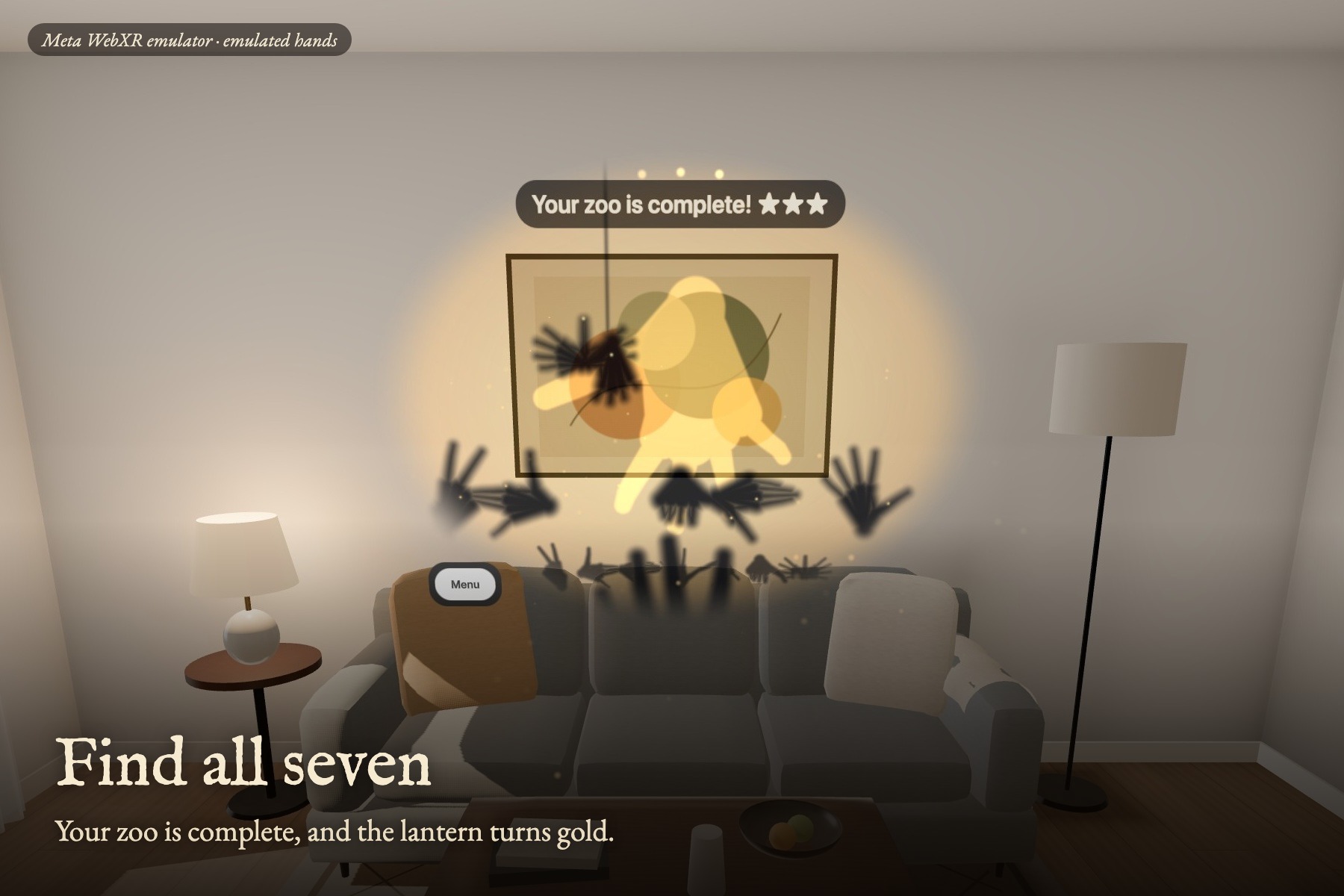
Find all seven: your zoo is complete, and the lantern turns gold.
-
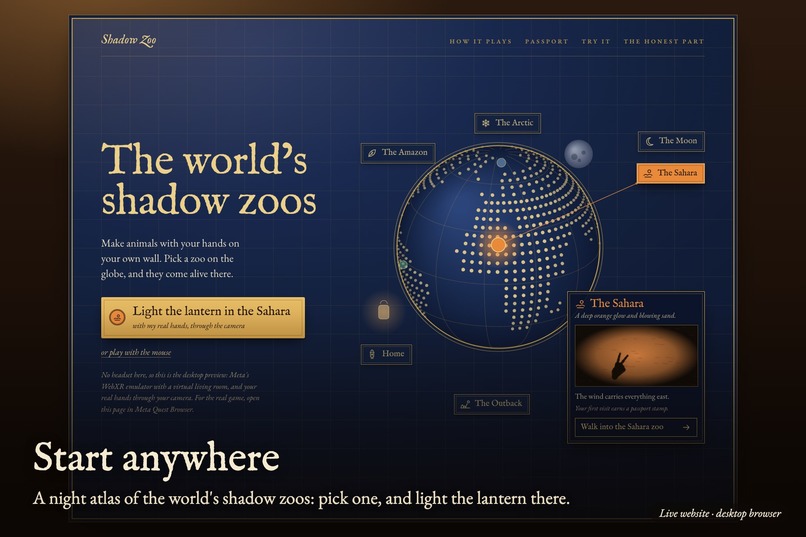
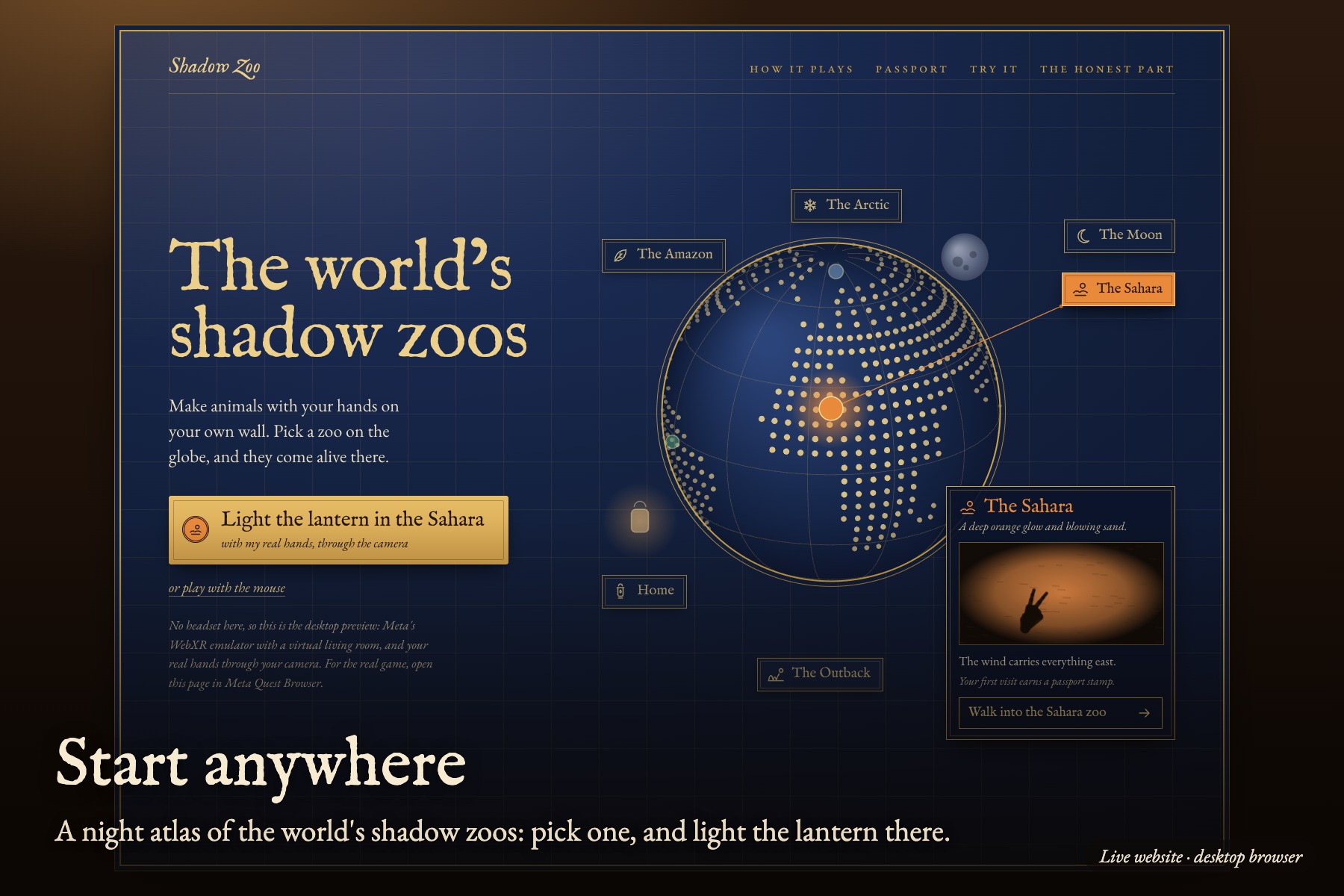
Start anywhere: a night atlas of the world's shadow zoos. Pick one, and light the lantern there.
-
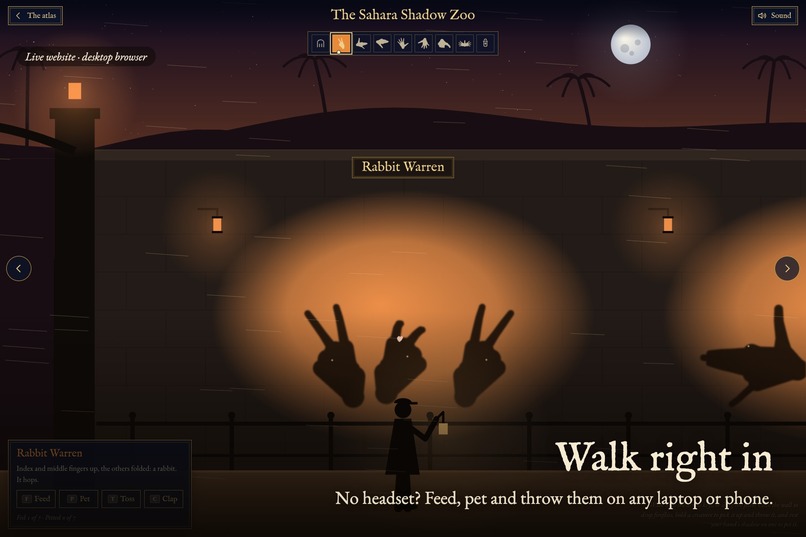
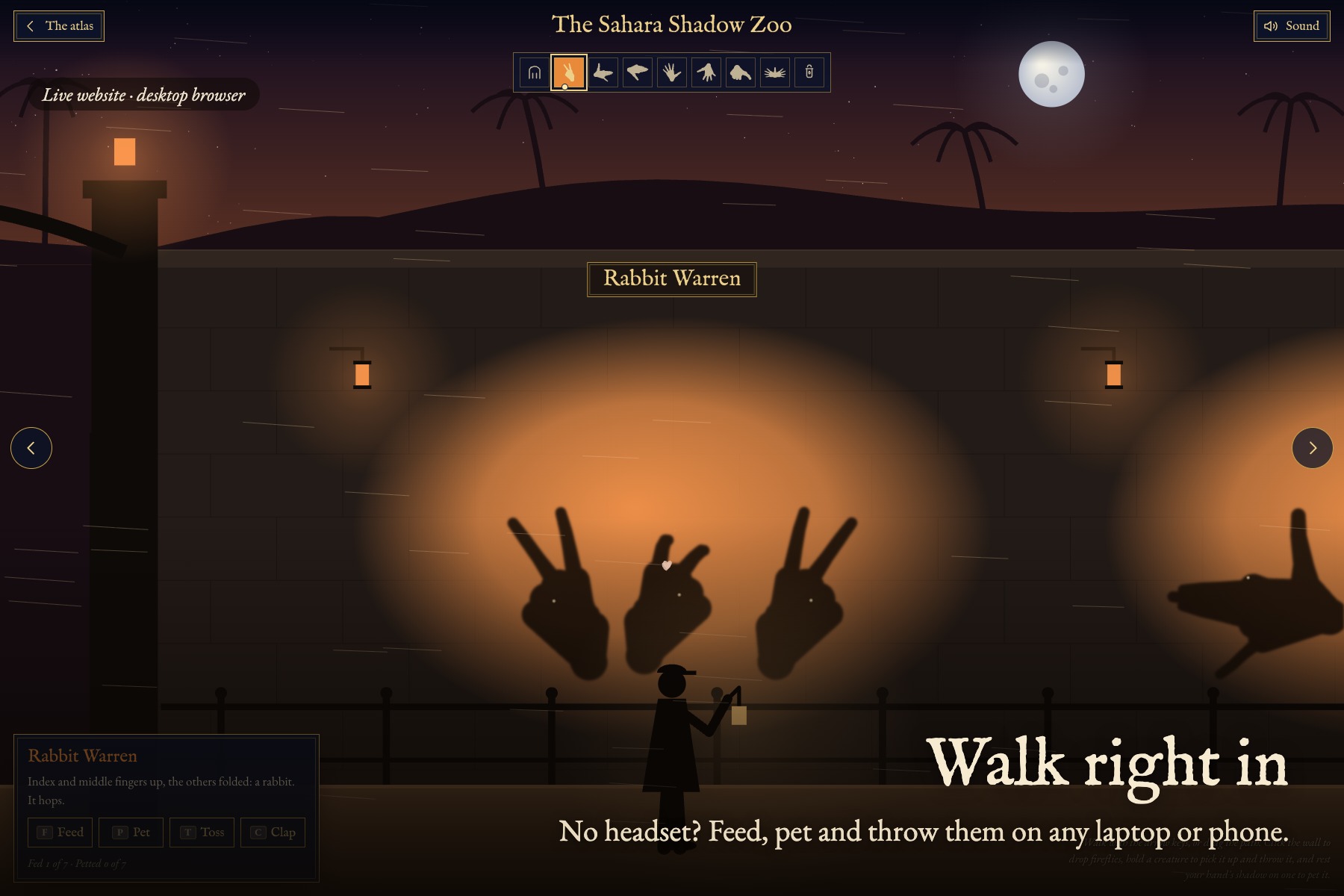
Walk right in: no headset? Feed, pet and throw them on any laptop or phone.
-
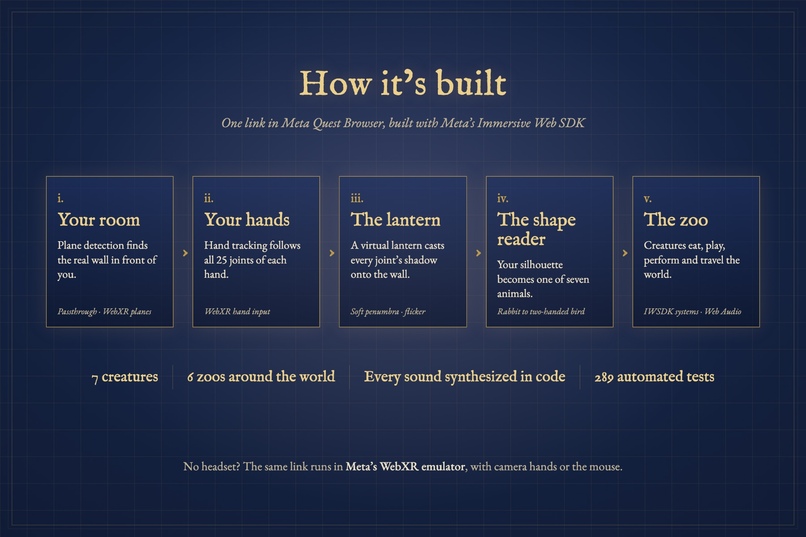
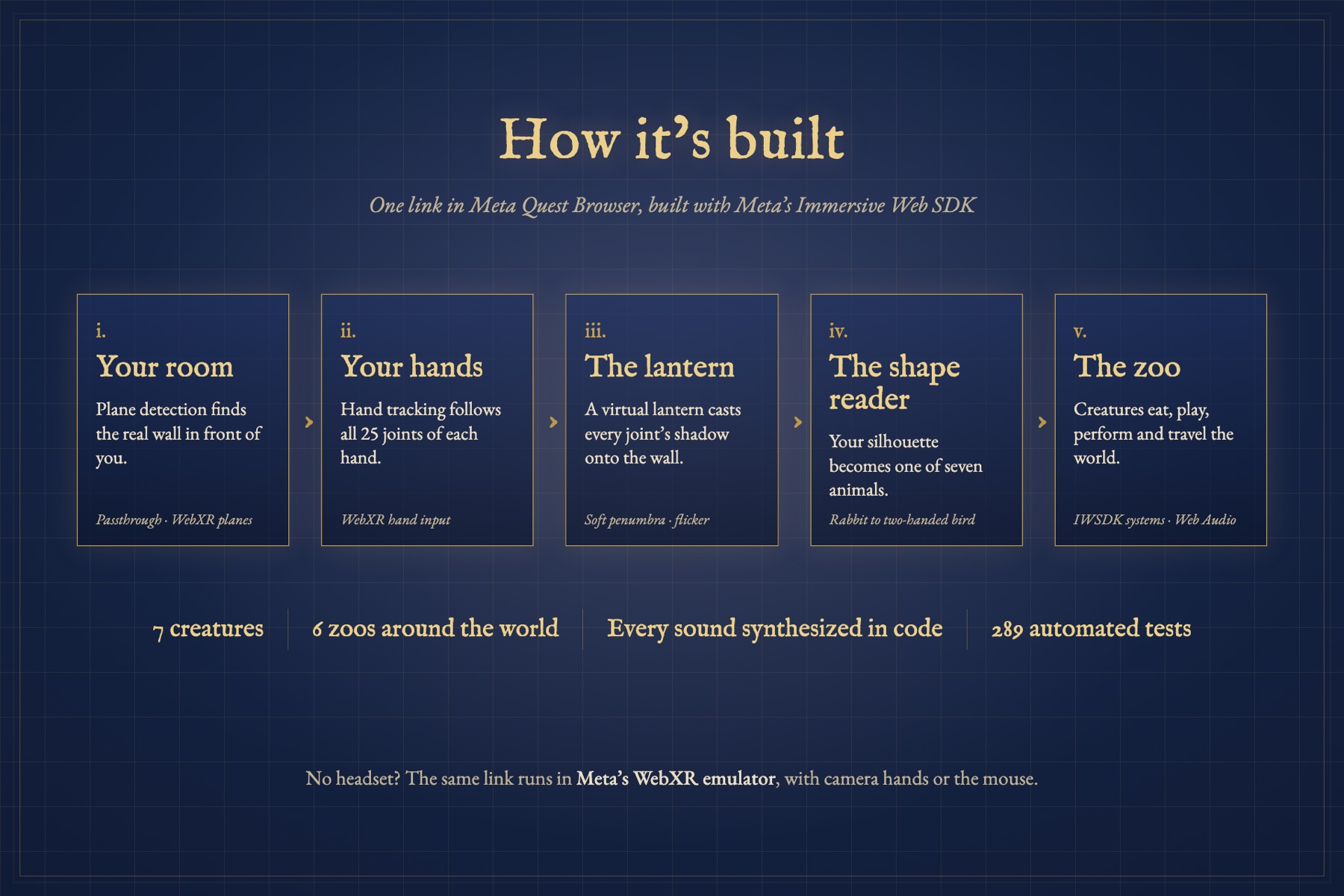
How it's built: plane detection, hand tracking, a virtual lantern, the shape reader and the zoo.
Inspiration
Every kid has made a rabbit on the wall with a flashlight. We wanted the moment your hand becomes an animal to keep going: what if the shadow hopped off your hand, and stayed?
What it does
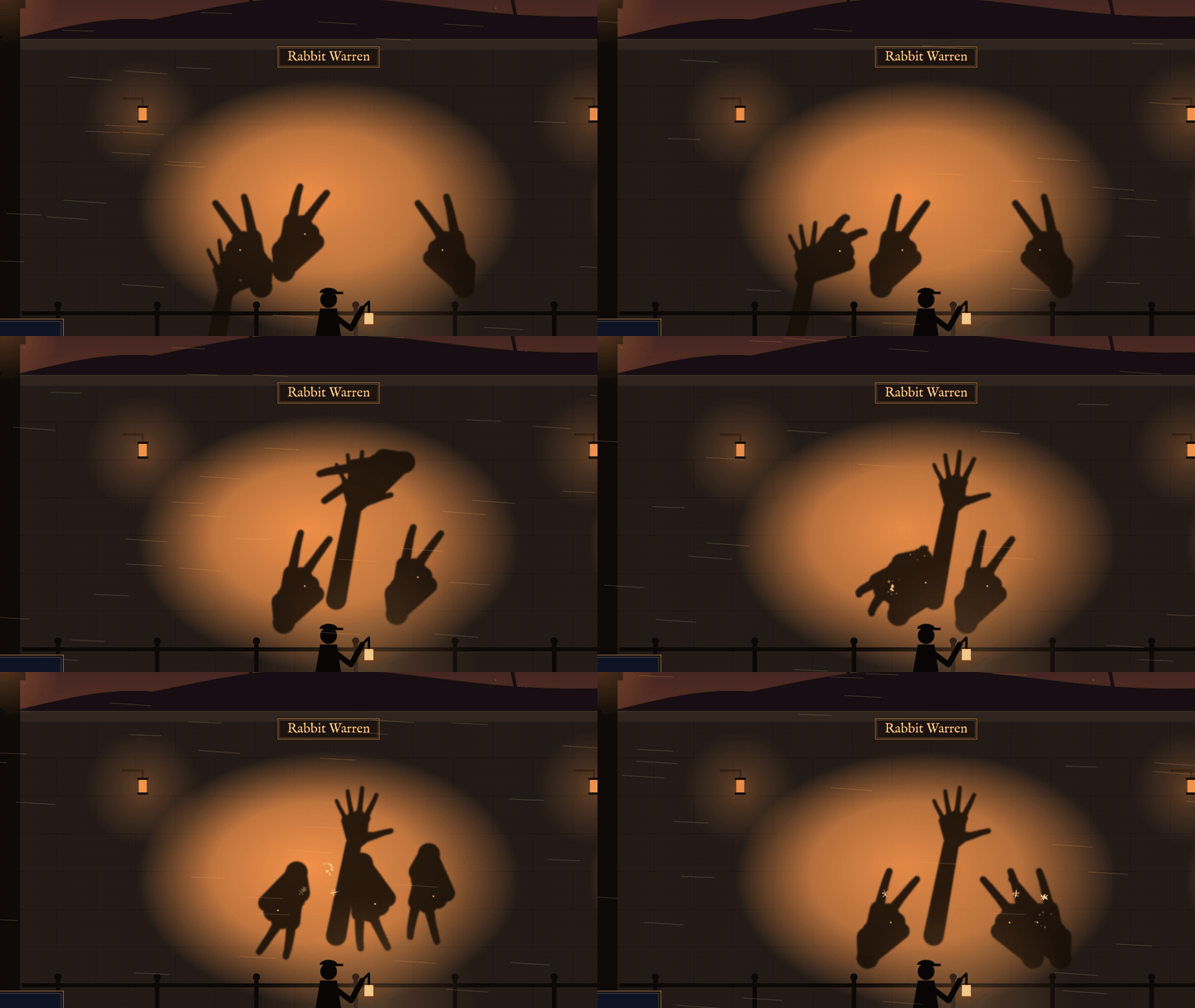
Shadow Zoo turns the wall in front of you into a stage. A warm lantern glows behind you and lights your real wall. A glowing outline appears: a rabbit. Shape your hand until its shadow fits, and the rabbit wriggles free, hops along your wall and blinks at you.
Seven creatures wait to be discovered, each a real shadow puppet with its own personality: rabbit, dog, crocodile, peacock, spider, turtle, and the bird, which takes both hands. Hook your thumbs, spread your fingers, and it takes wing.
Then you play with them, using nothing but your hands:
- Feed: pinch to release a firefly, and your creatures chase it down.
- Pet: rest your shadow on a creature to earn hearts. At three hearts it learns a trick.
- Wear: make a creature's shape and become it. Snap its jaw and your dog barks, and the rabbits scatter.
- Grab and throw: pinch a creature to pick it up. It dangles and protests in its own voice; let go mid-swing and it flies across your wall.
- Bonk: swipe fast and your shadow knocks creatures flying. They crash into each other in chain reactions, the combos get called out ("Double bonk!", "Zoo-quake!"), and everyone lands dizzy under twinkling stars.
- Clap: clap your hands and the whole zoo jumps.
A zoo day. The lantern lights on the zoo's gate swinging open on your wall. Then the zoo keeps a timetable like a real one: the keeper rings for feeding time and fireflies shower down for everyone, then calls show time, when every creature does its trick to applause. Pet a creature and its name plaque shows its hearts.
Travel the world. Open the Menu and pick World tour: a globe of light and shadow appears on your wall. Spin it with a pinch, and pinch a place to take your zoo there. Every zoo has its own light, weather, night sounds and rules: on Arctic ice thrown creatures slide, the Sahara wind blows everything east, the Amazon rain brings swarms of fireflies, everything bounces in the Outback, and on the Moon low gravity lets them float. Every first visit earns a passport stamp.
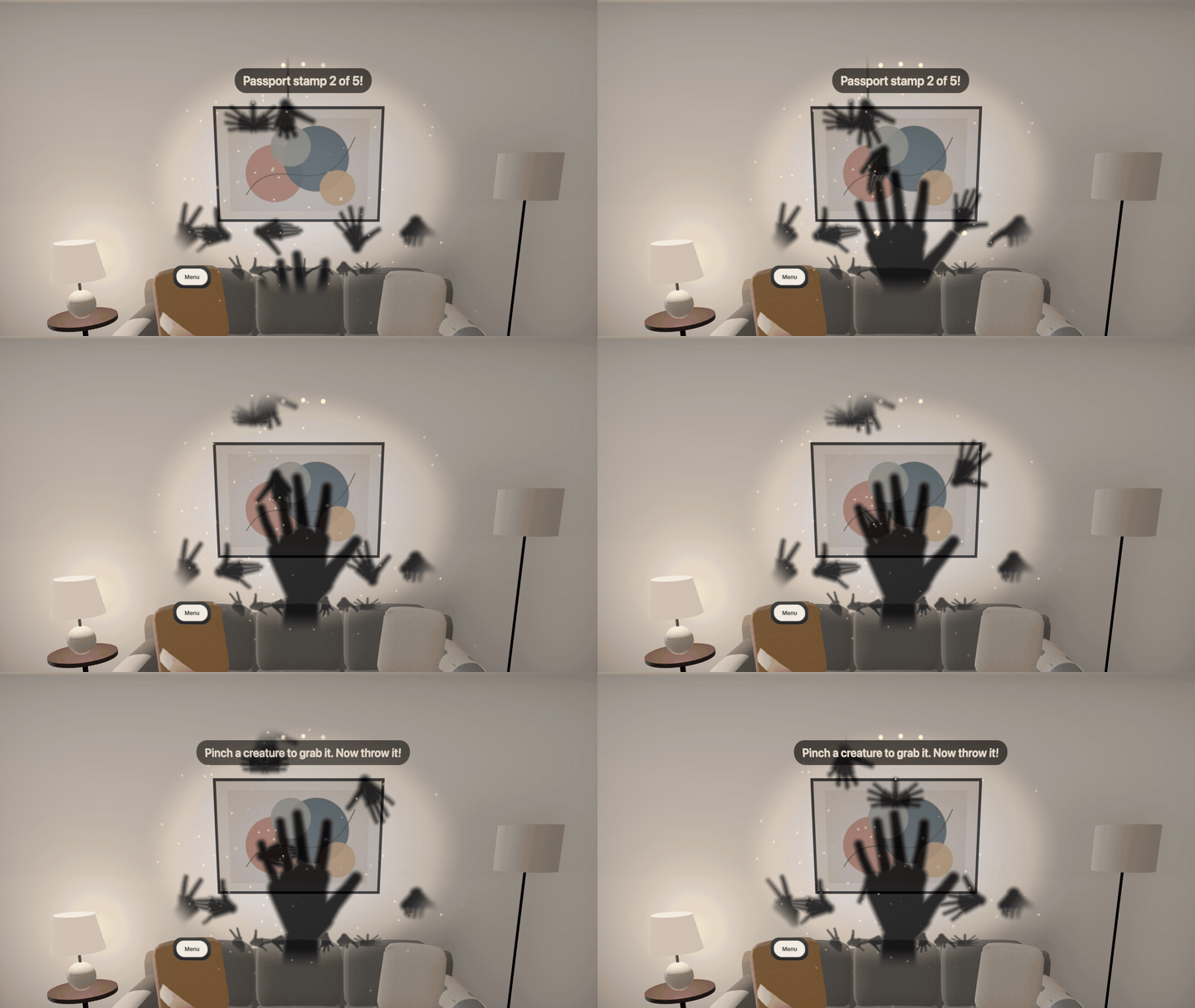
Every match earns up to three stars, a row of silhouettes on the wall shows who's still missing, and finding the last one sets off a finale and turns the lantern gold. Your zoo is saved and greets you tomorrow, and daily visitors bring a twist: a shy one you must hold perfectly still, or a big one that makes you bring your hand closer to the light.
In the headset it's hands-only and seated, with a complete moment in under ten minutes, and it only works with your real wall and your real hands.
Start anywhere. The homepage is a night atlas of the world's shadow zoos: spin the globe, pick a zoo and watch its rule play out live in a little lantern-lit legend (a rabbit's shadow tossed under that zoo's gravity, bounce, ice or wind, by the game's own physics), then light the lantern and the game starts there. Your passport stamps are waiting on the page when you come back.
Walk into the zoo. Every zoo on the homepage can be walked into, on any laptop, tablet or phone: a lantern-lit night zoo with a gate bearing its name, an enclosure for each of the seven creatures and a lantern house at the end. Your mouse or finger casts a hand shadow, so you feed, pet, grab, throw and bonk them under that zoo's rules (sliding on Arctic ice, blown east in the Sahara, floating on the Moon). Feed and pet everyone to finish the zoo's trail, then light the lantern to take the zoo home to your own wall.
How we built it
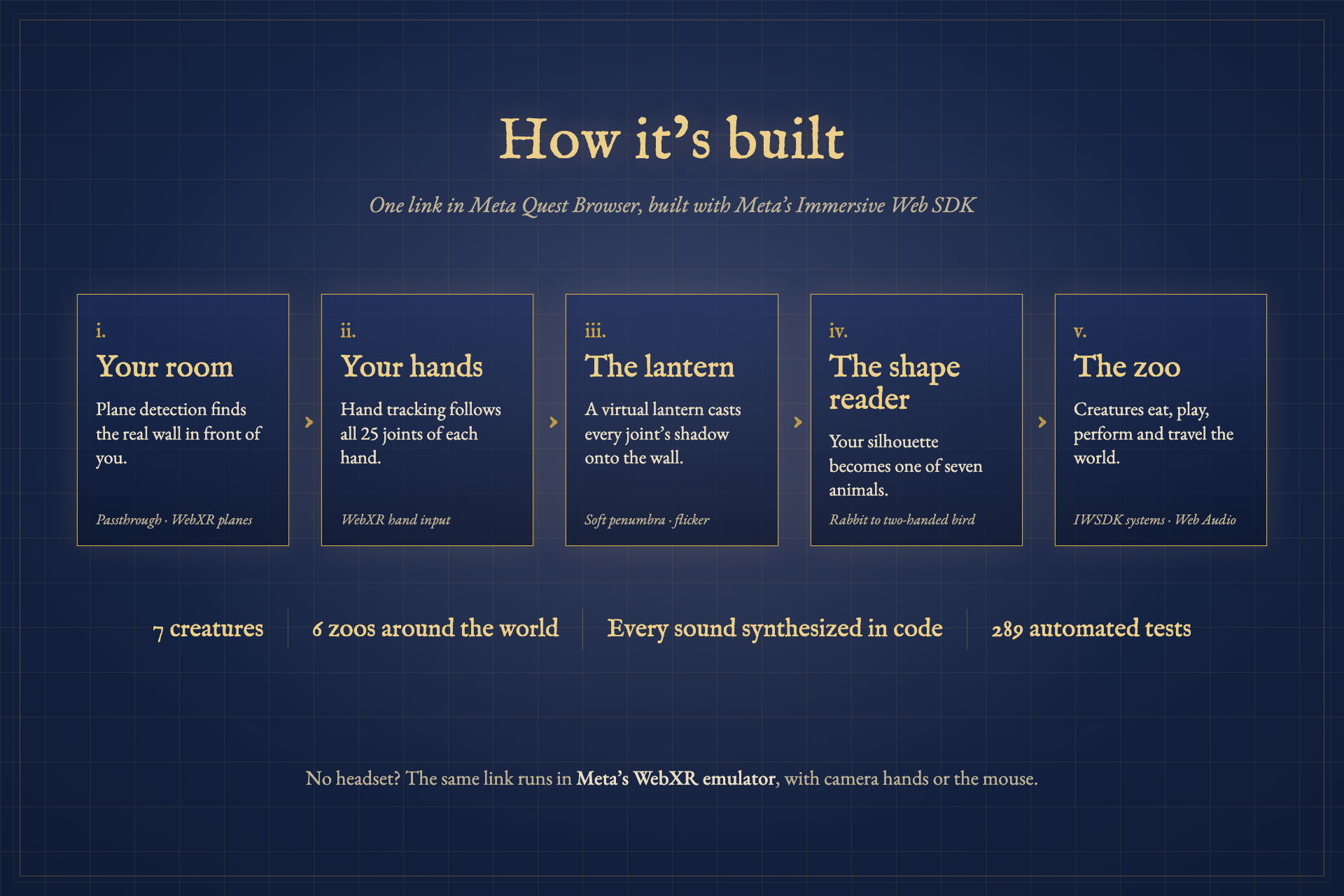 Figure 1. From your room to the zoo, in one link in Meta Quest Browser.
- Meta's Immersive Web SDK (WebXR): one link, nothing to install. Plane detection finds your wall; hand tracking gives 25 joints per hand.
- A shadow engine: each hand's bones are projected from a virtual flame onto the wall as soft capsules and composited over passthrough in a single pass, light enough for standalone hardware. Edges soften as your hand nears the lantern, and the flame flickers like candlelight.
- Designed for your field of view: the stage always covers the same 40 by 30 degrees of your view, however far away your wall is, so everything you need stays in the comfortable center on Quest 3 and 3S. A narrow view in the menu shrinks it further, and the menu opens at arm's reach in front of you.
- Shape matching: overlap plus a 64-direction radial signature, robust to hand size, rotation and tracking noise.
- Sound: every sound is synthesized live and placed on the wall in 3D.
- A globe of light and shadow: Natural Earth's public-domain coastlines, rasterized to a 5-degree grid, drawn as dots of shadow on an orthographic globe tipped toward you. Each place sets the lantern's color, the weather particles, a synthesized ambience and the physics rules: gravity, bounce, ice, wind and fireflies per pinch.
- The atlas homepage: the same Natural Earth globe drawn on a 2D canvas, spun with inertia by mouse, touch or keyboard; each zoo's legend runs the game's real creature physics and weather in miniature. Hand-drawn SVG glyphs, self-hosted open-licensed type (IM Fell English, EB Garamond), no external hosts.
- One zoo, two places to play it: the walk-in zoo on the website runs the game's own zoo logic and physics; a hand shadow cast from the game's open-hand pose follows the mouse or a finger, so feeding, petting, grabbing and chain bonks work exactly as they do with tracked hands in the headset.
- Realism, in code: creatures speed up, brake and turn round through side-on like real bodies, and their hops follow the ground they cover. Every sound rings softly in your own room through a room echo generated in code, the night is a chorus of individual crickets rather than a single buzz, and fireflies flash on their own rhythms. Still no audio files: every sound is synthesized.
Challenges we ran into
- Telling creatures apart. Hand silhouettes share a big palm blob, so a plain overlap score confused them (0.83 between two creatures). The radial signature cut the worst confusion to under 0.4, against a match threshold of 0.62.
- Finding the right wall. A picture frame was detected as the wall. The game now prefers real walls by size and label, and falls back to a paper screen when no wall is found.
- A crowded wall. Six creatures merged into one dark blob. The zoo now shrinks to a shared size and walkers spread into the gaps; overlaps fell from about 30% to under 10%.
- Two hands, one shadow. The bird scores both hands together and keeps their true spacing.
Accomplishments that we're proud of
- A complete game with no controllers and no reading: a glowing ghost hand teaches every shape.
- Shadows that behave like real light, cheap enough for standalone hardware.
- Playable anywhere: on Quest with your hands, on any computer even with your real hands through a webcam, and on any phone by walking into a zoo on the page.
- 289 automated tests and an emulator drill that brings all seven creatures to life.
What we learned
Hands-first design is mostly about forgiveness: real hands shake, so matching must tolerate noise, holds must be short, and every shape needs a demonstration. And mixed reality is at its most magical when the game borrows something real: your wall, and your hands.
What's next for Shadow Zoo
More two-handed creatures, a shadow-theater mode for performing stories, and shared zoos you can visit with friends. Target launch: March 2027, as a free web app for Meta Quest.
How to try it
- Meta Quest 3 or 3S: open https://ankitlade12.github.io/shadow-zoo/ in Meta Quest Browser, sit facing a wall in a lit room and put your controllers down. Press Light the lantern, and allow hand tracking and spatial data when asked.
- No headset: the same link opens a desktop preview in Meta's WebXR emulator. Play with your real hands through your webcam (tracked on your device, never recorded or sent), or with the mouse, where keys 1 to 7 make the shapes.
- Any laptop or phone: pick a zoo on the homepage and walk right in.
- The demo video is real gameplay, recorded in Meta's WebXR emulator with emulated hand tracking and on the live site, and says so on screen.
Built With
- github
- immersive-web-sdk
- mediapipe
- meta-quest
- natural-earth
- three.js
- typescript
- vite
- vitest
- web-audio-api
- webxr

