Inspiration
We have all seen projects that start with great ideas but slowly fall behind schedule, exceed budgets, or fail completely. The frustrating part is that teams often realize something is wrong only when it is already too late. We wanted to understand what happens behind the scenes before a project fails. What was the first warning sign? Which decision caused the biggest impact? Could the failure have been prevented?
This led us to build Project Autopsy. Inspired by the way investigators analyze an incident to find its root cause, we wanted to create a system that investigates the hidden patterns behind project failures. Our goal was not just to tell teams that a project is at risk, but to help them understand why, learn from the past, and make better decisions in the future.
What it does
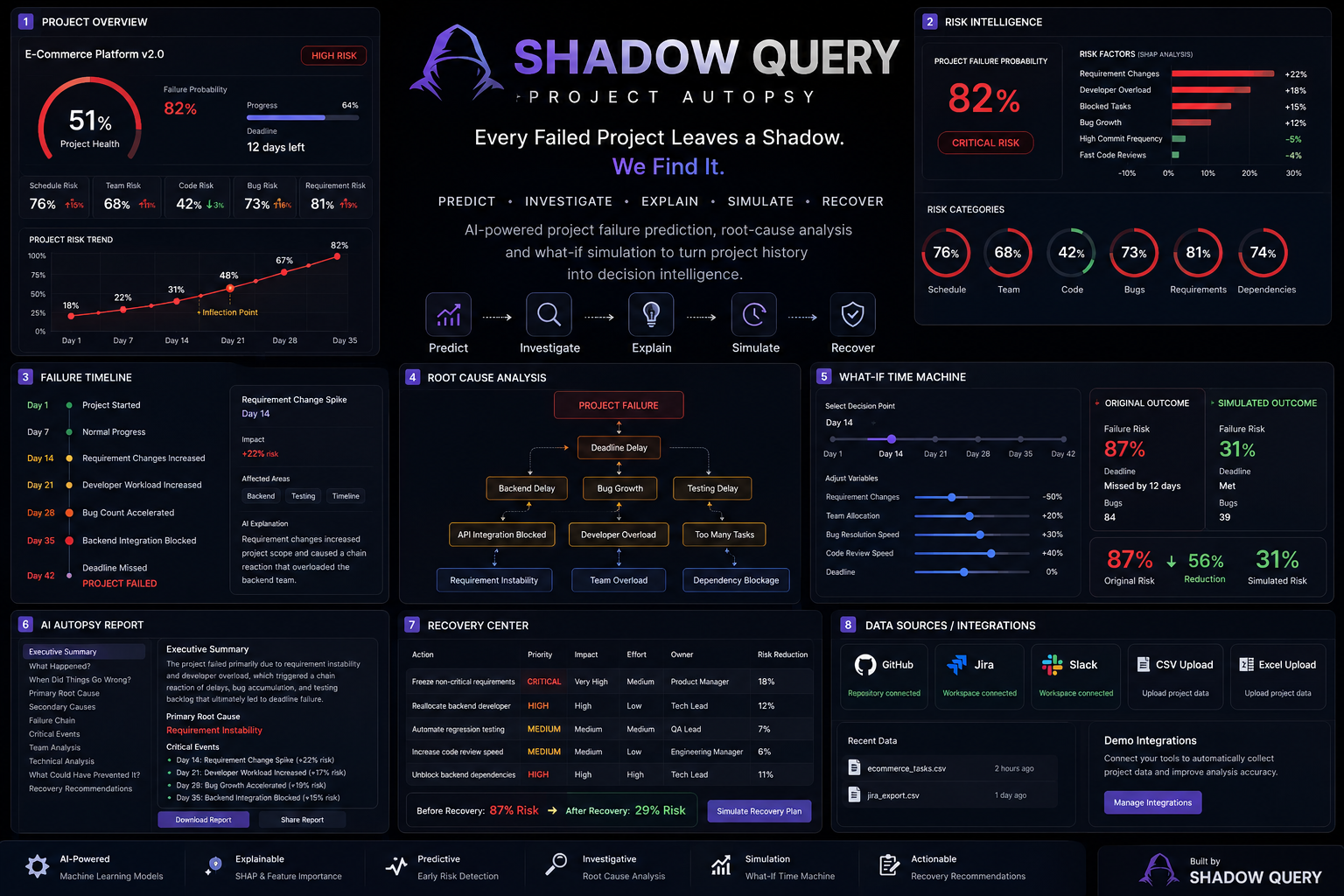
Project Autopsy is an AI-powered project intelligence platform that helps teams understand, predict, and prevent project failures.
It analyzes project information such as tasks, deadlines, team workload, bugs, development activity, requirement changes, and project timelines. Using Machine Learning and Explainable AI, it calculates the project's health and predicts the probability of failure.
The platform then goes deeper by identifying the major root causes and showing how different events are connected through an interactive failure chain. Its unique "What-If" simulation allows teams to explore alternative decisions and see how the project outcome might have changed.
In simple terms, Project Autopsy helps teams answer three important questions: What went wrong? Why did it happen? And what could we have done differently?
How we built it
We built Project Autopsy by combining modern web technologies, Machine Learning, and Generative AI.
The frontend was designed as an interactive dashboard where users can view project health, risk levels, timelines, root causes, and AI-generated insights. On the backend, we created a data processing layer that converts project activity into meaningful indicators such as task delays, workload, bug growth, requirement changes, and development trends.
For failure prediction, we use Machine Learning models to identify patterns associated with project risks. Explainable AI helps us understand which factors contributed most to a prediction. We then use Generative AI to turn these insights into understandable root-cause explanations and practical recommendations.
We also designed a simulation layer that allows users to explore "what-if" scenarios and understand how different decisions could potentially change the project's outcome.
Challenges we ran into
One of our biggest challenges was deciding how to convert complex and sometimes unstructured project information into meaningful data that an AI system could understand. Project failure is rarely caused by a single factor, so identifying relationships between deadlines, team workload, bugs, requirements, and development activity was challenging.
Another challenge was making the AI predictions explainable. We did not want to build a black-box system that simply says "this project will fail." We wanted the system to explain the reasons behind its prediction in a way that a project manager or team member could actually understand.
We also had to balance the ambition of our idea with the limited time available during the hackathon. We focused on building a strong end-to-end prototype with a clear user experience rather than trying to implement every possible integration.
Accomplishments that we're proud of
We are proud that we were able to turn a simple question—"Why do projects fail?"—into a complete AI-driven investigation platform.
One of the features we are most proud of is the ability to connect different warning signs and present them as a failure chain instead of showing isolated numbers. We also wanted to go beyond prediction, so we introduced the idea of "What-If" simulation, allowing users to explore how different decisions might have changed the project's outcome.
We are also proud of creating a system that combines Machine Learning, Explainable AI, Generative AI, and interactive data visualization into one platform. Most importantly, we built Project Autopsy with the goal of making complex project data easier for real teams to understand and act upon.
What we learned
This project taught us that building a good AI solution is not just about choosing the right model. The quality and structure of the data, the way insights are explained, and the overall user experience are equally important.
We learned how difficult it can be to identify meaningful patterns from project data and how important explainability is when AI is used to support decision-making. We also learned that a successful product should not simply identify a problem—it should help users understand the problem and guide them toward a possible solution.
Most importantly, we learned the value of building as a team. Combining different ideas, dividing responsibilities, testing assumptions, and continuously improving our approach helped us turn an initial concept into a working prototype.
What's next for Project Autopsy
Our vision for SHADOW QUERY goes beyond Project Autopsy. We want to evolve it into a complete AI-powered project decision intelligence platform.
Our next step is to integrate real-world platforms such as GitHub, Jira, Slack, and CI/CD tools so that teams can analyze live project data instead of relying only on manually uploaded information. We also plan to improve our Machine Learning models using larger and more diverse project datasets.
In the future, we want to make the platform more proactive. Instead of waiting for a project to fail, SHADOW QUERY should continuously monitor project health, detect early warning signals, explain emerging risks, and recommend actions before problems become critical.
Our long-term vision is simple: help teams learn from every project, turn failures into insights, and make better decisions before it's too late.
Built With
- agentic-ai
- artificialintelligence
- explainable-ai
- express.js
- fastapi
- generative-ai
- machine-learning
- node.js
- pandas
- python
- risk-prediction
- shap
- typescript
- xgboost

Log in or sign up for Devpost to join the conversation.