
Inspiration
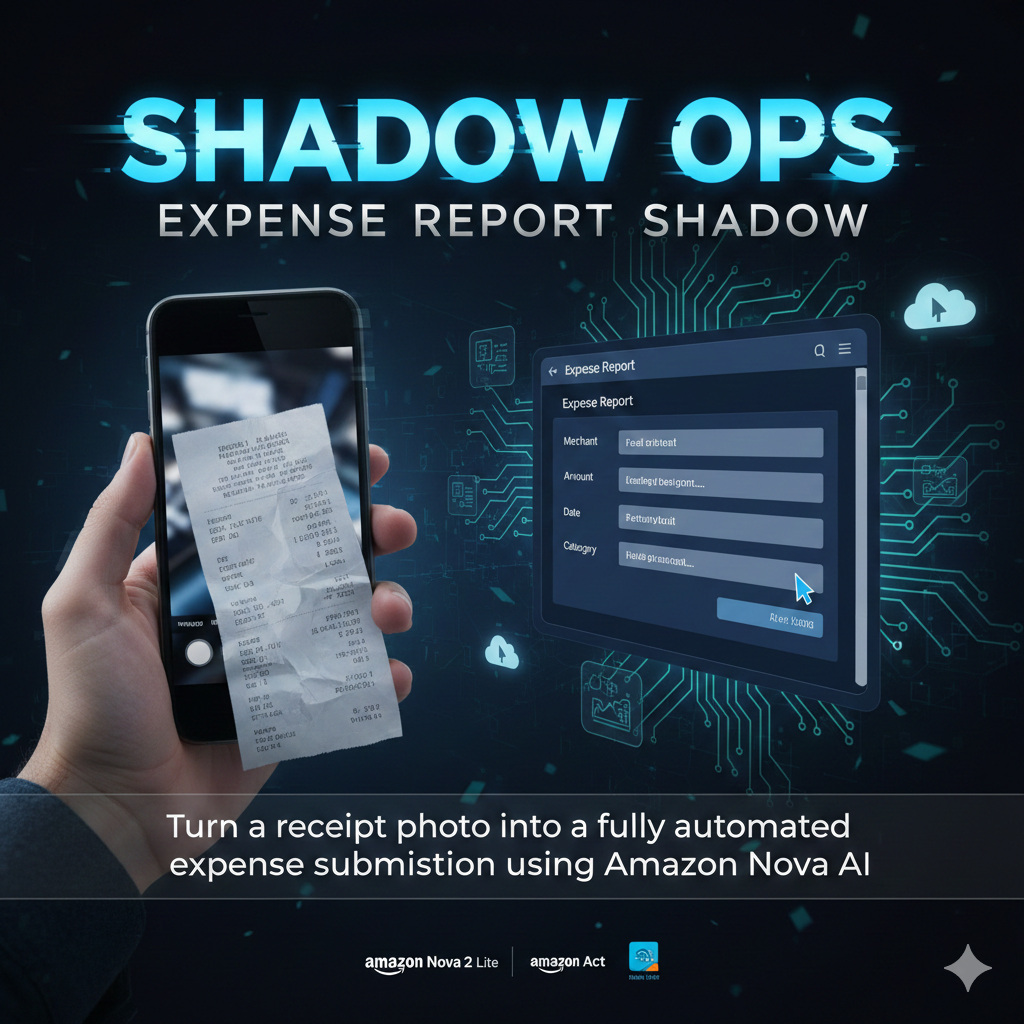
Expense reporting is universally hated. Employees spend 20+ minutes per report filling the same forms with the same data that's already on their receipts. I asked: what if an AI could look at a receipt, figure out what needs to happen, and do it — filling the actual form in a real browser?
What it does
Shadow Ops automates the entire expense submission pipeline:
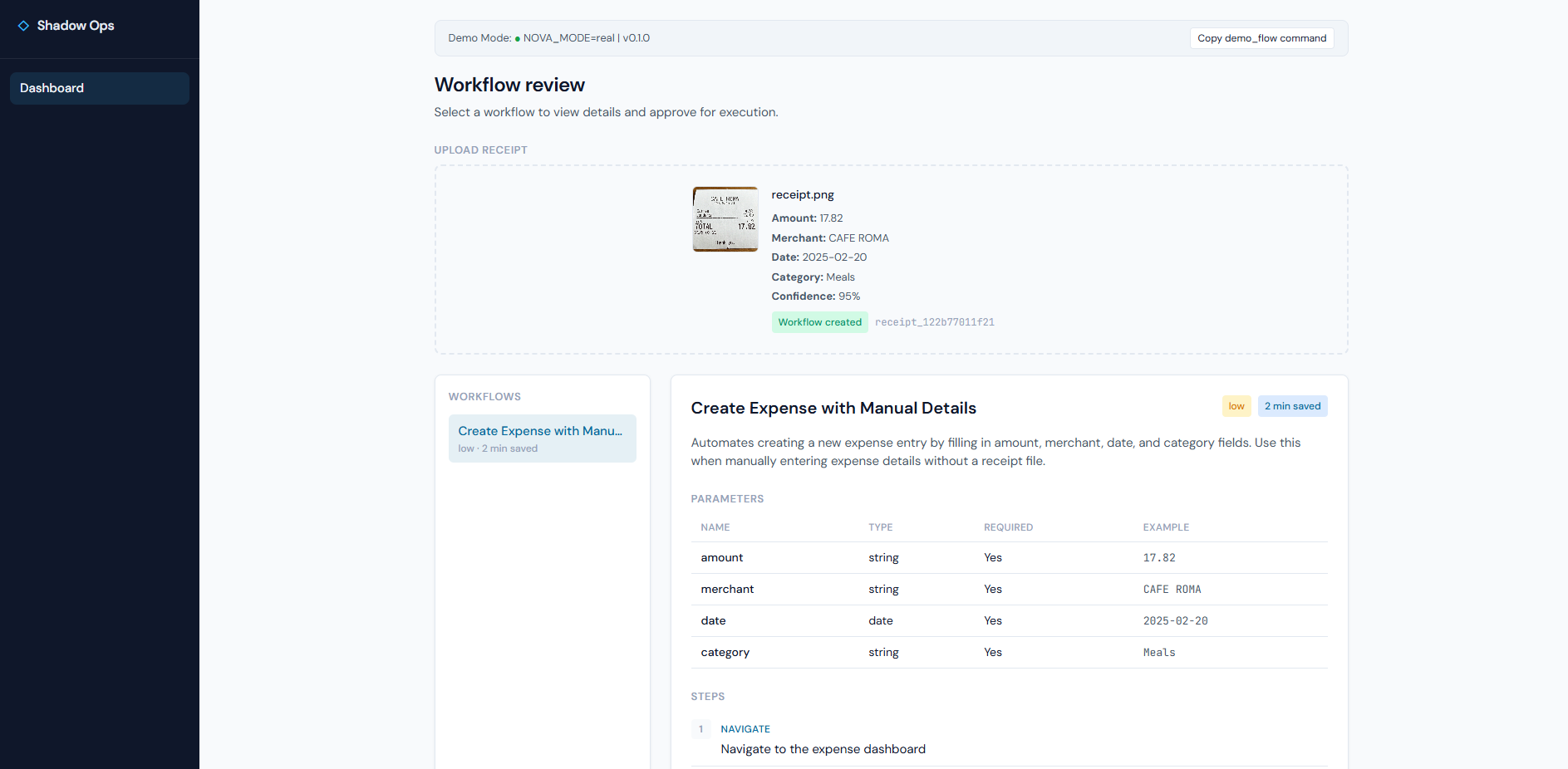
- Snap — Upload a receipt photo from your phone or desktop.
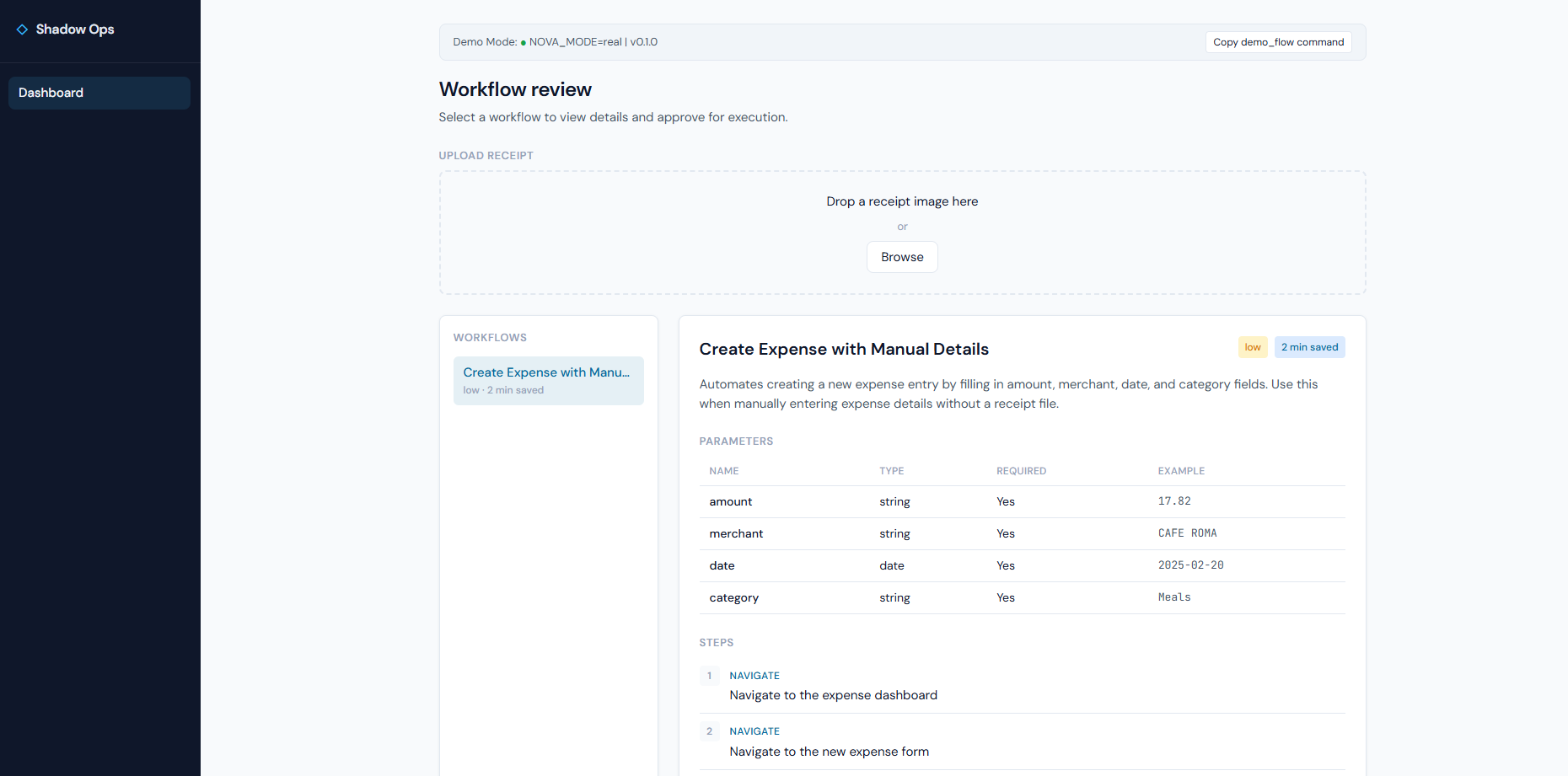
- Extract — Amazon Nova 2 Lite reads the receipt and extracts amount, merchant, date, category, and currency using multimodal AI.
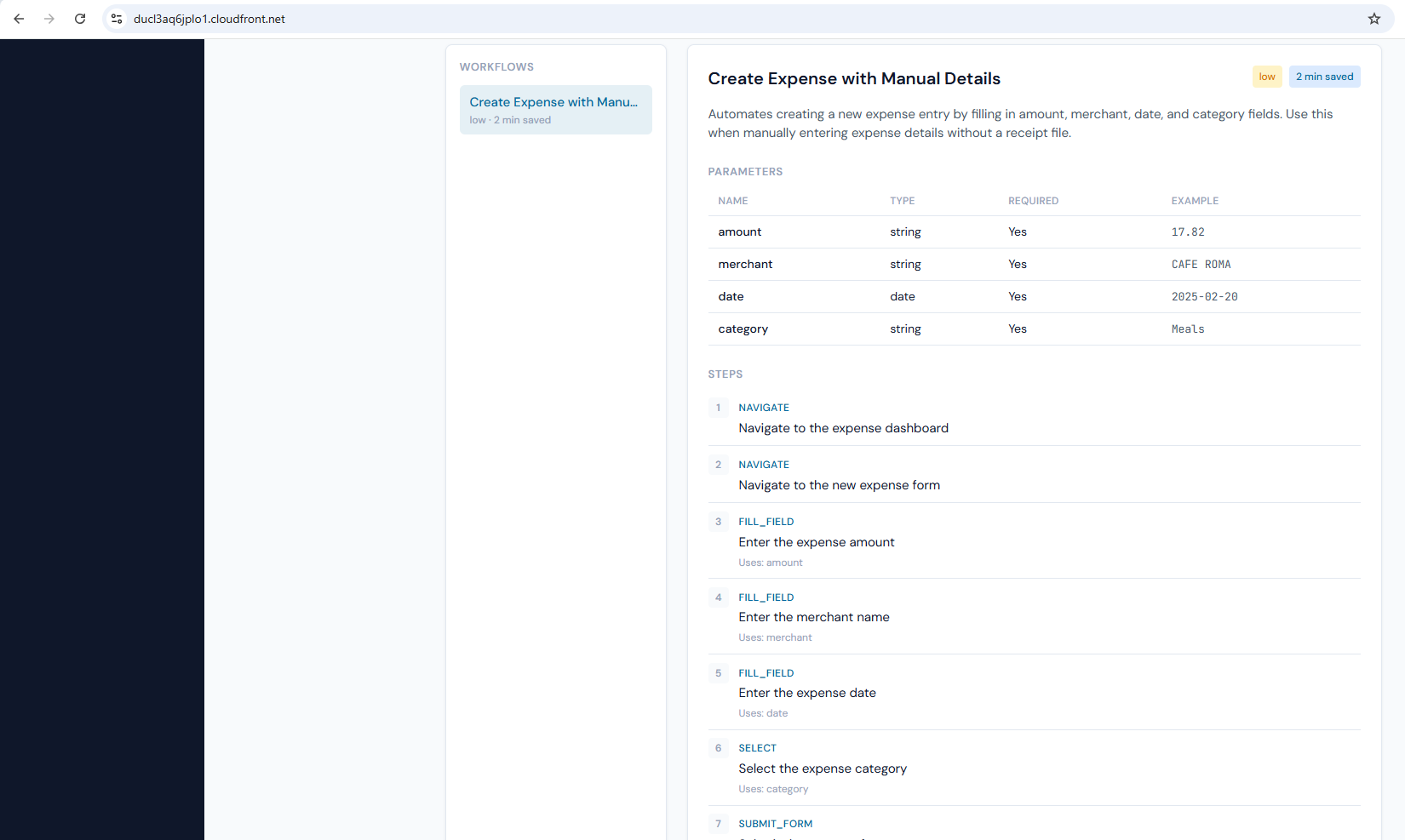
- Infer — The same model analyzes the extracted data and infers a complete automation workflow: what fields to fill, in what order, with what values.
- Approve — A human reviews the inferred workflow and approves it (human-in-the-loop safety gate).
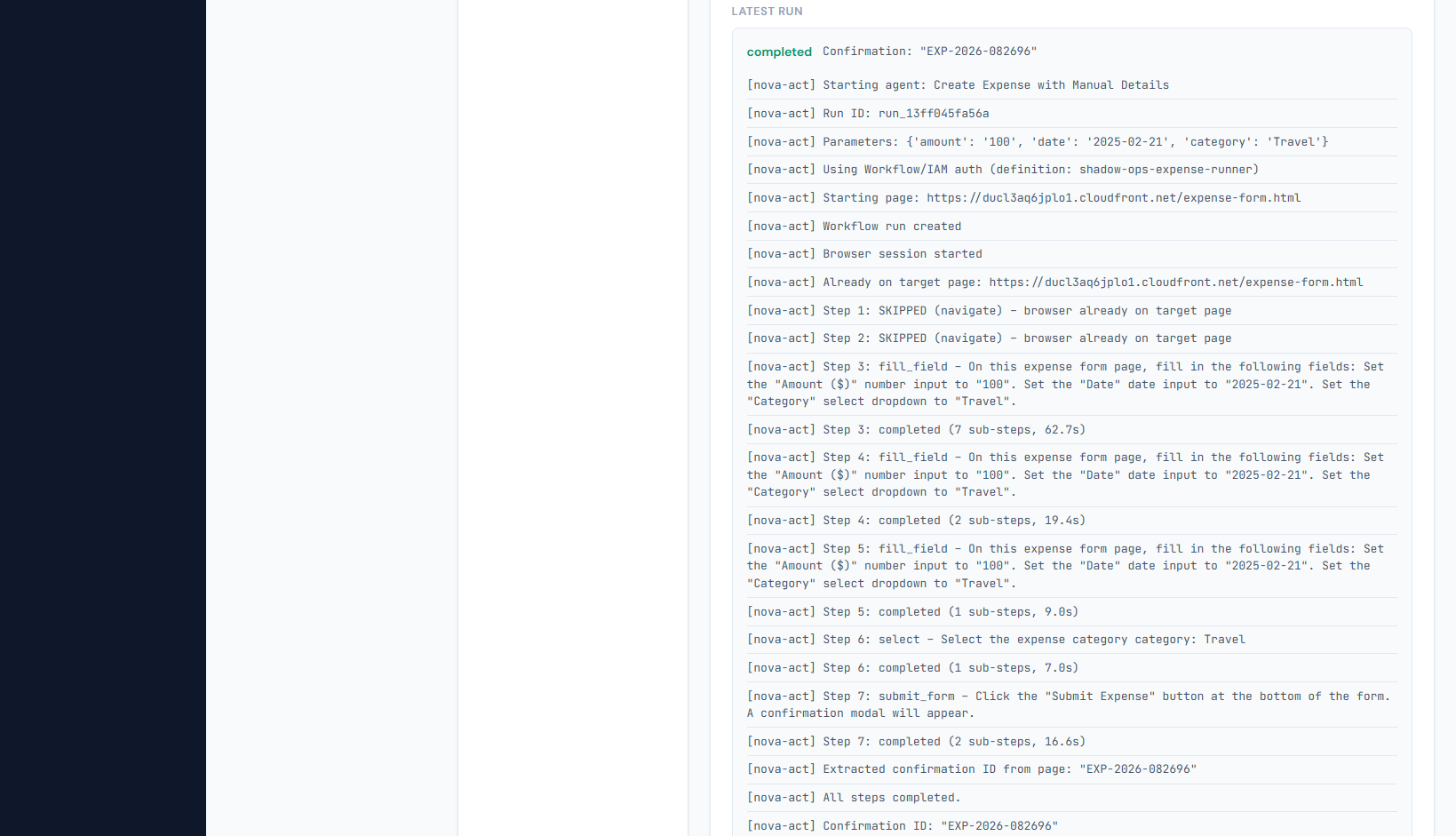
- Automate — Amazon Nova Act opens a cloud browser, navigates to the expense form, fills in every field, selects the right dropdown values, clicks Submit, clicks Confirm, and returns the confirmation ID. The agent is self-healing: if a UI element changes (e.g. "Submit" is renamed to "Confirm"), it detects the failure, adapts its approach, and retries automatically.
How I built it
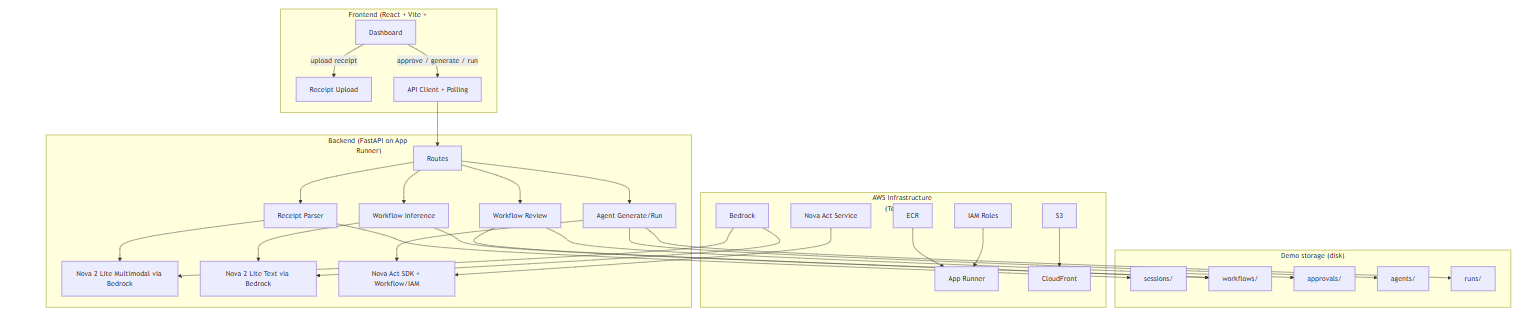
Backend: FastAPI (Python 3.12) with Pydantic v2 models, structlog JSON logging, and two Nova integration layers:
nova_client.pywraps Bedrock'sInvokeModelfor both text and multimodal Nova 2 Lite calls.act_client.pyuses the Nova Act SDK withWorkflowcontext manager for IAM-authenticated cloud browser automation. Frontend: React + TypeScript + Vite. Features a receipt upload with drag-and-drop, workflow approval flow, and an agent execution modal with live polling timer that shows real-time status as Nova Act fills forms. Infrastructure: Terraform-managed AWS stack — App Runner (backend), S3 + CloudFront (frontend), ECR (container registry), IAM roles with Bedrock + Nova Act permissions. Async pattern: Nova Act takes 2-4 minutes. I use background threads with a polling API to stay within App Runner's 120-second request timeout while showing live progress to the user.
Amazon Nova services used
| Service | Usage | Mode |
|---|---|---|
| Amazon Nova 2 Lite (Bedrock) | Multimodal receipt OCR + text workflow inference | Real (Bedrock InvokeModel) |
| Amazon Nova Act | Cloud browser automation — fills forms, clicks buttons, extracts results | Real (SDK + Workflow/IAM auth) |
Challenges I ran into
- Nova Act parameter inconsistency: The boto3
nova-actservice model usesnameforCreateWorkflowDefinitionbutworkflowDefinitionNameforGetWorkflowDefinition. I built runtime introspection to detect the correct parameter per operation. - App Runner 120-second timeout: Nova Act runs take 2-4 minutes. I implemented an async execution pattern with background threads and a polling API.
- Infinite loop bug: The inferred workflow's first step was "Navigate to the dashboard" — but the browser already starts on the form page, and the Dashboard link was a dead anchor. Nova Act kept clicking it forever. I solved this with intent-based step skipping and instruction enhancement.
- Date input formatting: Nova Act initially typed "2025-02-21" into a date field, but the browser expected MM/DD/YYYY. The model learned from its mistake and self-corrected to "02/21/2025" on the next attempt.
Accomplishments I'm proud of
- Full dual-Nova pipeline: Receipt photo → Nova 2 Lite OCR → Nova 2 Lite inference → Human approval → Nova Act browser automation → Confirmation ID. Few teams use both services together.
- Self-healing agent: Detects and adapts to UI changes in real-time.
- Production deployment: Not just localhost — fully deployed on AWS with Terraform IaC.
- Instruction enhancement: Generic inferred steps are automatically rewritten with page-specific context before execution.
What I learned
- Nova Act is remarkably good at understanding form layouts and making decisions about what to click/type. It handles dropdown redirects, date format conversions, and confirmation modals without explicit programming.
- Prompt engineering with strict output format guards (first char
{, last char}) dramatically improves JSON extraction reliability. - The async execution pattern (background thread + polling) is essential for any real-world Nova Act integration behind a load balancer.
What's next
- Recording mode: Capture real user actions in the browser to feed richer context to workflow inference.
- Multi-form support: Different expense systems (Concur, Expensify, custom portals) with form-specific instruction enhancement.
- Batch processing: Process a folder of receipt photos and submit all expenses in sequence.
- Audit trail: Store Nova Act browser session recordings for compliance review.
Built With
- amazon-bedrock
- amazon-cloudfront
- amazon-ecr
- amazon-nova-2-lite
- amazon-nova-act
- amazon-web-services
- aws-app-runner
- docker
- fastapi
- python
- react
- terraform
- typescript
- vite


Log in or sign up for Devpost to join the conversation.