-
-
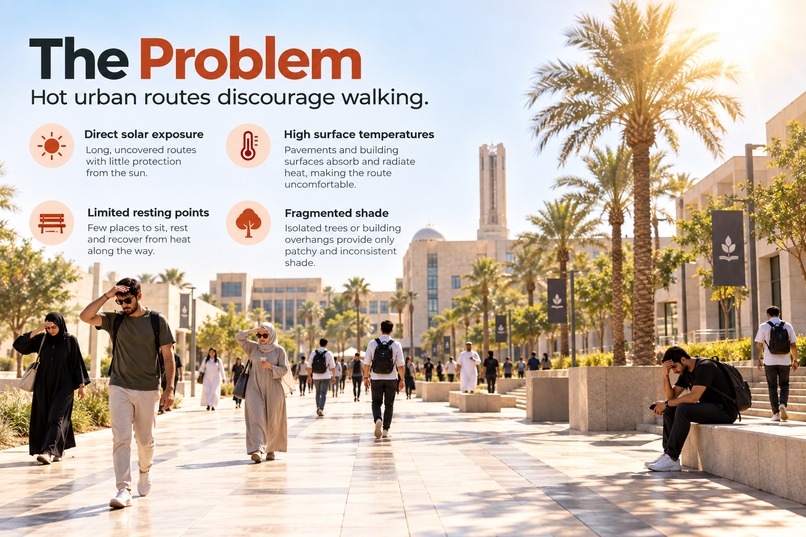
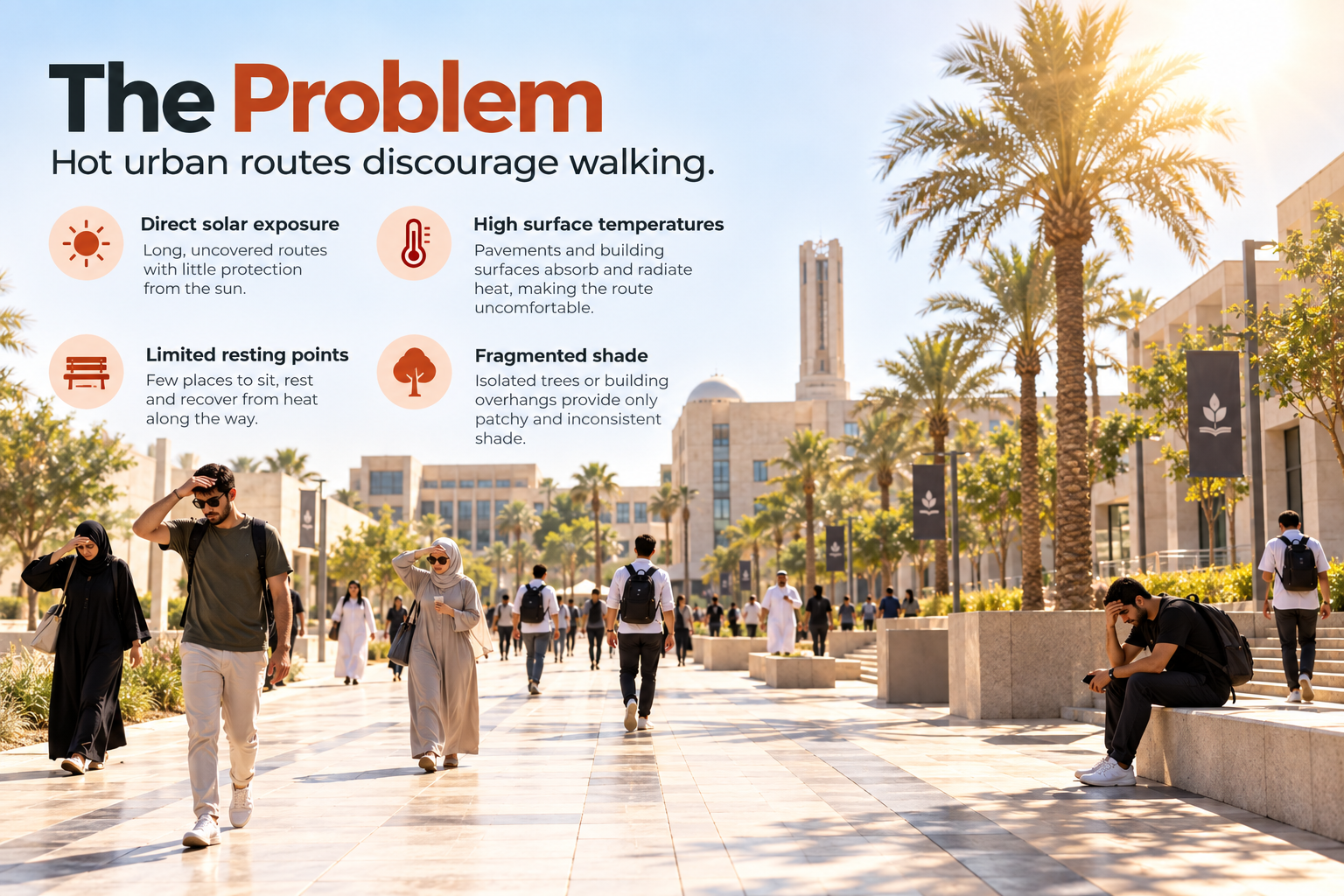
1. The Problem: Exposed pedestrian routes in hot climates reduce comfort and discourage walking.
-
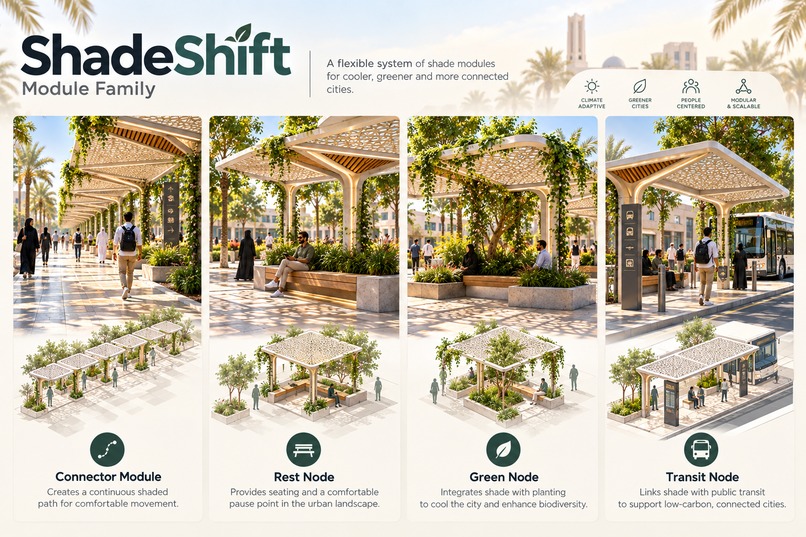
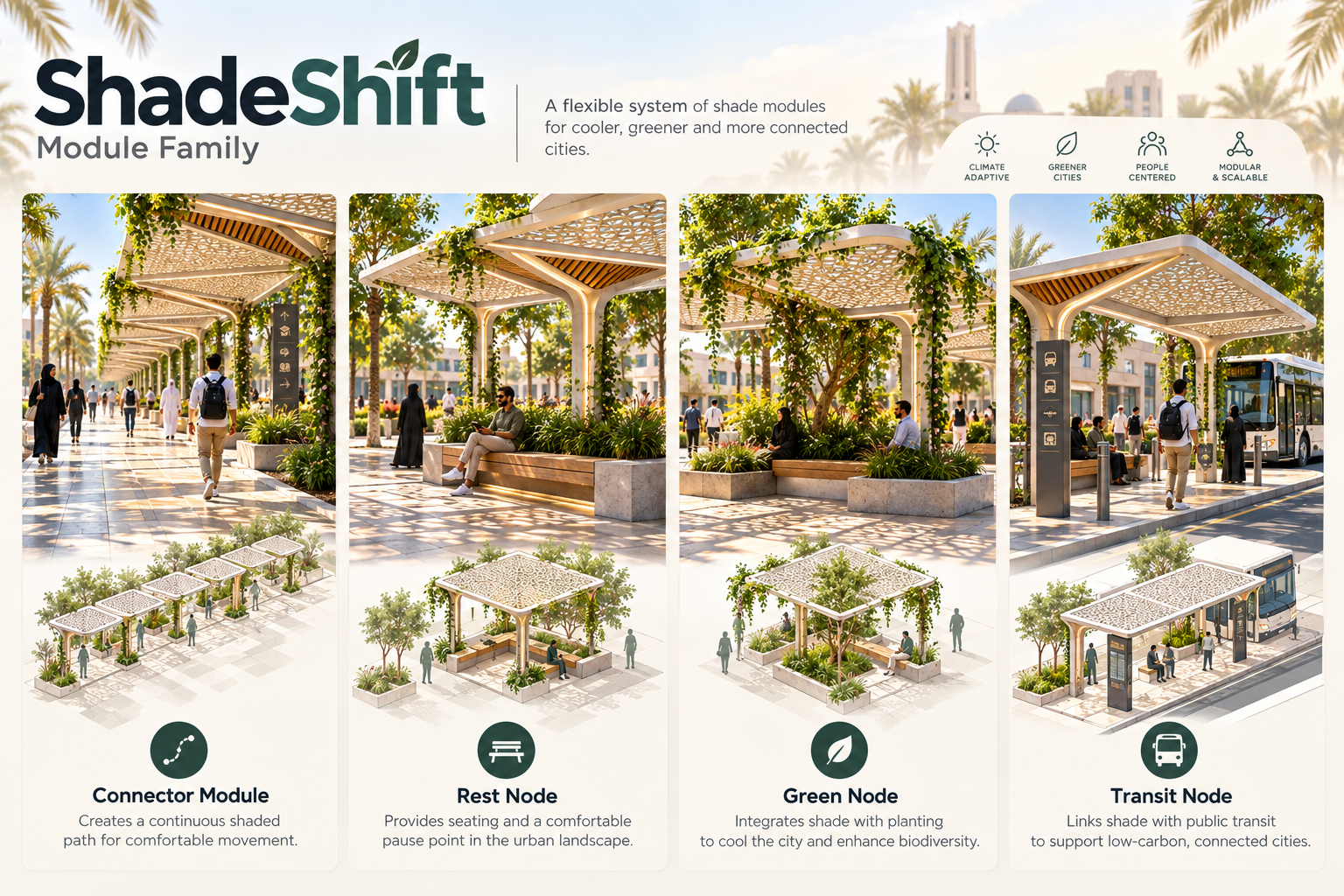
2. Module Family: A flexible family of Connector, Rest, Green and Transit modules for different urban needs.
-
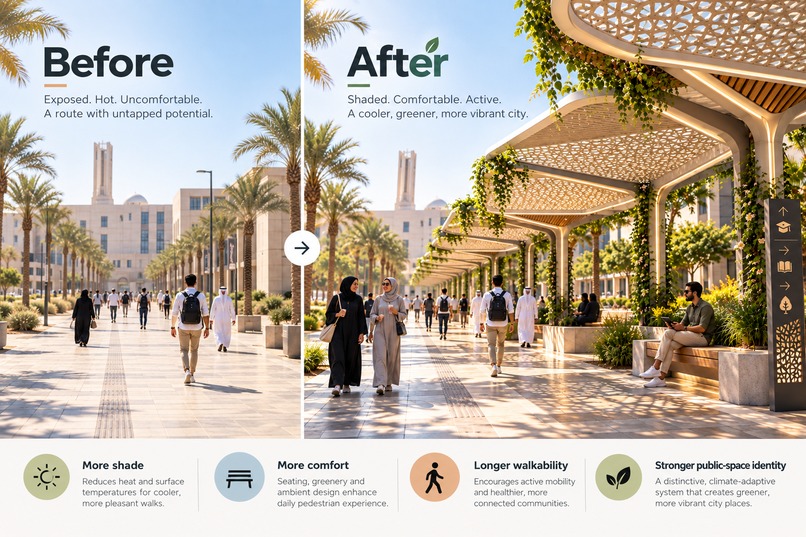
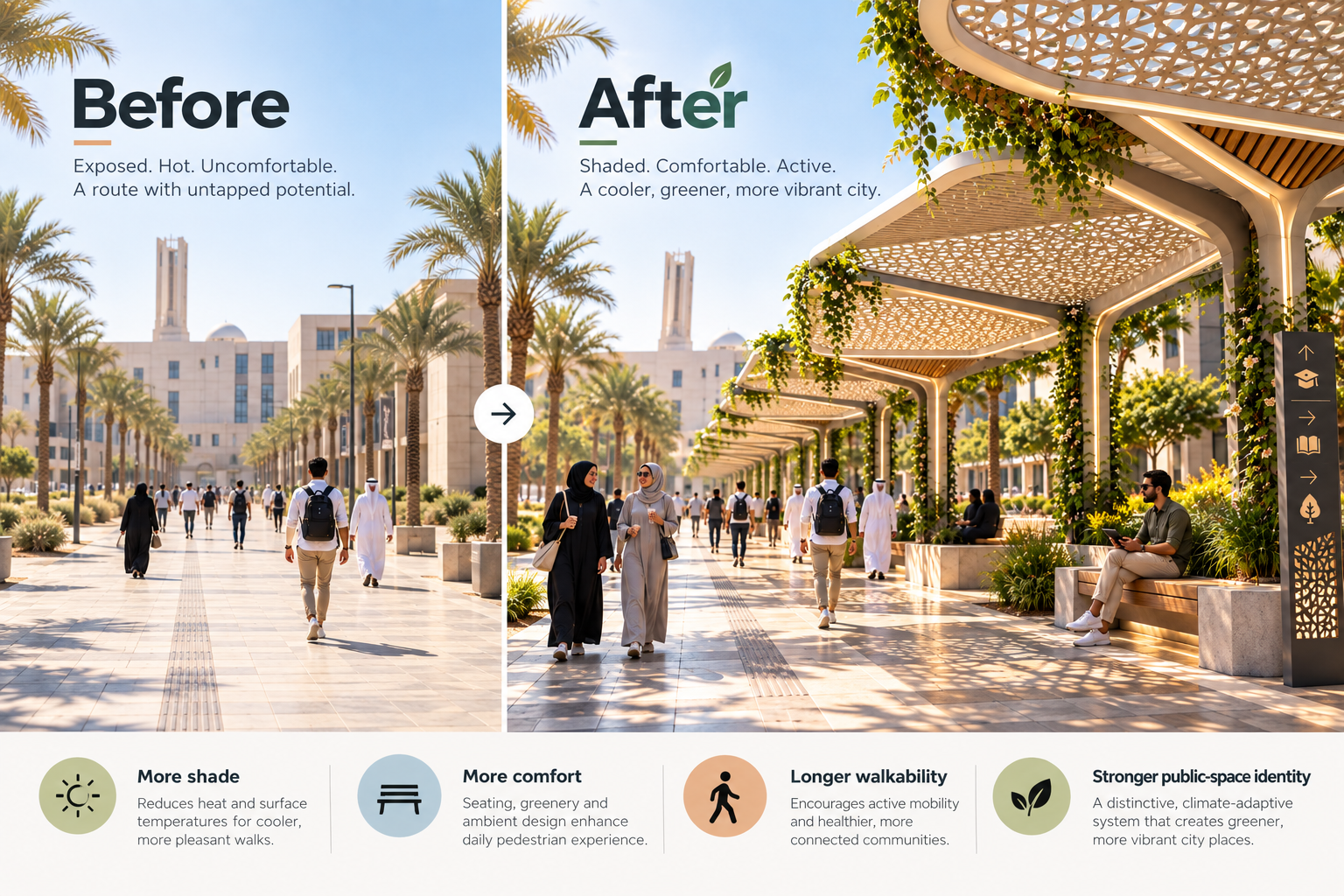
3. Before / After: ShadeShift transforms exposed routes into shaded, comfortable and active public spaces.
-
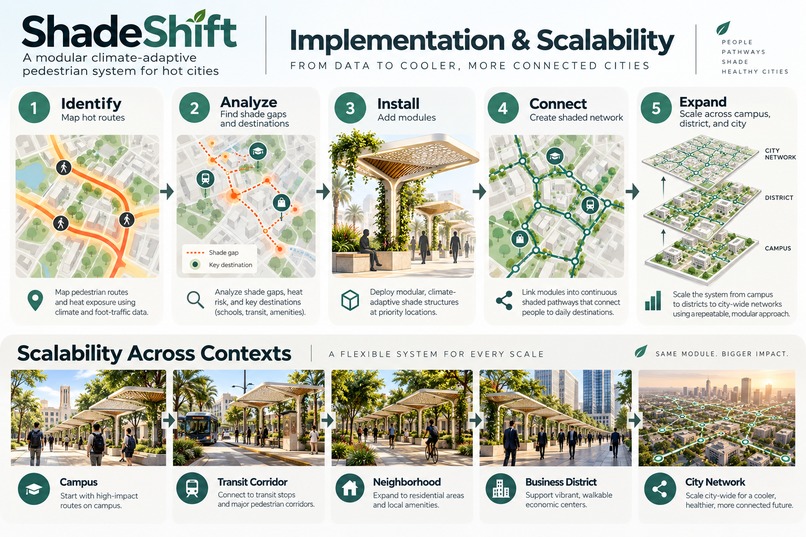
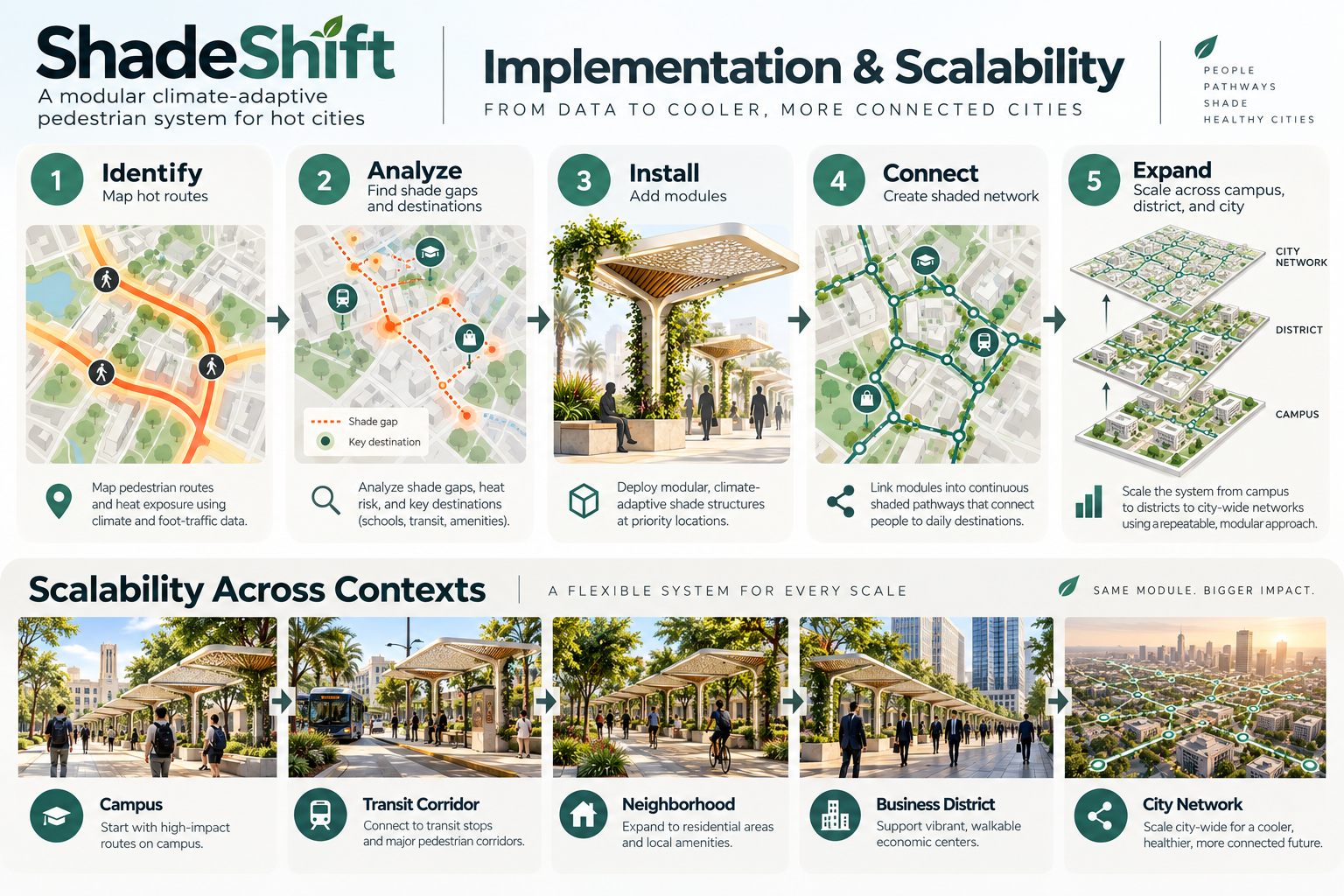
4. Implementation & Scalability: From hot-route mapping to a connected city-wide shade network.
Inspiration
In many hot cities, short walking trips become uncomfortable because of direct solar exposure, high surface temperatures, limited shade, and a lack of resting points. This often makes people rely on cars even for short distances between campuses, transit stops, public spaces, workplaces, and nearby services.
ShadeShift was inspired by a simple question:
What if shade was designed as a connected urban system rather than as isolated structures?
Problem Statement
Pedestrian infrastructure in hot climates is often fragmented. A shaded bus stop may exist, but the route leading to it remains exposed. Trees may provide shade in one area, while nearby paths are completely unprotected.
This affects students, commuters, elderly users, visitors, and anyone who needs to walk outdoors during hot periods.
Current approaches often depend on isolated canopies, permanent large-scale construction, or landscape solutions that require time, water, and maintenance before they become effective.
The challenge is therefore not only to create shade, but to create a continuous, adaptable, and scalable pedestrian comfort network.
Proposed Solution
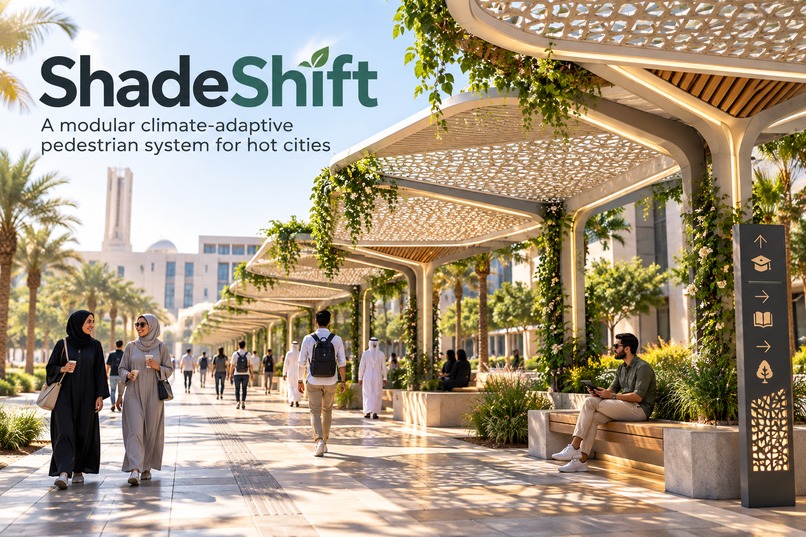
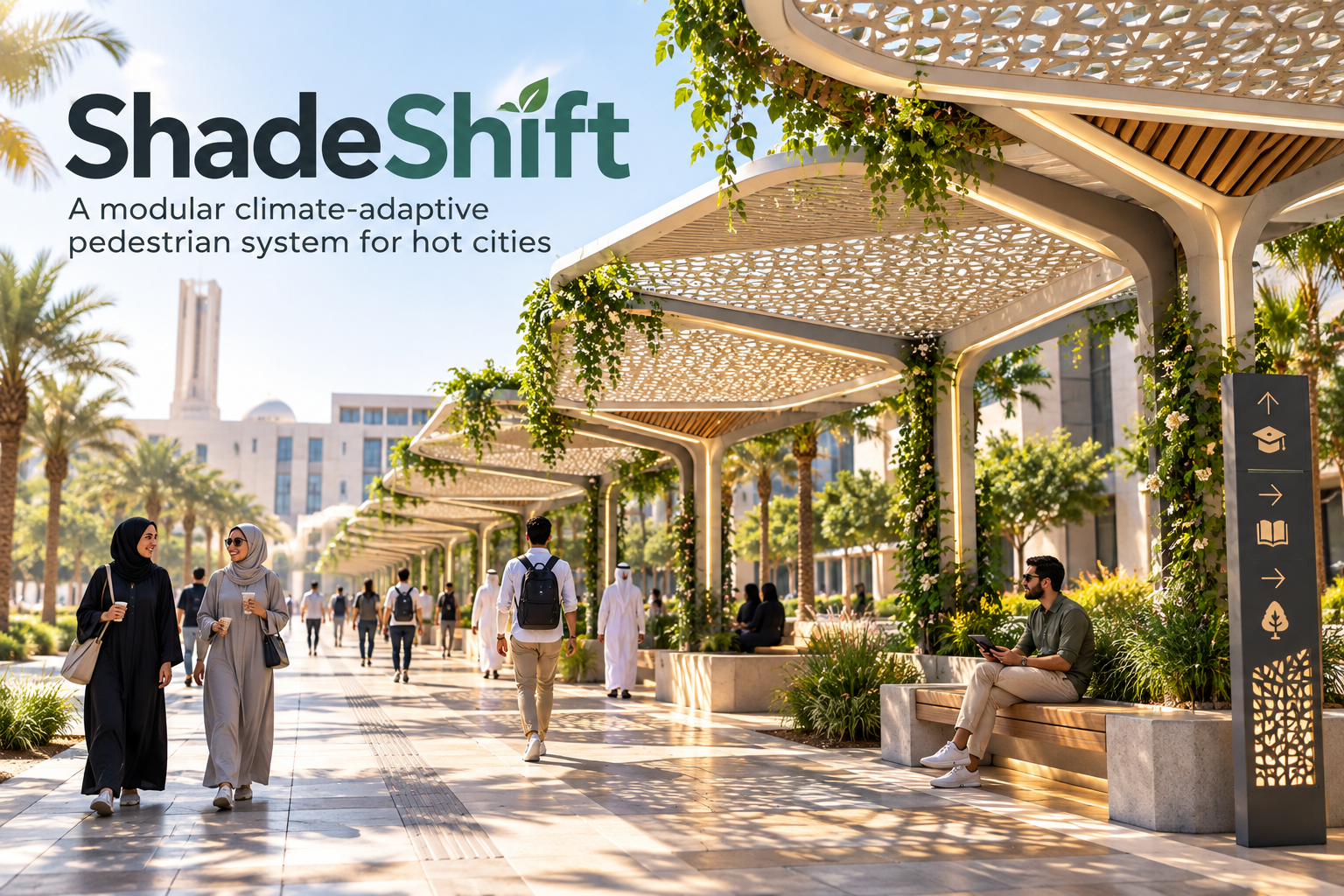
ShadeShift is a modular climate-adaptive pedestrian system designed for hot cities.
Instead of rebuilding an entire street or public space, ShadeShift uses a family of modular retrofit elements that can be added to existing pedestrian routes.
The system can include:
- Shading structures
- Resting and seating areas
- Vegetation
- Wayfinding
- Night lighting
- Water refill points
- Passive cooling strategies
- Solar-energy integration where appropriate
The modules can be installed individually or connected to form a continuous shaded walking network.
How It Works
ShadeShift follows a simple implementation process:
1. Identify
Map the most important pedestrian routes and areas with high solar exposure.
2. Analyze
Locate shade gaps, resting needs, transit connections, and major pedestrian destinations.
3. Select
Choose the appropriate ShadeShift module for each location.
4. Install
Add the modules to the existing environment with minimal disruption.
5. Connect
Link individual modules to create a recognizable and comfortable pedestrian route.
6. Expand
The network can gradually grow as demand, funding, and urban development increase.
Module System
ShadeShift is designed as a family of adaptable modules rather than one repeated structure.
Connector Module
Provides continuous shade along pedestrian routes.
Rest Node
Adds seating and a protected resting area along longer walking distances.
Green Node
Combines shade with vegetation and landscape elements to improve the pedestrian environment.
Transit Node
Creates a comfortable connection between walking routes and public transportation stops.
Different modules can share the same structural language while responding to different site conditions.
Innovation & Uniqueness
The innovation of ShadeShift is not simply the design of another urban canopy.
Its main idea is to treat thermal comfort as a networked layer of urban infrastructure.
Unlike isolated shade structures, ShadeShift:
- Connects multiple destinations through a continuous comfort network.
- Can be added to existing streets and campuses as a retrofit system.
- Uses different module types depending on the needs of each location.
- Can be implemented gradually rather than requiring one large construction project.
- Combines environmental comfort, pedestrian experience, landscape, and urban identity in one system.
This makes the concept adaptable to both small pilot projects and large urban networks.
Target Users
ShadeShift can benefit:
- Students and university communities
- Public-transport users
- Daily commuters
- Elderly pedestrians
- Visitors and tourists
- Workers in business districts
- Residents making short neighborhood trips
The system is especially relevant to cities where extreme heat significantly limits outdoor pedestrian activity.
Implementation
The project could begin with a small pilot route, such as the connection between a parking area, transit stop, and university entrance.
The pilot would help evaluate:
- Pedestrian use
- Shade coverage
- User comfort
- Maintenance requirements
- Appropriate spacing between modules
After evaluation, additional routes could be connected and expanded into a wider pedestrian network.
This phased approach reduces initial cost and allows the system to adapt to real user behavior.
Resources Required
Implementation would require collaboration between:
- Urban designers and architects
- Municipal authorities
- Structural and environmental engineers
- Landscape designers
- Fabrication and construction teams
- Maintenance providers
- Local transport or campus authorities
Possible materials may include lightweight steel or aluminum structures, durable shading panels, locally appropriate vegetation, energy-efficient lighting, and modular seating components.
Potential Challenges
One challenge is that every location has different dimensions, climate exposure, utilities, pedestrian patterns, and maintenance conditions.
ShadeShift addresses this through a modular system rather than a single fixed design.
Another challenge is long-term maintenance, particularly for vegetation and cooling elements. For this reason, the system can be configured differently depending on water availability, operational capacity, and local climate conditions.
Expected Impact
ShadeShift aims to make short urban journeys more comfortable and attractive.
Potential outcomes include:
- Increased pedestrian comfort
- Improved accessibility between important destinations
- More usable public spaces during hot periods
- Better connections to public transport
- Reduced dependence on cars for some short trips
- Stronger urban identity
- More opportunities for social interaction in outdoor spaces
Scalability
ShadeShift can begin as a single shaded route and gradually expand into a district-wide system.
Possible applications include:
University campuses → Transit corridors → Residential neighborhoods → Business districts → Public parks → City-wide pedestrian networks
Because the system is modular, the same basic concept can be adapted to different climates, budgets, identities, and urban conditions.
What We Learned
Developing ShadeShift highlighted that improving walkability in hot cities is not only a transportation issue.
It is also a question of environmental comfort, public-space quality, accessibility, and human experience.
A successful pedestrian route is not simply a path between two destinations. It must make the journey itself comfortable enough for people to choose walking.
Vision
ShadeShift imagines a future where shade is not an isolated urban feature, but a connected layer of city infrastructure.
Not just shaded spaces.
Shaded journeys.
Built With
- architecture
- climate-responsive
- human-centered
- landscape-integration
- modular-design
- pedestrian-experience
- public-space
- sustainable-design
- urban-design
- urban-innovation
- urban-retrofit
- walkability

Log in or sign up for Devpost to join the conversation.